GREAT DEPRESSION
REVIEW
IB Syllabus Summarized
(Section 7)
 7.1 Causes of the Great Depression
 7.2 Nature and Efficiency of Solutions; critiques.
 7.3. Canada: King and Bennett
 7.4 Brazil: Vargas (Or Argentina)
 7.5 Impact on Women, Minorities (Hispanics), and
African-Americans
 7.6. Effect on Arts, Movies, Literature
Historiography
 This is one of the biggest questions in
economic history (What caused the Great
Depression?).
 Typically, Progressive historians blame
inequality and lack of consumption (AD).
 Conservative historians blame the Federal
Reserve and Roosevelt’s overreaction.
Historiography
 Orthodox View
 Carl Degler
 New Deal was revolutionary change for America
 Revisionist View
 Bart Bernstein
 New Deal maintained the status quo by providing
the least amount of reform possible to maintain
the system.
III. Canada
Economic Differences
 Canada relied much more on commodity (raw materials) export
than the US
 Lumber
 Oil
 Metals
 Canada was going through a wheat and lumber (newspapers)
boom in the 1910s-1920s.
 Canada’s depression was as severe as the United States’, even
though it began in the United States.
 Canada had its own currency, but did not have a Central Bank
(Federal Reserve)
Political Differences--Parliament
Parties
 Liberal and Conservative Parties
 Many smaller parties
 Cooperative Commonwealth Federation (New
Democratic Party)---Labor Party
 Progressive Party---Middle Class Reformers
 United Farmers of Alberta---Farmer Party
 Bloc Populaire---Quebecois Party
Other Differences
 Party Leadership lasts much longer because
there are no term limits.
 Quebec: Ethno-linguistic differences are bigger
division than any other political division.
 Canada did not have a Constitution. Instead,
they had a British law that set up a legal
system similar to a Constitution.
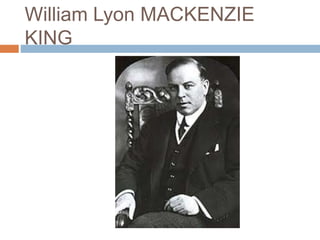
William Lyon MACKENZIE
KING
Mackenzie King
(Liberal party)
 Some similarities to FDR.
 Built a liberal coalition with progressives during the
Depression
 Was leader during Great Depression and World War
II.
 Considered by many to be Canada’s most
successful politician (served as Prime Minister for 22
Years)
 Some Differences
 Never pursued the radical reforms of FDR
 Was President when the Depression hit (some
similarities to Hoover)
 Never fully brought labor support into the Party
Mackenzie King’s Response to the
Depression
 Like Hoover, King and the Liberals were
blamed for the Depression.
 Claimed that British North America Act limited
how he could react (left public relief to the
provinces and then didn’t fund the provinces
claiming too much debt).
Overall Ideology
 As a “liberal,” King favored small government
to support economic and social freedom.
 He wanted to keep the Canadian
government’s response to the Depression
limited.
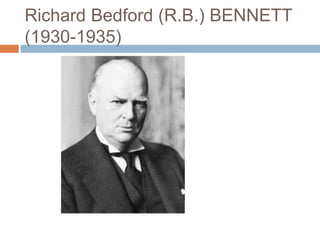
Richard Bedford (R.B.) BENNETT
(1930-1935)
1930 Election
 King called elections in 1930, but lost to Bennett and
the Conservative Party.
 Like Roosevelt, Bennett promised a series of
unspecified reforms to fix Canada.
 Like Roosevelt, Bennett called his reform program the
“New Deal,” after 1933.
 Unlike Roosevelt, Bennett stuck to his Conservative
beliefs and did not implement a lot of reforms.
Bennett’s Response
 Increased Tariffs (made things worse---see
Hawley-Smoot Tariff in the U.S.)
 Provided funds for public welfare system to the
unemployed and the destitute.
 Created a “work camp” program very similar to
Roosevelt’s CCC. Participants were called the
“Royal Twenty Centers.” (This was partially
done to prevent unemployed from calling for
more radical change).
Other Reforms
 Canadian Wheat Board: Somewhat similar to
AAA, but more helpful to poor farmers.
 Bank of Canada: Created a Central Bank
 Farmer’s Creditors Arrangement Act: Allowed
farmers to restructure their debt.
Bennett’s Ideology
 As a conservative, Bennett wanted to try to
maintain the status quo. His reforms were an
attempt to provide as little change as possible
to a problem that might require significant
change.
King Comes Back!
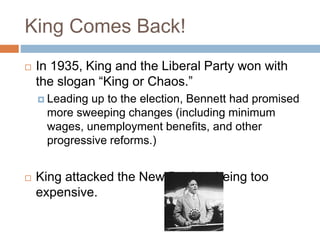
 In 1935, King and the Liberal Party won with
the slogan “King or Chaos.”
 Leading up to the election, Bennett had promised
more sweeping changes (including minimum
wages, unemployment benefits, and other
progressive reforms.)
 King attacked the New Deal as being too
expensive.
King’s 2nd “Fix”
 Instead of promoting more reforms, King passed
on Bennett’s laws to the courts.
 The Supreme Court of Canada ruled most of the
New Deal unconstitutional.
 Canada’s economy overall did recover faster than
the U.S.
 It also entered World War II earlier (1939 under
the UK).
Relief, Recovery, Reform
Programs Summarized
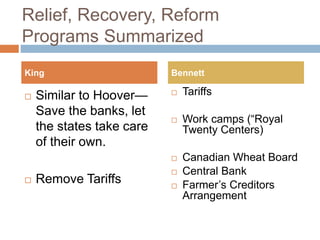
 Similar to Hoover—
Save the banks, let
the states take care
of their own.
 Remove Tariffs
 Tariffs
 Work camps (“Royal
Twenty Centers)
 Canadian Wheat Board
 Central Bank
 Farmer’s Creditors
Arrangement
King Bennett
Other Social Changes
 Hockey!
 Hockey became the national
pastime during the 1930s (on
radio broadcasts).
 MapleLeafs vs. Canadians
became symbolic rivalry
between English-Speaking
and French-Speaking Canada
Historiography
 Traditionalist:
 King and Bennett embraced far-reaching political and
economic change in order to move the nation out of the
Depression and did so effectively.
 Revisionist
 King and Bennett’s reforms were remarkably limited and
relied on political repression.
 Conservative
 King and Bennett’s economic success in getting Canada
out of the Depression shows the market-oriented
conservative action is the best remedy to a Depression.
Practice Questions
 How serious was the impact of the Depression on the Canadian
economy and society?
 Why did the Canadian federal governments of the 1930s introduce so
little social and economic legislation to deal with the problems of the
Depression?
 Assess the view that the response of the Canadian governments in
the 1930s to the problems of the Depression was limited.
 Assess the view that neither Mackenzie King or Bennett offered the
Canadian people a coherent policy to tackle the problems they faced
in the 1930s.
 ‘Provincial Governments did more to tackle the problems caused by
the Depression than federal governments in the 1930s.’ How far do
you agree with this view?
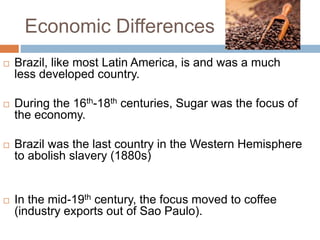
IV. Brazil and Vargas
Economic Differences
 Brazil, like most Latin America, is and was a much
less developed country.
 During the 16th-18th centuries, Sugar was the focus of
the economy.
 Brazil was the last country in the Western Hemisphere
to abolish slavery (1880s)
 In the mid-19th century, the focus moved to coffee
(industry exports out of Sao Paulo).
Political Differences
 Like most Latin American countries, Brazil
historically was run by rich landowning
oligarchs.
 Brazil’s central government was weak even by
Latin American standards up until the Great
Depression.
 Had once had a relatively strong central
government under a Brazilian monarchy (Pedro I
and Pedro II).
Political Parties
 Today, Brazil has tons of political parties.
 Leading up to the 1930s, the biggest divide wasn’t
political, it was geographical:
 Paulistanos (people from Sao Paulo)--Coffee
 Mineiros (people from Minais Gerais—Minerals,
and cattle
 In both areas, oligarchs (landowners) ran the
parties.
Getulio Vargas
Vargas and Roosevelt
 Similarities to FDR
 Radically changed role of government
 Was President during Depression and World War II
 Appealed to lower class for support.
 Adopted Corporatist framework to fix the economy
(as was done in Roosevelt’s NRA).
 Differences with Roosevelt
 Not Democratically elected
 Did not tolerate dissent  Authoritarian Dictator
 Did not create social welfare state
 Focused more on reforming the economy than
relieving it.
1930 Coup #1
 When the Depression hit Brazil, Washington Luis
was the president.
 Luis followed the conservative response of Hoover.
 Luis also represented Sao Paulo and many around the
country were upset that so much power was resting
there.
 In 1930, unrest across the country led to rebellion.
 The military scrambled to find a leader that would
avoid full-scale revolution, but would also please
the masses.
The “Estado Novo” (Coup #2)
 During his leadership, there were several attempts
to remove him from power from both the left and
right.
 A failed coup in 1937 gave Vargas the justification
to suspend the Constitution entirely and rule Brazil
as a dictator.
 After 1937, Vargas would call his plans to revive
Brazil socially and economically the “Estado
Novo.” (New State)
 His policies mirrored those of Mussolini, Franco, and
Salazar (many call Vargas a Fascist).
Vargas Economic Reforms (Trade
Policy)
 Vargas’ economic goals met with his political goal
of reducing the power of Sao Paulo.
 Vargas pursued Diversification through ISI.
 In other words, tariffs would be placed on specific
goods that Vargas wanted Brazil to make
(airplanes, steel, etc.)
 Incentives would be given to infant-industries to
produce these goods for Brazilian consumers.
Quote
 “If you were to ask me what is the program of
the Estado Novo, I would tell you that its
program is to crisccross the nation with
railroads, highways, and airlines; to increase
production; to provide for the laborer…to
expand exports; to prepare the armed forces
so that they are always ready; to organize
public opinion so that there is, body and soul,
one Brazilian thought.
Vargas Economic Policy (Domestic
Coffee)
 To deal specifically with Coffee, Vargas created the
National Department of Coffee.
 Reduced coffee tree planting ordered.
 Coffee planters in Brazil would be forced in a ‘cartel’
wherein they would have the amount that they could sell
on the market reduced in exchange for higher prices.
 The goal was to make Coffee exports more profitable for
the country and reduce the country’s reliance on those
exports.
 Critics would point out that this increased unemployment
in the Coffee sector.
Vargas Economic Policy (Unions---
”O Pai do Povo”)
 Rather than limit the power of unions, Vargas aimed to appeal to and
co-opt them
 (Co-opt means to control by including).
 Unions were given the legal right to exist, but all workers had to join
state-sponsored unions.
 Employers were also forced to join large industry organizations
 The state became the arbitror of industrial relations in labor disputes.
 This model was first developed by Mussolini and is called
“Corporatism.”
 Through this model, workers received minimum wages and
health/safety protections in exchange for a lack of genuine voice.
Quote
 “The Estado Novo does not recognize the
rights of the individual against the collective.
Individuals do not have rights; they have
duties. Rights belong to the collective.
Vargas Racial Policy
 Vargas promoted the idea that racial distinctions
were contrary to the unified vision of the Estado
Novo.
 All discussions of racism were banned. Eugenicists
were arrested. Brazilians were taught nobody was
one race, but all Brazilians were a mixture of races
(usually White, Black, and Indian).
 A racial class system still existed in many ways,
but he indoctrinated Brazilians to believe in a color-
blind society.
Vargas Denouement
 Vargas finally held elections in 1945 and lost them
to Gaspar Dutra.
 In 1951, Vargas ran again and won.
 In 1954, after an attempted assassination of one
of Vargas’ rivals (Carlos Lacerda) was traced back
to Vargas, the military asked Vargas to resign.
 Instead, Vargas committed suicide.
Suicide Note
 I was a slave to the Brazilian people, and
today I am freeing myself for eternal life. But
this people, whose slaves I was, will no longer
be slave to anyone. My sacrifices will forever
remain forever in their souls and my blood will
always be the price for their ransom. I fought
against the exploitation of Brazil…I have
fought with my whole heart…Now I offer you
my death. I fear nothing. Serenely I take my
first step towards eternity and leave life to
enter history.
Social Impact: Soccer
Historiography
 Vargas
 Traditionalist: Policies were too radical and led to his
demise.
 Revisionist: During the 1960s-1980s period, he was seen as
a precursor to the military dictatorship that then consumed
the country.
 Post-Revisionist: After 1985, historians have given him a
kinder look, focusing on his merits as an effective and
charismatic politician compared to the brutality of the
military’s generals.
 Race
 Degler: Sees Brazil’s embrace of Vargas’ racial policy as
evidence of its inherent muliticulturalism.
 Hanchard (Orpheus in Power): Vargas’ policy removed
discussions of racial inequalities, but not racism from
Brazilian society.
Overall Ideology of Vargas
 Populism—
 Base reforms on the perceived desires of the
people.
 Modernize Brazil into an economic world
power.
 Strengthen the nation.
Programs
 ISI (restrict imports to encourage eventual
exports)
 Diversification (move away from cash-crops)
 Corporatism (Simplify the running of the
country by putting people into organizations
that would represent their interests).
V. Effect of Depression on
Minorities
 Minority Groups: Women, Mexican-Americans,
African-Americans, Native Americans
A. Women
 1930s saw the end of the 1920s Flapper ideal.
 New job opportunities available to women in the 1920s
vanished in the 30s.
 Depression became stress on family life. Rise in
divorces.
 Husbands became insecure about losing their
breadwinner status.
 Few New Deal programs dealt with women’s issues as
these were overshadowed by the mass number of men
who were unemployed.
B. Mexican-Americans
 Mexican-Americans that were economically
encouraged to come to America and California
suffered the reverse when the Depression hit.
 White migrants from the Midwest pushed out
Mexican agricultural workers in California and
in the Southwest.
C. African-Americans
 Blacks that experienced new opportunities in the 1920s saw those
opportunities vanish in the 1920s.
 Despite voting for Roosevelt, not much in the New Deal helped
African-Americans.
 AAA did not help sharecroppers.
 Early work programs were run through the states so often
discriminated against African-Americans.
 Later national organizations (WPA, CCC) actively sought to employ
African-Americans.
 NAACP charged that Social Security discriminated against African-
Americans.
 CIO recruited African-Americans, which the AFL did not. (Both
D. Native Americans
 John Collier oversaw radical changes in the treatment of
Native Americans through the Bureau of Indian Affairs
 Indian Reorganization Act undid the Dawes Act (which had
made assimilation and individualism the goal of Federal
Indian policy).
 Native American cultural practices were collected,
breaking up of communal lands was halted, and power
was returned to tribal councils.
 Orthodox: Radical shift in policy for the benefit of Native
Americans.
 Revisionist: Policy still was paternalistic and Native
Americans remained rightfully suspicious.
Historiography
 Orthodox (Degler)
 New Deal transformed the lives of minorities,
which is why they overwhelmingly voted for
Roosevelt.
 Revisionist (Bernstein)
 New Deal failed to deliver its promise to its
minority constitutients. Its limited reforms
purposely or unpurposely left out minority groups.
VI. Effect of Depression on Arts,
Literature, and Film
Art: Community Murals
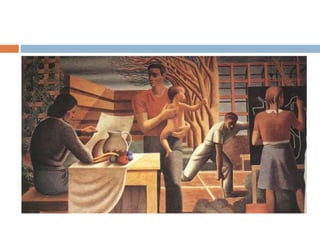
 Government supported mural projects through
the WPA.
 Murals reflected a type of populist art---from
the people, by the people.
 Emphasized work, community, and realism.
Literature:
 Novelist focused on the realistic deprivations
caused by the Depression
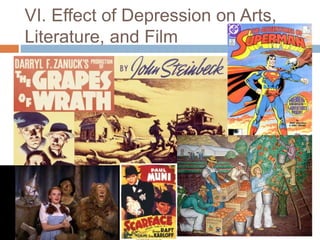
 Plight of Migrant Workers (John Steinbeck—
Grapes of Wrath, etc.)
 Racism (Richard Wright—Native Son)
 Southern Backwardness and Poverty (William
Faulkner—As I Lay Dying, etc.)
 Comic Books (Superman) with escapist
fantasies also became popular.
Film: Escapism and Realism
 Three different types of film became prevalent:
 Gangster Movies: Glorified the rebel individualist.
 Escapist Movies: Made people forget the burdens
of their own life. (The Thin Man, The Wizard of
Oz)
 Realist Movies: Showed people living through the
Depression and overcoming life’s obstacles.
(“Grapes of Wrath,” “I’m a Fugitive From a Chain
Gang.”)
Here are the Lecture Slides from
Last Year
1. Crisis in the Farm Sector
 New inventions (mechanized cotton picker,
tractor) corresponded with new demand
from Europe for food
 Farms began to overproduce
 Caused a drop in prices farmers produce
more to make the same profitmore
overproduction, etc.
 Farmers couldn’t pay back loans they had
taken out during World War I
 Foreclosures, Dust Storms, Environmental
Devastation
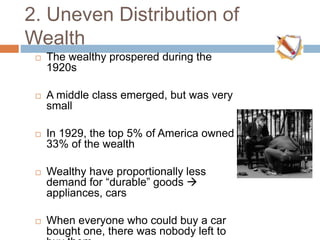
2. Uneven Distribution of
Wealth
 The wealthy prospered during the
1920s
 A middle class emerged, but was very
small
 In 1929, the top 5% of America owned
33% of the wealth
 Wealthy have proportionally less
demand for “durable” goods 
appliances, cars
 When everyone who could buy a car
bought one, there was nobody left to
3. Industrial Overproduction
 1920s Businesses assumed they would be able to sell everything
they produced
 New technologies of the 1920s (like the assembly line) allowed
production on an unprecedented scale
 Consumers could not keep up with production
 Warehouses began to pile up with inventory.
 Businesses fired workers to slow down production.
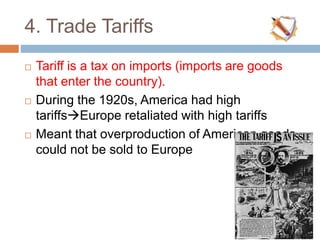
4. Trade Tariffs
 Tariff is a tax on imports (imports are goods
that enter the country).
 During the 1920s, America had high
tariffsEurope retaliated with high tariffs
 Meant that overproduction of American goods
could not be sold to Europe
5. Speculation
 For the first time, ordinary
middle class Americans began
investing in the Stock Market
 This created a bubble where
people assumed it would grow
forever
 Investors began taking out
short-term loans to invest in
the Stock Market
 Called “buying on margin”
 Eventually, bubbles burst!
. Availability of Easy Credit
 Banks assumed the booms would
continue forever
 Began getting high returns from
lending money for everything on
installment plans
 Installment Plan=Paying for
something over several months
or years instead of all at once
 System worked fine until loans
became so large that people
couldn’t even pay their
installments
6. The Crash
 The bubble burst in late October 1929
 “Black Tuesday” October 29, 1929
 Stock prices dropped rapidly
 Investors began to liquidate (sell) their
stocks while they still could
 In September of 1929, the Dow Jones
was at 381. By July 1932, it had fallen to
41.
 Billions of dollars in assets evaporated.
 People that had bought on margin
couldn’t pay their loans back. Banks and
businesses started running out of money
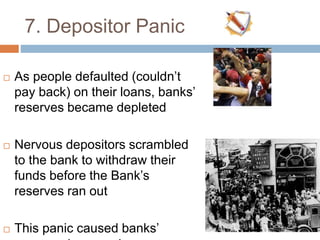
7. Depositor Panic
 As people defaulted (couldn’t
pay back) on their loans, banks’
reserves became depleted
 Nervous depositors scrambled
to the bank to withdraw their
funds before the Bank’s
reserves ran out
 This panic caused banks’
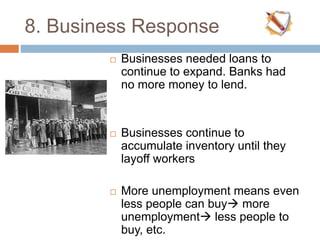
8. Business Response
 Businesses needed loans to
continue to expand. Banks had
no more money to lend.
 Businesses continue to
accumulate inventory until they
layoff workers
 More unemployment means even
less people can buy more
unemployment less people to
buy, etc.
9. Hoover’s Stubbornness
 Hoover subscribed to the economic theories of his
day: Protectionism, Laissez Faire, and Fiscal
Discipline
 Believed that the reason for the depression was that
too much money was leaving the country
 Congress Raised tariffs (Smoot-Hawley Tariff)
 Made it more difficult for businesses to sell abroad,
creating more unemployment
 Hoover also felt it necessary to cut spending and
raise taxes to make up for the deficit caused by the
depression
 Further decreased consumer spending and business
investment
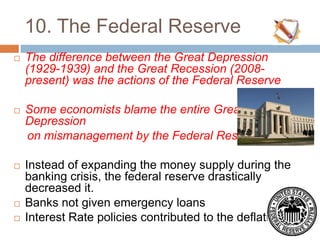
10. The Federal Reserve
 The difference between the Great Depression
(1929-1939) and the Great Recession (2008-
present) was the actions of the Federal Reserve
 Some economists blame the entire Great
Depression
on mismanagement by the Federal Reserve
 Instead of expanding the money supply during the
banking crisis, the federal reserve drastically
decreased it.
 Banks not given emergency loans
 Interest Rate policies contributed to the deflation
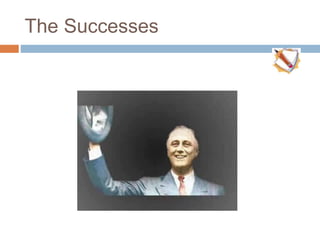
The Successes
CCC, PWA, CWA, WPA
 All had one goal: Give people jobs.
 Why give people jobs and not money?
 CCC (young men) plant trees, make trails,
clean the environment
 PWA/CWA States employ people to build
schools and libraries
 WPA (biggest jobs program in American
history)
 Built airports, roads, public buildings, sewage
systems, electricity systems.
 Painted Murals, collected histories, put on plays
 Specifically directed to employ women and
minorities
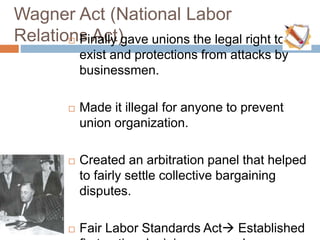
Wagner Act (National Labor
Relations Act) Finally gave unions the legal right to
exist and protections from attacks by
businessmen.
 Made it illegal for anyone to prevent
union organization.
 Created an arbitration panel that helped
to fairly settle collective bargaining
disputes.
 Fair Labor Standards Act Established
Social Security
 Began as a grassroots movement (from
California) to give seniors a stable
income.
 Had 3 components
 1. Fixed income for retired people over 65
 2. Unemployment payments
 3. Welfare for those with children (AFDC)
and the disabled.
 AFDC: Aid to Families with Dependent
Children
The Failures
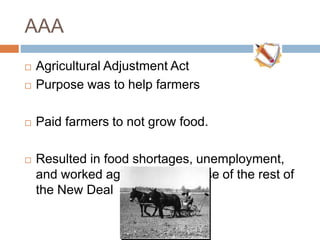
AAA
 Agricultural Adjustment Act
 Purpose was to help farmers
 Paid farmers to not grow food.
 Resulted in food shortages, unemployment,
and worked against the purpose of the rest of
the New Deal
NRA (NIRA)
 National Recovery Administration (National Industrial
Recovery Act)
 Failure in multiple ways:
 Based on the assumption that the cause of the Great
Depression was too much competition, resulting in
dropping prices
 Attempted to limit competition by creating regulated
oligopolies
 Each industry created a set of competition standards,
creating cartels.
 Consumers were encouraged to only buy from businesses
that flew the NRA logo
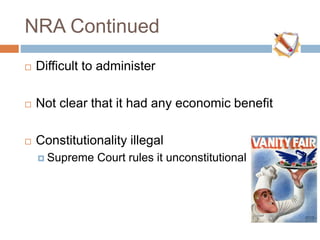
NRA Continued
 Difficult to administer
 Not clear that it had any economic benefit
 Constitutionality illegal
 Supreme Court rules it unconstitutional in 1935
Canada and brazil

Canada and brazil

  • 1.
  • 2.
    IB Syllabus Summarized (Section7)  7.1 Causes of the Great Depression  7.2 Nature and Efficiency of Solutions; critiques.  7.3. Canada: King and Bennett  7.4 Brazil: Vargas (Or Argentina)  7.5 Impact on Women, Minorities (Hispanics), and African-Americans  7.6. Effect on Arts, Movies, Literature
  • 3.
    Historiography  This isone of the biggest questions in economic history (What caused the Great Depression?).  Typically, Progressive historians blame inequality and lack of consumption (AD).  Conservative historians blame the Federal Reserve and Roosevelt’s overreaction.
  • 4.
    Historiography  Orthodox View Carl Degler  New Deal was revolutionary change for America  Revisionist View  Bart Bernstein  New Deal maintained the status quo by providing the least amount of reform possible to maintain the system.
  • 5.
  • 8.
    Economic Differences  Canadarelied much more on commodity (raw materials) export than the US  Lumber  Oil  Metals  Canada was going through a wheat and lumber (newspapers) boom in the 1910s-1920s.  Canada’s depression was as severe as the United States’, even though it began in the United States.  Canada had its own currency, but did not have a Central Bank (Federal Reserve)
  • 9.
  • 10.
    Parties  Liberal andConservative Parties  Many smaller parties  Cooperative Commonwealth Federation (New Democratic Party)---Labor Party  Progressive Party---Middle Class Reformers  United Farmers of Alberta---Farmer Party  Bloc Populaire---Quebecois Party
  • 11.
    Other Differences  PartyLeadership lasts much longer because there are no term limits.  Quebec: Ethno-linguistic differences are bigger division than any other political division.  Canada did not have a Constitution. Instead, they had a British law that set up a legal system similar to a Constitution.
  • 12.
  • 13.
    Mackenzie King (Liberal party) Some similarities to FDR.  Built a liberal coalition with progressives during the Depression  Was leader during Great Depression and World War II.  Considered by many to be Canada’s most successful politician (served as Prime Minister for 22 Years)  Some Differences  Never pursued the radical reforms of FDR  Was President when the Depression hit (some similarities to Hoover)  Never fully brought labor support into the Party
  • 14.
    Mackenzie King’s Responseto the Depression  Like Hoover, King and the Liberals were blamed for the Depression.  Claimed that British North America Act limited how he could react (left public relief to the provinces and then didn’t fund the provinces claiming too much debt).
  • 15.
    Overall Ideology  Asa “liberal,” King favored small government to support economic and social freedom.  He wanted to keep the Canadian government’s response to the Depression limited.
  • 16.
    Richard Bedford (R.B.)BENNETT (1930-1935)
  • 17.
    1930 Election  Kingcalled elections in 1930, but lost to Bennett and the Conservative Party.  Like Roosevelt, Bennett promised a series of unspecified reforms to fix Canada.  Like Roosevelt, Bennett called his reform program the “New Deal,” after 1933.  Unlike Roosevelt, Bennett stuck to his Conservative beliefs and did not implement a lot of reforms.
  • 18.
    Bennett’s Response  IncreasedTariffs (made things worse---see Hawley-Smoot Tariff in the U.S.)  Provided funds for public welfare system to the unemployed and the destitute.  Created a “work camp” program very similar to Roosevelt’s CCC. Participants were called the “Royal Twenty Centers.” (This was partially done to prevent unemployed from calling for more radical change).
  • 19.
    Other Reforms  CanadianWheat Board: Somewhat similar to AAA, but more helpful to poor farmers.  Bank of Canada: Created a Central Bank  Farmer’s Creditors Arrangement Act: Allowed farmers to restructure their debt.
  • 20.
    Bennett’s Ideology  Asa conservative, Bennett wanted to try to maintain the status quo. His reforms were an attempt to provide as little change as possible to a problem that might require significant change.
  • 21.
    King Comes Back! In 1935, King and the Liberal Party won with the slogan “King or Chaos.”  Leading up to the election, Bennett had promised more sweeping changes (including minimum wages, unemployment benefits, and other progressive reforms.)  King attacked the New Deal as being too expensive.
  • 22.
    King’s 2nd “Fix” Instead of promoting more reforms, King passed on Bennett’s laws to the courts.  The Supreme Court of Canada ruled most of the New Deal unconstitutional.  Canada’s economy overall did recover faster than the U.S.  It also entered World War II earlier (1939 under the UK).
  • 23.
    Relief, Recovery, Reform ProgramsSummarized  Similar to Hoover— Save the banks, let the states take care of their own.  Remove Tariffs  Tariffs  Work camps (“Royal Twenty Centers)  Canadian Wheat Board  Central Bank  Farmer’s Creditors Arrangement King Bennett
  • 24.
    Other Social Changes Hockey!  Hockey became the national pastime during the 1930s (on radio broadcasts).  MapleLeafs vs. Canadians became symbolic rivalry between English-Speaking and French-Speaking Canada
  • 25.
    Historiography  Traditionalist:  Kingand Bennett embraced far-reaching political and economic change in order to move the nation out of the Depression and did so effectively.  Revisionist  King and Bennett’s reforms were remarkably limited and relied on political repression.  Conservative  King and Bennett’s economic success in getting Canada out of the Depression shows the market-oriented conservative action is the best remedy to a Depression.
  • 26.
    Practice Questions  Howserious was the impact of the Depression on the Canadian economy and society?  Why did the Canadian federal governments of the 1930s introduce so little social and economic legislation to deal with the problems of the Depression?  Assess the view that the response of the Canadian governments in the 1930s to the problems of the Depression was limited.  Assess the view that neither Mackenzie King or Bennett offered the Canadian people a coherent policy to tackle the problems they faced in the 1930s.  ‘Provincial Governments did more to tackle the problems caused by the Depression than federal governments in the 1930s.’ How far do you agree with this view?
  • 27.
  • 28.
    Economic Differences  Brazil,like most Latin America, is and was a much less developed country.  During the 16th-18th centuries, Sugar was the focus of the economy.  Brazil was the last country in the Western Hemisphere to abolish slavery (1880s)  In the mid-19th century, the focus moved to coffee (industry exports out of Sao Paulo).
  • 29.
    Political Differences  Likemost Latin American countries, Brazil historically was run by rich landowning oligarchs.  Brazil’s central government was weak even by Latin American standards up until the Great Depression.  Had once had a relatively strong central government under a Brazilian monarchy (Pedro I and Pedro II).
  • 30.
    Political Parties  Today,Brazil has tons of political parties.  Leading up to the 1930s, the biggest divide wasn’t political, it was geographical:  Paulistanos (people from Sao Paulo)--Coffee  Mineiros (people from Minais Gerais—Minerals, and cattle  In both areas, oligarchs (landowners) ran the parties.
  • 31.
  • 32.
    Vargas and Roosevelt Similarities to FDR  Radically changed role of government  Was President during Depression and World War II  Appealed to lower class for support.  Adopted Corporatist framework to fix the economy (as was done in Roosevelt’s NRA).  Differences with Roosevelt  Not Democratically elected  Did not tolerate dissent  Authoritarian Dictator  Did not create social welfare state  Focused more on reforming the economy than relieving it.
  • 33.
    1930 Coup #1 When the Depression hit Brazil, Washington Luis was the president.  Luis followed the conservative response of Hoover.  Luis also represented Sao Paulo and many around the country were upset that so much power was resting there.  In 1930, unrest across the country led to rebellion.  The military scrambled to find a leader that would avoid full-scale revolution, but would also please the masses.
  • 34.
    The “Estado Novo”(Coup #2)  During his leadership, there were several attempts to remove him from power from both the left and right.  A failed coup in 1937 gave Vargas the justification to suspend the Constitution entirely and rule Brazil as a dictator.  After 1937, Vargas would call his plans to revive Brazil socially and economically the “Estado Novo.” (New State)  His policies mirrored those of Mussolini, Franco, and Salazar (many call Vargas a Fascist).
  • 35.
    Vargas Economic Reforms(Trade Policy)  Vargas’ economic goals met with his political goal of reducing the power of Sao Paulo.  Vargas pursued Diversification through ISI.  In other words, tariffs would be placed on specific goods that Vargas wanted Brazil to make (airplanes, steel, etc.)  Incentives would be given to infant-industries to produce these goods for Brazilian consumers.
  • 36.
    Quote  “If youwere to ask me what is the program of the Estado Novo, I would tell you that its program is to crisccross the nation with railroads, highways, and airlines; to increase production; to provide for the laborer…to expand exports; to prepare the armed forces so that they are always ready; to organize public opinion so that there is, body and soul, one Brazilian thought.
  • 37.
    Vargas Economic Policy(Domestic Coffee)  To deal specifically with Coffee, Vargas created the National Department of Coffee.  Reduced coffee tree planting ordered.  Coffee planters in Brazil would be forced in a ‘cartel’ wherein they would have the amount that they could sell on the market reduced in exchange for higher prices.  The goal was to make Coffee exports more profitable for the country and reduce the country’s reliance on those exports.  Critics would point out that this increased unemployment in the Coffee sector.
  • 38.
    Vargas Economic Policy(Unions--- ”O Pai do Povo”)  Rather than limit the power of unions, Vargas aimed to appeal to and co-opt them  (Co-opt means to control by including).  Unions were given the legal right to exist, but all workers had to join state-sponsored unions.  Employers were also forced to join large industry organizations  The state became the arbitror of industrial relations in labor disputes.  This model was first developed by Mussolini and is called “Corporatism.”  Through this model, workers received minimum wages and health/safety protections in exchange for a lack of genuine voice.
  • 39.
    Quote  “The EstadoNovo does not recognize the rights of the individual against the collective. Individuals do not have rights; they have duties. Rights belong to the collective.
  • 40.
    Vargas Racial Policy Vargas promoted the idea that racial distinctions were contrary to the unified vision of the Estado Novo.  All discussions of racism were banned. Eugenicists were arrested. Brazilians were taught nobody was one race, but all Brazilians were a mixture of races (usually White, Black, and Indian).  A racial class system still existed in many ways, but he indoctrinated Brazilians to believe in a color- blind society.
  • 41.
    Vargas Denouement  Vargasfinally held elections in 1945 and lost them to Gaspar Dutra.  In 1951, Vargas ran again and won.  In 1954, after an attempted assassination of one of Vargas’ rivals (Carlos Lacerda) was traced back to Vargas, the military asked Vargas to resign.  Instead, Vargas committed suicide.
  • 42.
    Suicide Note  Iwas a slave to the Brazilian people, and today I am freeing myself for eternal life. But this people, whose slaves I was, will no longer be slave to anyone. My sacrifices will forever remain forever in their souls and my blood will always be the price for their ransom. I fought against the exploitation of Brazil…I have fought with my whole heart…Now I offer you my death. I fear nothing. Serenely I take my first step towards eternity and leave life to enter history.
  • 43.
  • 44.
    Historiography  Vargas  Traditionalist:Policies were too radical and led to his demise.  Revisionist: During the 1960s-1980s period, he was seen as a precursor to the military dictatorship that then consumed the country.  Post-Revisionist: After 1985, historians have given him a kinder look, focusing on his merits as an effective and charismatic politician compared to the brutality of the military’s generals.  Race  Degler: Sees Brazil’s embrace of Vargas’ racial policy as evidence of its inherent muliticulturalism.  Hanchard (Orpheus in Power): Vargas’ policy removed discussions of racial inequalities, but not racism from Brazilian society.
  • 45.
    Overall Ideology ofVargas  Populism—  Base reforms on the perceived desires of the people.  Modernize Brazil into an economic world power.  Strengthen the nation.
  • 46.
    Programs  ISI (restrictimports to encourage eventual exports)  Diversification (move away from cash-crops)  Corporatism (Simplify the running of the country by putting people into organizations that would represent their interests).
  • 47.
    V. Effect ofDepression on Minorities  Minority Groups: Women, Mexican-Americans, African-Americans, Native Americans
  • 48.
    A. Women  1930ssaw the end of the 1920s Flapper ideal.  New job opportunities available to women in the 1920s vanished in the 30s.  Depression became stress on family life. Rise in divorces.  Husbands became insecure about losing their breadwinner status.  Few New Deal programs dealt with women’s issues as these were overshadowed by the mass number of men who were unemployed.
  • 49.
    B. Mexican-Americans  Mexican-Americansthat were economically encouraged to come to America and California suffered the reverse when the Depression hit.  White migrants from the Midwest pushed out Mexican agricultural workers in California and in the Southwest.
  • 50.
    C. African-Americans  Blacksthat experienced new opportunities in the 1920s saw those opportunities vanish in the 1920s.  Despite voting for Roosevelt, not much in the New Deal helped African-Americans.  AAA did not help sharecroppers.  Early work programs were run through the states so often discriminated against African-Americans.  Later national organizations (WPA, CCC) actively sought to employ African-Americans.  NAACP charged that Social Security discriminated against African- Americans.  CIO recruited African-Americans, which the AFL did not. (Both
  • 51.
    D. Native Americans John Collier oversaw radical changes in the treatment of Native Americans through the Bureau of Indian Affairs  Indian Reorganization Act undid the Dawes Act (which had made assimilation and individualism the goal of Federal Indian policy).  Native American cultural practices were collected, breaking up of communal lands was halted, and power was returned to tribal councils.  Orthodox: Radical shift in policy for the benefit of Native Americans.  Revisionist: Policy still was paternalistic and Native Americans remained rightfully suspicious.
  • 52.
    Historiography  Orthodox (Degler) New Deal transformed the lives of minorities, which is why they overwhelmingly voted for Roosevelt.  Revisionist (Bernstein)  New Deal failed to deliver its promise to its minority constitutients. Its limited reforms purposely or unpurposely left out minority groups.
  • 53.
    VI. Effect ofDepression on Arts, Literature, and Film
  • 54.
    Art: Community Murals Government supported mural projects through the WPA.  Murals reflected a type of populist art---from the people, by the people.  Emphasized work, community, and realism.
  • 56.
    Literature:  Novelist focusedon the realistic deprivations caused by the Depression  Plight of Migrant Workers (John Steinbeck— Grapes of Wrath, etc.)  Racism (Richard Wright—Native Son)  Southern Backwardness and Poverty (William Faulkner—As I Lay Dying, etc.)  Comic Books (Superman) with escapist fantasies also became popular.
  • 57.
    Film: Escapism andRealism  Three different types of film became prevalent:  Gangster Movies: Glorified the rebel individualist.  Escapist Movies: Made people forget the burdens of their own life. (The Thin Man, The Wizard of Oz)  Realist Movies: Showed people living through the Depression and overcoming life’s obstacles. (“Grapes of Wrath,” “I’m a Fugitive From a Chain Gang.”)
  • 58.
    Here are theLecture Slides from Last Year
  • 59.
    1. Crisis inthe Farm Sector  New inventions (mechanized cotton picker, tractor) corresponded with new demand from Europe for food  Farms began to overproduce  Caused a drop in prices farmers produce more to make the same profitmore overproduction, etc.  Farmers couldn’t pay back loans they had taken out during World War I  Foreclosures, Dust Storms, Environmental Devastation
  • 60.
    2. Uneven Distributionof Wealth  The wealthy prospered during the 1920s  A middle class emerged, but was very small  In 1929, the top 5% of America owned 33% of the wealth  Wealthy have proportionally less demand for “durable” goods  appliances, cars  When everyone who could buy a car bought one, there was nobody left to
  • 61.
    3. Industrial Overproduction 1920s Businesses assumed they would be able to sell everything they produced  New technologies of the 1920s (like the assembly line) allowed production on an unprecedented scale  Consumers could not keep up with production  Warehouses began to pile up with inventory.  Businesses fired workers to slow down production.
  • 62.
    4. Trade Tariffs Tariff is a tax on imports (imports are goods that enter the country).  During the 1920s, America had high tariffsEurope retaliated with high tariffs  Meant that overproduction of American goods could not be sold to Europe
  • 63.
    5. Speculation  Forthe first time, ordinary middle class Americans began investing in the Stock Market  This created a bubble where people assumed it would grow forever  Investors began taking out short-term loans to invest in the Stock Market  Called “buying on margin”  Eventually, bubbles burst!
  • 64.
    . Availability ofEasy Credit  Banks assumed the booms would continue forever  Began getting high returns from lending money for everything on installment plans  Installment Plan=Paying for something over several months or years instead of all at once  System worked fine until loans became so large that people couldn’t even pay their installments
  • 65.
    6. The Crash The bubble burst in late October 1929  “Black Tuesday” October 29, 1929  Stock prices dropped rapidly  Investors began to liquidate (sell) their stocks while they still could  In September of 1929, the Dow Jones was at 381. By July 1932, it had fallen to 41.  Billions of dollars in assets evaporated.  People that had bought on margin couldn’t pay their loans back. Banks and businesses started running out of money
  • 66.
    7. Depositor Panic As people defaulted (couldn’t pay back) on their loans, banks’ reserves became depleted  Nervous depositors scrambled to the bank to withdraw their funds before the Bank’s reserves ran out  This panic caused banks’
  • 67.
    8. Business Response Businesses needed loans to continue to expand. Banks had no more money to lend.  Businesses continue to accumulate inventory until they layoff workers  More unemployment means even less people can buy more unemployment less people to buy, etc.
  • 68.
    9. Hoover’s Stubbornness Hoover subscribed to the economic theories of his day: Protectionism, Laissez Faire, and Fiscal Discipline  Believed that the reason for the depression was that too much money was leaving the country  Congress Raised tariffs (Smoot-Hawley Tariff)  Made it more difficult for businesses to sell abroad, creating more unemployment  Hoover also felt it necessary to cut spending and raise taxes to make up for the deficit caused by the depression  Further decreased consumer spending and business investment
  • 69.
    10. The FederalReserve  The difference between the Great Depression (1929-1939) and the Great Recession (2008- present) was the actions of the Federal Reserve  Some economists blame the entire Great Depression on mismanagement by the Federal Reserve  Instead of expanding the money supply during the banking crisis, the federal reserve drastically decreased it.  Banks not given emergency loans  Interest Rate policies contributed to the deflation
  • 70.
  • 71.
    CCC, PWA, CWA,WPA  All had one goal: Give people jobs.  Why give people jobs and not money?  CCC (young men) plant trees, make trails, clean the environment  PWA/CWA States employ people to build schools and libraries  WPA (biggest jobs program in American history)  Built airports, roads, public buildings, sewage systems, electricity systems.  Painted Murals, collected histories, put on plays  Specifically directed to employ women and minorities
  • 72.
    Wagner Act (NationalLabor Relations Act) Finally gave unions the legal right to exist and protections from attacks by businessmen.  Made it illegal for anyone to prevent union organization.  Created an arbitration panel that helped to fairly settle collective bargaining disputes.  Fair Labor Standards Act Established
  • 73.
    Social Security  Beganas a grassroots movement (from California) to give seniors a stable income.  Had 3 components  1. Fixed income for retired people over 65  2. Unemployment payments  3. Welfare for those with children (AFDC) and the disabled.  AFDC: Aid to Families with Dependent Children
  • 74.
  • 75.
    AAA  Agricultural AdjustmentAct  Purpose was to help farmers  Paid farmers to not grow food.  Resulted in food shortages, unemployment, and worked against the purpose of the rest of the New Deal
  • 76.
    NRA (NIRA)  NationalRecovery Administration (National Industrial Recovery Act)  Failure in multiple ways:  Based on the assumption that the cause of the Great Depression was too much competition, resulting in dropping prices  Attempted to limit competition by creating regulated oligopolies  Each industry created a set of competition standards, creating cartels.  Consumers were encouraged to only buy from businesses that flew the NRA logo
  • 77.
    NRA Continued  Difficultto administer  Not clear that it had any economic benefit  Constitutionality illegal  Supreme Court rules it unconstitutional in 1935