POPULATION AND SAMPLING
POPULATION
“A population is a complete set of persons or
objects that possess some common
characteristics that is of interest to the
researcher.”
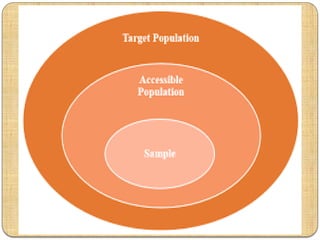
 The population for a study usually is
described as being composed of two groups:
1. Target population
2. Accessible population
POPULATION
TARGET POPULATION
The target population which is also called
the universe is composed of the entire
group of people or objects to which the
researcher wishes to generalize the
findings of the study.
The target population consists of people or
things that meet the designated set of
criteria of interest to the researcher.
ACCESSIBLE POPULATION
It is aggregate of cases that confirm to
designated criteria and are also
accessible as subjects for study.
 By identifying the group from which
the study sample was chosen, the
investigator about the conclusion of the
generalize ability of research findings.
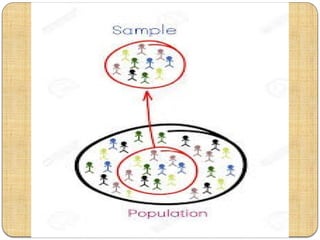
SAMPLE
 Sample may be defined as representative unit of target
population which is to be worked upon by researchers during
their study.
 Quantitative researchers often select samples that will
allow them to achieve stating conclusion validity and generalize
their result. They therefore develop a sampling plan that
specifies in advance how study participants are to selected and
how many to include.
 Qualitative researchers make sampling decision during the
course of data collection based on information & theoretical
need & typically do not develop a formal sampling plan in
advance.
PRINCIPLES OF SAMPLING
1. Principle or Law of statistical regularity: this
law is based upon mathematical theory of probability.
It is based upon the following two conditions:
 Large sample size: as the sample size increases, the
true characteristics of the population are more likely
to reveal.
 Random selection: the sample should be selected
randomly in which each and every unit of the
universe has an equal chance of being selected.
PRINCIPLES OF SAMPLING
2. Principle of inertia of large numbers
– it is based upon the concept that as the
sample size increases the better results we will
get.
For example, if we have to study the weight of
the students studying in a college then fairly
adequate sample of the students help us to
arrive at good results.
PRINCIPLES OF SAMPLING
3. Principle of validity: – if valid tests are
derived only then sampling design is termed
as valid.
4. Principle of optimization: – this
principle states that with the help of sample
one must be able to get optimum results
with maximum efficiency and minimum
cost.
DIFFERENCE BETWEEN SAMPLE
AND POPULATION
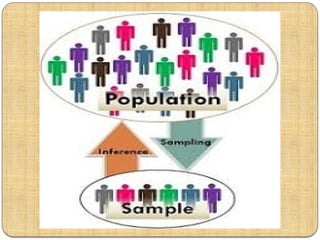
1. Population- refers to the collection of all
elements possessing common characteristics, that
comprises universe.
Sample- means a subgroup of the members of
population chosen for participation in the study.
2. Population- Each and every unit of the group.
Sample- only a handful of units of population.
DIFFERENCE BETWEEN SAMPLE
AND POPULATION
3. Population- it focus on identifying the
characteristics.
Sample- it focus on making inferences about
population.
4. Population- data collection is complete
enumeration/census.
Sample- data collection is sample survey or
sampling.

Population Vs. Sample.pptxPopulation Vs. Sample.pptx

  • 1.
  • 3.
    POPULATION “A population isa complete set of persons or objects that possess some common characteristics that is of interest to the researcher.”  The population for a study usually is described as being composed of two groups: 1. Target population 2. Accessible population
  • 4.
  • 5.
    TARGET POPULATION The targetpopulation which is also called the universe is composed of the entire group of people or objects to which the researcher wishes to generalize the findings of the study. The target population consists of people or things that meet the designated set of criteria of interest to the researcher.
  • 6.
    ACCESSIBLE POPULATION It isaggregate of cases that confirm to designated criteria and are also accessible as subjects for study.  By identifying the group from which the study sample was chosen, the investigator about the conclusion of the generalize ability of research findings.
  • 8.
    SAMPLE  Sample maybe defined as representative unit of target population which is to be worked upon by researchers during their study.  Quantitative researchers often select samples that will allow them to achieve stating conclusion validity and generalize their result. They therefore develop a sampling plan that specifies in advance how study participants are to selected and how many to include.  Qualitative researchers make sampling decision during the course of data collection based on information & theoretical need & typically do not develop a formal sampling plan in advance.
  • 10.
    PRINCIPLES OF SAMPLING 1.Principle or Law of statistical regularity: this law is based upon mathematical theory of probability. It is based upon the following two conditions:  Large sample size: as the sample size increases, the true characteristics of the population are more likely to reveal.  Random selection: the sample should be selected randomly in which each and every unit of the universe has an equal chance of being selected.
  • 11.
    PRINCIPLES OF SAMPLING 2.Principle of inertia of large numbers – it is based upon the concept that as the sample size increases the better results we will get. For example, if we have to study the weight of the students studying in a college then fairly adequate sample of the students help us to arrive at good results.
  • 12.
    PRINCIPLES OF SAMPLING 3.Principle of validity: – if valid tests are derived only then sampling design is termed as valid. 4. Principle of optimization: – this principle states that with the help of sample one must be able to get optimum results with maximum efficiency and minimum cost.
  • 13.
    DIFFERENCE BETWEEN SAMPLE ANDPOPULATION 1. Population- refers to the collection of all elements possessing common characteristics, that comprises universe. Sample- means a subgroup of the members of population chosen for participation in the study. 2. Population- Each and every unit of the group. Sample- only a handful of units of population.
  • 14.
    DIFFERENCE BETWEEN SAMPLE ANDPOPULATION 3. Population- it focus on identifying the characteristics. Sample- it focus on making inferences about population. 4. Population- data collection is complete enumeration/census. Sample- data collection is sample survey or sampling.