SUBMITTED TO MISS. SAPNA NEHRA
SUBMITTED BY MANAL KHAN
ROLL.NUMBER -2019BSB003
ASSIGNMENT ON POPULATION GROWTH
• Population growth definition
• Factors determining Population growth
• Factors influencing Population Growth
• Types of Growth curve
• Problems of Population Growth
• Limiting factors of Population Growth
• Regulation of Population Growth
CONTENTS
• POPULATION : A group of organisms
of same species
• Living in same habitat at same time.
• Where they can freely interbreed.
• It` s a changing entity.
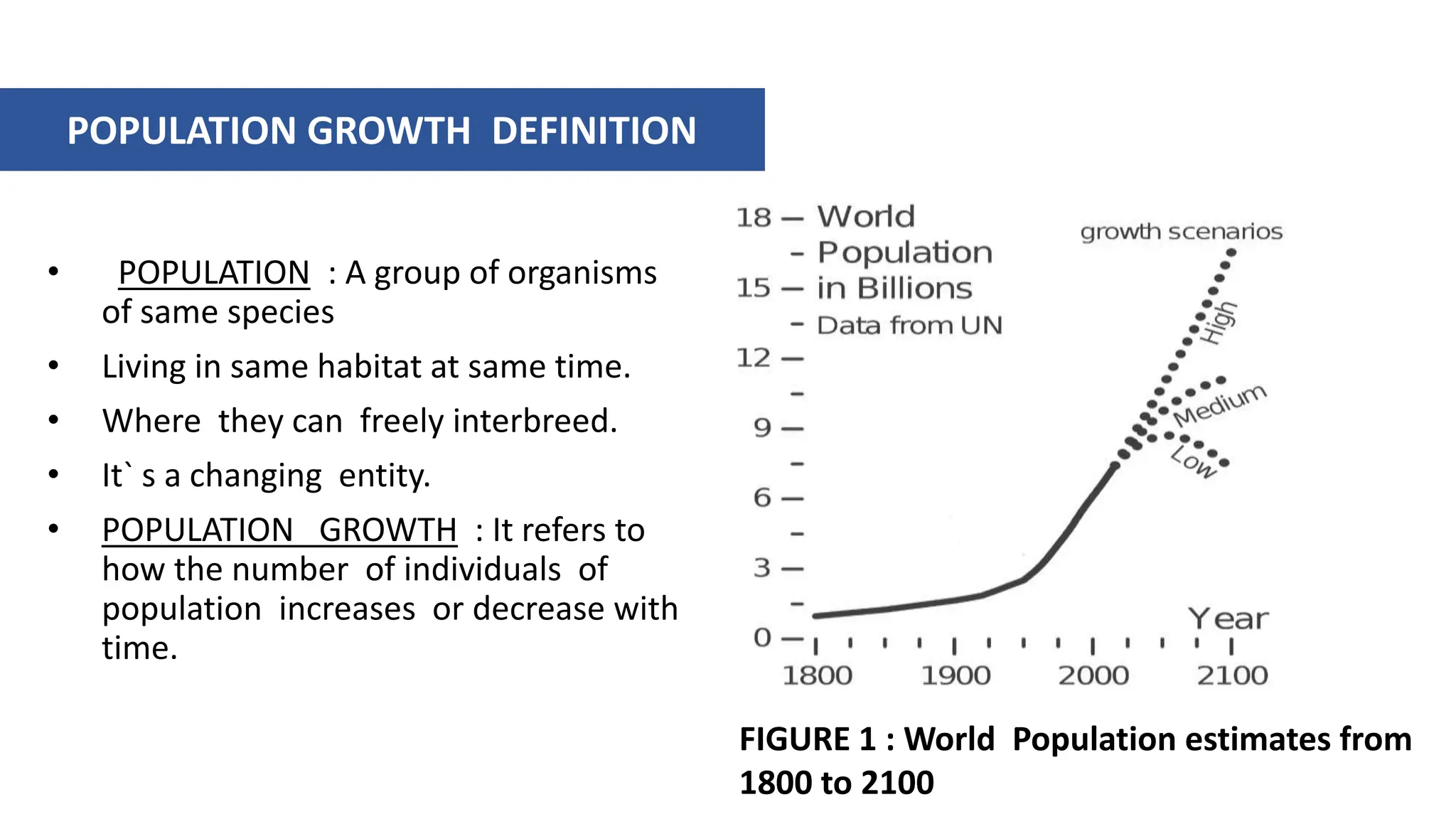
• POPULATION GROWTH : It refers to
how the number of individuals of
population increases or decrease with
time.
POPULATION GROWTH DEFINITION
FIGURE 1 : World Population estimates from
1800 to 2100
FACTORS DETERMINING POPULATION GROWTH
FACTORS
DETERMINING
POPULATION
GROWTH
Death Rate
Decrease in population
growth
Overcrowding leads
competition and infectious
diseases
EMIGRATION
People leaving a country to
other.
Decrease population growth.
IMMIGRATION
People entering a country
to settle their.
Increase population
growth
Birth Rate
Increase in population
size
Leads to exponential
growth
Factors
influencing
Populations
growth
STABILITY Of
SOCIETY
GOVERNMENT
POLICY
AVAILABILITY OF
FOOD AND WATER
COST OF
EDUCATION
NET MIGRATION
FEMALE LABOUR
MARKET
PARTICIPATION
GENDER INEQUALITY
ECONOMIC
GROWTH
HEALTH CARE
STANDARDS
OVERUSE OF ARABLE
LAND
FACTORS INFLUENCING POPULATION GROWTH
Two types of growth curve::
1. EXPONENTIAL
GROWTH CURVE-
The J-shaped curve.
This curve increase slowly in
beginning,but gains increase
rapidly as time goes on.
FIGURE 2 : Exponential growth curve
TYPES OF GROWTH CURVE
2. S-SHAPE GROWTH
CURVE
• In this a new environment,
Populations density increases
slowly initially, then increases
rapidly, but then decline
• PHASES OF S-CURVE ::
1. LOG OR EXPONENTIAL PHASE
2. LAG PHASE
3. STATIONARY PHASE
• Environmental resistance
comes to operate.
• Inhibiting factors influence ‘s.
LAG PHASE
Period of
maximum
increase in
population
STATIONARY
PHASE
No growth
LOG PHASE
Unlimited
food, no
disease, no
predator.
FIGURE 3 : S- shape growth curve
PROBLEMS OF POPULATION GROWTH
8. HOUSING
PROBLEMS
7. LACK OF
WATER
6.
UNEMPLOY
MENT 5. PEACE AND
ORDER
1.FOOD
SHORTAGE
2.POLLUTION
3. GARBAGE
AND HEALTH
PROBLEMS
4. GROSS
DOMESTIC
RATE REDUCE
PROBLEMS OF
POPULATION
GROWTH
LIMITING FACTORS OF POPULATION GROWTH
• A limiting factor is a biotic or abiotic factor that causes a decrease in population
growth.
• They can lower the population growth rate.
• Two types of limiting factors
1. Abiotic limiting factor –
Temperature, Weather events, Space to live , Shelter .
2. Biotic limiting factor –
Competition, Predation, Parasitism.
REGULATION OF
POPULATION GROWTH
8. 8. DENSITY
DEPENDENT
FACTORS
6.6. GROSS
DOMESTIC
PRODUCT
MUST BE
CONTROLLED
5.5. DRINKING
WATER AND
FOOD SUPPLY
3. PROPER
HEALTH CARE
FACILITIES
REGULATION OF POPULATION GROWTH
1. PROPER
EMPLOYMENT
2.DENSITY
INDEPENDENT
FACTORS
4. EDUCATION
RATES
7.
REPRODUCTIVI
TY
• I feel to acknowledge my deep sense of gratitude to my guide Miss.Sapna
Nehra and my mentor Miss. Zoya Hashmi for their valuable guidance and kind
supervision.
• I pay my deep sense of gratitude to Dr. Rajiv Dutta( HOD) of Science
department, of Dr. KEDAR NATH MODI UNIVERSITY.
ACKNOWLEDGEMENT
THANK YOU

POPULATION growth presentation-manal.pptx

  • 1.
    SUBMITTED TO MISS.SAPNA NEHRA SUBMITTED BY MANAL KHAN ROLL.NUMBER -2019BSB003 ASSIGNMENT ON POPULATION GROWTH
  • 2.
    • Population growthdefinition • Factors determining Population growth • Factors influencing Population Growth • Types of Growth curve • Problems of Population Growth • Limiting factors of Population Growth • Regulation of Population Growth CONTENTS
  • 3.
    • POPULATION :A group of organisms of same species • Living in same habitat at same time. • Where they can freely interbreed. • It` s a changing entity. • POPULATION GROWTH : It refers to how the number of individuals of population increases or decrease with time. POPULATION GROWTH DEFINITION FIGURE 1 : World Population estimates from 1800 to 2100
  • 4.
    FACTORS DETERMINING POPULATIONGROWTH FACTORS DETERMINING POPULATION GROWTH Death Rate Decrease in population growth Overcrowding leads competition and infectious diseases EMIGRATION People leaving a country to other. Decrease population growth. IMMIGRATION People entering a country to settle their. Increase population growth Birth Rate Increase in population size Leads to exponential growth
  • 5.
    Factors influencing Populations growth STABILITY Of SOCIETY GOVERNMENT POLICY AVAILABILITY OF FOODAND WATER COST OF EDUCATION NET MIGRATION FEMALE LABOUR MARKET PARTICIPATION GENDER INEQUALITY ECONOMIC GROWTH HEALTH CARE STANDARDS OVERUSE OF ARABLE LAND FACTORS INFLUENCING POPULATION GROWTH
  • 6.
    Two types ofgrowth curve:: 1. EXPONENTIAL GROWTH CURVE- The J-shaped curve. This curve increase slowly in beginning,but gains increase rapidly as time goes on. FIGURE 2 : Exponential growth curve TYPES OF GROWTH CURVE
  • 7.
    2. S-SHAPE GROWTH CURVE •In this a new environment, Populations density increases slowly initially, then increases rapidly, but then decline • PHASES OF S-CURVE :: 1. LOG OR EXPONENTIAL PHASE 2. LAG PHASE 3. STATIONARY PHASE • Environmental resistance comes to operate. • Inhibiting factors influence ‘s. LAG PHASE Period of maximum increase in population STATIONARY PHASE No growth LOG PHASE Unlimited food, no disease, no predator. FIGURE 3 : S- shape growth curve
  • 8.
    PROBLEMS OF POPULATIONGROWTH 8. HOUSING PROBLEMS 7. LACK OF WATER 6. UNEMPLOY MENT 5. PEACE AND ORDER 1.FOOD SHORTAGE 2.POLLUTION 3. GARBAGE AND HEALTH PROBLEMS 4. GROSS DOMESTIC RATE REDUCE PROBLEMS OF POPULATION GROWTH
  • 9.
    LIMITING FACTORS OFPOPULATION GROWTH • A limiting factor is a biotic or abiotic factor that causes a decrease in population growth. • They can lower the population growth rate. • Two types of limiting factors 1. Abiotic limiting factor – Temperature, Weather events, Space to live , Shelter . 2. Biotic limiting factor – Competition, Predation, Parasitism.
  • 10.
    REGULATION OF POPULATION GROWTH 8.8. DENSITY DEPENDENT FACTORS 6.6. GROSS DOMESTIC PRODUCT MUST BE CONTROLLED 5.5. DRINKING WATER AND FOOD SUPPLY 3. PROPER HEALTH CARE FACILITIES REGULATION OF POPULATION GROWTH 1. PROPER EMPLOYMENT 2.DENSITY INDEPENDENT FACTORS 4. EDUCATION RATES 7. REPRODUCTIVI TY
  • 11.
    • I feelto acknowledge my deep sense of gratitude to my guide Miss.Sapna Nehra and my mentor Miss. Zoya Hashmi for their valuable guidance and kind supervision. • I pay my deep sense of gratitude to Dr. Rajiv Dutta( HOD) of Science department, of Dr. KEDAR NATH MODI UNIVERSITY. ACKNOWLEDGEMENT
  • 12.