A limiting factoris an environmental factor or variable that has
the capacity to restrict the growth, abundance, or distribution of
a population in an ecosystem. These factors are present in
limited supply. Thus, organisms tend to compete for their
limited availability in the ecosystem. Different limiting factors
affect the ecosystem.
4.
The current humanpopulation is
approximately 8 billion people. It is
expected to grow to 9.7 billion by 2050.
FUN FACT
5.
• In thelaw of minimum, the growth of population could be regulated by the scarcest
resource, not by the resources in abundance.
• In the law of limiting factor, a biological or an ecological process that depends on
multiple factors will tend to have a rate limited by the slowest factor.
• In the law of tolerance, the survival success of an organism is suggested to depend on a
complex set of environmental factors.
LAWS THAT HELP EXPLICATE LIMITING FACTORS IN AN
ECOSYSTEM
6.
• The Lawof the minimum was originally developed by Carl Sprengel and then later popularized by Justus
von Liebig.
• This law states that the growth is regulated by a limiting factor, i.e. the scarcest resource, rather than by the
total resources available.
• the growth of a population is restricted by the factors that are scarcest and not by the factors that are
abundant. This was based on the observation of crop growth.
• This principle was used by William Cumming Rose as a basis for identifying the amino acids that were
labeled as essential.
LIEBIG’S LAW OF THE MINIMUM
8.
• The lawof limiting factor was proposed in 1905 by the British plant physiologist, Frederick Frost Blackman.
• According to this law, a process that depends on multiple factors will have a rate limited by the pace of the
slowest factor.
• photosynthesis is good example for this
BLACKMAN’S LAW OF LIMITING FACTOR
9.
• The lawof tolerance was developed in 1913 by American zoologist Victor Ernest Shelford.
• It states that the success of an organism depends on a complex set of environmental conditions
(environmental factors). And that organism would have the definite minimum, maximum, and optimum
environmental factors that determine success. (3) These signify the limit of tolerance of that organism
• However, the tolerance ranges may vary within the same organism, for example depending on the life
stage (larval vs. adult).
SHELFORD’S LAW OF TOLERANCE
11.
Explain how limitedspace might impact
population growth.
DISCUSSIO
N:
What could lead to limited space in a
human environment?
What could causeresources such as
food and water to become limited?
How might malnutrition lead
to population decline?
DISCUSSIO
N:
14.
• Density-dependent limitingfactor refers to the factor restricting the size of a population
based on density.
• A large, dense population is more strongly affected than a small or less dense
population.
• i.e. Food supply, water supply, availability of nutrients, diseases.
DENSITY-DEPENDENT
REGULATION
15.
• Density-independent limitingfactor refers to the limiting factor that is not dependent on
density.
• The limiting factor can restrict population size independent of how dense the population
is
• i.e. natural phenomena such as earthquake etc..
DENSITY-INDEPENDENT
REGULATION
Demography is thestatistical study of population changes over
time. The key statistics demographers use are birth rates, death
rates, and life expectancies; although, in practice, scientists also
study immigration and emigration rates, which also affect
populations.
18.
• provide importantinformation about the life history of an organism, divide the
population into age groups and often sexes; they show how long a member of that
group will probably live.
Life tables may include:
• the probability of individuals dying before their next birthday
(i.e., mortality rate )
the percentage of surviving individuals at a particular age interval
• the life expectancy at each interval
LIFE TABLE
EXPONENTIAL GROWTH
In histheory of natural selection, Charles Darwin was greatly influenced by the
English clergyman Thomas Malthus. Malthus published a book in 1798 stating that
populations with unlimited natural resources grow very rapidly, after which
population growth decreases as resources become depleted.
This accelerating pattern of increasing population size is called exponential
growth.
24.
The important conceptof exponential growth
is that the population growth rate, the number
of organisms added in each reproductive
generation, is accelerating; that is, it is
increasing at a greater and greater rate. When
the population size, N, is plotted over time, a J-
shaped growth curve is produced.
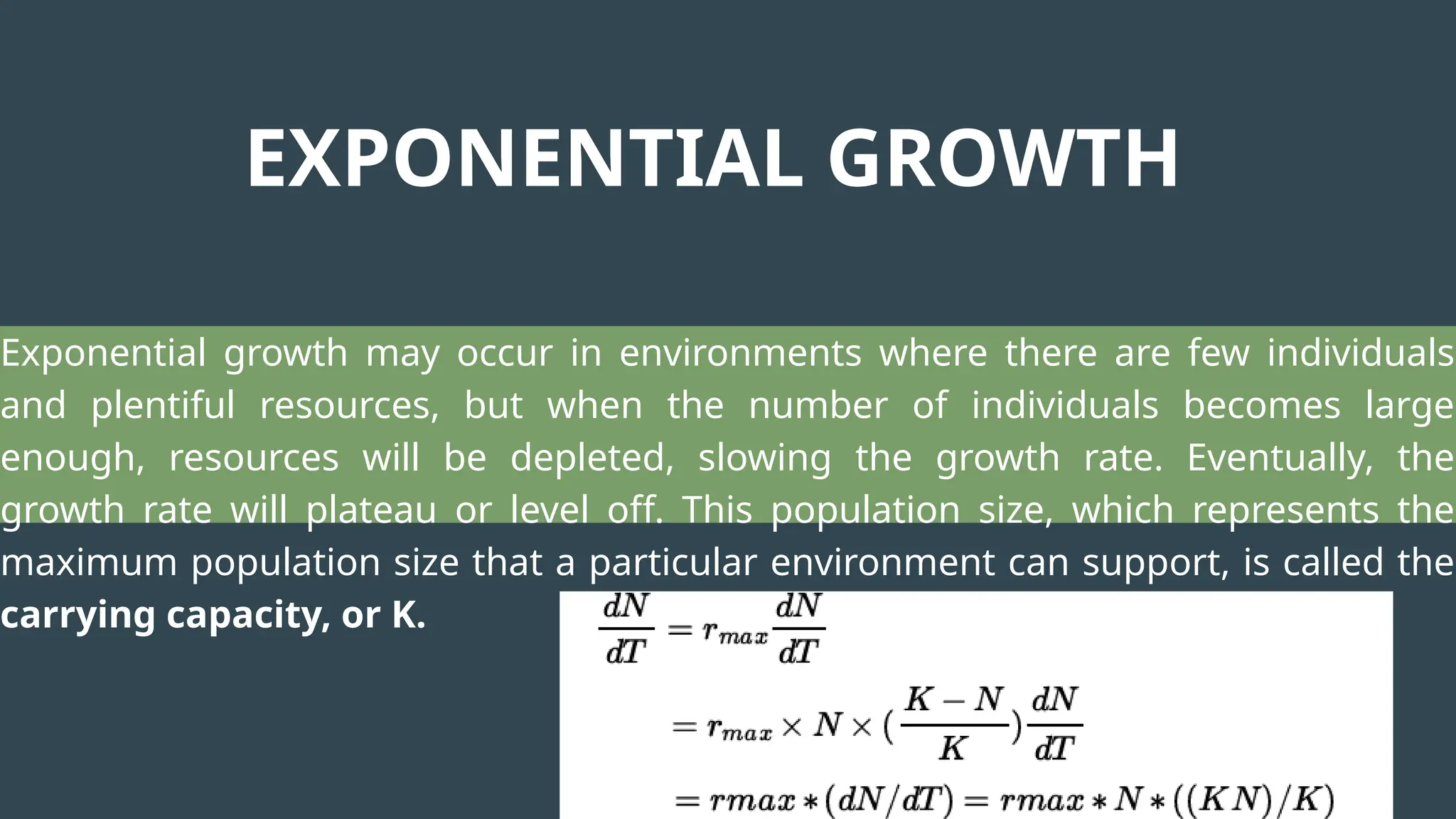
Exponential growth mayoccur in environments where there are few individuals
and plentiful resources, but when the number of individuals becomes large
enough, resources will be depleted, slowing the growth rate. Eventually, the
growth rate will plateau or level off. This population size, which represents the
maximum population size that a particular environment can support, is called the
carrying capacity, or K.
EXPONENTIAL GROWTH