1-Introduction
Population planning refersto the strategic efforts by
governments and international organizations to manage
demographic trends—including fertility rates, age
structures, urbanization, and migration—in ways that
promote sustainable development and social stability.
When these dynamics are not effectively managed, they
can create intense social and economic pressures that
fuel instability and, in some cases, extremism.
4.
ExtremismandClashes
Extremism refers tothe holding of radical political, religious, or
ideological views that reject or challenge the status quo, often
with the belief that violence or drastic measures are justified to
achieve a particular goal. Extremist movements often arise in
response to perceived injustices, inequalities, or societal
changes.
Clashes occur when groups with opposing ideologies, goals, or
beliefs come into conflict. These can be political, religious,
ethnic, or cultural in nature, and they often escalate into violence,
civil unrest, or even war.
5.
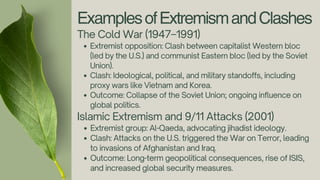
ExamplesofExtremismandClashes
The Cold War(1947–1991)
Extremist opposition: Clash between capitalist Western bloc
(led by the U.S.) and communist Eastern bloc (led by the Soviet
Union).
Clash: Ideological, political, and military standoffs, including
proxy wars like Vietnam and Korea.
Outcome: Collapse of the Soviet Union; ongoing influence on
global politics.
Islamic Extremism and 9/11 Attacks (2001)
Extremist group: Al-Qaeda, advocating jihadist ideology.
Clash: Attacks on the U.S. triggered the War on Terror, leading
to invasions of Afghanistan and Iraq.
Outcome: Long-term geopolitical consequences, rise of ISIS,
and increased global security measures.
6.
TheRoleofEthicsinPopulation
PoliciesandSocialInteractions
1. Preventing Marginalization
Ethicalprinciples promote inclusivity and equality, ensuring that no group is
pushed to the fringes of society based on race, gender, religion, ethnicity, or
socioeconomic status.
Example: In developing population policies, ethical guidelines discourage
targeting specific ethnic groups for birth control programs—something seen
in past coercive sterilization campaigns in countries like India or the U.S.
Ethical frameworks ensure that minority voices are heard and considered in
public decisions.
7.
TheRoleofEthicsinPopulation
PoliciesandSocialInteractions
2. Combating Discrimination
Ethicsemphasize the inherent dignity and equal worth of all individuals.
Discriminatory policies—whether in employment, education, healthcare, or
housing—are often rooted in prejudice and violate ethical standards of
fairness.
Example: Apartheid in South Africa was a system of legalized racial
discrimination. Ethical rejection of this system helped fuel both domestic
resistance and global pressure for reform.
8.
TheRoleofEthicsinPopulation
PoliciesandSocialInteractions
3. Preventing Violence
Ethicalsystems, whether based in human rights, religious traditions, or
philosophical principles, provide nonviolent means of resolving conflict and
addressing grievances.
By promoting empathy, dialogue, and mutual respect, ethical guidance
reduces the risk of violent extremism and social unrest.
Example: The Truth and Reconciliation Commission in post-apartheid South
Africa relied heavily on ethics—particularly the principle of restorative
justice—to rebuild a divided nation peacefully.
9.
TheRoleofEthicsinPopulation
PoliciesandSocialInteractions
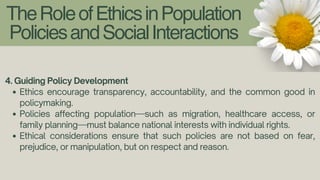
4. Guiding PolicyDevelopment
Ethics encourage transparency, accountability, and the common good in
policymaking.
Policies affecting population—such as migration, healthcare access, or
family planning—must balance national interests with individual rights.
Ethical considerations ensure that such policies are not based on fear,
prejudice, or manipulation, but on respect and reason.
10.
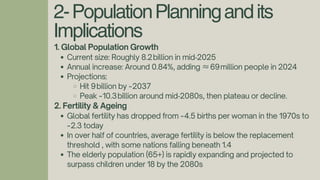
2-PopulationPlanningandits
Implications
1. Global PopulationGrowth
Current size: Roughly 8.2billion in mid‑2025
Annual increase: Around 0.84%, adding ≈69million people in 2024
Projections:
Hit 9billion by ~2037
Peak ~10.3billion around mid‑2080s, then plateau or decline.
2. Fertility & Ageing
Global fertility has dropped from ~4.5 births per woman in the 1970s to
~2.3 today
In over half of countries, average fertility is below the replacement
threshold , with some nations falling beneath 1.4
The elderly population (65+) is rapidly expanding and projected to
surpass children under 18 by the 2080s
11.
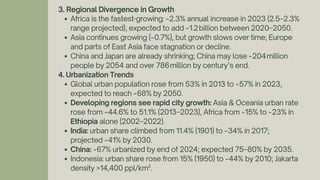
3. Regional Divergencein Growth
Africa is the fastest-growing: ~2.3% annual increase in 2023 (2.5–2.3%
range projected), expected to add ~1.2billion between 2020–2050.
Asia continues growing (~0.7%), but growth slows over time; Europe
and parts of East Asia face stagnation or decline.
China and Japan are already shrinking; China may lose ~204million
people by 2054 and over 786million by century’s end.
4. Urbanization Trends
Global urban population rose from 53% in 2013 to ~57% in 2023,
expected to reach ~68% by 2050.
Developing regions see rapid city growth: Asia & Oceania urban rate
rose from ~44.6% to 51.1% (2013–2023), Africa from ~15% to ~23% in
Ethiopia alone (2002–2022).
India: urban share climbed from 11.4% (1901) to ~34% in 2017;
projected ~41% by 2030.
China: ~67% urbanized by end of 2024; expected 75–80% by 2035.
Indonesia: urban share rose from 15% (1950) to ~44% by 2010; Jakarta
density >14,400 ppl/km².
12.
5. Migration Patterns
Internationalmigration helps offset population decline in ~50‑60
countries—including the U.S., Canada, Australia—by mid‑century .
Climate- and economy-driven migration is increasingly reshaping
cities (e.g., flood displacement in Kenya to urban centers) .
13.
3.FamilyPlanning
Family planning refersto the ability of individuals or
couples to decide freely and responsibly the number,
spacing, and timing of their children. It involves access
to safe, effective, and affordable methods of
contraception and reproductive health services.
14.
Family planning isa key tool in population planning, which
involves managing population growth to support sustainable
development, improve public health, and ensure resource
availability.
Role of Family Planning in Population Planning
1. Regulates Population Growth
Helps individuals and families limit or space births, reducing
overall fertility rates.
Especially effective in high-growth countries, where rapid
population increases strain resources like food, water, housing,
and healthcare.
Example:
Countries like Bangladesh and Thailand successfully reduced high
birth rates through voluntary family planning programs, contributing
to improved economic growth and lower poverty rates.
15.
2. Improves Maternaland Child Health
Prevents unintended and high-risk pregnancies.
Reduces maternal and infant mortality rates.
Healthier families mean a more productive, stable population.
3. Empowers Women and Supports Gender Equality
Gives women greater control over reproduction, enabling
them to pursue education and careers.
Delays early marriage and childbirth, leading to more
educated and economically active populations.
4. Eases Pressure on Public Services
Slower population growth means less demand on schools,
hospitals, housing, and jobs.
Allows governments to plan better and invest more in quality
services.
16.
5. Supports EnvironmentalSustainability
By moderating growth, family planning helps reduce strain
on natural resources and ecosystems.
Contributes to climate adaptation and food security
efforts.
17.
CONCLUSION
Managing population challengesand preventing conflict requires ethical,
inclusive, and well-informed policies. Extremism often stems from
injustice and exclusion, which ethical frameworks can help prevent by
promoting fairness, respect, and human rights.
Demographic trends—like population growth, urbanization, and
migration—must be addressed through responsible planning. Family
planning plays a key role by improving health, empowering women, and
balancing growth with resources.
Overall, ethical principles ensure that population policies are just, effective,
and supportive of social cohesion and sustainable development.




![Population policies of develovping countries [autosaved]](https://cdn.slidesharecdn.com/ss_thumbnails/populationpoliciesofdevelovpingcountriesautosaved-181125073711-thumbnail.jpg?width=640&height=640&fit=bounds)


![ONFH[AVN HIP] -TRIPLE REGIME -A NOVAL SURGICAL CONCEPT .pptx](https://cdn.slidesharecdn.com/ss_thumbnails/onfhavnhip2026koaconcalicutdrgokuldevdrmashraf-260210064517-213ec005-thumbnail.jpg?width=640&height=640&fit=bounds)


