BEST PRACTICES,
®
LLC
Best Practices, LLC Strategic Benchmarking Research
Clinical Affairs Excellence:
Benchmarking Clinical Trial Strategies to Ensure
Medical Device Success in a Global Marketplace
BEST PRACTICES,
®
LLC
TABLE OF CONTENTS
I. Executive Summary
 Business Issue and Project Blueprint, p.5-7
 Participants, p.8-9
 Key Findings, p.10-14
II. Outside-U.S. Clinical Trial Overview and Insights, p.15-21
III. Clinical Affairs Budget and FTEs, p. 22-31
IV. Clinical Affairs Presence Around the World, p.32-37
V. Cost and Quality of Outside-U.S. Trials and Outsourcing, p.38-45
VI. Outsourcing Levels for Key Clinical Activities, p.46-55
VII. Vendor Selection and Outsourcing Attributes, p.56-62
VIII. CRA, CRM, and CRD Competencies & Outsourcing Levels, p. 63-72
IX. Clinical Affairs Organizational Fit, p.73-80
X. Outsourcing Success Factors and Pitfalls, p. 81-85
XI. Trends and Directions for Outside-U.S. Trials & Outsourcing, p.86-88
XII. Appendix, p. 89-94
XIII. About Best Practices, LLC, p.95
BEST PRACTICES,
®
LLC
Budget & Staffing
Global Presence
Outside-U.S. Trial
Costs
Outside-U.S. Trial
Quality
Outsourcing Levels
Outsourcing Activities
Outside-U.S. Trial &
Outsourcing Trends
3
Copyright © Best Practices, LLC
Executive Brief: Benchmarking Clinical Affairs Excellence
These are some of the key Insights to surface out of this study into clinical trial strategies
to succeed in a global marketplace.
The device segment’s clinical budgets average $39M or 1.18 % of the company’s
total revenue. The device segment’s clinical staffing average was 158 FTEs or 3.3
FTEs per every $100M in revenue.
The device segment’s trials only had 2% of their patients from emerging areas
whereas the pharma segment had 13%.
A divided device segment (55% Yes, 45% No) thinks outside-U.S. trials cost more;
Pharma strongly believes they cost less (86%).
A majority of both segments were satisfied overall with the quality of outside-U.S.
trial data. A third of both groups felt the data led to extensive regulatory
conversations.
The device segment’s mean clinical staffing was 72% in-house, 23% outsourced &
5% offshore The pharma segment’s clinical staffing was 34% in-house, 60%
outsourced & 6% offshore, on average.
The device segment did not outsource a majority of any of the 7 key clinical
activities studied; the pharma segment outsourced a majority of all of them.
Seventy-five percent of device participants think the number of trials in emerging
areas will increase in the next 2-3 years and 83 % of pharma think the same thing.
Seventy-five percent of device participants think offshore and outsource staffing
will increase in the next 2-3 years and a majority of pharma think the same.
BEST PRACTICES,
®
LLC
4
Copyright © Best Practices, LLC
Formulate a StrategicFormulate a Strategic
Approach for EngagingApproach for Engaging
Emerging Regions in ClinicalEmerging Regions in Clinical
Affairs ActivitiesAffairs Activities
Business Issue & Objectives
Objectives:
 Determine the regions where medical device organizations conduct clinical trials and
percent of patients recruited annually from each region.
 Identify which Clinical Affairs activities are best suited to be outsourced or kept in-
house.
 Gauge what the experience of peer device organizations has been relative to the cost
of outsourcing clinical trial activities.
 Rate the value of benefits associated with outsourcing clinical trial activities.
Best Practices, LLC conducted this benchmarking study to establish meaningful
benchmarks for the medical device industry’s effort and methods to set a strategic
direction for outsourcing clinical trial activities in emerging regions of the world.
Field Research & Insight Development:
Survey 13 Clinical leaders at 10 medical device
organizations.
Conduct four executive interviews to collect
qualitative insights from selected survey participants.
INFORMINFORM
Objective:
BEST PRACTICES,
®
LLC
5
Copyright © Best Practices, LLC
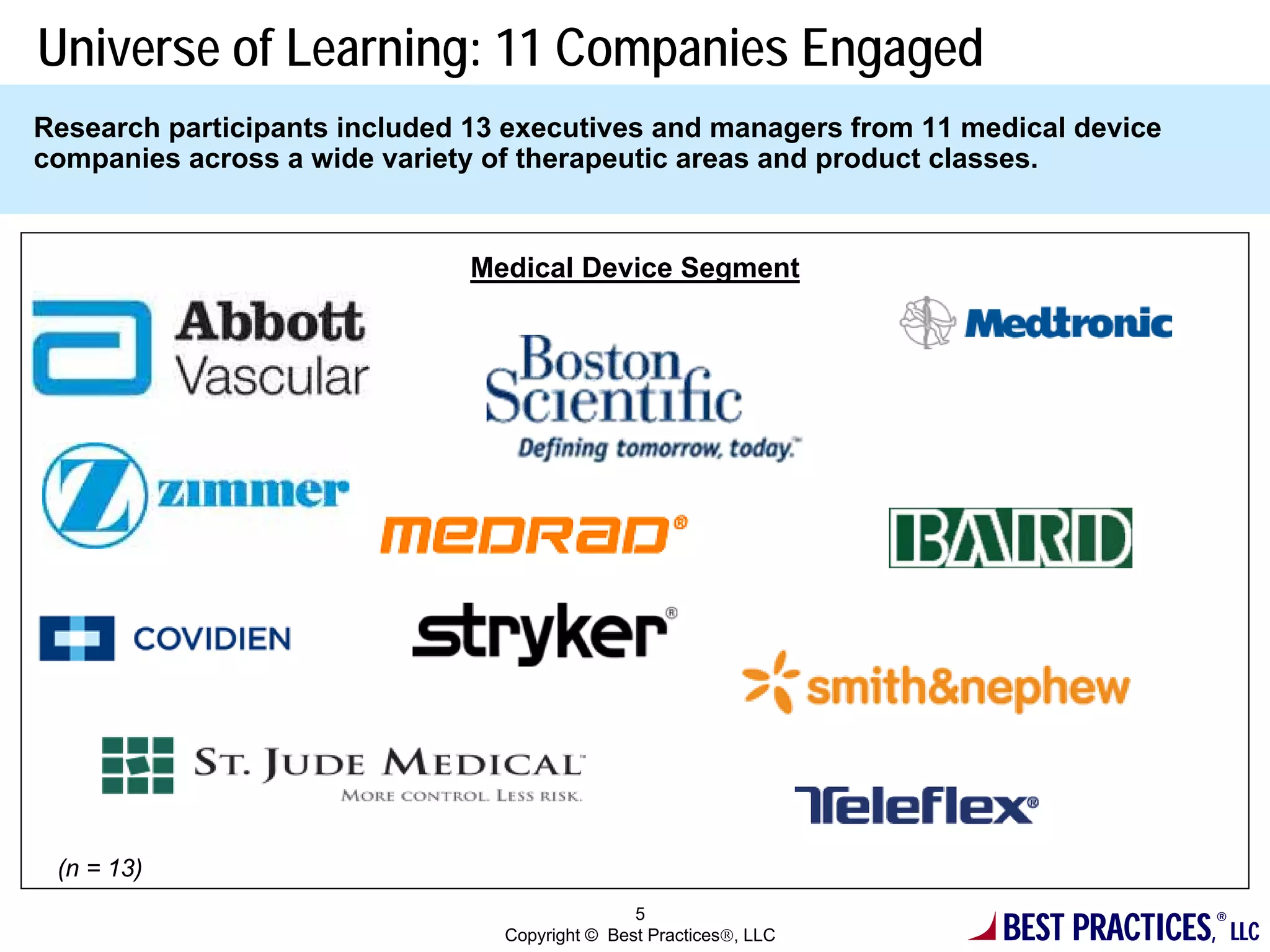
Universe of Learning: 11 Companies Engaged
Research participants included 13 executives and managers from 11 medical device
companies across a wide variety of therapeutic areas and product classes.
(n = 13)
Medical Device Segment
BEST PRACTICES,
®
LLC
6
Copyright © Best Practices, LLC
3. Key Findings – Outside U.S. Trials Trends & Activity Overview
Insights into study metrics around outside-U.S. clinical trial trends and activities.
Outside U.S. Clinical Trial Trends
 A majority of clinical leaders in the device segment (64%) believe in the coming 2-3
years more trials will be conducted in Asia-Pacific and emerging markets/high growth
BRIC countries. Correspondingly, 77 % believe outsource staffing will increase over
the same period and 69% believe offshore staffing will similarly increase.
Overview of Outsourcing Clinical Activities
 The device segment appears to lag significantly behind pharma regarding outsourcing
clinical activities. While the device segment did not outsource a majority of any of the
seven key clinical activities benchmarked in this study, a parallel study found that
pharma companies typically outsource a majority of all of them.
Outside U.S. Clinical Trial Activity
 Device participants, on average, had 91 % of their trial patients in the U.S. & Europe.
But an average of 6% of their patients were in Asia-Pacific and 2 % were in emerging
markets.
BEST PRACTICES,
®
LLC
Device Participants Average $3.8B with $39M Clinical Budget
7
Copyright © Best Practices, LLC
Q. What were the approximate total 2010 revenues for your company and the corresponding Clinical
Affairs Spend?
(n = 7)
Estimated Revenue
($USD):
Clinical Affairs
Spend ($USD):
Clinical Affairs
Spend/ Company
Revenue:
Max $7,300,000,000 $130,000,000 4.06%
Mean $3,764,285,714 $38,928,571 1.10%
Median $3,200,000,000 $30,000,000 0.67%
Min $650,000,000 $500,000 0.03%
On average, the device segment represented a company with $3.8B in annual revenue and
a Clinical Affairs group with a $39M budget. When the budget is presented as a percentage
of revenue supported, participants’ clinical budget was 1.10 % of the revenues supported.
Medical Device Segment: Revenue and Clinical Affairs Spend
BEST PRACTICES,
®
LLC
(n = 12)
Outsourced
22%
Offshored
4%
Insourced
72%
In sourced
Staffing of
Clinical Affairs/
Clinical Trials
Offshore
Staffing
Clinical Affairs/
Clinical Trials
Outsourced
Staffing of
Clinical Affairs/
Clinical Trials
Max 95% 10% 60%
Mean 72% 4% 22%
Median 80% 3% 20%
Min 30% 0% 4%
8
Copyright © Best Practices, LLC
Q. What is the approximate staff sourcing percentage mix of Clinical Trials conducted across your
global enterprise in terms of % In sourced Staffing, % Offshore Staffing, and % Outsourced Staffing
Average Staff Sourcing MixStaff Sourcing Mix
Medical Device Segment: Staff Resourcing Mix
Device Segment: Clinical Trial Staffing 72% In-house
Device participants described their clinical trial staffing mix as 72 percent in-house, 22
percent outsourced and 4 percent offshore, on average. As cost pressures escalate and
regulators in other countries require more local trials, offshore and outsourced staffing
will increase at device firms while in-house staff will shrink.
BEST PRACTICES,
®
LLC
9
Copyright © Best Practices, LLC
Q. In general, how do regulatory authorities react to clinical trial data from research conducted
outside the U.S.?
(n = 13)
Few
questions
about data
46%
Rejected
8%
Extensive
conversations
about data
38%
No
questions
8%
Medical Device Segment: Reaction of Regulators to Outside-US Clinical Trial Data
While a majority of device participants felt regulators have few to no questions about
data for trials conducted outside the U.S., a disconcerting 46 percent felt data from other
regions generated extensive conversations to outright rejection.
Device Segment Divided on Regulators’ View of Trial Data
Total = 46 % Total = 54 %
BEST PRACTICES,
®
LLC
10
Copyright © Best Practices, LLC
Q. By clinical affairs activity, note the percent of activities that outsourced and the percent that are
handled in-house (Total of each row = 100%).
This slide presents an overview of device participants’ outsourcing levels for seven key Clinical activities.
Participants keep in-house a majority of the tasks associated with each activity. The activities with the most
outsourcing are data management and site management.
Device Segment: Clinical Activities Overview Shows
Outsourcing Not a Major Tool for Key Activities
Medical Device Segment: Outsourced vs. In-house Breakdown Summary
29%
27%
16%
19%
40%
3%
7%
71%
73%
84%
81%
60%
97%
93%
Site Mangement
Data Analysis
Trial Management
Patient Enrollment
Data Management
Investigator
Recruitment
Site Evaluation
Outsourced In-house n =
11
11
11
11
11
11
5
BEST PRACTICES,
®
LLC
8%
8%
62%
8%
8%
8%
15%
23%
85%
77%
62%
46%
54%
15%
31%
38%
38%
8%
8%Educational credentials
Experience of staff in relevant areas
Tenure of their staff
Proven track record in the
geography
Turn-over rates of their staff
Proven track record in therapeutic
area
Highly Inaccurate Somewhat Inaccurate Inconsistent Somewhat Accurate Highly Accurate
11
Copyright © Best Practices, LLC
Q. If you outsource, what capabilities are best predictors that the your outsource vendor will
provide a high quality service that meets your expectations:
(n = 13)
Medical Device Segment: Predictors of Vendor Quality
Device Segment: Track Record is Good Vendor Predictor
Device Clinical Affairs leaders felt that the best predictor for the quality of an outsourcing
vendor was its track record – both in the target geography and therapeutic area. The turn-
over rate of the vendor’s staff was also cited, but that can be a difficult metric to obtain.
BEST PRACTICES,
®
LLC
Successful CRO has Local Office & Strong Management
When considering a CRO for a device trial in an emerging market, two of the most critical
traits to look for are 1) Experience in that region and preferably a local office there and 2)
Strong management, both at its main office and at the local office in the market you want
to do a trial in.
• The CRO should have a main office in your geography so you can
manage them, but CRO also needs to have office in emerging area
so they have local presence. “So they can do the local work but then
we can still drive our timelines and push from here. It’s hard to push a
CRO when you can’t get over to their office quickly – they’re too far
away.”
• The CRO has to have experience in the geographic region
• The CRO has to have people knowledgeable in the management side
of clinical trials and have strong local management as well. “If they
don’t have a strong manager in that local area that knows what it
takes to get clinical trials done, it’s not going to work.”
Don’t…
• Automatically assume a U.S. CRO has a presence in an emerging
market because they say they can work there. That may translate to
we’ll hire another, locally based CRO to do our work.
“We had a CRO running a global
project that did not include Japan
and China – it was a huge project.
That same company was also
helping us run a Japan trial. It was
night and day difference and it
was all because we had very good
management on the global project
and poor management on the
Japan trial.”
– Director, Global Clinical
CRO Dos and DonCRO Dos and Don’’tsts
12
Copyright © Best Practices, LLC
BEST PRACTICES,
®
LLC
50%
42%
33%
25%
17%
8%
8%
50%
58%
67%
75%
83%
92%
92%
Therapeutic Area Expertise
Experience in managing or
monitoring a clinical study
Organizational Skills
Communication Skills (written/oral)
Collaboration Skills
Structured/Detail-oriented
Relationship / Interpersonal skills to
interact with various internal and
external groups
Highly Unimportant Somewhat Unimportant Neutral Somewhat Important Highly Important
13
Copyright © Best Practices, LLC
Q. Rate the competencies you find most important when hiring a Clinical Research Associate (CRA).
(n = 12)
Medical Device Segment: CRA Competencies
Device Segment: Interpersonal Skills/Detail-Oriented Traits Vital for CRAs
Device participants placed a high value on many competencies for CRAs, but the two with
the highest rating were interpersonal skills for internal/external interactions and a detail-
oriented personality.
BEST PRACTICES,
®
LLC
14
Copyright © Best Practices, LLC
Q. What are the three most valuable lessons learned or critical success factors to make clinical
affairs outsourcing work?
Medical Device Segment: Critical Success Factors/Lessons Learned
Medical device participants felt the critical success factors behind successful clinical
outsourcing were established relationships, accountability and incentives, goals and
expectations and knowledge and oversight.
Device: Critical Success Factors/Lessons Learned
(n = 8)
BEST PRACTICES,
®
LLC
15%
8%
31%
31%
15%
23%
15%
54%
69%
77%
77%
85%
100%
Internal Clinical Affairs Staffing
Offshore Staffing
Outsourced Staffing
Number of clinical trials in Emerging
/ high growth markets
Number of volunteers required by
regulatory bodies
Number of clinical trials to support
Class III / II products/NDAs
Decrease No Change Increase
15
Copyright © Best Practices, LLC
Q. In the next three years, what changes - if any - do you expect for each of the following Clinical
Affairs trend areas?
(n = 13)
Medical Device Segment: Clinical Affairs Trends
Device Segment: Outsourced and Offshore Staffing to Rise
During the next three years, most device clinical leaders expect to see an increase in trials
in high-growth emerging areas of the world. To handle that growth, they anticipate hiring
more outsource and offshore staff (company employees located in low-cost regions).
BEST PRACTICES,
®
LLC
Best Practices, LLC is a research and consulting firm that conducts work
based on the simple yet profound principle that organizations can chart a
course to superior economic performance by studying the best business
practices, operating tactics and winning strategies of world-class
companies.
Best Practices, LLC
6350 Quadrangle Drive, Suite 200, Chapel Hill, NC 27517
919-403-0251
best@best-in-class.com
www.best-in-class.com
About Best Practices, LLC

Clinical Affairs Excellence: Benchmarking Clinical Trial Strategies To Ensure Medical Device Success in a Global Marketplace

  • 1.
    BEST PRACTICES, ® LLC Best Practices,LLC Strategic Benchmarking Research Clinical Affairs Excellence: Benchmarking Clinical Trial Strategies to Ensure Medical Device Success in a Global Marketplace
  • 2.
    BEST PRACTICES, ® LLC TABLE OFCONTENTS I. Executive Summary  Business Issue and Project Blueprint, p.5-7  Participants, p.8-9  Key Findings, p.10-14 II. Outside-U.S. Clinical Trial Overview and Insights, p.15-21 III. Clinical Affairs Budget and FTEs, p. 22-31 IV. Clinical Affairs Presence Around the World, p.32-37 V. Cost and Quality of Outside-U.S. Trials and Outsourcing, p.38-45 VI. Outsourcing Levels for Key Clinical Activities, p.46-55 VII. Vendor Selection and Outsourcing Attributes, p.56-62 VIII. CRA, CRM, and CRD Competencies & Outsourcing Levels, p. 63-72 IX. Clinical Affairs Organizational Fit, p.73-80 X. Outsourcing Success Factors and Pitfalls, p. 81-85 XI. Trends and Directions for Outside-U.S. Trials & Outsourcing, p.86-88 XII. Appendix, p. 89-94 XIII. About Best Practices, LLC, p.95
  • 3.
    BEST PRACTICES, ® LLC Budget &Staffing Global Presence Outside-U.S. Trial Costs Outside-U.S. Trial Quality Outsourcing Levels Outsourcing Activities Outside-U.S. Trial & Outsourcing Trends 3 Copyright © Best Practices, LLC Executive Brief: Benchmarking Clinical Affairs Excellence These are some of the key Insights to surface out of this study into clinical trial strategies to succeed in a global marketplace. The device segment’s clinical budgets average $39M or 1.18 % of the company’s total revenue. The device segment’s clinical staffing average was 158 FTEs or 3.3 FTEs per every $100M in revenue. The device segment’s trials only had 2% of their patients from emerging areas whereas the pharma segment had 13%. A divided device segment (55% Yes, 45% No) thinks outside-U.S. trials cost more; Pharma strongly believes they cost less (86%). A majority of both segments were satisfied overall with the quality of outside-U.S. trial data. A third of both groups felt the data led to extensive regulatory conversations. The device segment’s mean clinical staffing was 72% in-house, 23% outsourced & 5% offshore The pharma segment’s clinical staffing was 34% in-house, 60% outsourced & 6% offshore, on average. The device segment did not outsource a majority of any of the 7 key clinical activities studied; the pharma segment outsourced a majority of all of them. Seventy-five percent of device participants think the number of trials in emerging areas will increase in the next 2-3 years and 83 % of pharma think the same thing. Seventy-five percent of device participants think offshore and outsource staffing will increase in the next 2-3 years and a majority of pharma think the same.
  • 4.
    BEST PRACTICES, ® LLC 4 Copyright ©Best Practices, LLC Formulate a StrategicFormulate a Strategic Approach for EngagingApproach for Engaging Emerging Regions in ClinicalEmerging Regions in Clinical Affairs ActivitiesAffairs Activities Business Issue & Objectives Objectives:  Determine the regions where medical device organizations conduct clinical trials and percent of patients recruited annually from each region.  Identify which Clinical Affairs activities are best suited to be outsourced or kept in- house.  Gauge what the experience of peer device organizations has been relative to the cost of outsourcing clinical trial activities.  Rate the value of benefits associated with outsourcing clinical trial activities. Best Practices, LLC conducted this benchmarking study to establish meaningful benchmarks for the medical device industry’s effort and methods to set a strategic direction for outsourcing clinical trial activities in emerging regions of the world. Field Research & Insight Development: Survey 13 Clinical leaders at 10 medical device organizations. Conduct four executive interviews to collect qualitative insights from selected survey participants. INFORMINFORM Objective:
  • 5.
    BEST PRACTICES, ® LLC 5 Copyright ©Best Practices, LLC Universe of Learning: 11 Companies Engaged Research participants included 13 executives and managers from 11 medical device companies across a wide variety of therapeutic areas and product classes. (n = 13) Medical Device Segment
  • 6.
    BEST PRACTICES, ® LLC 6 Copyright ©Best Practices, LLC 3. Key Findings – Outside U.S. Trials Trends & Activity Overview Insights into study metrics around outside-U.S. clinical trial trends and activities. Outside U.S. Clinical Trial Trends  A majority of clinical leaders in the device segment (64%) believe in the coming 2-3 years more trials will be conducted in Asia-Pacific and emerging markets/high growth BRIC countries. Correspondingly, 77 % believe outsource staffing will increase over the same period and 69% believe offshore staffing will similarly increase. Overview of Outsourcing Clinical Activities  The device segment appears to lag significantly behind pharma regarding outsourcing clinical activities. While the device segment did not outsource a majority of any of the seven key clinical activities benchmarked in this study, a parallel study found that pharma companies typically outsource a majority of all of them. Outside U.S. Clinical Trial Activity  Device participants, on average, had 91 % of their trial patients in the U.S. & Europe. But an average of 6% of their patients were in Asia-Pacific and 2 % were in emerging markets.
  • 7.
    BEST PRACTICES, ® LLC Device ParticipantsAverage $3.8B with $39M Clinical Budget 7 Copyright © Best Practices, LLC Q. What were the approximate total 2010 revenues for your company and the corresponding Clinical Affairs Spend? (n = 7) Estimated Revenue ($USD): Clinical Affairs Spend ($USD): Clinical Affairs Spend/ Company Revenue: Max $7,300,000,000 $130,000,000 4.06% Mean $3,764,285,714 $38,928,571 1.10% Median $3,200,000,000 $30,000,000 0.67% Min $650,000,000 $500,000 0.03% On average, the device segment represented a company with $3.8B in annual revenue and a Clinical Affairs group with a $39M budget. When the budget is presented as a percentage of revenue supported, participants’ clinical budget was 1.10 % of the revenues supported. Medical Device Segment: Revenue and Clinical Affairs Spend
  • 8.
    BEST PRACTICES, ® LLC (n =12) Outsourced 22% Offshored 4% Insourced 72% In sourced Staffing of Clinical Affairs/ Clinical Trials Offshore Staffing Clinical Affairs/ Clinical Trials Outsourced Staffing of Clinical Affairs/ Clinical Trials Max 95% 10% 60% Mean 72% 4% 22% Median 80% 3% 20% Min 30% 0% 4% 8 Copyright © Best Practices, LLC Q. What is the approximate staff sourcing percentage mix of Clinical Trials conducted across your global enterprise in terms of % In sourced Staffing, % Offshore Staffing, and % Outsourced Staffing Average Staff Sourcing MixStaff Sourcing Mix Medical Device Segment: Staff Resourcing Mix Device Segment: Clinical Trial Staffing 72% In-house Device participants described their clinical trial staffing mix as 72 percent in-house, 22 percent outsourced and 4 percent offshore, on average. As cost pressures escalate and regulators in other countries require more local trials, offshore and outsourced staffing will increase at device firms while in-house staff will shrink.
  • 9.
    BEST PRACTICES, ® LLC 9 Copyright ©Best Practices, LLC Q. In general, how do regulatory authorities react to clinical trial data from research conducted outside the U.S.? (n = 13) Few questions about data 46% Rejected 8% Extensive conversations about data 38% No questions 8% Medical Device Segment: Reaction of Regulators to Outside-US Clinical Trial Data While a majority of device participants felt regulators have few to no questions about data for trials conducted outside the U.S., a disconcerting 46 percent felt data from other regions generated extensive conversations to outright rejection. Device Segment Divided on Regulators’ View of Trial Data Total = 46 % Total = 54 %
  • 10.
    BEST PRACTICES, ® LLC 10 Copyright ©Best Practices, LLC Q. By clinical affairs activity, note the percent of activities that outsourced and the percent that are handled in-house (Total of each row = 100%). This slide presents an overview of device participants’ outsourcing levels for seven key Clinical activities. Participants keep in-house a majority of the tasks associated with each activity. The activities with the most outsourcing are data management and site management. Device Segment: Clinical Activities Overview Shows Outsourcing Not a Major Tool for Key Activities Medical Device Segment: Outsourced vs. In-house Breakdown Summary 29% 27% 16% 19% 40% 3% 7% 71% 73% 84% 81% 60% 97% 93% Site Mangement Data Analysis Trial Management Patient Enrollment Data Management Investigator Recruitment Site Evaluation Outsourced In-house n = 11 11 11 11 11 11 5
  • 11.
    BEST PRACTICES, ® LLC 8% 8% 62% 8% 8% 8% 15% 23% 85% 77% 62% 46% 54% 15% 31% 38% 38% 8% 8%Educational credentials Experienceof staff in relevant areas Tenure of their staff Proven track record in the geography Turn-over rates of their staff Proven track record in therapeutic area Highly Inaccurate Somewhat Inaccurate Inconsistent Somewhat Accurate Highly Accurate 11 Copyright © Best Practices, LLC Q. If you outsource, what capabilities are best predictors that the your outsource vendor will provide a high quality service that meets your expectations: (n = 13) Medical Device Segment: Predictors of Vendor Quality Device Segment: Track Record is Good Vendor Predictor Device Clinical Affairs leaders felt that the best predictor for the quality of an outsourcing vendor was its track record – both in the target geography and therapeutic area. The turn- over rate of the vendor’s staff was also cited, but that can be a difficult metric to obtain.
  • 12.
    BEST PRACTICES, ® LLC Successful CROhas Local Office & Strong Management When considering a CRO for a device trial in an emerging market, two of the most critical traits to look for are 1) Experience in that region and preferably a local office there and 2) Strong management, both at its main office and at the local office in the market you want to do a trial in. • The CRO should have a main office in your geography so you can manage them, but CRO also needs to have office in emerging area so they have local presence. “So they can do the local work but then we can still drive our timelines and push from here. It’s hard to push a CRO when you can’t get over to their office quickly – they’re too far away.” • The CRO has to have experience in the geographic region • The CRO has to have people knowledgeable in the management side of clinical trials and have strong local management as well. “If they don’t have a strong manager in that local area that knows what it takes to get clinical trials done, it’s not going to work.” Don’t… • Automatically assume a U.S. CRO has a presence in an emerging market because they say they can work there. That may translate to we’ll hire another, locally based CRO to do our work. “We had a CRO running a global project that did not include Japan and China – it was a huge project. That same company was also helping us run a Japan trial. It was night and day difference and it was all because we had very good management on the global project and poor management on the Japan trial.” – Director, Global Clinical CRO Dos and DonCRO Dos and Don’’tsts 12 Copyright © Best Practices, LLC
  • 13.
    BEST PRACTICES, ® LLC 50% 42% 33% 25% 17% 8% 8% 50% 58% 67% 75% 83% 92% 92% Therapeutic AreaExpertise Experience in managing or monitoring a clinical study Organizational Skills Communication Skills (written/oral) Collaboration Skills Structured/Detail-oriented Relationship / Interpersonal skills to interact with various internal and external groups Highly Unimportant Somewhat Unimportant Neutral Somewhat Important Highly Important 13 Copyright © Best Practices, LLC Q. Rate the competencies you find most important when hiring a Clinical Research Associate (CRA). (n = 12) Medical Device Segment: CRA Competencies Device Segment: Interpersonal Skills/Detail-Oriented Traits Vital for CRAs Device participants placed a high value on many competencies for CRAs, but the two with the highest rating were interpersonal skills for internal/external interactions and a detail- oriented personality.
  • 14.
    BEST PRACTICES, ® LLC 14 Copyright ©Best Practices, LLC Q. What are the three most valuable lessons learned or critical success factors to make clinical affairs outsourcing work? Medical Device Segment: Critical Success Factors/Lessons Learned Medical device participants felt the critical success factors behind successful clinical outsourcing were established relationships, accountability and incentives, goals and expectations and knowledge and oversight. Device: Critical Success Factors/Lessons Learned (n = 8)
  • 15.
    BEST PRACTICES, ® LLC 15% 8% 31% 31% 15% 23% 15% 54% 69% 77% 77% 85% 100% Internal ClinicalAffairs Staffing Offshore Staffing Outsourced Staffing Number of clinical trials in Emerging / high growth markets Number of volunteers required by regulatory bodies Number of clinical trials to support Class III / II products/NDAs Decrease No Change Increase 15 Copyright © Best Practices, LLC Q. In the next three years, what changes - if any - do you expect for each of the following Clinical Affairs trend areas? (n = 13) Medical Device Segment: Clinical Affairs Trends Device Segment: Outsourced and Offshore Staffing to Rise During the next three years, most device clinical leaders expect to see an increase in trials in high-growth emerging areas of the world. To handle that growth, they anticipate hiring more outsource and offshore staff (company employees located in low-cost regions).
  • 16.
    BEST PRACTICES, ® LLC Best Practices,LLC is a research and consulting firm that conducts work based on the simple yet profound principle that organizations can chart a course to superior economic performance by studying the best business practices, operating tactics and winning strategies of world-class companies. Best Practices, LLC 6350 Quadrangle Drive, Suite 200, Chapel Hill, NC 27517 919-403-0251 best@best-in-class.com www.best-in-class.com About Best Practices, LLC