PATIENT MEDICATION
ADHERENCE
Aswathy N S
Pharm D
ď‚´ Definition
ď‚´ Factors affecting medication adherence
ď‚´ Role of pharmacist in improving the adherence.
MEDICATION ADHERENCE
 Defined by the World Health Organization as “ the extent to which a persons
behaviour taking medication…corresponds with agreed recommendations from a
health care provider”
ď‚´ Adherence : Patient participation in treatment as a shared decision- making
process.The patient is under no compulsion to accept a particular treatment.
FACTORS AFFECTING MEDICATION ADHERENCE
ď‚´ Age ang Gender of the patient
ď‚´ Income
ď‚´ Education
ď‚´ Patient intelligence
ď‚´ Knowledge about the disease
ď‚´ Illness being treated. Actual seriousness of disease
ď‚´ Actual efficiency of the treatment
ď‚´ Marital state
ď‚´ Number of people in household.
ď‚´ Therapeutic regimen
ď‚´ Clinical settings
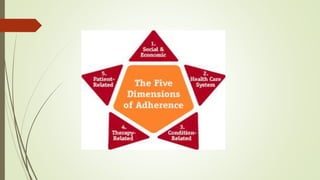
Adherence is a multidimensional phenomenon determined by the interplay of five
sets of factors, termed “dimensions” by the world health organization:
1. Social /economics factors.
2. Provider-patient/health care system factors.
3. Condition-related factors.
4. Therapy-related factors.
5. Patient-related factors
SOCIALAND ECONOMICS DIMENSION
ď‚´ Limited English language proficiency
ď‚´ Low health literacy
ď‚´ Lack of family or social support network.
ď‚´ Unstable living conditions ; homelessness
ď‚´ Burdensome schedule
ď‚´ Limited access to health care facilities
ď‚´ Medication cost
ď‚´ Elder abuse
ď‚´ Inability or difficulty accessing pharmacy.
ď‚´ Cultural and lay beliefs about illness and treatment.
HEALTH CARE SYSTEM DIMENSION
ď‚´ Provider-patient relationship.
ď‚´ Provider communication skills(contributing to lack of knowledge or
understanding of the treatment regimen).
ď‚´ Disparity between the health beliefs of the healthcare provider and those of the
patient.
ď‚´ Lack of positive reinforcement from the healthcare provider.
ď‚´ Weak capacity of the system to educate patients and provide follow-up.
ď‚´ Lack of knowledge on adherence and of effective interventions for improving it.
ď‚´ Patient information materials written at too high literacy level.
ď‚´ High drug cost
ď‚´ Poor access or missed appointments
ď‚´ Long wait times
ď‚´ Lack of continuity of care
ď‚´ Restricted formularies; changing medications covered on formularies.
CONDITION-RELATED DIMENSION
ď‚´ Chronic conditions
ď‚´ Lack of symptoms
ď‚´ Severity of symptoms
ď‚´ Depression
ď‚´ Psychotic disorders
ď‚´ Mental retardation/developmental disability
THERAPY-RELATED DIMENSION
ď‚´ Complexity of medication regimen( number of daily doses ; number of concurrent
medications)
ď‚´ Treatment requires mastery of certain techniques(injections , inhalers)
ď‚´ Duration of therapy
ď‚´ Frequent changes in medication regimen
ď‚´ Lack of immediate benefit of therapy
ď‚´ Medications with social stigma attached to use
ď‚´ Actual or perceived unpleasant side effects.
ď‚´ Treatment interferes with lifestyle or requires significant behavioural changes.
PATIENT-RELATED DIMENSION
ď‚´ PHYSICAL FACTORS:
ď‚´ Visual impairment
ď‚´ Hearing impairment
ď‚´ Cognitive impairment
ď‚´ Impaired mobility or dexterity
ď‚´ Swallowing problems
ď‚´ PSYCHOLOGICAL/BEHAVIORAL FACTORS:
ď‚´ Knowledge about disease
ď‚´ Perceived risk/susceptibility to disease
ď‚´ Understanding reason medication is needed
ď‚´ Expectations or attitude toward treatment
ď‚´ Motivation
ď‚´ Fear of possible adverse effects
ď‚´ Fear of dependence
ď‚´ Psychological stress, anxiety, anger
ď‚´ Alcohol or substance abuse
ROLE OF PHARMACISTS IN MEDICATION ADHERENCE
ď‚´ Be friendly and approachable to the patient
ď‚´ Improve communication skills
ď‚´ Take into account the spiritual and psychological needs of the patient
ď‚´ Improve in patient education
ď‚´ Encourage the patient to discuss their main concern without interruption or
premature closing.
ď‚´ Elicit the patient perception of the illness and the associated feelings and
expectations.
ď‚´ Learning methods of active listening and empathy.
ď‚´ Give clear explanation(regarding disease and drugs)
ď‚´ Check the patient understanding.
ď‚´ Simplify the therapeutic regimen.
ď‚´ Monitor the side effects
ď‚´ Monitor the beneficial effects.
ď‚´ Speak the same language of patient.
ď‚´ Involvement of the patient treatment discussion.
THANK YOU

Medication adherence,

  • 1.
  • 2.
    ď‚´ Definition ď‚´ Factorsaffecting medication adherence ď‚´ Role of pharmacist in improving the adherence.
  • 3.
    MEDICATION ADHERENCE  Definedby the World Health Organization as “ the extent to which a persons behaviour taking medication…corresponds with agreed recommendations from a health care provider”  Adherence : Patient participation in treatment as a shared decision- making process.The patient is under no compulsion to accept a particular treatment.
  • 4.
    FACTORS AFFECTING MEDICATIONADHERENCE ď‚´ Age ang Gender of the patient ď‚´ Income ď‚´ Education ď‚´ Patient intelligence ď‚´ Knowledge about the disease ď‚´ Illness being treated. Actual seriousness of disease ď‚´ Actual efficiency of the treatment ď‚´ Marital state ď‚´ Number of people in household. ď‚´ Therapeutic regimen ď‚´ Clinical settings
  • 5.
    Adherence is amultidimensional phenomenon determined by the interplay of five sets of factors, termed “dimensions” by the world health organization: 1. Social /economics factors. 2. Provider-patient/health care system factors. 3. Condition-related factors. 4. Therapy-related factors. 5. Patient-related factors
  • 7.
    SOCIALAND ECONOMICS DIMENSION ď‚´Limited English language proficiency ď‚´ Low health literacy ď‚´ Lack of family or social support network. ď‚´ Unstable living conditions ; homelessness ď‚´ Burdensome schedule ď‚´ Limited access to health care facilities ď‚´ Medication cost ď‚´ Elder abuse ď‚´ Inability or difficulty accessing pharmacy. ď‚´ Cultural and lay beliefs about illness and treatment.
  • 8.
    HEALTH CARE SYSTEMDIMENSION ď‚´ Provider-patient relationship. ď‚´ Provider communication skills(contributing to lack of knowledge or understanding of the treatment regimen). ď‚´ Disparity between the health beliefs of the healthcare provider and those of the patient. ď‚´ Lack of positive reinforcement from the healthcare provider. ď‚´ Weak capacity of the system to educate patients and provide follow-up. ď‚´ Lack of knowledge on adherence and of effective interventions for improving it.
  • 9.
    ď‚´ Patient informationmaterials written at too high literacy level. ď‚´ High drug cost ď‚´ Poor access or missed appointments ď‚´ Long wait times ď‚´ Lack of continuity of care ď‚´ Restricted formularies; changing medications covered on formularies.
  • 10.
    CONDITION-RELATED DIMENSION ď‚´ Chronicconditions ď‚´ Lack of symptoms ď‚´ Severity of symptoms ď‚´ Depression ď‚´ Psychotic disorders ď‚´ Mental retardation/developmental disability
  • 11.
    THERAPY-RELATED DIMENSION ď‚´ Complexityof medication regimen( number of daily doses ; number of concurrent medications) ď‚´ Treatment requires mastery of certain techniques(injections , inhalers) ď‚´ Duration of therapy ď‚´ Frequent changes in medication regimen ď‚´ Lack of immediate benefit of therapy ď‚´ Medications with social stigma attached to use ď‚´ Actual or perceived unpleasant side effects. ď‚´ Treatment interferes with lifestyle or requires significant behavioural changes.
  • 12.
    PATIENT-RELATED DIMENSION ď‚´ PHYSICALFACTORS: ď‚´ Visual impairment ď‚´ Hearing impairment ď‚´ Cognitive impairment ď‚´ Impaired mobility or dexterity ď‚´ Swallowing problems
  • 13.
    ď‚´ PSYCHOLOGICAL/BEHAVIORAL FACTORS: ď‚´Knowledge about disease ď‚´ Perceived risk/susceptibility to disease ď‚´ Understanding reason medication is needed ď‚´ Expectations or attitude toward treatment ď‚´ Motivation ď‚´ Fear of possible adverse effects ď‚´ Fear of dependence ď‚´ Psychological stress, anxiety, anger ď‚´ Alcohol or substance abuse
  • 14.
    ROLE OF PHARMACISTSIN MEDICATION ADHERENCE ď‚´ Be friendly and approachable to the patient ď‚´ Improve communication skills ď‚´ Take into account the spiritual and psychological needs of the patient ď‚´ Improve in patient education ď‚´ Encourage the patient to discuss their main concern without interruption or premature closing. ď‚´ Elicit the patient perception of the illness and the associated feelings and expectations. ď‚´ Learning methods of active listening and empathy.
  • 15.
    ď‚´ Give clearexplanation(regarding disease and drugs) ď‚´ Check the patient understanding. ď‚´ Simplify the therapeutic regimen. ď‚´ Monitor the side effects ď‚´ Monitor the beneficial effects. ď‚´ Speak the same language of patient. ď‚´ Involvement of the patient treatment discussion.
  • 16.