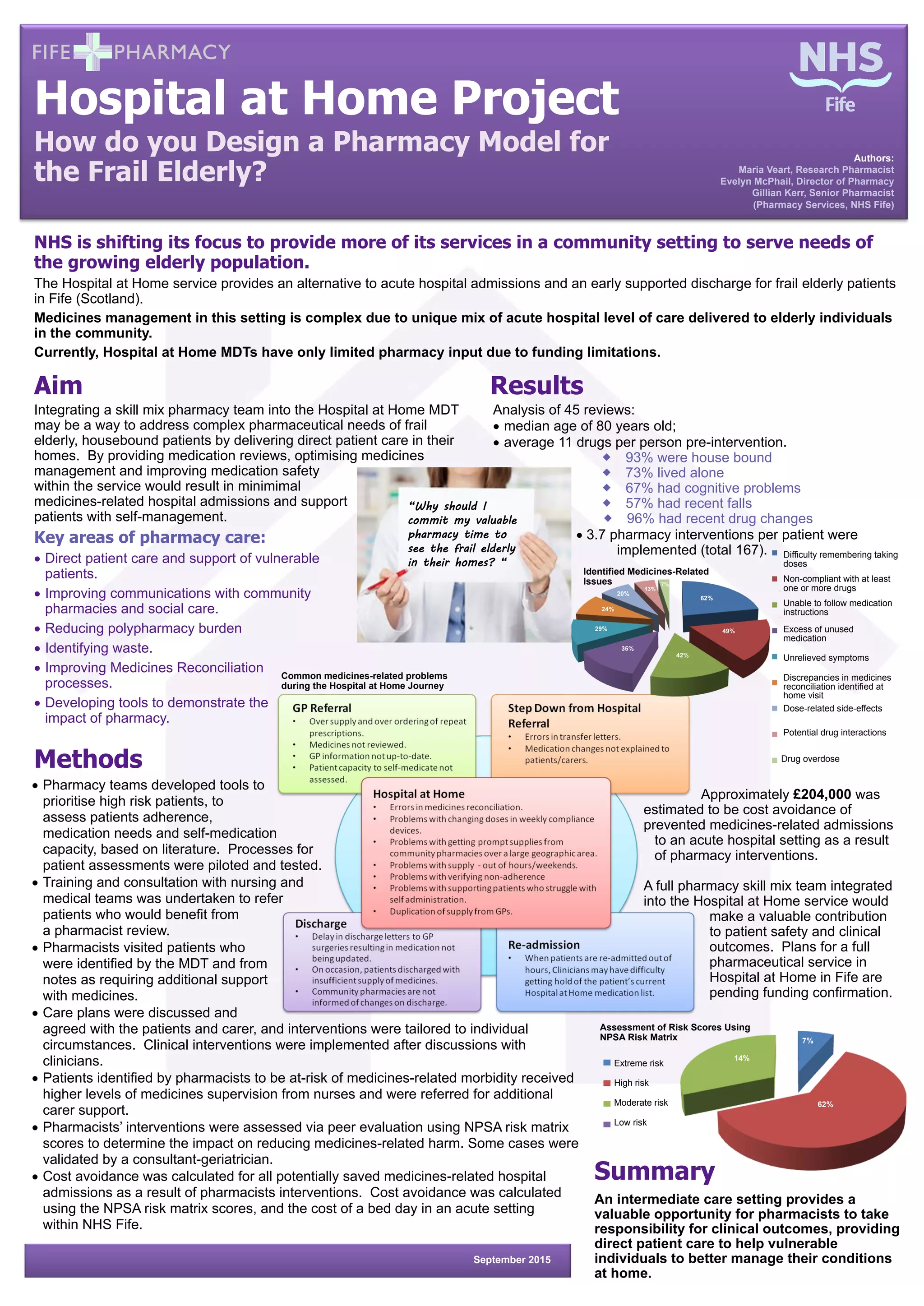
ResultsAim
Methods
Authors:
Maria Veart, Research Pharmacist
Evelyn McPhail, Director of Pharmacy
Gillian Kerr, Senior Pharmacist
(Pharmacy Services, NHS Fife)
NHS is shifting its focus to provide more of its services in a community setting to serve needs of
the growing elderly population.
The Hospital at Home service provides an alternative to acute hospital admissions and an early supported discharge for frail elderly patients
in Fife (Scotland).
Medicines management in this setting is complex due to unique mix of acute hospital level of care delivered to elderly individuals
in the community.
Currently, Hospital at Home MDTs have only limited pharmacy input due to funding limitations.
Assessment of Risk Scores Using
NPSA Risk Matrix 7%
62%
14%
Integrating a skill mix pharmacy team into the Hospital at Home MDT
may be a way to address complex pharmaceutical needs of frail
elderly, housebound patients by delivering direct patient care in their
homes. By providing medication reviews, optimising medicines
management and improving medication safety
within the service would result in minimimal
medicines-related hospital admissions and support
patients with self-management.
Key areas of pharmacy care:
 Direct patient care and support of vulnerable
patients.
 Improving communications with community
pharmacies and social care.
 Reducing polypharmacy burden
 Identifying waste.
 Improving Medicines Reconciliation
processes.
 Developing tools to demonstrate the
impact of pharmacy.
An intermediate care setting provides a
valuable opportunity for pharmacists to take
responsibility for clinical outcomes, providing
direct patient care to help vulnerable
individuals to better manage their conditions
at home.
 Pharmacy teams developed tools to
prioritise high risk patients, to
assess patients adherence,
medication needs and self-medication
capacity, based on literature. Processes for
patient assessments were piloted and tested.
 Training and consultation with nursing and
medical teams was undertaken to refer
patients who would benefit from
a pharmacist review.
 Pharmacists visited patients who
were identified by the MDT and from
notes as requiring additional support
with medicines.
 Care plans were discussed and
agreed with the patients and carer, and interventions were tailored to individual
circumstances. Clinical interventions were implemented after discussions with
clinicians.
 Patients identified by pharmacists to be at-risk of medicines-related morbidity received
higher levels of medicines supervision from nurses and were referred for additional
carer support.
 Pharmacists’ interventions were assessed via peer evaluation using NPSA risk matrix
scores to determine the impact on reducing medicines-related harm. Some cases were
validated by a consultant-geriatrician.
 Cost avoidance was calculated for all potentially saved medicines-related hospital
admissions as a result of pharmacists interventions. Cost avoidance was calculated
using the NPSA risk matrix scores, and the cost of a bed day in an acute setting
within NHS Fife.
Common medicines-related problems
during the Hospital at Home Journey
Identified Medicines-Related
Issues
Approximately £204,000 was
estimated to be cost avoidance of
prevented medicines-related admissions
to an acute hospital setting as a result
of pharmacy interventions.
A full pharmacy skill mix team integrated
into the Hospital at Home service would
make a valuable contribution
to patient safety and clinical
outcomes. Plans for a full
pharmaceutical service in
Hospital at Home in Fife are
pending funding confirmation.
Summary
Analysis of 45 reviews:
 median age of 80 years old;
 average 11 drugs per person pre-intervention.
93% were house bound
73% lived alone
67% had cognitive problems
57% had recent falls
96% had recent drug changes
 3.7 pharmacy interventions per patient were
implemented (total 167). Difficulty remembering taking
doses
Non-compliant with at least
one or more drugs
Unable to follow medication
instructions
Excess of unused
medication
Unrelieved symptoms
Discrepancies in medicines
reconciliation identified at
home visit
Dose-related side-effects
Potential drug interactions
Drug overdose
62%
49%
42%
35%
29%
24%
20%
13%
7%
Extreme risk
High risk
Moderate risk
Low risk
September 2015
“Why should I
commit my valuable
pharmacy time to
see the frail elderly
in their homes? “
Hospital at Home Project
How do you Design a Pharmacy Model for
the Frail Elderly?

Hospital at Home poster- final

  • 1.
    ResultsAim Methods Authors: Maria Veart, ResearchPharmacist Evelyn McPhail, Director of Pharmacy Gillian Kerr, Senior Pharmacist (Pharmacy Services, NHS Fife) NHS is shifting its focus to provide more of its services in a community setting to serve needs of the growing elderly population. The Hospital at Home service provides an alternative to acute hospital admissions and an early supported discharge for frail elderly patients in Fife (Scotland). Medicines management in this setting is complex due to unique mix of acute hospital level of care delivered to elderly individuals in the community. Currently, Hospital at Home MDTs have only limited pharmacy input due to funding limitations. Assessment of Risk Scores Using NPSA Risk Matrix 7% 62% 14% Integrating a skill mix pharmacy team into the Hospital at Home MDT may be a way to address complex pharmaceutical needs of frail elderly, housebound patients by delivering direct patient care in their homes. By providing medication reviews, optimising medicines management and improving medication safety within the service would result in minimimal medicines-related hospital admissions and support patients with self-management. Key areas of pharmacy care:  Direct patient care and support of vulnerable patients.  Improving communications with community pharmacies and social care.  Reducing polypharmacy burden  Identifying waste.  Improving Medicines Reconciliation processes.  Developing tools to demonstrate the impact of pharmacy. An intermediate care setting provides a valuable opportunity for pharmacists to take responsibility for clinical outcomes, providing direct patient care to help vulnerable individuals to better manage their conditions at home.  Pharmacy teams developed tools to prioritise high risk patients, to assess patients adherence, medication needs and self-medication capacity, based on literature. Processes for patient assessments were piloted and tested.  Training and consultation with nursing and medical teams was undertaken to refer patients who would benefit from a pharmacist review.  Pharmacists visited patients who were identified by the MDT and from notes as requiring additional support with medicines.  Care plans were discussed and agreed with the patients and carer, and interventions were tailored to individual circumstances. Clinical interventions were implemented after discussions with clinicians.  Patients identified by pharmacists to be at-risk of medicines-related morbidity received higher levels of medicines supervision from nurses and were referred for additional carer support.  Pharmacists’ interventions were assessed via peer evaluation using NPSA risk matrix scores to determine the impact on reducing medicines-related harm. Some cases were validated by a consultant-geriatrician.  Cost avoidance was calculated for all potentially saved medicines-related hospital admissions as a result of pharmacists interventions. Cost avoidance was calculated using the NPSA risk matrix scores, and the cost of a bed day in an acute setting within NHS Fife. Common medicines-related problems during the Hospital at Home Journey Identified Medicines-Related Issues Approximately £204,000 was estimated to be cost avoidance of prevented medicines-related admissions to an acute hospital setting as a result of pharmacy interventions. A full pharmacy skill mix team integrated into the Hospital at Home service would make a valuable contribution to patient safety and clinical outcomes. Plans for a full pharmaceutical service in Hospital at Home in Fife are pending funding confirmation. Summary Analysis of 45 reviews:  median age of 80 years old;  average 11 drugs per person pre-intervention. 93% were house bound 73% lived alone 67% had cognitive problems 57% had recent falls 96% had recent drug changes  3.7 pharmacy interventions per patient were implemented (total 167). Difficulty remembering taking doses Non-compliant with at least one or more drugs Unable to follow medication instructions Excess of unused medication Unrelieved symptoms Discrepancies in medicines reconciliation identified at home visit Dose-related side-effects Potential drug interactions Drug overdose 62% 49% 42% 35% 29% 24% 20% 13% 7% Extreme risk High risk Moderate risk Low risk September 2015 “Why should I commit my valuable pharmacy time to see the frail elderly in their homes? “ Hospital at Home Project How do you Design a Pharmacy Model for the Frail Elderly?