VIRTUAL BASE CLASS
AND
VIRTUAL FUNCTION
Need for Virtual Base Classes
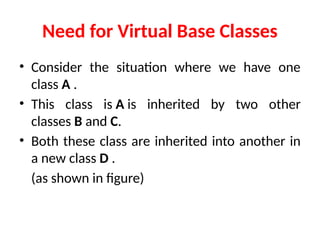
• Consider the situation where we have one
class A .
• This class is A is inherited by two other
classes B and C.
• Both these class are inherited into another in
a new class D .
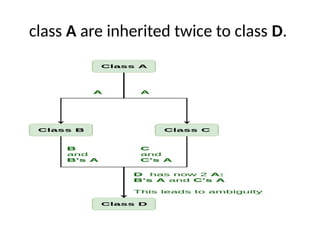
(as shown in figure)
class A are inherited twice to class D.
• data members/function of class A are inherited
twice to class D.
• One through class B and second through
class C.
• When any data / function member of class A is
accessed by an object of class D, ambiguity
arises
• which data/function member would be called?
One inherited through B or the other inherited
through C.
• This confuses compiler and it displays error.
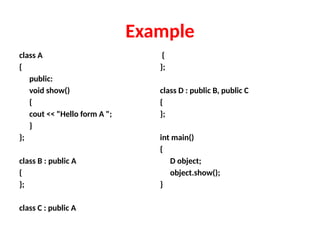
Example
class A
{
public:
void show()
{
cout << "Hello form A ";
}
};
class B : public A
{
};
class C : public A
{
};
class D : public B, public C
{
};
int main()
{
D object;
object.show();
}
How to resolve this issue?
• To resolve this ambiguity when class A is
inherited in both class B and class C, it is
declared as virtual base class by placing a
keyword virtual as :
• Syntax for Virtual Base Classes:
• Syntax 1: class B : virtual public A { };
Syntax 2: class C : public virtual A { };
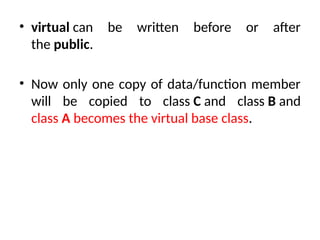
• virtual can be written before or after
the public.
• Now only one copy of data/function member
will be copied to class C and class B and
class A becomes the virtual base class.
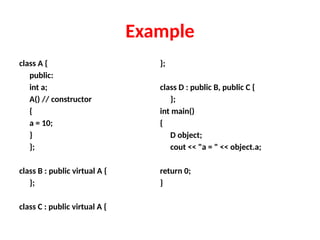
Example
class A {
public:
int a;
A() // constructor
{
a = 10;
}
};
class B : public virtual A {
};
class C : public virtual A {
};
class D : public B, public C {
};
int main()
{
D object;
cout << "a = " << object.a;
return 0;
}
Pointers to Derived Classes
• C++ allows a pointer in base class to point to
either base class object or to any derived class
object.
• Pointer declared as a pointer to base class can
also be pointer to derived class.
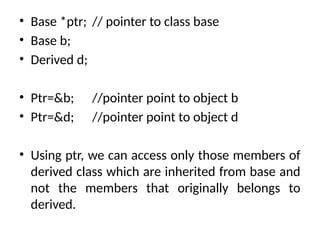
• Base *ptr; // pointer to class base
• Base b;
• Derived d;
• Ptr=&b; //pointer point to object b
• Ptr=&d; //pointer point to object d
• Using ptr, we can access only those members of
derived class which are inherited from base and
not the members that originally belongs to
derived.
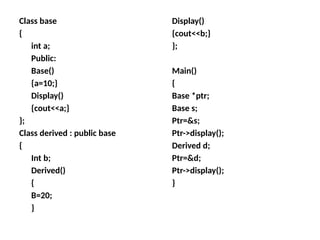
Class base
{
int a;
Public:
Base()
{a=10;}
Display()
{cout<<a;}
};
Class derived : public base
{
Int b;
Derived()
{
B=20;
}
Display()
{cout<<b;}
};
Main()
{
Base *ptr;
Base s;
Ptr=&s;
Ptr->display();
Derived d;
Ptr=&d;
Ptr->display();
}
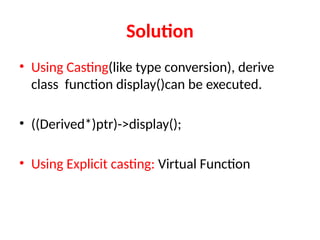
Solution
• Using Casting(like type conversion), derive
class function display()can be executed.
• ((Derived*)ptr)->display();
• Using Explicit casting: Virtual Function
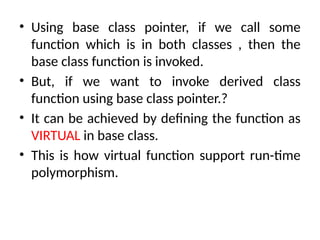
• Using base class pointer, if we call some
function which is in both classes , then the
base class function is invoked.
• But, if we want to invoke derived class
function using base class pointer.?
• It can be achieved by defining the function as
VIRTUAL in base class.
• This is how virtual function support run-time
polymorphism.
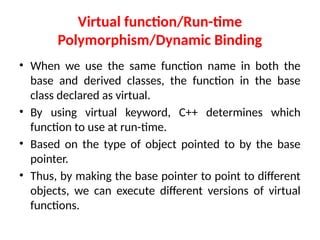
Virtual function/Run-time
Polymorphism/Dynamic Binding
• When we use the same function name in both the
base and derived classes, the function in the base
class declared as virtual.
• By using virtual keyword, C++ determines which
function to use at run-time.
• Based on the type of object pointed to by the base
pointer.
• Thus, by making the base pointer to point to different
objects, we can execute different versions of virtual
functions.
Run-time polymorphism
• C++ supports a mechanism called virtual
function to achieve run-time polymorphism.
• At run-time, when it is known what class
objects are under consideration, the
appropriate version of the function is invoked.
• Since, the function is linked with a particular
class much later after the compilation, this
process is termed as late binding or dynamic
binding.
Early binding/static binding/compile time
binding
• When a compiler is able to select the
appropriate function for a particular call at the
compile-time, then this is called early binding
or static binding or compile time
polymorphism.
class base
{
public:
void display()
{
cout<<“base class displayn”;
}
virtual void show()
{
cout<<“base class shown”;
}
};
Class derived:public base
{
public:
void display()
{
cout<<“derived class displayn”;
}
virtual void show()
{
cout<<“derived class shown”;
}
};
int main()
{
base b,*ptr;
derived d;
ptr=&b;
ptr->display();
ptr->show();
ptr=&d;
ptr->display();
ptr->show();
return 0;
}

6. Virtual base class.pptx and virtual function

  • 1.
  • 2.
    Need for VirtualBase Classes • Consider the situation where we have one class A . • This class is A is inherited by two other classes B and C. • Both these class are inherited into another in a new class D . (as shown in figure)
  • 3.
    class A areinherited twice to class D.
  • 4.
    • data members/functionof class A are inherited twice to class D. • One through class B and second through class C. • When any data / function member of class A is accessed by an object of class D, ambiguity arises • which data/function member would be called? One inherited through B or the other inherited through C. • This confuses compiler and it displays error.
  • 5.
    Example class A { public: void show() { cout<< "Hello form A "; } }; class B : public A { }; class C : public A { }; class D : public B, public C { }; int main() { D object; object.show(); }
  • 6.
    How to resolvethis issue? • To resolve this ambiguity when class A is inherited in both class B and class C, it is declared as virtual base class by placing a keyword virtual as : • Syntax for Virtual Base Classes: • Syntax 1: class B : virtual public A { }; Syntax 2: class C : public virtual A { };
  • 7.
    • virtual canbe written before or after the public. • Now only one copy of data/function member will be copied to class C and class B and class A becomes the virtual base class.
  • 8.
    Example class A { public: inta; A() // constructor { a = 10; } }; class B : public virtual A { }; class C : public virtual A { }; class D : public B, public C { }; int main() { D object; cout << "a = " << object.a; return 0; }
  • 9.
    Pointers to DerivedClasses • C++ allows a pointer in base class to point to either base class object or to any derived class object. • Pointer declared as a pointer to base class can also be pointer to derived class.
  • 10.
    • Base *ptr;// pointer to class base • Base b; • Derived d; • Ptr=&b; //pointer point to object b • Ptr=&d; //pointer point to object d • Using ptr, we can access only those members of derived class which are inherited from base and not the members that originally belongs to derived.
  • 11.
    Class base { int a; Public: Base() {a=10;} Display() {cout<<a;} }; Classderived : public base { Int b; Derived() { B=20; } Display() {cout<<b;} }; Main() { Base *ptr; Base s; Ptr=&s; Ptr->display(); Derived d; Ptr=&d; Ptr->display(); }
  • 12.
    Solution • Using Casting(liketype conversion), derive class function display()can be executed. • ((Derived*)ptr)->display(); • Using Explicit casting: Virtual Function
  • 13.
    • Using baseclass pointer, if we call some function which is in both classes , then the base class function is invoked. • But, if we want to invoke derived class function using base class pointer.? • It can be achieved by defining the function as VIRTUAL in base class. • This is how virtual function support run-time polymorphism.
  • 14.
    Virtual function/Run-time Polymorphism/Dynamic Binding •When we use the same function name in both the base and derived classes, the function in the base class declared as virtual. • By using virtual keyword, C++ determines which function to use at run-time. • Based on the type of object pointed to by the base pointer. • Thus, by making the base pointer to point to different objects, we can execute different versions of virtual functions.
  • 15.
    Run-time polymorphism • C++supports a mechanism called virtual function to achieve run-time polymorphism. • At run-time, when it is known what class objects are under consideration, the appropriate version of the function is invoked. • Since, the function is linked with a particular class much later after the compilation, this process is termed as late binding or dynamic binding.
  • 16.
    Early binding/static binding/compiletime binding • When a compiler is able to select the appropriate function for a particular call at the compile-time, then this is called early binding or static binding or compile time polymorphism.
  • 17.
    class base { public: void display() { cout<<“baseclass displayn”; } virtual void show() { cout<<“base class shown”; } }; Class derived:public base { public: void display() { cout<<“derived class displayn”; } virtual void show() { cout<<“derived class shown”; } }; int main() { base b,*ptr; derived d; ptr=&b; ptr->display(); ptr->show(); ptr=&d; ptr->display(); ptr->show(); return 0; }