SOLUTION
POLY-MER STABILIZATION
Problems in road
o Deterioration of road (fatigue loading)
o Corrugation
o Potholes
o Rutting
All these factors suggest modifications to original soil-stabilization is
necessary in order to meet critical needs of pavements today
Question is
Uptill now, have we able to find any material that can alleviate these issues?
Why Poly-mer??
 Conventional soil-stabilization proved susceptible to sulphate
attack
 Proved inappropriate for clayey soils
 Containing excessive fines(>35% passing the no. 200 sieve)
 High plasticity(P.I.>10)
 Tests by renown laboratory, full-scale test pavements and in-
service pavements have confirmed the suitability of various
polymer products solution as a modifier.
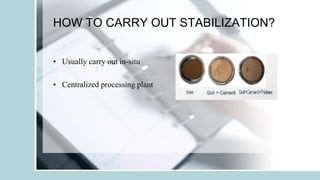
HOW TO CARRY OUT STABILIZATION?
• Usually carry out in-situ
• Centralized processing plant
STABILIZATION TECHNIQUE
 Stabilization agent preserves strength of water susceptible gravels
by creating a hydrophobic soil matrix between the stones which
reduce permeability and limits water ingress(external water
proofing).
 Softening and lubricating effect of any moisture that does enter the
pavement is much reduced (internal water proofing)
How polymer modify soil-stabilization??
Increase modulus of elasticity through connecting cement coated
soil particles by numerous ‘micro-rubber bands’
Prevent penetration and capillary rise of water within soil
stabilization.
Poly-mer compatibility measures
Polymer should be;
 Water based
 Non-toxic
 Non-flammable
 Economically preventive or EPA compliant
Comparison
• Traditional Road Design Polymer Stabilized Road
Key benefits
 Fatigue crack reduction
 Shrinkage crack reduction
 Water proofing
 Increase compressive strength
 Increased tensile strength
 Increased resilient modulus
 Long life
Key benefits
 Following are some of its benefits;
 Reduce the need of bitumen by around 10%
 Substantial reduction in construction time
 Significant reduction in material
 Efficient and rapid construction
 Environmentally sound
 Reduces susceptibility to water
 Long life

Polymer Stablization

  • 1.
  • 2.
    Problems in road oDeterioration of road (fatigue loading) o Corrugation o Potholes o Rutting All these factors suggest modifications to original soil-stabilization is necessary in order to meet critical needs of pavements today Question is Uptill now, have we able to find any material that can alleviate these issues?
  • 3.
    Why Poly-mer??  Conventionalsoil-stabilization proved susceptible to sulphate attack  Proved inappropriate for clayey soils  Containing excessive fines(>35% passing the no. 200 sieve)  High plasticity(P.I.>10)  Tests by renown laboratory, full-scale test pavements and in- service pavements have confirmed the suitability of various polymer products solution as a modifier.
  • 4.
    HOW TO CARRYOUT STABILIZATION? • Usually carry out in-situ • Centralized processing plant
  • 5.
    STABILIZATION TECHNIQUE  Stabilizationagent preserves strength of water susceptible gravels by creating a hydrophobic soil matrix between the stones which reduce permeability and limits water ingress(external water proofing).  Softening and lubricating effect of any moisture that does enter the pavement is much reduced (internal water proofing)
  • 6.
    How polymer modifysoil-stabilization?? Increase modulus of elasticity through connecting cement coated soil particles by numerous ‘micro-rubber bands’ Prevent penetration and capillary rise of water within soil stabilization.
  • 7.
    Poly-mer compatibility measures Polymershould be;  Water based  Non-toxic  Non-flammable  Economically preventive or EPA compliant
  • 8.
    Comparison • Traditional RoadDesign Polymer Stabilized Road
  • 9.
    Key benefits  Fatiguecrack reduction  Shrinkage crack reduction  Water proofing  Increase compressive strength  Increased tensile strength  Increased resilient modulus  Long life
  • 10.
    Key benefits  Followingare some of its benefits;  Reduce the need of bitumen by around 10%  Substantial reduction in construction time  Significant reduction in material  Efficient and rapid construction  Environmentally sound  Reduces susceptibility to water  Long life