*
by: JAVIER CANALES
WHAT IS POLLUTION?
*Pollution is the introduction of

contaminants into the natural environment
that cause adverse change.[1] Pollution can
take the form of chemical
substances or energy, such as noise, heat
or light. Pollutants, the components of
pollution, can be either foreign
substances/energies or naturally occurring
contaminants. Pollution is often classed
as point source or nonpoint source
pollution.
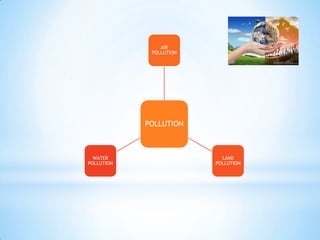
AIR
POLLUTION

POLLUTION

WATER
POLLUTION

LAND
POLLUTION
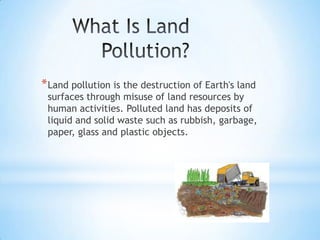
* Land pollution is the destruction of Earth's land

surfaces through misuse of land resources by
human activities. Polluted land has deposits of
liquid and solid waste such as rubbish, garbage,
paper, glass and plastic objects.
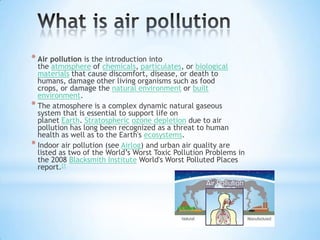
* Air pollution is the introduction into

the atmosphere of chemicals, particulates, or biological
materials that cause discomfort, disease, or death to
humans, damage other living organisms such as food
crops, or damage the natural environment or built
environment.
* The atmosphere is a complex dynamic natural gaseous
system that is essential to support life on
planet Earth. Stratospheric ozone depletion due to air
pollution has long been recognized as a threat to human
health as well as to the Earth's ecosystems.
* Indoor air pollution (see Airlog) and urban air quality are
listed as two of the World’s Worst Toxic Pollution Problems in
the 2008 Blacksmith Institute World's Worst Polluted Places
report.[1
*
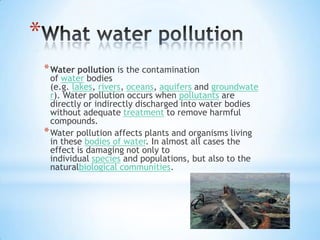
* Water pollution is the contamination

of water bodies
(e.g. lakes, rivers, oceans, aquifers and groundwate
r). Water pollution occurs when pollutants are
directly or indirectly discharged into water bodies
without adequate treatment to remove harmful
compounds.
* Water pollution affects plants and organisms living
in these bodies of water. In almost all cases the
effect is damaging not only to
individual species and populations, but also to the
naturalbiological communities.

Pollution

  • 1.
  • 2.
    WHAT IS POLLUTION? *Pollutionis the introduction of contaminants into the natural environment that cause adverse change.[1] Pollution can take the form of chemical substances or energy, such as noise, heat or light. Pollutants, the components of pollution, can be either foreign substances/energies or naturally occurring contaminants. Pollution is often classed as point source or nonpoint source pollution.
  • 3.
  • 4.
    * Land pollutionis the destruction of Earth's land surfaces through misuse of land resources by human activities. Polluted land has deposits of liquid and solid waste such as rubbish, garbage, paper, glass and plastic objects.
  • 5.
    * Air pollutionis the introduction into the atmosphere of chemicals, particulates, or biological materials that cause discomfort, disease, or death to humans, damage other living organisms such as food crops, or damage the natural environment or built environment. * The atmosphere is a complex dynamic natural gaseous system that is essential to support life on planet Earth. Stratospheric ozone depletion due to air pollution has long been recognized as a threat to human health as well as to the Earth's ecosystems. * Indoor air pollution (see Airlog) and urban air quality are listed as two of the World’s Worst Toxic Pollution Problems in the 2008 Blacksmith Institute World's Worst Polluted Places report.[1
  • 6.
    * * Water pollutionis the contamination of water bodies (e.g. lakes, rivers, oceans, aquifers and groundwate r). Water pollution occurs when pollutants are directly or indirectly discharged into water bodies without adequate treatment to remove harmful compounds. * Water pollution affects plants and organisms living in these bodies of water. In almost all cases the effect is damaging not only to individual species and populations, but also to the naturalbiological communities.