What the Duck Is DeFi:
Lending, Borrowing and Farming for Crypto
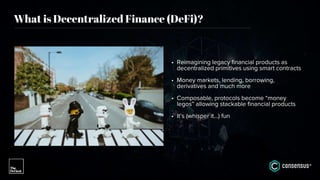
• Reimagining legacy financial products as
decentralized primitives using smart contracts
• Money markets, lending, borrowing,
derivatives and much more
• Composable, protocols become “money
legos” allowing stackable financial products
• It’s (whisper it…) fun
What is Decentralized Finance (DeFi)?
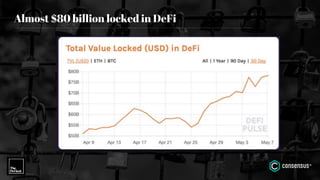
Almost $80 billion locked in DeFi
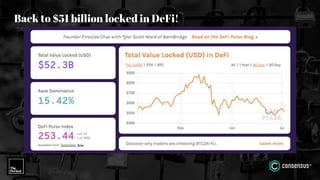
Back to $51 billion locked in DeFi!
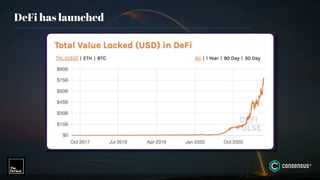
DeFi has launched
DeFi = Open Finance?
• Permissionless
• Trustless
• Decentralized
DeFi Jargon
• Stablecoins
• Wrapping
• AMM
• LP
• Liquidity mining/Farm/
• Impermanent Loss
• Composability
• Layer 2
• Bridge
Stablecoins
• Not ideal in most financial transactions to
use a cryptocurrency that has price
volatility e.g. taking out a loan
• Stablecoins aim to reduce price volatility
(many pegged to USD)
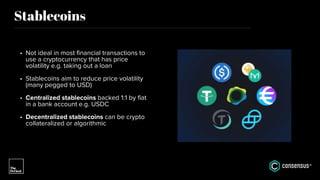
• Centralized stablecoins backed 1:1 by fiat
in a bank account e.g. USDC
• Decentralized stablecoins can be crypto
collateralized or algorithmic
Maker
• Decentralized stablecoin on Ethereum that is
overcollateralized by crypto
• Stablecoin DAI can be minted by anyone through
locking up crypto as collateral to take out a DAI
loan e.g. lock up $200 of ETH to borrow $100 of
DAI
• If price of collateral drops, then assets are seized
and liquidated
• Common use case is leverage
Wrapping
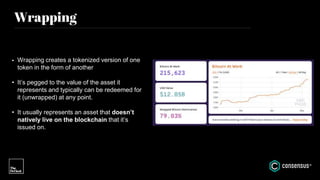
• Wrapping creates a tokenized version of one
token in the form of another
• It’s pegged to the value of the asset it
represents and typically can be redeemed for
it (unwrapped) at any point.
• It usually represents an asset that doesn’t
natively live on the blockchain that it’s
issued on.
Automated Market Maker
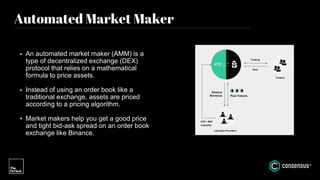
• An automated market maker (AMM) is a
type of decentralized exchange (DEX)
protocol that relies on a mathematical
formula to price assets.
• Instead of using an order book like a
traditional exchange, assets are priced
according to a pricing algorithm.
• Market makers help you get a good price
and tight bid-ask spread on an order book
exchange like Binance.
LP - Liquidity Provider
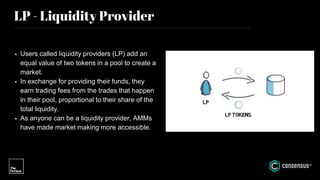
• Users called liquidity providers (LP) add an
equal value of two tokens in a pool to create a
market.
• In exchange for providing their funds, they
earn trading fees from the trades that happen
in their pool, proportional to their share of the
total liquidity.
• As anyone can be a liquidity provider, AMMs
have made market making more accessible.
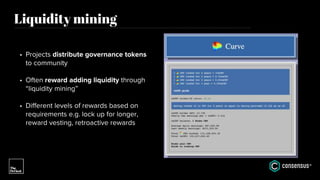
Liquidity mining
• Projects distribute governance tokens
to community
• Often reward adding liquidity through
“liquidity mining”
• Different levels of rewards based on
requirements e.g. lock up for longer,
reward vesting, retroactive rewards
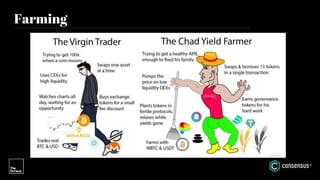
Farming
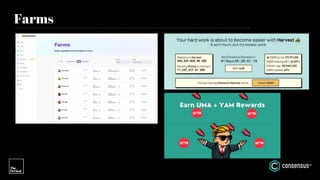
• Staking or locking up cryptocurrencies in return
for rewards.
• Individuals can earn tokens in exchange for
their participation in DeFi applications. Yield
farming can also be called liquidity mining.
• As each new project that emerges offers new
tokens or ways to earn rewards, users have
been flocking to it, hoping to get a cut of the
yield on offer.
• In turn, this creates a demand that pushes up
the value invested in the project and the
tokens.
Farming
Farms
Impermanent Loss
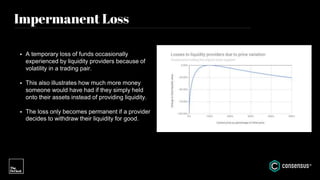
• A temporary loss of funds occasionally
experienced by liquidity providers because of
volatility in a trading pair.
• This also illustrates how much more money
someone would have had if they simply held
onto their assets instead of providing liquidity.
• The loss only becomes permanent if a provider
decides to withdraw their liquidity for good.
Composability
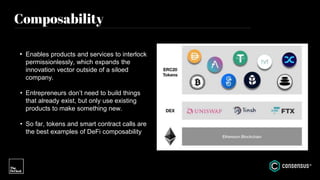
• Enables products and services to interlock
permissionlessly, which expands the
innovation vector outside of a siloed
company.
• Entrepreneurs don’t need to build things
that already exist, but only use existing
products to make something new.
• So far, tokens and smart contract calls are
the best examples of DeFi composability
Layer 2
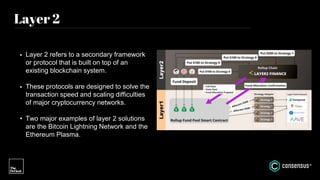
• Layer 2 refers to a secondary framework
or protocol that is built on top of an
existing blockchain system.
• These protocols are designed to solve the
transaction speed and scaling difficulties
of major cryptocurrency networks.
• Two major examples of layer 2 solutions
are the Bitcoin Lightning Network and the
Ethereum Plasma.
Bridge
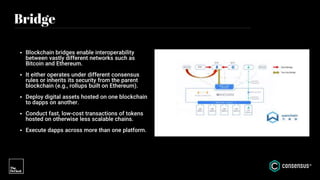
• Blockchain bridges enable interoperability
between vastly different networks such as
Bitcoin and Ethereum.
• It either operates under different consensus
rules or inherits its security from the parent
blockchain (e.g., rollups built on Ethereum).
• Deploy digital assets hosted on one blockchain
to dapps on another.
• Conduct fast, low-cost transactions of tokens
hosted on otherwise less scalable chains.
• Execute dapps across more than one platform.
What can we do with DeFi?
• Lending and Borrowing
• Decentralized Exchanges
• Token governance
• Flash loans
• Composability (Money Legos)
• Magic...
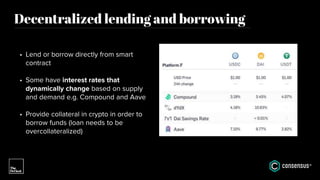
Decentralized lending and borrowing
• Lend or borrow directly from smart
contract
• Some have interest rates that
dynamically change based on supply
and demand e.g. Compound and Aave
• Provide collateral in crypto in order to
borrow funds (loan needs to be
overcollateralized)
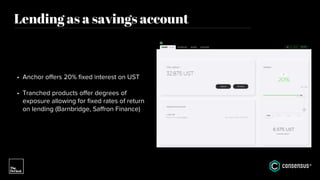
Lending as a savings account
• Anchor offers 20% fixed interest on UST
• Tranched products offer degrees of
exposure allowing for fixed rates of return
on lending (Barnbridge, Saffron Finance)
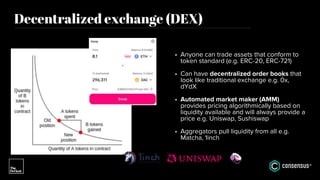
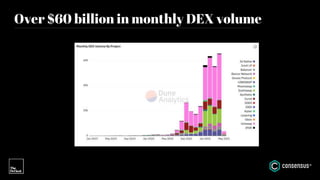
Decentralized exchange (DEX)
• Anyone can trade assets that conform to
token standard (e.g. ERC-20, ERC-721)
• Can have decentralized order books that
look like traditional exchange e.g. 0x,
dYdX
• Automated market maker (AMM)
provides pricing algorithmically based on
liquidity available and will always provide a
price e.g. Uniswap, Sushiswap
• Aggregators pull liquidity from all e.g.
Matcha, 1inch
Over $60 billion in monthly DEX volume
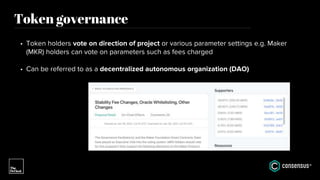
Token governance
• Token holders vote on direction of project or various parameter settings e.g. Maker
(MKR) holders can vote on parameters such as fees charged
• Can be referred to as a decentralized autonomous organization (DAO)
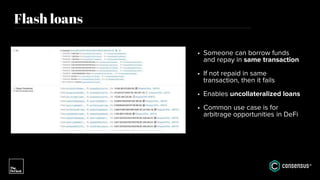
Flash loans
• Someone can borrow funds
and repay in same transaction
• If not repaid in same
transaction, then it fails
• Enables uncollateralized loans
• Common use case is for
arbitrage opportunities in DeFi
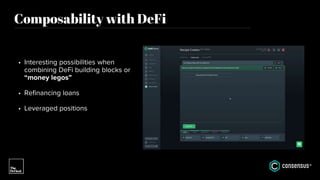
Composability with DeFi
• Interesting possibilities when
combining DeFi building blocks or
“money legos”
• Refinancing loans
• Leveraged positions
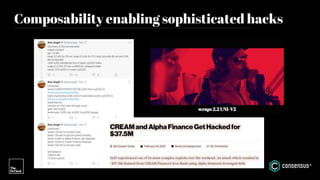
Composability enabling sophisticated hacks
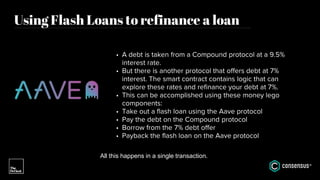
Using Flash Loans to refinance a loan
• A debt is taken from a Compound protocol at a 9.5%
interest rate.
• But there is another protocol that offers debt at 7%
interest. The smart contract contains logic that can
explore these rates and refinance your debt at 7%.
• This can be accomplished using these money lego
components:
• Take out a flash loan using the Aave protocol
• Pay the debt on the Compound protocol
• Borrow from the 7% debt offer
• Payback the flash loan on the Aave protocol
All this happens in a single transaction.
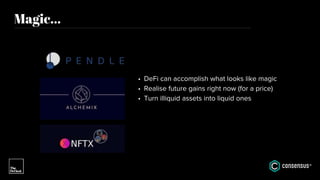
Magic...
• DeFi can accomplish what looks like magic
• Realise future gains right now (for a price)
• Turn illiquid assets into liquid ones
Walk in my shoes
• DefiRate
• Coingecko
• Daily Ape
• Loanscan
• Bankless
• Zapper
We are living in a simulation
Head over to defisaver.com

What the Duck is DeFi

  • 1.
    What the DuckIs DeFi: Lending, Borrowing and Farming for Crypto
  • 2.
    • Reimagining legacyfinancial products as decentralized primitives using smart contracts • Money markets, lending, borrowing, derivatives and much more • Composable, protocols become “money legos” allowing stackable financial products • It’s (whisper it…) fun What is Decentralized Finance (DeFi)?
  • 3.
    Almost $80 billionlocked in DeFi
  • 4.
    Back to $51billion locked in DeFi!
  • 5.
  • 6.
    DeFi = OpenFinance? • Permissionless • Trustless • Decentralized
  • 7.
    DeFi Jargon • Stablecoins •Wrapping • AMM • LP • Liquidity mining/Farm/ • Impermanent Loss • Composability • Layer 2 • Bridge
  • 8.
    Stablecoins • Not idealin most financial transactions to use a cryptocurrency that has price volatility e.g. taking out a loan • Stablecoins aim to reduce price volatility (many pegged to USD) • Centralized stablecoins backed 1:1 by fiat in a bank account e.g. USDC • Decentralized stablecoins can be crypto collateralized or algorithmic
  • 9.
    Maker • Decentralized stablecoinon Ethereum that is overcollateralized by crypto • Stablecoin DAI can be minted by anyone through locking up crypto as collateral to take out a DAI loan e.g. lock up $200 of ETH to borrow $100 of DAI • If price of collateral drops, then assets are seized and liquidated • Common use case is leverage
  • 10.
    Wrapping • Wrapping createsa tokenized version of one token in the form of another • It’s pegged to the value of the asset it represents and typically can be redeemed for it (unwrapped) at any point. • It usually represents an asset that doesn’t natively live on the blockchain that it’s issued on.
  • 11.
    Automated Market Maker •An automated market maker (AMM) is a type of decentralized exchange (DEX) protocol that relies on a mathematical formula to price assets. • Instead of using an order book like a traditional exchange, assets are priced according to a pricing algorithm. • Market makers help you get a good price and tight bid-ask spread on an order book exchange like Binance.
  • 12.
    LP - LiquidityProvider • Users called liquidity providers (LP) add an equal value of two tokens in a pool to create a market. • In exchange for providing their funds, they earn trading fees from the trades that happen in their pool, proportional to their share of the total liquidity. • As anyone can be a liquidity provider, AMMs have made market making more accessible.
  • 13.
    Liquidity mining • Projectsdistribute governance tokens to community • Often reward adding liquidity through “liquidity mining” • Different levels of rewards based on requirements e.g. lock up for longer, reward vesting, retroactive rewards
  • 14.
    Farming • Staking orlocking up cryptocurrencies in return for rewards. • Individuals can earn tokens in exchange for their participation in DeFi applications. Yield farming can also be called liquidity mining. • As each new project that emerges offers new tokens or ways to earn rewards, users have been flocking to it, hoping to get a cut of the yield on offer. • In turn, this creates a demand that pushes up the value invested in the project and the tokens.
  • 15.
  • 16.
  • 17.
    Impermanent Loss • Atemporary loss of funds occasionally experienced by liquidity providers because of volatility in a trading pair. • This also illustrates how much more money someone would have had if they simply held onto their assets instead of providing liquidity. • The loss only becomes permanent if a provider decides to withdraw their liquidity for good.
  • 18.
    Composability • Enables productsand services to interlock permissionlessly, which expands the innovation vector outside of a siloed company. • Entrepreneurs don’t need to build things that already exist, but only use existing products to make something new. • So far, tokens and smart contract calls are the best examples of DeFi composability
  • 19.
    Layer 2 • Layer2 refers to a secondary framework or protocol that is built on top of an existing blockchain system. • These protocols are designed to solve the transaction speed and scaling difficulties of major cryptocurrency networks. • Two major examples of layer 2 solutions are the Bitcoin Lightning Network and the Ethereum Plasma.
  • 20.
    Bridge • Blockchain bridgesenable interoperability between vastly different networks such as Bitcoin and Ethereum. • It either operates under different consensus rules or inherits its security from the parent blockchain (e.g., rollups built on Ethereum). • Deploy digital assets hosted on one blockchain to dapps on another. • Conduct fast, low-cost transactions of tokens hosted on otherwise less scalable chains. • Execute dapps across more than one platform.
  • 21.
    What can wedo with DeFi? • Lending and Borrowing • Decentralized Exchanges • Token governance • Flash loans • Composability (Money Legos) • Magic...
  • 22.
    Decentralized lending andborrowing • Lend or borrow directly from smart contract • Some have interest rates that dynamically change based on supply and demand e.g. Compound and Aave • Provide collateral in crypto in order to borrow funds (loan needs to be overcollateralized)
  • 23.
    Lending as asavings account • Anchor offers 20% fixed interest on UST • Tranched products offer degrees of exposure allowing for fixed rates of return on lending (Barnbridge, Saffron Finance)
  • 24.
    Decentralized exchange (DEX) •Anyone can trade assets that conform to token standard (e.g. ERC-20, ERC-721) • Can have decentralized order books that look like traditional exchange e.g. 0x, dYdX • Automated market maker (AMM) provides pricing algorithmically based on liquidity available and will always provide a price e.g. Uniswap, Sushiswap • Aggregators pull liquidity from all e.g. Matcha, 1inch
  • 25.
    Over $60 billionin monthly DEX volume
  • 26.
    Token governance • Tokenholders vote on direction of project or various parameter settings e.g. Maker (MKR) holders can vote on parameters such as fees charged • Can be referred to as a decentralized autonomous organization (DAO)
  • 27.
    Flash loans • Someonecan borrow funds and repay in same transaction • If not repaid in same transaction, then it fails • Enables uncollateralized loans • Common use case is for arbitrage opportunities in DeFi
  • 28.
    Composability with DeFi •Interesting possibilities when combining DeFi building blocks or “money legos” • Refinancing loans • Leveraged positions
  • 29.
  • 30.
    Using Flash Loansto refinance a loan • A debt is taken from a Compound protocol at a 9.5% interest rate. • But there is another protocol that offers debt at 7% interest. The smart contract contains logic that can explore these rates and refinance your debt at 7%. • This can be accomplished using these money lego components: • Take out a flash loan using the Aave protocol • Pay the debt on the Compound protocol • Borrow from the 7% debt offer • Payback the flash loan on the Aave protocol All this happens in a single transaction.
  • 31.
    Magic... • DeFi canaccomplish what looks like magic • Realise future gains right now (for a price) • Turn illiquid assets into liquid ones
  • 32.
    Walk in myshoes • DefiRate • Coingecko • Daily Ape • Loanscan • Bankless • Zapper
  • 33.
    We are livingin a simulation Head over to defisaver.com