BY: NIHARIKA GARG
CRO0523170
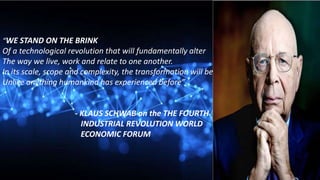
“WE STAND ON THE BRINK
Of a technological revolution that will fundamentally alter
The way we live, work and relate to one another.
In its scale, scope and complexity, the transformation will be
Unlike anything humankind has experienced before”
- KLAUS SCHWAB on the THE FOURTH
INDUSTRIAL REVOLUTION WORLD
ECONOMIC FORUM
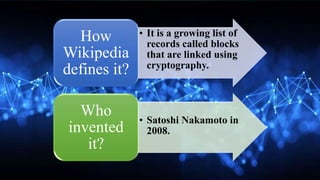
• It is a growing list of
records called blocks
that are linked using
cryptography.
How
Wikipedia
defines it?
• Satoshi Nakamoto in
2008.
Who
invented
it?
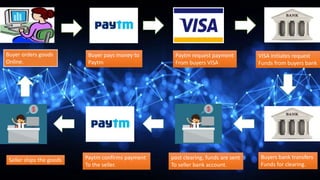
Buyer orders goods
Online.
Buyer pays money to
Paytm
Paytm request payment
From buyers VISA
VISA initiates request
Funds from buyers bank
Buyers bank transfers
Funds for clearing.
post clearing, funds are sent
To seller bank account.
Paytm confirms payment
To the seller.
Seller ships the goods
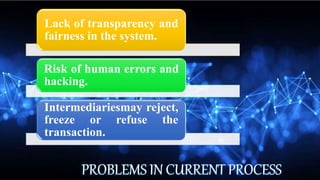
Lack of transparency and
fairness in the system.
Risk of human errors and
hacking.
Intermediariesmay reject,
freeze or refuse the
transaction.
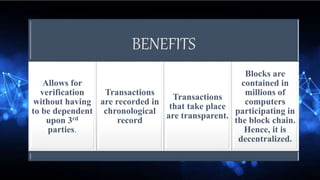
BENEFITS
Allows for
verification
without having
to be dependent
upon 3rd
parties.
Transactions
are recorded in
chronological
record
Transactions
that take place
are transparent.
Blocks are
contained in
millions of
computers
participating in
the block chain.
Hence, it is
decentralized.
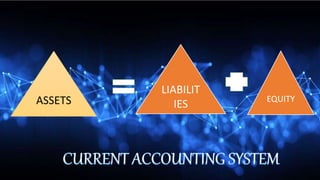
ASSETS
LIABILIT
IES EQUITY
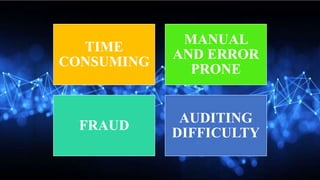
TIME
CONSUMING
MANUAL
AND ERROR
PRONE
FRAUD
AUDITING
DIFFICULTY
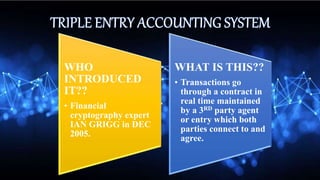
WHO
INTRODUCED
IT??
• Financial
cryptography expert
IAN GRIGG in DEC
2005.
WHAT IS THIS??
• Transactions go
through a contract in
real time maintained
by a 3RD party agent
or entry which both
parties connect to and
agree.
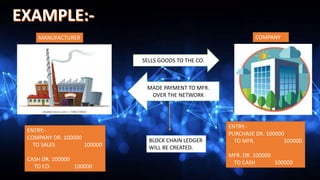
SELLS GOODS TO THE CO.
MADE PAYMENT TO MFR.
OVER THE NETWORK
MANUFACTURER COMPANY
ENTRY:-
COMPANY DR. 100000
TO SALES 100000
CASH DR. 100000
TO CO. 100000
ENTRY:-
PURCHASE DR. 100000
TO MFR. 100000
MFR. DR. 100000
TO CASH 100000
BLOCK CHAIN LEDGER
WILL BE CREATED.
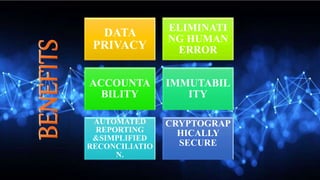
DATA
PRIVACY
ELIMINATI
NG HUMAN
ERROR
ACCOUNTA
BILITY
IMMUTABIL
ITY
AUTOMATED
REPORTING
&SIMPLIFIED
RECONCILIATIO
N.
CRYPTOGRAP
HICALLY
SECURE
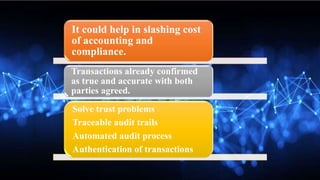
It could help in slashing cost
of accounting and
compliance.
Transactions already confirmed
as true and accurate with both
parties agreed.
Solve trust problems
Traceable audit trails
Automated audit process
Authentication of transactions
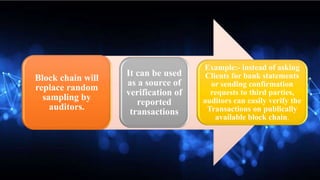
Block chain will
replace random
sampling by
auditors.
It can be used
as a source of
verification of
reported
transactions
Example:- instead of asking
Clients for bank statements
or sending confirmation
requests to third parties,
auditors can easily verify the
Transactions on publically
available block chain.
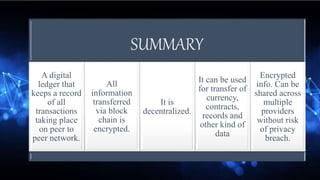
SUMMARY
A digital
ledger that
keeps a record
of all
transactions
taking place
on peer to
peer network.
All
information
transferred
via block
chain is
encrypted.
It is
decentralized.
It can be used
for transfer of
currency,
contracts,
records and
other kind of
data
Encrypted
info. Can be
shared across
multiple
providers
without risk
of privacy
breach.
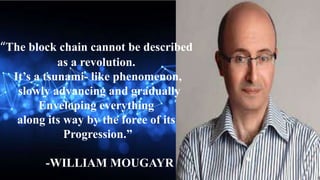
“The block chain cannot be described
as a revolution.
It’s a tsunami- like phenomenon,
slowly advancing and gradually
Enveloping everything
along its way by the force of its
Progression.”
-WILLIAM MOUGAYR
BLOCK CHAIN TECHNOLOGY

BLOCK CHAIN TECHNOLOGY

  • 1.
  • 2.
    “WE STAND ONTHE BRINK Of a technological revolution that will fundamentally alter The way we live, work and relate to one another. In its scale, scope and complexity, the transformation will be Unlike anything humankind has experienced before” - KLAUS SCHWAB on the THE FOURTH INDUSTRIAL REVOLUTION WORLD ECONOMIC FORUM
  • 4.
    • It isa growing list of records called blocks that are linked using cryptography. How Wikipedia defines it? • Satoshi Nakamoto in 2008. Who invented it?
  • 6.
    Buyer orders goods Online. Buyerpays money to Paytm Paytm request payment From buyers VISA VISA initiates request Funds from buyers bank Buyers bank transfers Funds for clearing. post clearing, funds are sent To seller bank account. Paytm confirms payment To the seller. Seller ships the goods
  • 7.
    Lack of transparencyand fairness in the system. Risk of human errors and hacking. Intermediariesmay reject, freeze or refuse the transaction.
  • 10.
    BENEFITS Allows for verification without having tobe dependent upon 3rd parties. Transactions are recorded in chronological record Transactions that take place are transparent. Blocks are contained in millions of computers participating in the block chain. Hence, it is decentralized.
  • 12.
  • 13.
  • 14.
    WHO INTRODUCED IT?? • Financial cryptography expert IANGRIGG in DEC 2005. WHAT IS THIS?? • Transactions go through a contract in real time maintained by a 3RD party agent or entry which both parties connect to and agree.
  • 15.
    SELLS GOODS TOTHE CO. MADE PAYMENT TO MFR. OVER THE NETWORK MANUFACTURER COMPANY ENTRY:- COMPANY DR. 100000 TO SALES 100000 CASH DR. 100000 TO CO. 100000 ENTRY:- PURCHASE DR. 100000 TO MFR. 100000 MFR. DR. 100000 TO CASH 100000 BLOCK CHAIN LEDGER WILL BE CREATED.
  • 16.
  • 18.
    It could helpin slashing cost of accounting and compliance. Transactions already confirmed as true and accurate with both parties agreed. Solve trust problems Traceable audit trails Automated audit process Authentication of transactions
  • 19.
    Block chain will replacerandom sampling by auditors. It can be used as a source of verification of reported transactions Example:- instead of asking Clients for bank statements or sending confirmation requests to third parties, auditors can easily verify the Transactions on publically available block chain.
  • 21.
    SUMMARY A digital ledger that keepsa record of all transactions taking place on peer to peer network. All information transferred via block chain is encrypted. It is decentralized. It can be used for transfer of currency, contracts, records and other kind of data Encrypted info. Can be shared across multiple providers without risk of privacy breach.
  • 22.
    “The block chaincannot be described as a revolution. It’s a tsunami- like phenomenon, slowly advancing and gradually Enveloping everything along its way by the force of its Progression.” -WILLIAM MOUGAYR

Editor's Notes

  • #7 Common transaction PROCESS
  • #11 Basic advantages are decentralization, immutability, security and transparency.