1
Introduction to Blockchain
Derek Yoo
September 10, 2019
Introduction to Blockchain
TOPICS FOR THIS TALK
► What is a blockchain?
► What are blockchain networks and why are
they interesting?
► Key blockchain use cases
► Analyzing and categorizing different
blockchain networks
► Existing scalability challenges and
solutions
A LITTLE ABOUT ME
► 20+ years building as-a-service &
cloud technology companies
► Co-Founded Fuze
(An enterprise cloud company based in Boston)
► Currently CEO of PureStake
(A crypto-infrastructure-as-a-service company)
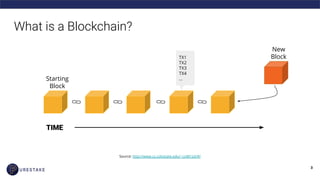
What is a Blockchain?
Source: http://www.cs.colostate.edu/~cs481a3/#/
TX1
TX2
TX3
TX4
...Starting
Block
New
Block
TIME
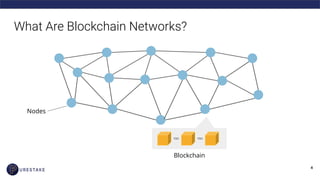
What Are Blockchain Networks?
Nodes
Blockchain
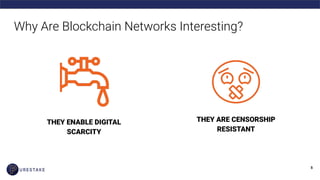
Why Are Blockchain Networks Interesting?
THEY ENABLE DIGITAL
SCARCITY
THEY ARE CENSORSHIP
RESISTANT
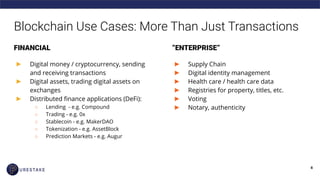
Blockchain Use Cases: More Than Just Transactions
FINANCIAL
► Digital money / cryptocurrency, sending
and receiving transactions
► Digital assets, trading digital assets on
exchanges
► Distributed finance applications (DeFi):
○ Lending - e.g. Compound
○ Trading - e.g. 0x
○ Stablecoin - e.g. MakerDAO
○ Tokenization - e.g. AssetBlock
○ Prediction Markets - e.g. Augur
“ENTERPRISE”
► Supply Chain
► Digital identity management
► Health care / health care data
► Registries for property, titles, etc.
► Voting
► Notary, authenticity
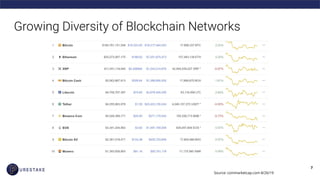
Growing Diversity of Blockchain Networks
Source: coinmarketcap.com 8/26/19
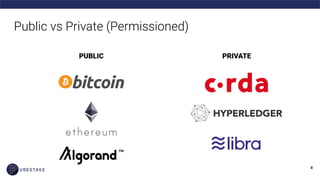
Public vs Private (Permissioned)
PRIVATEPUBLIC
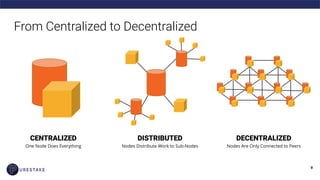
From Centralized to Decentralized
CENTRALIZED
One Node Does Everything
DISTRIBUTED
Nodes Distribute Work to Sub-Nodes
DECENTRALIZED
Nodes Are Only Connected to Peers
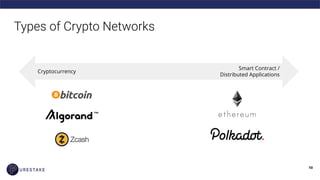
Types of Crypto Networks
Cryptocurrency
Smart Contract /
Distributed Applications
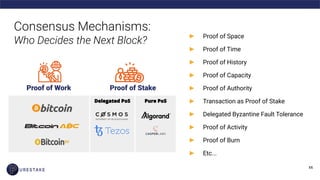
Proof of Work Proof of Stake
Consensus Mechanisms:
Who Decides the Next Block?
► Proof of Space
► Proof of Time
► Proof of History
► Proof of Capacity
► Proof of Authority
► Transaction as Proof of Stake
► Delegated Byzantine Fault Tolerance
► Proof of Activity
► Proof of Burn
► Etc...
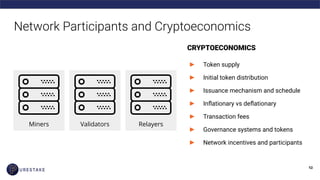
Miners Relayers
Network Participants and Cryptoeconomics
Validators
CRYPTOECONOMICS
► Token supply
► Initial token distribution
► Issuance mechanism and schedule
► Inflationary vs deflationary
► Transaction fees
► Governance systems and tokens
► Network incentives and participants
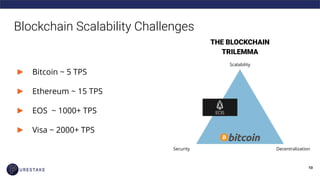
Blockchain Scalability Challenges
► Bitcoin ~ 5 TPS
► Ethereum ~ 15 TPS
► EOS ~ 1000+ TPS
► Visa ~ 2000+ TPS
Scalability
DecentralizationSecurity
THE BLOCKCHAIN
TRILEMMA
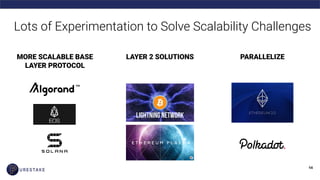
MORE SCALABLE BASE
LAYER PROTOCOL
Lots of Experimentation to Solve Scalability Challenges
LAYER 2 SOLUTIONS PARALLELIZE
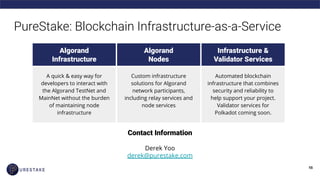
PureStake: Blockchain Infrastructure-as-a-Service
Algorand
Infrastructure
Algorand
Nodes
Infrastructure &
Validator Services
A quick & easy way for
developers to interact with
the Algorand TestNet and
MainNet without the burden
of maintaining node
infrastructure
Custom infrastructure
solutions for Algorand
network participants,
including relay services and
node services
Automated blockchain
infrastructure that combines
security and reliability to
help support your project.
Validator services for
Polkadot coming soon.
Contact Information
Derek Yoo
derek@purestake.com
Appendix
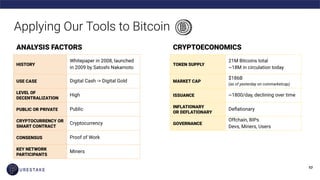
CRYPTOECONOMICS
TOKEN SUPPLY
21M Bitcoins total
~18M in circulation today
MARKET CAP
$186B
(as of yesterday on coinmarketcap)
ISSUANCE ~1800/day, declining over time
INFLATIONARY
OR DEFLATIONARY
Deflationary
GOVERNANCE
Offchain, BIPs
Devs, Miners, Users
Applying Our Tools to Bitcoin
ANALYSIS FACTORS
HISTORY
Whitepaper in 2008, launched
in 2009 by Satoshi Nakamoto
USE CASE Digital Cash -> Digital Gold
LEVEL OF
DECENTRALIZATION
High
PUBLIC OR PRIVATE Public
CRYPTOCURRENCY OR
SMART CONTRACT
Cryptocurrency
CONSENSUS Proof of Work
KEY NETWORK
PARTICIPANTS
Miners
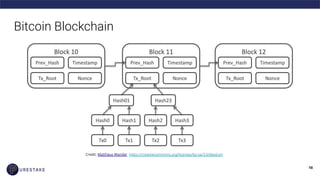
Bitcoin Blockchain
Credit: Matthäus Wander https://creativecommons.org/licenses/by-sa/3.0/deed.en

Blockchain 101: An Introduction to the Blockchain Ecosystem

  • 1.
    1 Introduction to Blockchain DerekYoo September 10, 2019
  • 2.
    Introduction to Blockchain TOPICSFOR THIS TALK ► What is a blockchain? ► What are blockchain networks and why are they interesting? ► Key blockchain use cases ► Analyzing and categorizing different blockchain networks ► Existing scalability challenges and solutions A LITTLE ABOUT ME ► 20+ years building as-a-service & cloud technology companies ► Co-Founded Fuze (An enterprise cloud company based in Boston) ► Currently CEO of PureStake (A crypto-infrastructure-as-a-service company)
  • 3.
    What is aBlockchain? Source: http://www.cs.colostate.edu/~cs481a3/#/ TX1 TX2 TX3 TX4 ...Starting Block New Block TIME
  • 4.
    What Are BlockchainNetworks? Nodes Blockchain
  • 5.
    Why Are BlockchainNetworks Interesting? THEY ENABLE DIGITAL SCARCITY THEY ARE CENSORSHIP RESISTANT
  • 6.
    Blockchain Use Cases:More Than Just Transactions FINANCIAL ► Digital money / cryptocurrency, sending and receiving transactions ► Digital assets, trading digital assets on exchanges ► Distributed finance applications (DeFi): ○ Lending - e.g. Compound ○ Trading - e.g. 0x ○ Stablecoin - e.g. MakerDAO ○ Tokenization - e.g. AssetBlock ○ Prediction Markets - e.g. Augur “ENTERPRISE” ► Supply Chain ► Digital identity management ► Health care / health care data ► Registries for property, titles, etc. ► Voting ► Notary, authenticity
  • 7.
    Growing Diversity ofBlockchain Networks Source: coinmarketcap.com 8/26/19
  • 8.
    Public vs Private(Permissioned) PRIVATEPUBLIC
  • 9.
    From Centralized toDecentralized CENTRALIZED One Node Does Everything DISTRIBUTED Nodes Distribute Work to Sub-Nodes DECENTRALIZED Nodes Are Only Connected to Peers
  • 10.
    Types of CryptoNetworks Cryptocurrency Smart Contract / Distributed Applications
  • 11.
    Proof of WorkProof of Stake Consensus Mechanisms: Who Decides the Next Block? ► Proof of Space ► Proof of Time ► Proof of History ► Proof of Capacity ► Proof of Authority ► Transaction as Proof of Stake ► Delegated Byzantine Fault Tolerance ► Proof of Activity ► Proof of Burn ► Etc...
  • 12.
    Miners Relayers Network Participantsand Cryptoeconomics Validators CRYPTOECONOMICS ► Token supply ► Initial token distribution ► Issuance mechanism and schedule ► Inflationary vs deflationary ► Transaction fees ► Governance systems and tokens ► Network incentives and participants
  • 13.
    Blockchain Scalability Challenges ►Bitcoin ~ 5 TPS ► Ethereum ~ 15 TPS ► EOS ~ 1000+ TPS ► Visa ~ 2000+ TPS Scalability DecentralizationSecurity THE BLOCKCHAIN TRILEMMA
  • 14.
    MORE SCALABLE BASE LAYERPROTOCOL Lots of Experimentation to Solve Scalability Challenges LAYER 2 SOLUTIONS PARALLELIZE
  • 15.
    PureStake: Blockchain Infrastructure-as-a-Service Algorand Infrastructure Algorand Nodes Infrastructure& Validator Services A quick & easy way for developers to interact with the Algorand TestNet and MainNet without the burden of maintaining node infrastructure Custom infrastructure solutions for Algorand network participants, including relay services and node services Automated blockchain infrastructure that combines security and reliability to help support your project. Validator services for Polkadot coming soon. Contact Information Derek Yoo derek@purestake.com
  • 16.
  • 17.
    CRYPTOECONOMICS TOKEN SUPPLY 21M Bitcoinstotal ~18M in circulation today MARKET CAP $186B (as of yesterday on coinmarketcap) ISSUANCE ~1800/day, declining over time INFLATIONARY OR DEFLATIONARY Deflationary GOVERNANCE Offchain, BIPs Devs, Miners, Users Applying Our Tools to Bitcoin ANALYSIS FACTORS HISTORY Whitepaper in 2008, launched in 2009 by Satoshi Nakamoto USE CASE Digital Cash -> Digital Gold LEVEL OF DECENTRALIZATION High PUBLIC OR PRIVATE Public CRYPTOCURRENCY OR SMART CONTRACT Cryptocurrency CONSENSUS Proof of Work KEY NETWORK PARTICIPANTS Miners
  • 18.
    Bitcoin Blockchain Credit: MatthäusWander https://creativecommons.org/licenses/by-sa/3.0/deed.en