Political Parties
Political parties are vehicles of federal sharing of political power
http://socialscienceclub.blogspot.ae/
Akbarali
A political party is a group of people who come together
to contest elections and hold power in the government.
They agree on some policies and programmes for a
society with a view to promote collective good
components
1.The leaders
2.The active members and
3. The supporters.
Functions
● Contest elections.
● Form and run governments in country.
● Put different policies and programmes.
● Making laws for a country.
● Playing opposition to the parties in power.
● Shape public opinion by raising and highlighting issues.
● Provide people access to gov.t machinery and welfare
schemes implemented.
Different Party Systems
One party system
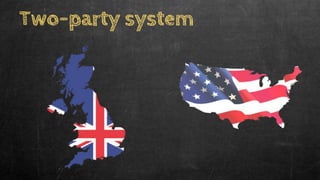
Two-party system
Multi party system
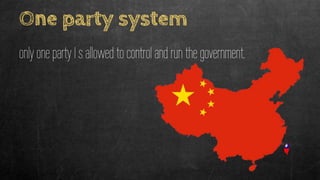
One party system
only one party I s allowed to control and run the government.
Two-party system
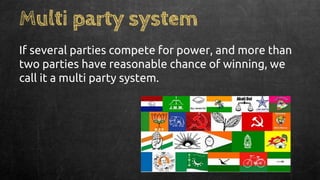
Multi party system
If several parties compete for power, and more than
two parties have reasonable chance of winning, we
call it a multi party system.
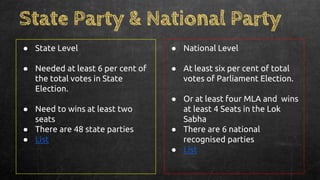
State Party & National Party
● State Level
● Needed at least 6 per cent of
the total votes in State
Election.
● Need to wins at least two
seats
● There are 48 state parties
● List
● National Level
● At least six per cent of total
votes of Parliament Election.
● Or at least four MLA and wins
at least 4 Seats in the Lok
Sabha
● There are 6 national
recognised parties
● List
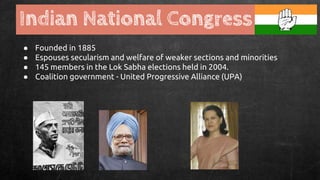
Indian National Congress
● Founded in 1885
● Espouses secularism and welfare of weaker sections and minorities
● 145 members in the Lok Sabha elections held in 2004.
● Coalition government - United Progressive Alliance (UPA)
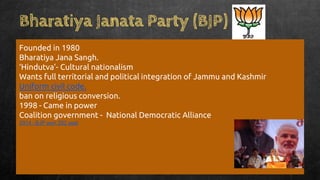
Bharatiya Janata Party (BJP)
Founded in 1980
Bharatiya Jana Sangh.
‘Hindutva’- Cultural nationalism
Wants full territorial and political integration of Jammu and Kashmir
Uniform civil code.
ban on religious conversion.
1998 - Came in power
Coalition government - National Democratic Alliance
2014 - BJP won 282 seat
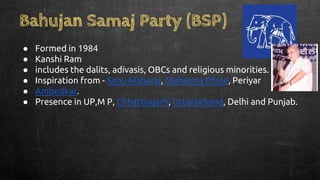
Bahujan Samaj Party (BSP)
● Formed in 1984
● Kanshi Ram
● includes the dalits, adivasis, OBCs and religious minorities.
● Inspiration from - Sahu Maharaj, Mahatma Phule, Periyar
● Ambedkar.
● Presence in UP,M P, Chhattisgarh, Uttarakhand, Delhi and Punjab.
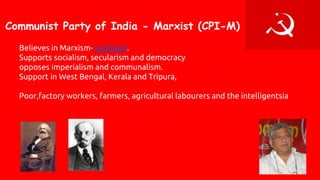
Communist Party of India - Marxist (CPI-M)
Believes in Marxism- Leninism.
Supports socialism, secularism and democracy
opposes imperialism and communalism.
Support in West Bengal, Kerala and Tripura,
Poor,factory workers, farmers, agricultural labourers and the intelligentsia
Communist Party of India (CPI):
Formed in 1925.
Believes in Marxism-Leninism, secularism and democracy.
Became weak after the split in the party in 1964 -CPI(M).
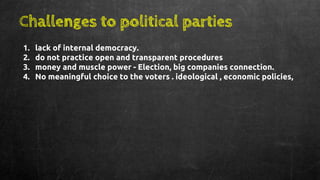
Challenges to political parties
1. lack of internal democracy.
2. do not practice open and transparent procedures
3. money and muscle power - Election, big companies connection.
4. No meaningful choice to the voters . ideological , economic policies,
How can parties be reformed?
Are political parties willing to reform?
If they are willing, what has prevented them from reforming so far?
If they are not willing, is it possible to force them to reform?
Let us look at
some of the recent efforts and suggestions in India
to reform political parties and its leaders:
Reforms
1.Defection is not allowed -Can’t Change the party
2. Candidate should Submit Affidavit - But no
option to recheck - Supreme Court
3. E.C passed an order to hold their
organisational elections & file their income
tax returns.
But it become a formality
Should keep membership register &
Constitution.
Mandatory for political parties to give a minimum
number of tickets, about one-third, to women
candidates.
Functions of political parties?
Necessity of political parties?

Political parties

  • 1.
    Political Parties Political partiesare vehicles of federal sharing of political power http://socialscienceclub.blogspot.ae/ Akbarali
  • 2.
    A political partyis a group of people who come together to contest elections and hold power in the government. They agree on some policies and programmes for a society with a view to promote collective good
  • 3.
    components 1.The leaders 2.The activemembers and 3. The supporters.
  • 4.
    Functions ● Contest elections. ●Form and run governments in country. ● Put different policies and programmes. ● Making laws for a country.
  • 5.
    ● Playing oppositionto the parties in power. ● Shape public opinion by raising and highlighting issues. ● Provide people access to gov.t machinery and welfare schemes implemented.
  • 6.
    Different Party Systems Oneparty system Two-party system Multi party system
  • 7.
    One party system onlyone party I s allowed to control and run the government.
  • 8.
  • 9.
    Multi party system Ifseveral parties compete for power, and more than two parties have reasonable chance of winning, we call it a multi party system.
  • 10.
    State Party &National Party ● State Level ● Needed at least 6 per cent of the total votes in State Election. ● Need to wins at least two seats ● There are 48 state parties ● List ● National Level ● At least six per cent of total votes of Parliament Election. ● Or at least four MLA and wins at least 4 Seats in the Lok Sabha ● There are 6 national recognised parties ● List
  • 11.
    Indian National Congress ●Founded in 1885 ● Espouses secularism and welfare of weaker sections and minorities ● 145 members in the Lok Sabha elections held in 2004. ● Coalition government - United Progressive Alliance (UPA)
  • 12.
    Bharatiya Janata Party(BJP) Founded in 1980 Bharatiya Jana Sangh. ‘Hindutva’- Cultural nationalism Wants full territorial and political integration of Jammu and Kashmir Uniform civil code. ban on religious conversion. 1998 - Came in power Coalition government - National Democratic Alliance 2014 - BJP won 282 seat
  • 13.
    Bahujan Samaj Party(BSP) ● Formed in 1984 ● Kanshi Ram ● includes the dalits, adivasis, OBCs and religious minorities. ● Inspiration from - Sahu Maharaj, Mahatma Phule, Periyar ● Ambedkar. ● Presence in UP,M P, Chhattisgarh, Uttarakhand, Delhi and Punjab.
  • 14.
    Communist Party ofIndia - Marxist (CPI-M) Believes in Marxism- Leninism. Supports socialism, secularism and democracy opposes imperialism and communalism. Support in West Bengal, Kerala and Tripura, Poor,factory workers, farmers, agricultural labourers and the intelligentsia
  • 15.
    Communist Party ofIndia (CPI): Formed in 1925. Believes in Marxism-Leninism, secularism and democracy. Became weak after the split in the party in 1964 -CPI(M).
  • 16.
    Challenges to politicalparties 1. lack of internal democracy. 2. do not practice open and transparent procedures 3. money and muscle power - Election, big companies connection. 4. No meaningful choice to the voters . ideological , economic policies,
  • 17.
    How can partiesbe reformed? Are political parties willing to reform?
  • 18.
    If they arewilling, what has prevented them from reforming so far? If they are not willing, is it possible to force them to reform?
  • 19.
    Let us lookat some of the recent efforts and suggestions in India to reform political parties and its leaders:
  • 20.
    Reforms 1.Defection is notallowed -Can’t Change the party
  • 21.
    2. Candidate shouldSubmit Affidavit - But no option to recheck - Supreme Court
  • 22.
    3. E.C passedan order to hold their organisational elections & file their income tax returns. But it become a formality
  • 23.
    Should keep membershipregister & Constitution.
  • 24.
    Mandatory for politicalparties to give a minimum number of tickets, about one-third, to women candidates.
  • 26.
  • 27.