Analyzing Political Cartoons
What is a political cartoon?
• Interpretive drawing, sometimes with words, that convey
an idea or message about a current issue, event, or
problem.
• Are simple, usually black and white, graphic depictions of
a news story or event.
• Portray people’s attitudes about a problem or issue.
Common characteristics for a good political cartoon:
• Wit and humor used to send a message.
• The cartoon must have a foundation in truth.
• Characters should be recognizable
• The cartoon should have a moral purpose - should
provide opportunities to inform the viewer about
an issue and allow for critical thinking
Interpreting a Political Cartoon – 5 Techniques
1. Symbolism
•Cartoonists use simple objects, or symbols, to
stand for larger concepts or ideas.
•After you identify the symbols in a cartoon, think
about what the cartoonist intends each symbol
to stand for.
Interpreting a Political Cartoon – 5 Techniques
2. Exaggeration
• Sometimes cartoonists overdo, or exaggerate, the physical
characteristics of people or things in order to make a
point.
• When you study a cartoon, look for any characteristics
that seem overdone or overblown. Then, try to decide
what point the cartoonist was trying to make through
exaggeration.
Interpreting a Political Cartoon – 5 Techniques
3. Labeling
•Cartoonists often label objects or people to
make it clear exactly what they stand for.
•Does the label make the meaning of the object
more clear?
Interpreting a Political Cartoon – 5 Techniques
4. Analogy
•An analogy is a comparison between two
unlike things that share some characteristics.
•By comparing a complex issue or situation
with a more familiar one, cartoonists can help
their readers see it in a different light.
Interpreting a Political Cartoon – 5 Techniques
5. Irony
•Irony is the difference between the ways things are
and the way things should be, or the way things are
expected to be.
•Cartoonists often use irony to express their opinion
on an issue.
More info
• Powerful people are usually fat, large people
• Weak people are usually skinny, small people
• Green – environmental
• Red – communist
• Good guys usually wear white
• Bad guys usually wear black
Curiosity Landing on Mars
Is there an
exaggeration?
Is there irony that
expresses an opinion?
Curiosity Landing on Mars
 There are no aliens on Mars.
 Curiosity’s landing is similar to a perfect Olympic landing.
 The alien’s t-shirt and Curiosity are labeled.
 The Flag is symbolic of America. The alien’s shirt
represents the Olympics.
The exaggeration
is….
The analogy is…..
The symbolism
is..
The labels
are….
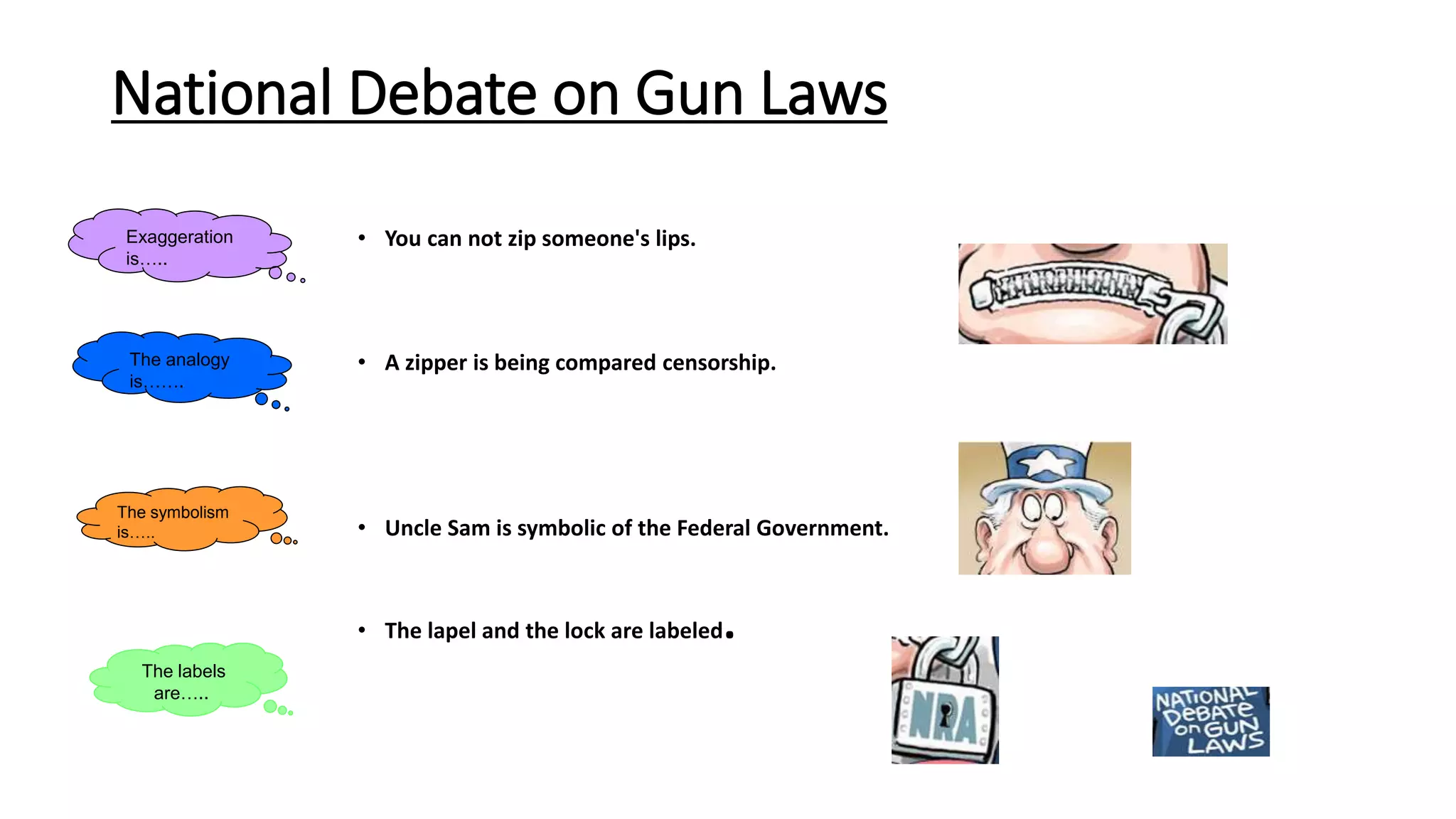
National Debate on Gun Laws
Is there an
exaggeration?
Is there an
analogy?
What is being
compared?
Is there irony that
expresses an opinion?
National Debate on Gun Laws
• You can not zip someone's lips.
• A zipper is being compared censorship.
• Uncle Sam is symbolic of the Federal Government.
• The lapel and the lock are labeled.
Exaggeration
is…..
The analogy
is…….
The symbolism
is…..
The labels
are…..
Now it’s your turn!
• Ready?
• Look at the next slide and answer the questions. Then check to see
how good you did.
Bush and Obama Portrait
Is there an
exaggeration?
Is there irony that
expresses an opinion?
Bush and Obama Portrait
 The size of the Bushes Ears are exaggerated.
 Is that Obama is fixing problems Bush created.
 The Irony is that some people are blaming Obama for
all of America’s problems.
 The portrait is a symbol of a presidents legacy.
 The portrait is labeled.
Exaggeration
is…..
The analogy
is…….
The irony is…..
The symbolism
is…..
The labels
are…..

political cartoons final.pptx

  • 1.
    Analyzing Political Cartoons Whatis a political cartoon? • Interpretive drawing, sometimes with words, that convey an idea or message about a current issue, event, or problem. • Are simple, usually black and white, graphic depictions of a news story or event. • Portray people’s attitudes about a problem or issue.
  • 3.
    Common characteristics fora good political cartoon: • Wit and humor used to send a message. • The cartoon must have a foundation in truth. • Characters should be recognizable • The cartoon should have a moral purpose - should provide opportunities to inform the viewer about an issue and allow for critical thinking
  • 4.
    Interpreting a PoliticalCartoon – 5 Techniques 1. Symbolism •Cartoonists use simple objects, or symbols, to stand for larger concepts or ideas. •After you identify the symbols in a cartoon, think about what the cartoonist intends each symbol to stand for.
  • 6.
    Interpreting a PoliticalCartoon – 5 Techniques 2. Exaggeration • Sometimes cartoonists overdo, or exaggerate, the physical characteristics of people or things in order to make a point. • When you study a cartoon, look for any characteristics that seem overdone or overblown. Then, try to decide what point the cartoonist was trying to make through exaggeration.
  • 8.
    Interpreting a PoliticalCartoon – 5 Techniques 3. Labeling •Cartoonists often label objects or people to make it clear exactly what they stand for. •Does the label make the meaning of the object more clear?
  • 10.
    Interpreting a PoliticalCartoon – 5 Techniques 4. Analogy •An analogy is a comparison between two unlike things that share some characteristics. •By comparing a complex issue or situation with a more familiar one, cartoonists can help their readers see it in a different light.
  • 12.
    Interpreting a PoliticalCartoon – 5 Techniques 5. Irony •Irony is the difference between the ways things are and the way things should be, or the way things are expected to be. •Cartoonists often use irony to express their opinion on an issue.
  • 14.
    More info • Powerfulpeople are usually fat, large people • Weak people are usually skinny, small people • Green – environmental • Red – communist • Good guys usually wear white • Bad guys usually wear black
  • 15.
    Curiosity Landing onMars Is there an exaggeration? Is there irony that expresses an opinion?
  • 16.
    Curiosity Landing onMars  There are no aliens on Mars.  Curiosity’s landing is similar to a perfect Olympic landing.  The alien’s t-shirt and Curiosity are labeled.  The Flag is symbolic of America. The alien’s shirt represents the Olympics. The exaggeration is…. The analogy is….. The symbolism is.. The labels are….
  • 17.
    National Debate onGun Laws Is there an exaggeration? Is there an analogy? What is being compared? Is there irony that expresses an opinion?
  • 18.
    National Debate onGun Laws • You can not zip someone's lips. • A zipper is being compared censorship. • Uncle Sam is symbolic of the Federal Government. • The lapel and the lock are labeled. Exaggeration is….. The analogy is……. The symbolism is….. The labels are…..
  • 19.
    Now it’s yourturn! • Ready? • Look at the next slide and answer the questions. Then check to see how good you did.
  • 20.
    Bush and ObamaPortrait Is there an exaggeration? Is there irony that expresses an opinion?
  • 21.
    Bush and ObamaPortrait  The size of the Bushes Ears are exaggerated.  Is that Obama is fixing problems Bush created.  The Irony is that some people are blaming Obama for all of America’s problems.  The portrait is a symbol of a presidents legacy.  The portrait is labeled. Exaggeration is….. The analogy is……. The irony is….. The symbolism is….. The labels are…..