SMALL DETAIL OF POLAND
Location: Central Europe
Capital: Warsaw
Climate: Temperate with cold, cloudy, moderately
severe winters with frequent precipitation; mild
summers with frequent showers and thundershowers
Population: 38,346,279 (2014 est.)
Ethnic Make-up: Polish 96.7%, German 0.4%,
Belarusian 0.1%, Ukrainian 0.1%, other and unspecified
2.7% (2002 census)
Population: 159,196,336 (July 2004 est.)
Religions: Roman Catholic 89.8% (about 75%
practicing), Eastern Orthodox 1.3%, Protestant 0.3%,
other 0.3%, unspecified 8.3% (2002)
Government: Republic
Poland was established as a state under the Piast
dynasty, which ruled the country between the 10th
and 14th centuries. Historical records referring to the
Polish state begin with the rule of Duke Mieszko I.
Mieszko, whose reign commenced sometime before
963 and who continued as the Polish monarch until
his death in 992, chose to be baptized in the Western
Latin Rite, probably on 14 April 966, following his
marriage to Princess Doubravka of Bohemia a
fervent Christian. This event has become known as
the baptism of Poland, and its date is often used to
mark a symbolic beginning of Polish statehood.
Poland now has a new constitution which was
signed in 1997
THE CAPITAL CITY OF POLAND:
WARSAW
VARSOVIA
WARSZAWA
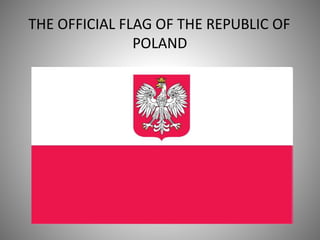
THE OFFICIAL FLAG OF THE REPUBLIC OF
POLAND
THE MEANING OF COLOURS ON THE FLAG:
WHITE: PURITY, MORALITY AND GOODNESS
RED:* BRAVERY, HEROISM
*THE MEANING WAS ADDED AFTER MANY WARS POLAND HAS FOUGHT. THE
ORIGINAL ANCIENT MEANING OF RED WAS NOBILITY AND DIGNITY (RED
PAINT USED TO BE VERY EXPENSIVE AND USED ONLY BY RICH PEOPLE)
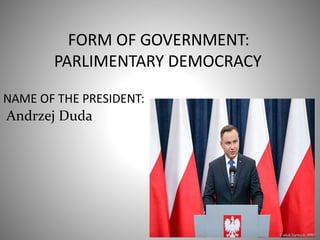
FORM OF GOVERNMENT:
PARLIMENTARY DEMOCRACY
NAME OF THE PRESIDENT:
Andrzej Duda
HOW BIG IS POLAND?
- IT HAS 322 575 sqkm
- IT IS THE 69TH BIGGEST COUNTRY IN
THE WORLD*
*SPAIN IS THE 52TH BIGGEST COUNTRY IN THE WORLD
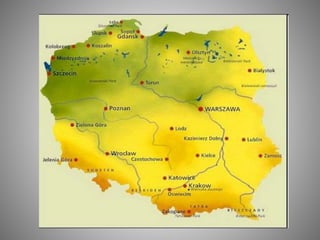
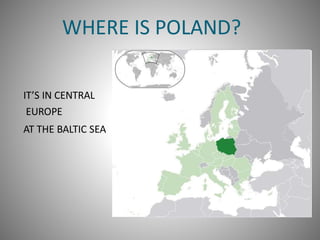
WHERE IS POLAND?
IT’S IN CENTRAL
EUROPE
AT THE BALTIC SEA
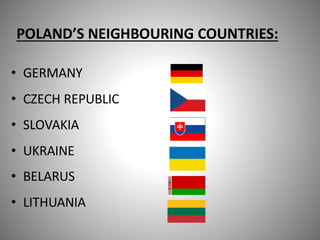
POLAND’S NEIGHBOURING COUNTRIES:
• GERMANY
• CZECH REPUBLIC
• SLOVAKIA
• UKRAINE
• BELARUS
• LITHUANIA
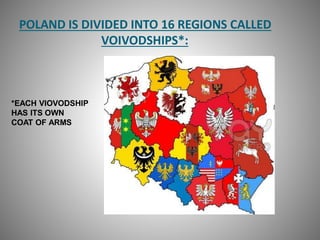
POLAND IS DIVIDED INTO 16 REGIONS CALLED
VOIVODSHIPS*:
*EACH VIOVODSHIP
HAS ITS OWN
COAT OF ARMS
FACTS OF POLAND
 The name “Poland” derives from the name of the West Slavic tribe of Polans
(“Polanie”) which means “people living in open fields” (“pole” = field).
 Poland is the 9th largest country in Europe.
 Approximately 30% of the around 60 million Poles live outside Poland. Large
communities of Polish diaspora can be found in the US, Canada, UK, Ireland,
Germany, Ukraine, Belarus, Lithuania, Russia, Australia, Brazil and Argentina.
 Krakow was the country’s capital and the place of coronation of Polish kings
from 1038 until the capital was moved to Warsaw in 1596.
 The symbol of Warsaw is a mermaid.
 Poland adopted its first constitution on 3 May 1791. It was the first constitution
of its kind in Europe and the second ever in the world after that of the United
States. Sadly, it remained in force for only 18 months before Poland ceased to
exist on maps of Europe for the next 123 years.
 Poland disappeared from European maps in 1795 when the country was divided
between its neighbours: Russia, Prussia and Austria, and didn’t exist for 123
years until it regained its independence on 11 November 1918.
 It is estimated that more than 6 million Poles, including soldiers and civilians,
died in executions, concentration camps, labor camps, prisons, and forced labor
during the 5 years of Nazi occupation (1939-1945).
 Poles represent the biggest number of people by nationality to rescue Jews during
the German Nazi-organised Holocaust. Up to around 450,000 Jews were saved from
certain death. Poland holds the world record with the 6,135 people being awarded
the title of Righteous among the Nations by the State of Israel
 The first oil refinery in the world was built in 1856 by Polish pharmacist and
petroleum industry pioneer, Ignacy Lukasiewicz.
 Poland boasts 17 Nobel prize winners, including 4 Peace Prizes and 5 in Literature.
 Marie Curie (born Maria Sklodowska; 1867-1934) was the first and only Nobel
laureate in two different sciences and first female professor at the Sorbonne
University
 Polish born astronomer, Nicolaus Copernicus (1473-1543), was the first person to
propose that the Earth was not the canter of the universe.
 Another Polish astronomer, Johannes Hevelius (1611-1687), published the earliest
exact maps of the moon.
 Some Polish people famous worldwide: Nicolaus Copernicus (astronomer),
Johannes Hevelius (astronomer), Frederic Chopin (musical composer), Maria
Sklodowska Curie (physicist and chemist), John Paul II (pope).
 Two of the world’s oldest working mines are found
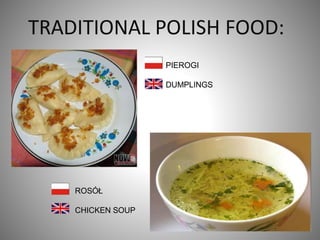
TRADITIONAL POLISH FOOD:
PIEROGI
DUMPLINGS
ROSÓŁ
CHICKEN SOUP
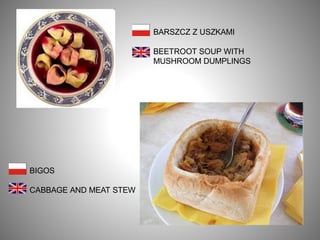
BARSZCZ Z USZKAMI
BEETROOT SOUP WITH
MUSHROOM DUMPLINGS
BIGOS
CABBAGE AND MEAT STEW
TRADITIONAL POLISH FESTIVALS
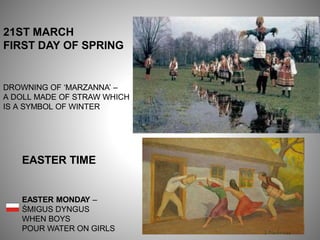
21ST MARCH
FIRST DAY OF SPRING
DROWNING OF ‘MARZANNA’ –
A DOLL MADE OF STRAW WHICH
IS A SYMBOL OF WINTER
EASTER TIME
EASTER MONDAY –
ŚMIGUS DYNGUS
WHEN BOYS
POUR WATER ON GIRLS
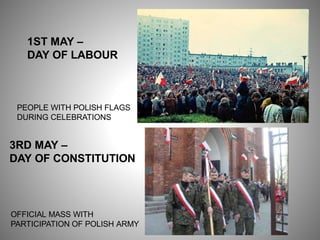
1ST MAY –
DAY OF LABOUR
PEOPLE WITH POLISH FLAGS
DURING CELEBRATIONS
3RD MAY –
DAY OF CONSTITUTION
OFFICIAL MASS WITH
PARTICIPATION OF POLISH ARMY
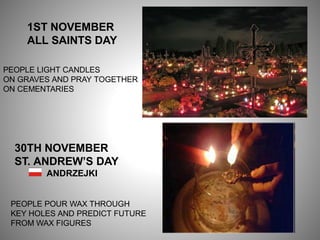
1ST NOVEMBER
ALL SAINTS DAY
PEOPLE LIGHT CANDLES
ON GRAVES AND PRAY TOGETHER
ON CEMENTARIES
30TH NOVEMBER
ST. ANDREW’S DAY
ANDRZEJKI
PEOPLE POUR WAX THROUGH
KEY HOLES AND PREDICT FUTURE
FROM WAX FIGURES
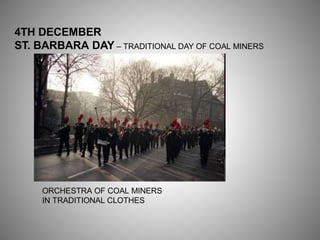
4TH DECEMBER
ST. BARBARA DAY – TRADITIONAL DAY OF COAL MINERS
ORCHESTRA OF COAL MINERS
IN TRADITIONAL CLOTHES
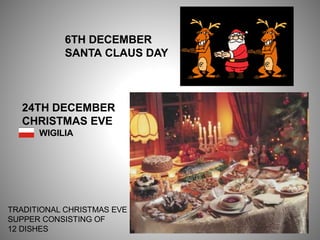
6TH DECEMBER
SANTA CLAUS DAY
24TH DECEMBER
CHRISTMAS EVE
WIGILIA
TRADITIONAL CHRISTMAS EVE
SUPPER CONSISTING OF
12 DISHES
FAMOUS CITIES OF POLAND
WARSZAWA
FACTS:
• Situated on both sides of main Polish river
Wisła (Vistula )
• Polish government headquraters
• Completely destroyed during World War II
and rebuilt after the war
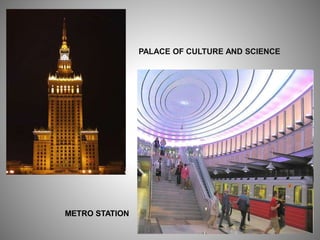
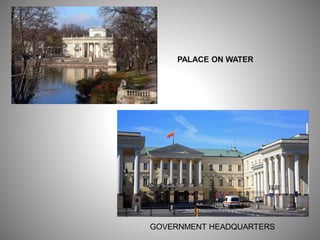
PALACE OF CULTURE AND SCIENCE
METRO STATION
GOVERNMENT HEADQUARTERS
PALACE ON WATER
WROCŁAW
FACTS:
• Selected European Capital of Culture 2016
• Situated on both sides of the second biggest
Polish river: Odra
• One of the biggest and oldest cities in Poland
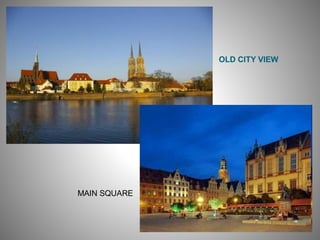
OLD CITY VIEW
MAIN SQUARE
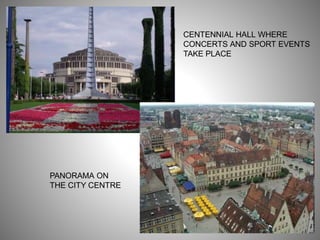
CENTENNIAL HALL WHERE
CONCERTS AND SPORT EVENTS
TAKE PLACE
PANORAMA ON
THE CITY CENTRE
KATOWICE
• Capital city of Silesia region (
industrial region of Poland
• Has got many coal mines
Ś sk) -lą
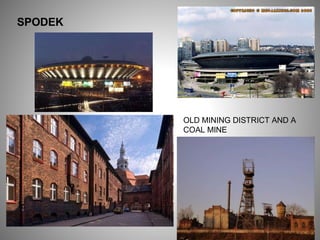
• Famous for its sport hall called Spodek
(saucer) which looks like a UFO
SPODEK
OLD MINING DISTRICT AND A
COAL MINE
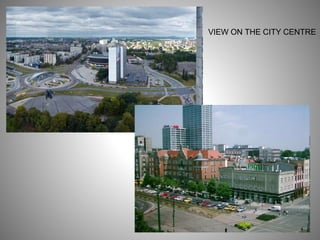
VIEW ON THE CITY CENTRE
KRAKÓW
• Historical capital city of Poland
• Academic and artistic centre
• According to a legend it used to have a dragon
• Like Warszwa, Kraków lays on Wisła river
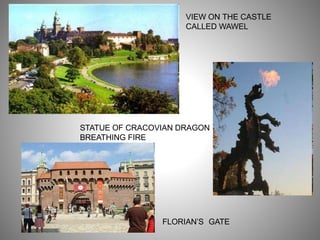
VIEW ON THE CASTLE
CALLED WAWEL
STATUE OF CRACOVIAN DRAGON
BREATHING FIRE
FLORIAN’S GATE
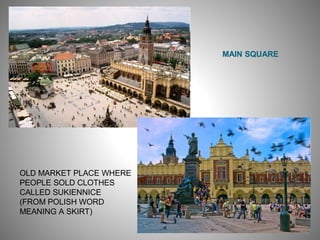
MAIN SQUARE
OLD MARKET PLACE WHERE
PEOPLE SOLD CLOTHES
CALLED SUKIENNICE
(FROM POLISH WORD
MEANING A SKIRT)
GDAŃSK
• Situated at the seaside
• Fourth biggest Polish city
• Known for the uprising of Polish workers
during Communism in Poland
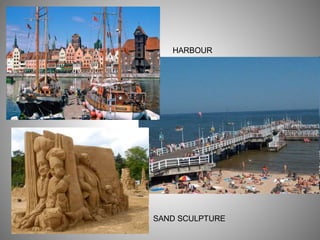
• Famous for annual summer Sand Festival
when artists make sand sculptures on the
beach
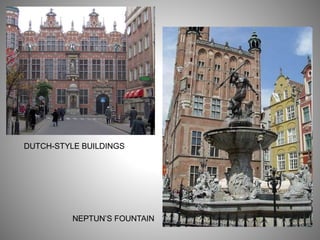
NEPTUN’S FOUNTAIN
DUTCH-STYLE BUILDINGS
HARBOUR
SAND SCULPTURE
THANK YOU

Poland by hitesh malani

  • 2.
    SMALL DETAIL OFPOLAND Location: Central Europe Capital: Warsaw Climate: Temperate with cold, cloudy, moderately severe winters with frequent precipitation; mild summers with frequent showers and thundershowers Population: 38,346,279 (2014 est.) Ethnic Make-up: Polish 96.7%, German 0.4%, Belarusian 0.1%, Ukrainian 0.1%, other and unspecified 2.7% (2002 census) Population: 159,196,336 (July 2004 est.) Religions: Roman Catholic 89.8% (about 75% practicing), Eastern Orthodox 1.3%, Protestant 0.3%, other 0.3%, unspecified 8.3% (2002) Government: Republic
  • 3.
    Poland was establishedas a state under the Piast dynasty, which ruled the country between the 10th and 14th centuries. Historical records referring to the Polish state begin with the rule of Duke Mieszko I. Mieszko, whose reign commenced sometime before 963 and who continued as the Polish monarch until his death in 992, chose to be baptized in the Western Latin Rite, probably on 14 April 966, following his marriage to Princess Doubravka of Bohemia a fervent Christian. This event has become known as the baptism of Poland, and its date is often used to mark a symbolic beginning of Polish statehood. Poland now has a new constitution which was signed in 1997
  • 4.
    THE CAPITAL CITYOF POLAND: WARSAW VARSOVIA WARSZAWA
  • 5.
    THE OFFICIAL FLAGOF THE REPUBLIC OF POLAND
  • 6.
    THE MEANING OFCOLOURS ON THE FLAG: WHITE: PURITY, MORALITY AND GOODNESS RED:* BRAVERY, HEROISM *THE MEANING WAS ADDED AFTER MANY WARS POLAND HAS FOUGHT. THE ORIGINAL ANCIENT MEANING OF RED WAS NOBILITY AND DIGNITY (RED PAINT USED TO BE VERY EXPENSIVE AND USED ONLY BY RICH PEOPLE)
  • 7.
    FORM OF GOVERNMENT: PARLIMENTARYDEMOCRACY NAME OF THE PRESIDENT: Andrzej Duda
  • 8.
    HOW BIG ISPOLAND? - IT HAS 322 575 sqkm - IT IS THE 69TH BIGGEST COUNTRY IN THE WORLD* *SPAIN IS THE 52TH BIGGEST COUNTRY IN THE WORLD
  • 10.
    WHERE IS POLAND? IT’SIN CENTRAL EUROPE AT THE BALTIC SEA
  • 11.
    POLAND’S NEIGHBOURING COUNTRIES: •GERMANY • CZECH REPUBLIC • SLOVAKIA • UKRAINE • BELARUS • LITHUANIA
  • 12.
    POLAND IS DIVIDEDINTO 16 REGIONS CALLED VOIVODSHIPS*: *EACH VIOVODSHIP HAS ITS OWN COAT OF ARMS
  • 13.
    FACTS OF POLAND The name “Poland” derives from the name of the West Slavic tribe of Polans (“Polanie”) which means “people living in open fields” (“pole” = field).  Poland is the 9th largest country in Europe.  Approximately 30% of the around 60 million Poles live outside Poland. Large communities of Polish diaspora can be found in the US, Canada, UK, Ireland, Germany, Ukraine, Belarus, Lithuania, Russia, Australia, Brazil and Argentina.  Krakow was the country’s capital and the place of coronation of Polish kings from 1038 until the capital was moved to Warsaw in 1596.  The symbol of Warsaw is a mermaid.  Poland adopted its first constitution on 3 May 1791. It was the first constitution of its kind in Europe and the second ever in the world after that of the United States. Sadly, it remained in force for only 18 months before Poland ceased to exist on maps of Europe for the next 123 years.  Poland disappeared from European maps in 1795 when the country was divided between its neighbours: Russia, Prussia and Austria, and didn’t exist for 123 years until it regained its independence on 11 November 1918.  It is estimated that more than 6 million Poles, including soldiers and civilians, died in executions, concentration camps, labor camps, prisons, and forced labor during the 5 years of Nazi occupation (1939-1945).
  • 14.
     Poles representthe biggest number of people by nationality to rescue Jews during the German Nazi-organised Holocaust. Up to around 450,000 Jews were saved from certain death. Poland holds the world record with the 6,135 people being awarded the title of Righteous among the Nations by the State of Israel  The first oil refinery in the world was built in 1856 by Polish pharmacist and petroleum industry pioneer, Ignacy Lukasiewicz.  Poland boasts 17 Nobel prize winners, including 4 Peace Prizes and 5 in Literature.  Marie Curie (born Maria Sklodowska; 1867-1934) was the first and only Nobel laureate in two different sciences and first female professor at the Sorbonne University  Polish born astronomer, Nicolaus Copernicus (1473-1543), was the first person to propose that the Earth was not the canter of the universe.  Another Polish astronomer, Johannes Hevelius (1611-1687), published the earliest exact maps of the moon.  Some Polish people famous worldwide: Nicolaus Copernicus (astronomer), Johannes Hevelius (astronomer), Frederic Chopin (musical composer), Maria Sklodowska Curie (physicist and chemist), John Paul II (pope).  Two of the world’s oldest working mines are found
  • 15.
  • 16.
    BARSZCZ Z USZKAMI BEETROOTSOUP WITH MUSHROOM DUMPLINGS BIGOS CABBAGE AND MEAT STEW
  • 17.
  • 18.
    21ST MARCH FIRST DAYOF SPRING DROWNING OF ‘MARZANNA’ – A DOLL MADE OF STRAW WHICH IS A SYMBOL OF WINTER EASTER TIME EASTER MONDAY – ŚMIGUS DYNGUS WHEN BOYS POUR WATER ON GIRLS
  • 19.
    1ST MAY – DAYOF LABOUR PEOPLE WITH POLISH FLAGS DURING CELEBRATIONS 3RD MAY – DAY OF CONSTITUTION OFFICIAL MASS WITH PARTICIPATION OF POLISH ARMY
  • 20.
    1ST NOVEMBER ALL SAINTSDAY PEOPLE LIGHT CANDLES ON GRAVES AND PRAY TOGETHER ON CEMENTARIES 30TH NOVEMBER ST. ANDREW’S DAY ANDRZEJKI PEOPLE POUR WAX THROUGH KEY HOLES AND PREDICT FUTURE FROM WAX FIGURES
  • 21.
    4TH DECEMBER ST. BARBARADAY – TRADITIONAL DAY OF COAL MINERS ORCHESTRA OF COAL MINERS IN TRADITIONAL CLOTHES
  • 22.
    6TH DECEMBER SANTA CLAUSDAY 24TH DECEMBER CHRISTMAS EVE WIGILIA TRADITIONAL CHRISTMAS EVE SUPPER CONSISTING OF 12 DISHES
  • 23.
  • 24.
    WARSZAWA FACTS: • Situated onboth sides of main Polish river Wisła (Vistula ) • Polish government headquraters • Completely destroyed during World War II and rebuilt after the war
  • 25.
    PALACE OF CULTUREAND SCIENCE METRO STATION
  • 26.
  • 27.
    WROCŁAW FACTS: • Selected EuropeanCapital of Culture 2016 • Situated on both sides of the second biggest Polish river: Odra • One of the biggest and oldest cities in Poland
  • 28.
  • 29.
    CENTENNIAL HALL WHERE CONCERTSAND SPORT EVENTS TAKE PLACE PANORAMA ON THE CITY CENTRE
  • 30.
    KATOWICE • Capital cityof Silesia region ( industrial region of Poland • Has got many coal mines Ś sk) -lą • Famous for its sport hall called Spodek (saucer) which looks like a UFO
  • 31.
  • 32.
    VIEW ON THECITY CENTRE
  • 33.
    KRAKÓW • Historical capitalcity of Poland • Academic and artistic centre • According to a legend it used to have a dragon • Like Warszwa, Kraków lays on Wisła river
  • 34.
    VIEW ON THECASTLE CALLED WAWEL STATUE OF CRACOVIAN DRAGON BREATHING FIRE FLORIAN’S GATE
  • 35.
    MAIN SQUARE OLD MARKETPLACE WHERE PEOPLE SOLD CLOTHES CALLED SUKIENNICE (FROM POLISH WORD MEANING A SKIRT)
  • 36.
    GDAŃSK • Situated atthe seaside • Fourth biggest Polish city • Known for the uprising of Polish workers during Communism in Poland • Famous for annual summer Sand Festival when artists make sand sculptures on the beach
  • 37.
  • 38.
  • 39.