PoetryPoetry
VocabularyVocabulary
1. Alliteration:
– Repetition of initial consonant sounds
1. Allusion:
– A reference to a well-known person,
place, event, literary work, or work of
art
1. Ballad:
– A song-like poem that tells a story
4. Blank Verse:
– Poetry written in unrhymed, ten-
syllable lines
5. Concrete Poem:
– A poem with a shape that suggests its
subject
5. Figurative Language:
– Writing that is not meant to be taken
literally
5. Free Verse:
– Poetry not written in a regular
rhythmical pattern or meter
8. Haiku:
– A three-lined Japanese verse
9. Image:
– A word or phrase that appeals to one
or more of the five senses
9. Lyric Poem:
– Highly musical verse that expresses
the observations and feelings of a
single speaker
9. Metaphor:
– A figure of speech in which something
is described as though it were
something else
12. Mood:
– The feeling created in the reader by
a literary work
13. Narrative Poem:
– A story told in verse
13. Onomatopoeia:
– The use of words that imitate sounds
13. Personification:
– A type of figurative language in which
a non-human subject is given human
characteristics
16. Refrain:
– A regularly repeated line or group of
lines in a poem
16. Repetition:
– The use, more than once, of any
element of language
16. Rhyme:
– Repetition of sounds at the end of
words
16. Rhyme Scheme:
– A regular pattern of rhyming
words in a poem
20.Rhythm:
– Pattern of beats or stresses in
spoken or written language
20.Simile:
– A figure of speech that uses
like or as to make a direct
comparison between two unlike
ideas
20.Stanza:
– A formal division of lines in a poem
considered as a unit
My love is like a red rose.
PoetryPoetry
Humor & PoetryHumor & Poetry
Humor
• Humor in poetry can arise
from a number of sources:
– Surprise
– Exaggeration
– Bringing together of
unrelated things
• Most funny poems have two
things in common:
– Rhythm
– Rhyme
Rhythm & Rhyme
• Using more spirited language makes
humorous situations even more humorous
“The Porcupine”
By Ogden Nash
Any hound a porcupine nudges
Can’t be blamed for harboring grudges.
I know one hound that laughed all winter
At a porcupine that sat on a splinter.
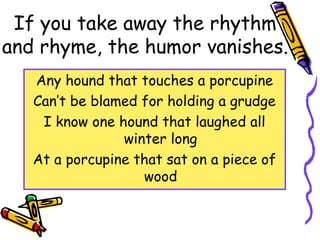
If you take away the rhythm
and rhyme, the humor vanishes.
Any hound that touches a porcupine
Can’t be blamed for holding a grudge
I know one hound that laughed all
winter long
At a porcupine that sat on a piece of
wood
Lewis Carroll
1832-1898
• Born in England
• Wrote Alice’s Adventures in Wonderland
• Wrote Through the Looking Glass
• His life was quiet and uneventful, but in
works like Father William, he found escape
from his serious work into a delightfully
zany, topsy-turvy world that still amuses
children old and young.
“Father William”
Page 400
• In this poem, a young man questions
his father about some rather unusual
behavior.
• Have you ever asked someone what
they were doing and received an
explanation that made very little
sense at all?
Limericks
• A limerick is a poem of five lines
• The first, second, and fifth lines
have three rhythmic beats and rhyme
with one another.
• The third and fourth lines have two
beats and rhyme with one another.
• They are always light-hearted,
humorous poems.
Limericks
There once was a man with no hair.
He gave everyone quite a scare.
He got some Rogaine,
Grew out a mane,
And now he resembles a bear!
Limerick About a Bee
I wish that my room had a floor,
I don’t care so much for a door.
But this walking around
Without touching the ground
Is getting to be quite a bore.
Another Limerick
There once was a very small mouse
Who lived in a very small house,
The ocean’s spray
Washed it away,
All that was left was her blouse!
You will create a limerick
similar to this one…
There once was a man from Beijing.
All his life he hoped to be King.
So he put on a crown,
Which quickly fell down.
That small silly man from Beijing.
Fill in the blanks and
create your own Limerick.
There once was a _____ from _____.
All the while she/he hoped ________.
So she/he ____________________,
And ________________________,
That _________ from ___________.
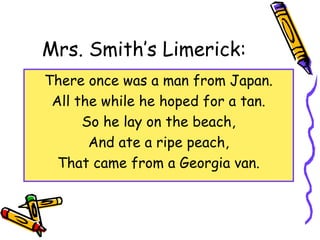
Mrs. Smith’s Limerick:
There once was a man from Japan.
All the while he hoped for a tan.
So he lay on the beach,
And ate a ripe peach,
That came from a Georgia van.

Poetry power (language arts)

  • 1.
  • 2.
    1. Alliteration: – Repetitionof initial consonant sounds 1. Allusion: – A reference to a well-known person, place, event, literary work, or work of art 1. Ballad: – A song-like poem that tells a story 4. Blank Verse: – Poetry written in unrhymed, ten- syllable lines
  • 3.
    5. Concrete Poem: –A poem with a shape that suggests its subject 5. Figurative Language: – Writing that is not meant to be taken literally 5. Free Verse: – Poetry not written in a regular rhythmical pattern or meter 8. Haiku: – A three-lined Japanese verse
  • 4.
    9. Image: – Aword or phrase that appeals to one or more of the five senses 9. Lyric Poem: – Highly musical verse that expresses the observations and feelings of a single speaker 9. Metaphor: – A figure of speech in which something is described as though it were something else
  • 5.
    12. Mood: – Thefeeling created in the reader by a literary work 13. Narrative Poem: – A story told in verse 13. Onomatopoeia: – The use of words that imitate sounds 13. Personification: – A type of figurative language in which a non-human subject is given human characteristics
  • 6.
    16. Refrain: – Aregularly repeated line or group of lines in a poem 16. Repetition: – The use, more than once, of any element of language 16. Rhyme: – Repetition of sounds at the end of words 16. Rhyme Scheme: – A regular pattern of rhyming words in a poem
  • 7.
    20.Rhythm: – Pattern ofbeats or stresses in spoken or written language 20.Simile: – A figure of speech that uses like or as to make a direct comparison between two unlike ideas 20.Stanza: – A formal division of lines in a poem considered as a unit My love is like a red rose.
  • 8.
  • 9.
    Humor • Humor inpoetry can arise from a number of sources: – Surprise – Exaggeration – Bringing together of unrelated things • Most funny poems have two things in common: – Rhythm – Rhyme
  • 10.
    Rhythm & Rhyme •Using more spirited language makes humorous situations even more humorous “The Porcupine” By Ogden Nash Any hound a porcupine nudges Can’t be blamed for harboring grudges. I know one hound that laughed all winter At a porcupine that sat on a splinter.
  • 11.
    If you takeaway the rhythm and rhyme, the humor vanishes. Any hound that touches a porcupine Can’t be blamed for holding a grudge I know one hound that laughed all winter long At a porcupine that sat on a piece of wood
  • 12.
    Lewis Carroll 1832-1898 • Bornin England • Wrote Alice’s Adventures in Wonderland • Wrote Through the Looking Glass • His life was quiet and uneventful, but in works like Father William, he found escape from his serious work into a delightfully zany, topsy-turvy world that still amuses children old and young.
  • 13.
    “Father William” Page 400 •In this poem, a young man questions his father about some rather unusual behavior. • Have you ever asked someone what they were doing and received an explanation that made very little sense at all?
  • 14.
    Limericks • A limerickis a poem of five lines • The first, second, and fifth lines have three rhythmic beats and rhyme with one another. • The third and fourth lines have two beats and rhyme with one another. • They are always light-hearted, humorous poems.
  • 15.
    Limericks There once wasa man with no hair. He gave everyone quite a scare. He got some Rogaine, Grew out a mane, And now he resembles a bear!
  • 16.
    Limerick About aBee I wish that my room had a floor, I don’t care so much for a door. But this walking around Without touching the ground Is getting to be quite a bore.
  • 17.
    Another Limerick There oncewas a very small mouse Who lived in a very small house, The ocean’s spray Washed it away, All that was left was her blouse!
  • 18.
    You will createa limerick similar to this one… There once was a man from Beijing. All his life he hoped to be King. So he put on a crown, Which quickly fell down. That small silly man from Beijing.
  • 19.
    Fill in theblanks and create your own Limerick. There once was a _____ from _____. All the while she/he hoped ________. So she/he ____________________, And ________________________, That _________ from ___________.
  • 20.
    Mrs. Smith’s Limerick: Thereonce was a man from Japan. All the while he hoped for a tan. So he lay on the beach, And ate a ripe peach, That came from a Georgia van.