Articles from TOETOE Technology for
    Open English Toying with Open E-
              resources (ˈtɔɪtɔɪ)
A Pledge for Open English
2012-03-05 00:03:00 admin


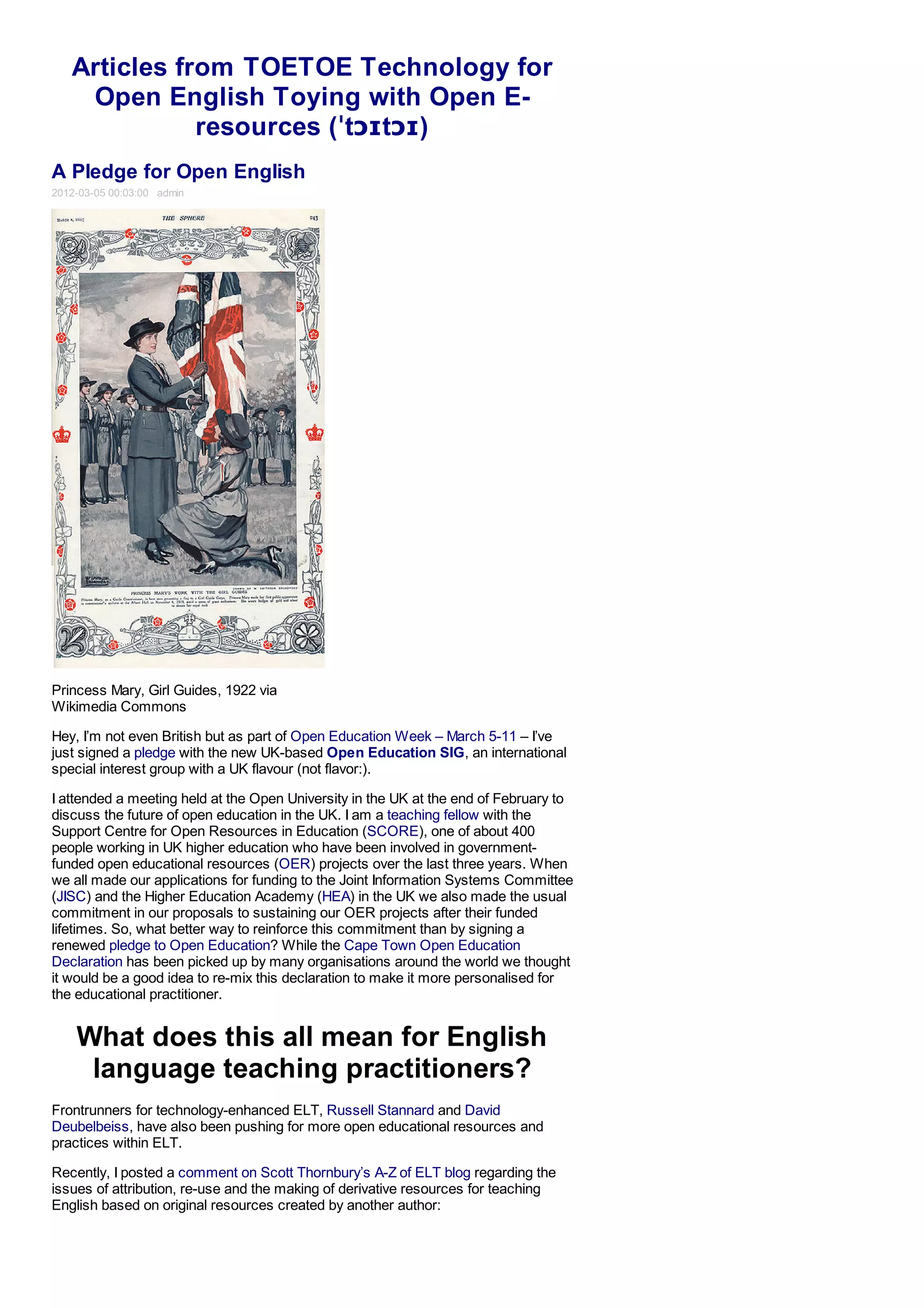
Princess Mary, Girl Guides, 1922 via
Wikimedia Commons

Hey, I’m not even British but as part of Open Education Week – March 5-11 – I’ve
just signed a pledge with the new UK-based Open Education SIG, an international
special interest group with a UK flavour (not flavor:).

I attended a meeting held at the Open University in the UK at the end of February to
discuss the future of open education in the UK. I am a teaching fellow with the
Support Centre for Open Resources in Education (SCORE), one of about 400
people working in UK higher education who have been involved in government-
funded open educational resources (OER) projects over the last three years. When
we all made our applications for funding to the Joint Information Systems Committee
(JISC) and the Higher Education Academy (HEA) in the UK we also made the usual
commitment in our proposals to sustaining our OER projects after their funded
lifetimes. So, what better way to reinforce this commitment than by signing a
renewed pledge to Open Education? While the Cape Town Open Education
Declaration has been picked up by many organisations around the world we thought
it would be a good idea to re-mix this declaration to make it more personalised for
the educational practitioner.


    What does this all mean for English
     language teaching practitioners?
Frontrunners for technology-enhanced ELT, Russell Stannard and David
Deubelbeiss, have also been pushing for more open educational resources and
practices within ELT.

Recently, I posted a comment on Scott Thornbury’s A-Z of ELT blog regarding the
issues of attribution, re-use and the making of derivative resources for teaching
English based on original resources created by another author:
Attribution, Creative Commons licence
via Flickr

[One of the things that interests me most about this post and the comments related
to it is the issue of attribution to the original work on automaticity by Gatbonton and
Segalowitz. Attribution is essential whether you’re sharing resources in closed
teaching and learning environments (e.g. classrooms, password-protected virtual
learning environments, workshop and continuing professional development spaces)
or through publishing channels using copyright or copyleft licences (e.g. books,
research articles, blogs, online forum discussions). There is obviously a great
amount of sharing and attribution going on in this discussion and the blogging
platform is an enabler for this activity.

What also interests me is the behaviour around resource enhancement. As Scott
outlines in the example here, an original resource from a research article by
Gatbonton and Segalowitz was re-formatted into a workshop by Stephen Gaies
(presumably with attribution to Gatbonton and Segalowitz). This in turn inspired Scott
to engage in further resource gathering to inform his teaching practice while applying
the five criteria for automaticity, and this further informed the section on fluency in
his book, How to Teach Grammar (presumably with attribution to Gaies but now he
realises he should’ve included attribution to Gatbonton and Segalowitz). In its latest
iteration we find the same criteria for automaticity here in his blog post containing
more ideas on how to apply this approach in language learning and teaching from
both Scott and his blogpost readers. This is a great example of resource
enhancement via re-use and re-mixing, something which the creative commons
suite of licences http://creativecommons.org/ allow materials developers and users
to do while maintaining full legal attribution rights for the original developer as well as
extended rights to the re-mixer of that resource to create new derivative resources.

Legally enabling others to openly re-mix your resources and publish new ones
based on them was not possible back in 1988. Arguably, Gatbonton and
Segalowitz’s paper with the original criteria on automaticity has stood the test of time
because of its enhancement through sharing by Gaies and by the same criteria
having been embedded in a further published iteration by Scott in How to Teach
Grammar. Times have changed and there is a lot we can now do with digital
capabilities for best practice in the use and re-use of resources with attribution still
being at the core of the exchange between resource creation and consumption.
Except that now with self-publishing and resource sharing platforms, including blogs,
it’s a lot easier for all of us to be involved in the resource creation process and to
receive attribution for our work in sharing. This coming week, March 5-10, is Open
Education Week http://www.openeducationweek.org/ with many great resources on
how to openly share your teaching and learning resources along with how to locate,
re-use, re-mix and re-distribute with attribution those open educational resources
created by others. Why not check it out and see how this activity can apply to ELT?]

If you’re new to all of this and have any pesky questions about the business models
behind open education, please check out Paul Stacey’s blog, Musings on the Edtech
Frontier, with his most recent post on the Economics of Open.


           So, why the interest in British
           resources for open English?
I’ve been coming in and out of the UK for the past 10 years with my work related to
technology-enhanced ELT and EAP. Resources include not only those artifacts that
we teach and learn with but also the vibrant communities that come together to
share their understandings with peers through open channels of practice. BALEAP,
formerly a British organisation (the British Association for Lecturers in English for
Academic Purposes) but now with an outreach mandate to become the global
forum for EAP practitioners, is such an informal community of practice. Members
within BALEAP are actively making up for a deficit in formal EAP training by
providing useful resources to both EAP teachers and learners via their website and
through lively discussions relevant to current issues in EAP via their mailing list.

Because of my interest in corpus linguistics and data-driven language learning, I’ve
also been working with exciting practitioners from the world of computer science,
namely those working at the open source digital library software lab, Greenstone, at
the University of Waikato in New Zealand, to help with the testing and promotion of
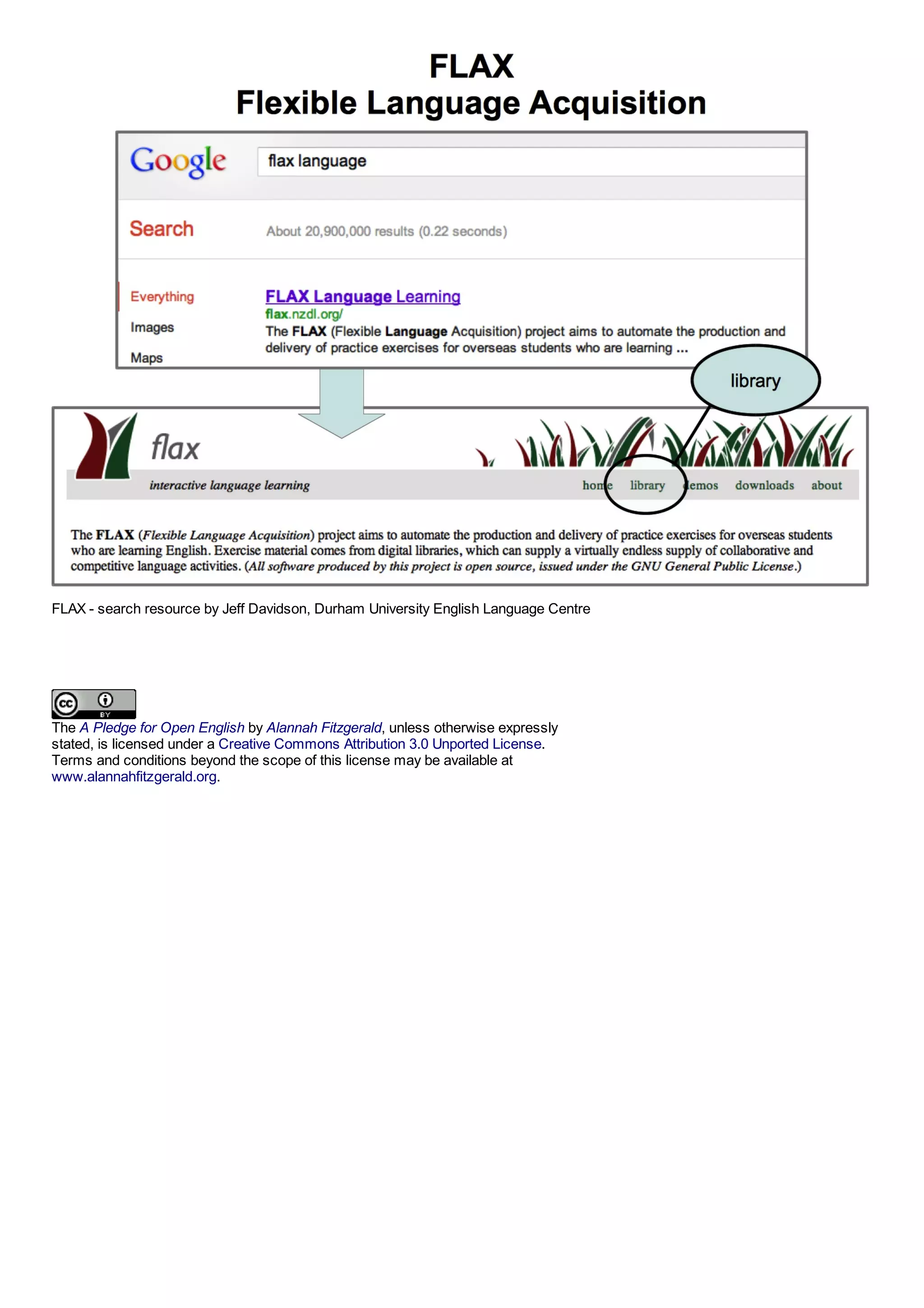
their open English language project, FLAX (the Flexible Language Acquisition
project). The FLAX team are building open corpora and open tools for text analysis
using a combination of both open and proprietary content. A copyrighted reference
corpus such as the British National Corpus (BNC) is enhanced within the FLAX
project by being linked to different open reference corpora such as a Wikipedia and
a Web-derived corpus (released by Google) as well as specialist corpora, including
the copyrighted British Academic Written English (BAWE) corpus, developed by
Nesi, Gardner, Thompson and Wickens between 2004-2007 and housed within the
Oxford Text Archive (OTA).

Oxford University Computing Services (OUCS) manage the OTA along with jointly
managing the BNC which is physically housed at the British Library. The
OpenSpires project is also based at the OUCS and this is where Oxford podcasts
have been made openly available through creative commons licences for use and
re-use in learning and teaching beyond the brick-n-mortar that is Oxford’s UK
campus. Try out the Credit Crunch and Global Recession OER that are based on
an Oxford seminar series and have been enhanced with corpus-based text analysis
resources. Or, make your own resources based on these same seminars to share
with your own learning and teaching communities. In addition to being housed on the
OUCS website these resources, along with many other creative commons-licensed
resources from educational institutions around the world, can also be found on the
Apple channel, iTunesU.

So, it seems there’s quite a bit going on with open English in the UK that’s worth
engaging with, and maybe even making a commitment to sharing with open
educational resources and practices.


                       A finale take-away
Check out FLAX’s new Learning Collocations collection where you can compare
collocations for keyword searches and harvest useful phrases to embed into your
writing, using the BAWE and the BNC along with corpora derived from Wikipedia
and the Web.
FLAX - search resource by Jeff Davidson, Durham University English Language Centre


The A Pledge for Open English by Alannah Fitzgerald, unless otherwise expressly
stated, is licensed under a Creative Commons Attribution 3.0 Unported License.
Terms and conditions beyond the scope of this license may be available at
www.alannahfitzgerald.org.

A Pledge for Open English

  • 1.
    Articles from TOETOETechnology for Open English Toying with Open E- resources (ˈtɔɪtɔɪ) A Pledge for Open English 2012-03-05 00:03:00 admin Princess Mary, Girl Guides, 1922 via Wikimedia Commons Hey, I’m not even British but as part of Open Education Week – March 5-11 – I’ve just signed a pledge with the new UK-based Open Education SIG, an international special interest group with a UK flavour (not flavor:). I attended a meeting held at the Open University in the UK at the end of February to discuss the future of open education in the UK. I am a teaching fellow with the Support Centre for Open Resources in Education (SCORE), one of about 400 people working in UK higher education who have been involved in government- funded open educational resources (OER) projects over the last three years. When we all made our applications for funding to the Joint Information Systems Committee (JISC) and the Higher Education Academy (HEA) in the UK we also made the usual commitment in our proposals to sustaining our OER projects after their funded lifetimes. So, what better way to reinforce this commitment than by signing a renewed pledge to Open Education? While the Cape Town Open Education Declaration has been picked up by many organisations around the world we thought it would be a good idea to re-mix this declaration to make it more personalised for the educational practitioner. What does this all mean for English language teaching practitioners? Frontrunners for technology-enhanced ELT, Russell Stannard and David Deubelbeiss, have also been pushing for more open educational resources and practices within ELT. Recently, I posted a comment on Scott Thornbury’s A-Z of ELT blog regarding the issues of attribution, re-use and the making of derivative resources for teaching English based on original resources created by another author:
  • 2.
    Attribution, Creative Commonslicence via Flickr [One of the things that interests me most about this post and the comments related to it is the issue of attribution to the original work on automaticity by Gatbonton and Segalowitz. Attribution is essential whether you’re sharing resources in closed teaching and learning environments (e.g. classrooms, password-protected virtual learning environments, workshop and continuing professional development spaces) or through publishing channels using copyright or copyleft licences (e.g. books, research articles, blogs, online forum discussions). There is obviously a great amount of sharing and attribution going on in this discussion and the blogging platform is an enabler for this activity. What also interests me is the behaviour around resource enhancement. As Scott outlines in the example here, an original resource from a research article by Gatbonton and Segalowitz was re-formatted into a workshop by Stephen Gaies (presumably with attribution to Gatbonton and Segalowitz). This in turn inspired Scott to engage in further resource gathering to inform his teaching practice while applying the five criteria for automaticity, and this further informed the section on fluency in his book, How to Teach Grammar (presumably with attribution to Gaies but now he realises he should’ve included attribution to Gatbonton and Segalowitz). In its latest iteration we find the same criteria for automaticity here in his blog post containing more ideas on how to apply this approach in language learning and teaching from both Scott and his blogpost readers. This is a great example of resource enhancement via re-use and re-mixing, something which the creative commons suite of licences http://creativecommons.org/ allow materials developers and users to do while maintaining full legal attribution rights for the original developer as well as extended rights to the re-mixer of that resource to create new derivative resources. Legally enabling others to openly re-mix your resources and publish new ones based on them was not possible back in 1988. Arguably, Gatbonton and Segalowitz’s paper with the original criteria on automaticity has stood the test of time because of its enhancement through sharing by Gaies and by the same criteria having been embedded in a further published iteration by Scott in How to Teach Grammar. Times have changed and there is a lot we can now do with digital capabilities for best practice in the use and re-use of resources with attribution still being at the core of the exchange between resource creation and consumption. Except that now with self-publishing and resource sharing platforms, including blogs, it’s a lot easier for all of us to be involved in the resource creation process and to receive attribution for our work in sharing. This coming week, March 5-10, is Open Education Week http://www.openeducationweek.org/ with many great resources on how to openly share your teaching and learning resources along with how to locate, re-use, re-mix and re-distribute with attribution those open educational resources created by others. Why not check it out and see how this activity can apply to ELT?] If you’re new to all of this and have any pesky questions about the business models behind open education, please check out Paul Stacey’s blog, Musings on the Edtech Frontier, with his most recent post on the Economics of Open. So, why the interest in British resources for open English? I’ve been coming in and out of the UK for the past 10 years with my work related to technology-enhanced ELT and EAP. Resources include not only those artifacts that we teach and learn with but also the vibrant communities that come together to share their understandings with peers through open channels of practice. BALEAP, formerly a British organisation (the British Association for Lecturers in English for Academic Purposes) but now with an outreach mandate to become the global
  • 3.
    forum for EAPpractitioners, is such an informal community of practice. Members within BALEAP are actively making up for a deficit in formal EAP training by providing useful resources to both EAP teachers and learners via their website and through lively discussions relevant to current issues in EAP via their mailing list. Because of my interest in corpus linguistics and data-driven language learning, I’ve also been working with exciting practitioners from the world of computer science, namely those working at the open source digital library software lab, Greenstone, at the University of Waikato in New Zealand, to help with the testing and promotion of their open English language project, FLAX (the Flexible Language Acquisition project). The FLAX team are building open corpora and open tools for text analysis using a combination of both open and proprietary content. A copyrighted reference corpus such as the British National Corpus (BNC) is enhanced within the FLAX project by being linked to different open reference corpora such as a Wikipedia and a Web-derived corpus (released by Google) as well as specialist corpora, including the copyrighted British Academic Written English (BAWE) corpus, developed by Nesi, Gardner, Thompson and Wickens between 2004-2007 and housed within the Oxford Text Archive (OTA). Oxford University Computing Services (OUCS) manage the OTA along with jointly managing the BNC which is physically housed at the British Library. The OpenSpires project is also based at the OUCS and this is where Oxford podcasts have been made openly available through creative commons licences for use and re-use in learning and teaching beyond the brick-n-mortar that is Oxford’s UK campus. Try out the Credit Crunch and Global Recession OER that are based on an Oxford seminar series and have been enhanced with corpus-based text analysis resources. Or, make your own resources based on these same seminars to share with your own learning and teaching communities. In addition to being housed on the OUCS website these resources, along with many other creative commons-licensed resources from educational institutions around the world, can also be found on the Apple channel, iTunesU. So, it seems there’s quite a bit going on with open English in the UK that’s worth engaging with, and maybe even making a commitment to sharing with open educational resources and practices. A finale take-away Check out FLAX’s new Learning Collocations collection where you can compare collocations for keyword searches and harvest useful phrases to embed into your writing, using the BAWE and the BNC along with corpora derived from Wikipedia and the Web.
  • 4.
    FLAX - searchresource by Jeff Davidson, Durham University English Language Centre The A Pledge for Open English by Alannah Fitzgerald, unless otherwise expressly stated, is licensed under a Creative Commons Attribution 3.0 Unported License. Terms and conditions beyond the scope of this license may be available at www.alannahfitzgerald.org.