Machine Learning Live


        Clojure Conj 2012
         Mike Anderson

    @mikera   mike@nuroko.com
Machine Learning – A definition


               "Field of study that gives computers
               the ability to learn without being
               explicitly programmed.“

                               Arthur Samuel, 1959


Source: Good Old Wikipedia                            2
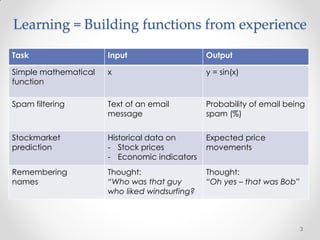
Learning = Building functions from experience

Task                  Input                    Output

Simple mathematical   x                        y = sin(x)
function

Spam filtering        Text of an email         Probability of email being
                      message                  spam (%)

Stockmarket           Historical data on       Expected price
prediction            - Stock prices           movements
                      - Economic indicators
Remembering           Thought:                 Thought:
names                 “Who was that guy        “Oh yes – that was Bob”
                      who liked windsurfing?


                                                                         3
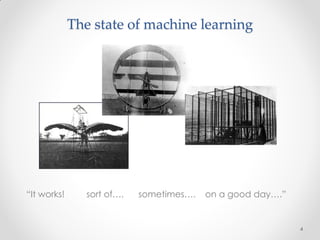
The state of machine learning


“It works!      sort of….   sometimes….   on a good day….”


                                                             4
nuroko.com

We’re building a toolkit for machine learning that is:

• General purpose – works on any data

• Powerful – advanced algorithms to detect complex patterns

• Scalable – handle unlimited data at internet scale

• Realtime – suitable for online use in real applications

• Pragmatic – designed for solving real problems


                                                              5
Why Clojure?

       Productivity and fun!

       Good parts of the JVM


REPL
       Interactive experiments

       Functional programming

       DSLs with composable abstractions


                                           6
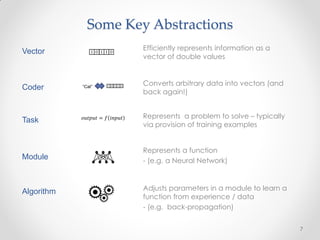
Some Key Abstractions
Vector          1 0 1 1 0
                                   Efficiently represents information as a
                                   vector of double values


                                   Converts arbitrary data into vectors (and
Coder       “Cat”      1 0 1 1 0

                                   back again!)


            𝑜𝑢𝑡𝑝𝑢𝑡 = 𝑓 𝑖𝑛𝑝𝑢𝑡       Represents a problem to solve – typically
Task
                                   via provision of training examples


                                   Represents a function
Module                             - (e.g. a Neural Network)


Algorithm                          Adjusts parameters in a module to learn a
                                   function from experience / data
                                   - (e.g. back-propagation)


                                                                               7
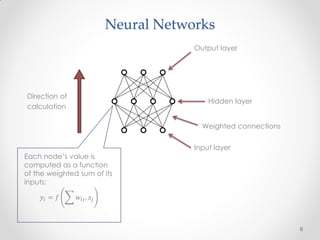
Neural Networks
                                        Output layer


Direction of
                                            Hidden layer
calculation

                                          Weighted connections


                                        Input layer
Each node’s value is
computed as a function
of the weighted sum of its
inputs:

     𝑦𝑖 = 𝑓    𝑤 𝑖𝑗 . 𝑥 𝑗


                                                                 8
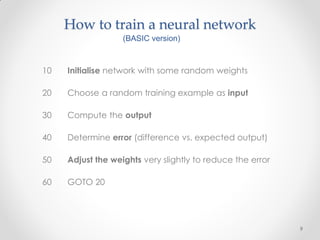
How to train a neural network
                   (BASIC version)


10   Initialise network with some random weights

20   Choose a random training example as input

30   Compute the output

40   Determine error (difference vs. expected output)

50   Adjust the weights very slightly to reduce the error

60   GOTO 20


                                                            9
Live Demo – Part 1


                     10
A harder problem….


                     11
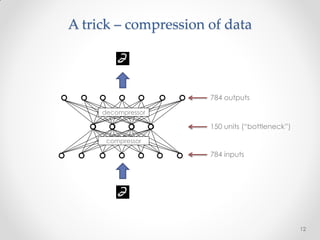
A trick – compression of data


                      784 outputs

     decompressor

                      150 units (“bottleneck”)

      compressor

                      784 inputs


                                                 12
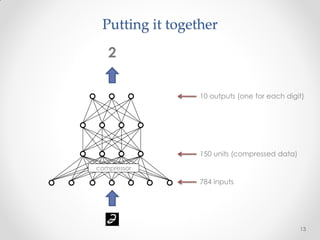
Putting it together

   2

                 10 outputs (one for each digit)


                 150 units (compressed data)
compressor

                 784 inputs


                                               13
Live Demo – Part 2


                     14
Questions?


             15

Machine Learning Live

  • 1.
    Machine Learning Live Clojure Conj 2012 Mike Anderson @mikera mike@nuroko.com
  • 2.
    Machine Learning –A definition "Field of study that gives computers the ability to learn without being explicitly programmed.“ Arthur Samuel, 1959 Source: Good Old Wikipedia 2
  • 3.
    Learning = Buildingfunctions from experience Task Input Output Simple mathematical x y = sin(x) function Spam filtering Text of an email Probability of email being message spam (%) Stockmarket Historical data on Expected price prediction - Stock prices movements - Economic indicators Remembering Thought: Thought: names “Who was that guy “Oh yes – that was Bob” who liked windsurfing? 3
  • 4.
    The state ofmachine learning “It works! sort of…. sometimes…. on a good day….” 4
  • 5.
    nuroko.com We’re building atoolkit for machine learning that is: • General purpose – works on any data • Powerful – advanced algorithms to detect complex patterns • Scalable – handle unlimited data at internet scale • Realtime – suitable for online use in real applications • Pragmatic – designed for solving real problems 5
  • 6.
    Why Clojure? Productivity and fun! Good parts of the JVM REPL Interactive experiments Functional programming DSLs with composable abstractions 6
  • 7.
    Some Key Abstractions Vector 1 0 1 1 0 Efficiently represents information as a vector of double values Converts arbitrary data into vectors (and Coder “Cat” 1 0 1 1 0 back again!) 𝑜𝑢𝑡𝑝𝑢𝑡 = 𝑓 𝑖𝑛𝑝𝑢𝑡 Represents a problem to solve – typically Task via provision of training examples Represents a function Module - (e.g. a Neural Network) Algorithm Adjusts parameters in a module to learn a function from experience / data - (e.g. back-propagation) 7
  • 8.
    Neural Networks Output layer Direction of Hidden layer calculation Weighted connections Input layer Each node’s value is computed as a function of the weighted sum of its inputs: 𝑦𝑖 = 𝑓 𝑤 𝑖𝑗 . 𝑥 𝑗 8
  • 9.
    How to traina neural network (BASIC version) 10 Initialise network with some random weights 20 Choose a random training example as input 30 Compute the output 40 Determine error (difference vs. expected output) 50 Adjust the weights very slightly to reduce the error 60 GOTO 20 9
  • 10.
    Live Demo –Part 1 10
  • 11.
  • 12.
    A trick –compression of data 784 outputs decompressor 150 units (“bottleneck”) compressor 784 inputs 12
  • 13.
    Putting it together 2 10 outputs (one for each digit) 150 units (compressed data) compressor 784 inputs 13
  • 14.
    Live Demo –Part 2 14
  • 15.