Data types
• Valuesheld in machine location can be classified into basic types such
as integers, characters, reals and Booleans. In addition to basic types,
languages support constructed or structured types that are built up
from simpler types.
• A type expression describes how a data representation is built up. For
example, array [0…99] of char
3.
Contd…
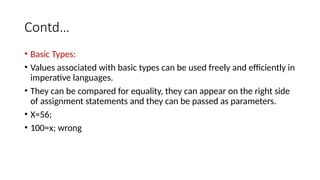
• Basic Types:
•Values associated with basic types can be used freely and efficiently in
imperative languages.
• They can be compared for equality, they can appear on the right side
of assignment statements and they can be passed as parameters.
• X=56;
• 100=x; wrong
4.
Datatypes
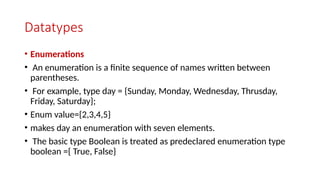
• Enumerations
• Anenumeration is a finite sequence of names written between
parentheses.
• For example, type day = {Sunday, Monday, Wednesday, Thrusday,
Friday, Saturday};
• Enum value={2,3,4,5}
• makes day an enumeration with seven elements.
• The basic type Boolean is treated as predeclared enumeration type
boolean ={ True, False}
5.
Datatypes
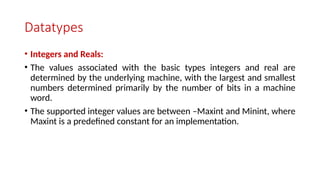
• Integers andReals:
• The values associated with the basic types integers and real are
determined by the underlying machine, with the largest and smallest
numbers determined primarily by the number of bits in a machine
word.
• The supported integer values are between –Maxint and Minint, where
Maxint is a predefined constant for an implementation.
6.
Ranges of datatype
•Subranges:
• Subranges are a special case of basic types because they restrict the
range of values of an existing type. An example is the subrange 0 .. 99,
which restricts attention to the integer values o through 99. The value
of the underlying type must be integers or they must be of some
enumerated type, subranges of reals are not permitted.
• The syntax of a subrange in Pascal is …
• <constant1>…<constant2>
• Subranges are typically used for array bounds.
7.
Contd…
• Arrays: Sequenceof Elements of same type.
• Array is a data structure that holds a sequence of elements of the
same type. A[i] ith element of array that can be quickly accessed for
any value of i at runtime
• Array Types:
An array type specifies the index of the first and last elements of the
array and the type of all the elements.
• index of first element lower bound
• index of last element upper bound
8.
Contd…
Array Layout
The layoutof an array determines the machine address of an element
A[i] relative to the address of first element.
Relative Addresses:
var A : array [low .. high] of T
Let w be the width of each array element
If A[low] begins at location base then A[low+1] begins at base + w,
A[low+2] at base + 2 * w and so on.
100 102
9.
Contd…
• Efficient AddressComputation:
• The addresses of an array element can be computed in two parts.
• A part that can be precomputed as soon as the array is declared
• A part that has to be computed at runtime because it depends on the value of an
array subscript.
• The address of A[i] can be expressed as i*w + (base – low * w) where i*w has to be
computed at run time and (base – low * w) can be precomputed.
• In C, the first element is the zeroth element; so low=0. Hence formula becomes
i*w + base.
• The subexpression (base – low * w) can be precomputed and stored, say c. The
address of A[i] can be computed as i* w + c
10.
Layout and allocation
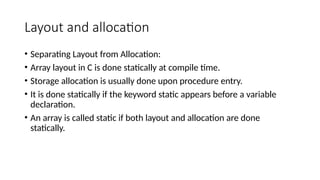
•Separating Layout from Allocation:
• Array layout in C is done statically at compile time.
• Storage allocation is usually done upon procedure entry.
• It is done statically if the keyword static appears before a variable
declaration.
• An array is called static if both layout and allocation are done
statically.
11.
ex
• The followingC procedure produce declares two arrays, buffer and
temp.
• int produce()
• {
• static char buffer[128];
• char temp[128];
• . . .
• }
12.
Contd…
• The keywordstatic identifies buffer as a static array, so its storage is
allocated at compile time and its elements retain their values across
calls of produce.
• Storage for array temp is allocated afresh each time control enters
procedure produce.
• Pascal does not allow static arrays.
13.
Contd…
• Static andDynamic Array Bounds:
• Static evaluation:
• Array bounds are computed at compile time.
• Pascal allows bounds like [xmin .. xmax] where xmin and xmax are
constants.
• C allows constant expressions.
• Evaluation upon procedure entry:
• In Algol 60, array bounds were computed when control entered a procedure.
14.
Contd…
• Dynamic Evaluation:
•In C++, an expression of the form new char[size] can be evaluated at
any time.
• It uses the current value of size at run time to allocate an array of size
elements, with lower bound 0 and upper bound size-1.
15.
Contd…
• Array Valuesand Initialization
• An array initializer is a sequence of values for array elements.
Initializers can be used only in declarations to initialize an array
variable. For example,
• int coin[] = {1, 2, 5, 10, 20, 50, 100,500,2000};
• Since array bound is not specified, the size of array coin is taken from
the number of elements on the right side. i.e., 7 (from coin[0] to
coin[6])

![Data types
• Values held in machine location can be classified into basic types such
as integers, characters, reals and Booleans. In addition to basic types,
languages support constructed or structured types that are built up
from simpler types.
• A type expression describes how a data representation is built up. For
example, array [0…99] of char](https://image.slidesharecdn.com/datatypes-250722052120-81823684/85/datatypes-in-java-helpfull-for-collage-students-pptx-2-320.jpg)

![Contd…
• Arrays: Sequence of Elements of same type.
• Array is a data structure that holds a sequence of elements of the
same type. A[i] ith element of array that can be quickly accessed for
any value of i at runtime
• Array Types:
An array type specifies the index of the first and last elements of the
array and the type of all the elements.
• index of first element lower bound
• index of last element upper bound](https://image.slidesharecdn.com/datatypes-250722052120-81823684/85/datatypes-in-java-helpfull-for-collage-students-pptx-7-320.jpg)
![Contd…
Array Layout
The layout of an array determines the machine address of an element
A[i] relative to the address of first element.
Relative Addresses:
var A : array [low .. high] of T
Let w be the width of each array element
If A[low] begins at location base then A[low+1] begins at base + w,
A[low+2] at base + 2 * w and so on.
100 102](https://image.slidesharecdn.com/datatypes-250722052120-81823684/85/datatypes-in-java-helpfull-for-collage-students-pptx-8-320.jpg)
![Contd…
• Efficient Address Computation:
• The addresses of an array element can be computed in two parts.
• A part that can be precomputed as soon as the array is declared
• A part that has to be computed at runtime because it depends on the value of an
array subscript.
• The address of A[i] can be expressed as i*w + (base – low * w) where i*w has to be
computed at run time and (base – low * w) can be precomputed.
• In C, the first element is the zeroth element; so low=0. Hence formula becomes
i*w + base.
• The subexpression (base – low * w) can be precomputed and stored, say c. The
address of A[i] can be computed as i* w + c](https://image.slidesharecdn.com/datatypes-250722052120-81823684/85/datatypes-in-java-helpfull-for-collage-students-pptx-9-320.jpg)
![ex
• The following C procedure produce declares two arrays, buffer and
temp.
• int produce()
• {
• static char buffer[128];
• char temp[128];
• . . .
• }](https://image.slidesharecdn.com/datatypes-250722052120-81823684/85/datatypes-in-java-helpfull-for-collage-students-pptx-11-320.jpg)

![Contd…
• Static and Dynamic Array Bounds:
• Static evaluation:
• Array bounds are computed at compile time.
• Pascal allows bounds like [xmin .. xmax] where xmin and xmax are
constants.
• C allows constant expressions.
• Evaluation upon procedure entry:
• In Algol 60, array bounds were computed when control entered a procedure.](https://image.slidesharecdn.com/datatypes-250722052120-81823684/85/datatypes-in-java-helpfull-for-collage-students-pptx-13-320.jpg)
![Contd…
• Dynamic Evaluation:
• In C++, an expression of the form new char[size] can be evaluated at
any time.
• It uses the current value of size at run time to allocate an array of size
elements, with lower bound 0 and upper bound size-1.](https://image.slidesharecdn.com/datatypes-250722052120-81823684/85/datatypes-in-java-helpfull-for-collage-students-pptx-14-320.jpg)
![Contd…
• Array Values and Initialization
• An array initializer is a sequence of values for array elements.
Initializers can be used only in declarations to initialize an array
variable. For example,
• int coin[] = {1, 2, 5, 10, 20, 50, 100,500,2000};
• Since array bound is not specified, the size of array coin is taken from
the number of elements on the right side. i.e., 7 (from coin[0] to
coin[6])](https://image.slidesharecdn.com/datatypes-250722052120-81823684/85/datatypes-in-java-helpfull-for-collage-students-pptx-15-320.jpg)


