PLASTIC
Ms. Waszolek
Ag Science
October 2011
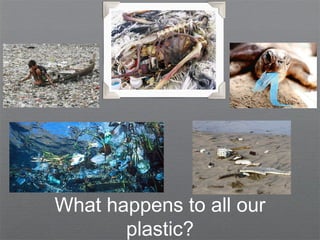
What happens to all our
plastic?
The Problem...
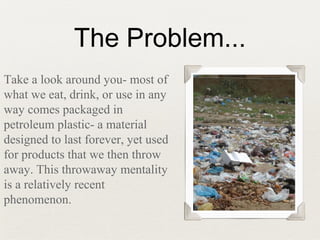
Take a look around you- most of
what we eat, drink, or use in any
way comes packaged in
petroleum plastic- a material
designed to last forever, yet used
for products that we then throw
away. This throwaway mentality
is a relatively recent
phenomenon.
This throwaway mentality is a
relatively recent phenomenon.
Just a generation ago, we
packaged our products in
reusable or recyclable materials
– glass, metals, and paper, and
designed products that would
last. Today, our landfills and
beaches are awash in plastic
packaging, and expendable
products that have no value at
the end of their short lifecycle.
✦ Popular science suggests that it takes a plastic water bottle 450
to 1000 years to completely biodegrade. To make matters
worse, the compounds that common plastics breaks down to
can be described as hazardous at best. The actual amount of
time depends on the conditions the bottles are placed in, but the
message should be crystal clear: it takes a long time. Plastics
cannot be incinerated using low heat incinerators (like those
used at most trash to power plants) because the combustion
creates one of the most deadly gases humanity has discovered,
Dioxin. Dioxin is a organic compound class that includes Agent
Orange, produced by Monsanto during the Vietnam War. The
greatest threat of dioxins is not the immediate deaths and
ecological destruction, but the residual effects and birth defects
that destroy the lives of generation after generation.
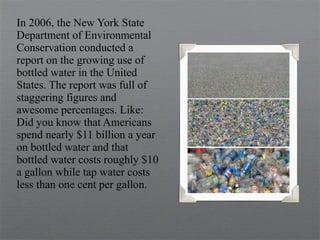
In 2006, the New York State
Department of Environmental
Conservation conducted a
report on the growing use of
bottled water in the United
States. The report was full of
staggering figures and
awesome percentages. Like:
Did you know that Americans
spend nearly $11 billion a year
on bottled water and that
bottled water costs roughly $10
a gallon while tap water costs
less than one cent per gallon.
✦ While most bottled water in the U.S. does come
from springs or underground reservoirs, 25% of
bottlers simply sell packaged tap water. In truth, it is
a brilliant business model: let the city do all the
costly and energy demanding work to filter, treat,
and chlorinate the water supply before placing it in
cheap plastic bottles and selling it at hundreds of
times the production cost. If you drink Pepsi’s
Aquifina or Coke’s Dasani, you are most likely
drinking processed tap water. If the label says
“purified” or “drinking water,” that is a sign that the
water is not coming from a glistening mountain
stream like the image suggests.
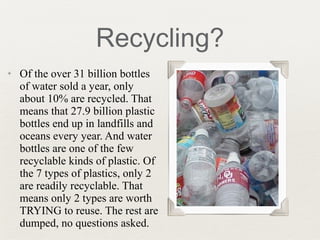
✦ Of the over 31 billion bottles
of water sold a year, only
about 10% are recycled. That
means that 27.9 billion plastic
bottles end up in landfills and
oceans every year. And water
bottles are one of the few
recyclable kinds of plastic. Of
the 7 types of plastics, only 2
are readily recyclable. That
means only 2 types are worth
TRYING to reuse. The rest are
dumped, no questions asked.
Recycling?
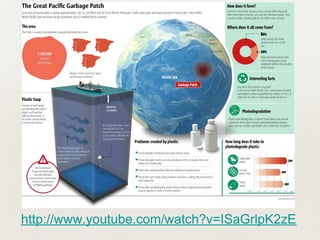
http://www.youtube.com/watch?v=ISaGrlpK2zE
What is being done?
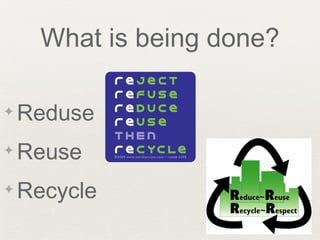
✦ Reduse
✦ Reuse
✦ Recycle
What is being done?
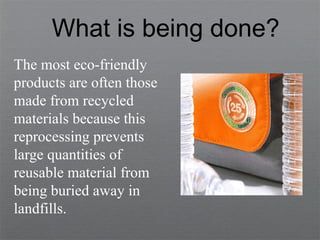
The most eco-friendly
products are often those
made from recycled
materials because this
reprocessing prevents
large quantities of
reusable material from
being buried away in
landfills.
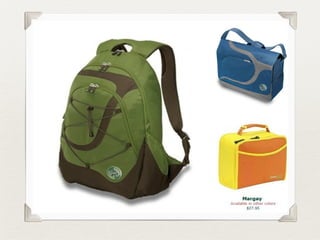
The people at GreenSmart are using recycled plastic bottles to
produce a fabric-like material that can be used to manufacture
backpacks, laptop sleeves, messenger bags, and other simple
products. This recycled plastic fabric is a safe and environmentally
friendly use for tons upon tons of discarded plastic water bottles,
bottles that if placed in a landfill would practically never
decompose.
This fabric is made by collecting bottles, grinding the plastic into
flakes, removing any impurities (i.e. any non-plastic material), and
forming the bits of plastic into fiber through a process known as
polymerization. This raw fiber is finally spun, just like wool or
cotton, into yarn and woven into the fabrics that compose
GreenSmart’s products. According to Greensmart, the fabric
production process uses less energy than making polyester out of
refined petroleum, adding even greater credibility to the eco-
conscious character of these bags and backpacks.
What is being done?
Plastic Bag Laws
Plastic Bag Laws
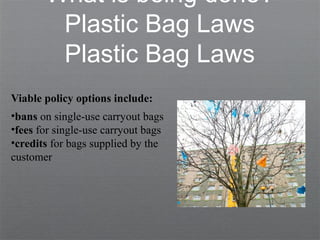
Viable policy options include:
•bans on single-use carryout bags
•fees for single-use carryout bags
•credits for bags supplied by the
customer
4 key strategies for a plastic free
life
4 key strategies for a plastic free
life
✦ #1: Expect failure!!
As the team of bloggers over at Growing a Greener World put it, this is one challenge in which
failure is almost certain—and that’s OK. As we said from the beginning, completely eliminating
all plastic from your life is impossible. Even the stuff you try to avoid will sometimes creep past
your defenses, so rather than stress about a mistake or moment of weakness, just accept it and
keep trying.
#2: Prioritize.
Deciding to go (mostly) plastic-free can easily leave you feeling overwhelmed. Each of us
experienced that sensation, and many of you wrote or commented about that too. So it’s a good
idea to start by IDing some of the bigger plastic inputs in your life, and work on those. Once
you’ve established a plastic-free habit, you can move on to the next one on your list.
Here are some tips to get you started...
✦ Focus on food.
Following the lead of Beth Terry’s blog MyPlasticFreeLife.com, we each surveyed a week’s worth of trash to see how we generated
most of our plastic garbage. If you’re anything like us, you’ll find that food packaging is your number one source of plastic
waste. Along with sheer volume, there are other reasons that food-related plastic is a good place to focus your efforts.
Chemicals from plastic packaging and containers leach into the stuff we eat and drink, and therefore have the biggest potential
impact on our immediate health.
In addition to avoiding over-packaged foods at the supermarket, swap out plastic food-storage containers and cooking utensils and
replace them with glass, ceramic, wood, or other materials. And never heating up food in any kind of plastic is a pretty easy
rule to follow.
• Ban those bags.
If you forget your reusable bags at the grocery store, carry your items out by hand. After doing that a few times, you’ll probably
NEVER forget your bags again! If you do find yourself with more items than you can carry, why not use a cart to get them to
the car without bags? At the very least, use as few shopping bags as possible (and don’t bag items that already come in bags,
like those oranges or potatoes).
Bring the plastic bags to back to the supermarket for recycling (along with any other stray plastic bags that find their way into your
hands). Make it easier on yourself to remember your reusable bags for your next trip by stashing them with your shopper’s club
cards, or in your car’s trunk or glove compartment.
• Stop using stupid plastic.
Some plastic is just pointless. A straw? Would it kill you to let your lip touch the glass? A plastic bag just to hold the greeting card
you bought? Carry it in your hand! Plastic fork? It’ll probably break! Wash your hands and eat with your fingers. Plastic
Halloween decorations? Use real bones! (If you eat meat, that is. Otherwise, probably not!)
✦ #3: Slow down.
Plastic exists to support the go-go-go lifestyle that we all think we need to maintain.
Committing to cutting back on plastic gives you a reason to insert some helpful
speed bumps into your day. So enjoy them! Take 10 extra minutes to eat breakfast at
home, for example, or use a full 30 minutes to eat lunch at a restaurant, off glass
plates using real silverware, rather than grabbing something packaged in plastic to
eat at your desk. Along with the benefits of avoiding plastic, you’ll gain an
opportunity to catch your breath, enjoy your food, and let go of some stress.
#4: Don’t be a jerk about it.
None of your plastic-addicted friends wants to hear a lecture about the evils of
plastic (ours sure didn’t). Be relaxed and nonjudgmental when you talk about your
decision to cut the plastic cord. Focus on why the alternative is better, not on why
plastic and the people who use it are evil. And let your deeds, rather than your
words, be the strongest argument.
Every time you tell a cashier you don’t need a bag, and walk out of the story carrying
your carton of milk in your hand instead, you’re planting an idea in the head of
everyone around you. And that’s how new norms are created.
✦ http://www.5gyres.org/what_is_the_problem
✦ http://www.teachpeace.com/plastic_bag_free_camp.h
✦ http://electrictreehouse.com/tag/plastic-water-bottles/
✦ http://today.msnbc.msn.com/id/5467759/ns/today-foo
✦ http://plasticbaglaws.org/
✦ http://www.care2.com/greenliving/5-key-strategies-
for-a-plastic-free-life.html?page=4
REFERENCES

Plastic1

  • 1.
  • 2.
    What happens toall our plastic?
  • 3.
    The Problem... Take alook around you- most of what we eat, drink, or use in any way comes packaged in petroleum plastic- a material designed to last forever, yet used for products that we then throw away. This throwaway mentality is a relatively recent phenomenon.
  • 5.
    This throwaway mentalityis a relatively recent phenomenon. Just a generation ago, we packaged our products in reusable or recyclable materials – glass, metals, and paper, and designed products that would last. Today, our landfills and beaches are awash in plastic packaging, and expendable products that have no value at the end of their short lifecycle.
  • 6.
    ✦ Popular sciencesuggests that it takes a plastic water bottle 450 to 1000 years to completely biodegrade. To make matters worse, the compounds that common plastics breaks down to can be described as hazardous at best. The actual amount of time depends on the conditions the bottles are placed in, but the message should be crystal clear: it takes a long time. Plastics cannot be incinerated using low heat incinerators (like those used at most trash to power plants) because the combustion creates one of the most deadly gases humanity has discovered, Dioxin. Dioxin is a organic compound class that includes Agent Orange, produced by Monsanto during the Vietnam War. The greatest threat of dioxins is not the immediate deaths and ecological destruction, but the residual effects and birth defects that destroy the lives of generation after generation.
  • 7.
    In 2006, theNew York State Department of Environmental Conservation conducted a report on the growing use of bottled water in the United States. The report was full of staggering figures and awesome percentages. Like: Did you know that Americans spend nearly $11 billion a year on bottled water and that bottled water costs roughly $10 a gallon while tap water costs less than one cent per gallon.
  • 8.
    ✦ While mostbottled water in the U.S. does come from springs or underground reservoirs, 25% of bottlers simply sell packaged tap water. In truth, it is a brilliant business model: let the city do all the costly and energy demanding work to filter, treat, and chlorinate the water supply before placing it in cheap plastic bottles and selling it at hundreds of times the production cost. If you drink Pepsi’s Aquifina or Coke’s Dasani, you are most likely drinking processed tap water. If the label says “purified” or “drinking water,” that is a sign that the water is not coming from a glistening mountain stream like the image suggests.
  • 9.
    ✦ Of theover 31 billion bottles of water sold a year, only about 10% are recycled. That means that 27.9 billion plastic bottles end up in landfills and oceans every year. And water bottles are one of the few recyclable kinds of plastic. Of the 7 types of plastics, only 2 are readily recyclable. That means only 2 types are worth TRYING to reuse. The rest are dumped, no questions asked. Recycling?
  • 10.
  • 11.
    What is beingdone? ✦ Reduse ✦ Reuse ✦ Recycle
  • 12.
    What is beingdone? The most eco-friendly products are often those made from recycled materials because this reprocessing prevents large quantities of reusable material from being buried away in landfills.
  • 13.
    The people atGreenSmart are using recycled plastic bottles to produce a fabric-like material that can be used to manufacture backpacks, laptop sleeves, messenger bags, and other simple products. This recycled plastic fabric is a safe and environmentally friendly use for tons upon tons of discarded plastic water bottles, bottles that if placed in a landfill would practically never decompose. This fabric is made by collecting bottles, grinding the plastic into flakes, removing any impurities (i.e. any non-plastic material), and forming the bits of plastic into fiber through a process known as polymerization. This raw fiber is finally spun, just like wool or cotton, into yarn and woven into the fabrics that compose GreenSmart’s products. According to Greensmart, the fabric production process uses less energy than making polyester out of refined petroleum, adding even greater credibility to the eco- conscious character of these bags and backpacks.
  • 15.
    What is beingdone? Plastic Bag Laws Plastic Bag Laws Viable policy options include: •bans on single-use carryout bags •fees for single-use carryout bags •credits for bags supplied by the customer
  • 16.
    4 key strategiesfor a plastic free life 4 key strategies for a plastic free life ✦ #1: Expect failure!! As the team of bloggers over at Growing a Greener World put it, this is one challenge in which failure is almost certain—and that’s OK. As we said from the beginning, completely eliminating all plastic from your life is impossible. Even the stuff you try to avoid will sometimes creep past your defenses, so rather than stress about a mistake or moment of weakness, just accept it and keep trying. #2: Prioritize. Deciding to go (mostly) plastic-free can easily leave you feeling overwhelmed. Each of us experienced that sensation, and many of you wrote or commented about that too. So it’s a good idea to start by IDing some of the bigger plastic inputs in your life, and work on those. Once you’ve established a plastic-free habit, you can move on to the next one on your list. Here are some tips to get you started...
  • 17.
    ✦ Focus onfood. Following the lead of Beth Terry’s blog MyPlasticFreeLife.com, we each surveyed a week’s worth of trash to see how we generated most of our plastic garbage. If you’re anything like us, you’ll find that food packaging is your number one source of plastic waste. Along with sheer volume, there are other reasons that food-related plastic is a good place to focus your efforts. Chemicals from plastic packaging and containers leach into the stuff we eat and drink, and therefore have the biggest potential impact on our immediate health. In addition to avoiding over-packaged foods at the supermarket, swap out plastic food-storage containers and cooking utensils and replace them with glass, ceramic, wood, or other materials. And never heating up food in any kind of plastic is a pretty easy rule to follow. • Ban those bags. If you forget your reusable bags at the grocery store, carry your items out by hand. After doing that a few times, you’ll probably NEVER forget your bags again! If you do find yourself with more items than you can carry, why not use a cart to get them to the car without bags? At the very least, use as few shopping bags as possible (and don’t bag items that already come in bags, like those oranges or potatoes). Bring the plastic bags to back to the supermarket for recycling (along with any other stray plastic bags that find their way into your hands). Make it easier on yourself to remember your reusable bags for your next trip by stashing them with your shopper’s club cards, or in your car’s trunk or glove compartment. • Stop using stupid plastic. Some plastic is just pointless. A straw? Would it kill you to let your lip touch the glass? A plastic bag just to hold the greeting card you bought? Carry it in your hand! Plastic fork? It’ll probably break! Wash your hands and eat with your fingers. Plastic Halloween decorations? Use real bones! (If you eat meat, that is. Otherwise, probably not!)
  • 18.
    ✦ #3: Slowdown. Plastic exists to support the go-go-go lifestyle that we all think we need to maintain. Committing to cutting back on plastic gives you a reason to insert some helpful speed bumps into your day. So enjoy them! Take 10 extra minutes to eat breakfast at home, for example, or use a full 30 minutes to eat lunch at a restaurant, off glass plates using real silverware, rather than grabbing something packaged in plastic to eat at your desk. Along with the benefits of avoiding plastic, you’ll gain an opportunity to catch your breath, enjoy your food, and let go of some stress. #4: Don’t be a jerk about it. None of your plastic-addicted friends wants to hear a lecture about the evils of plastic (ours sure didn’t). Be relaxed and nonjudgmental when you talk about your decision to cut the plastic cord. Focus on why the alternative is better, not on why plastic and the people who use it are evil. And let your deeds, rather than your words, be the strongest argument. Every time you tell a cashier you don’t need a bag, and walk out of the story carrying your carton of milk in your hand instead, you’re planting an idea in the head of everyone around you. And that’s how new norms are created.
  • 19.
    ✦ http://www.5gyres.org/what_is_the_problem ✦ http://www.teachpeace.com/plastic_bag_free_camp.h ✦http://electrictreehouse.com/tag/plastic-water-bottles/ ✦ http://today.msnbc.msn.com/id/5467759/ns/today-foo ✦ http://plasticbaglaws.org/ ✦ http://www.care2.com/greenliving/5-key-strategies- for-a-plastic-free-life.html?page=4 REFERENCES