PLANT QUARANTINE & SPS MEASURES
By
Abdul Haseeb
What will Students learn?
 The Agreement on the Application of Sanitary and
Phytosanitary Measures (SPS)
 The IPPC and international bodies involved in the
implementation of sanitary and phytosanitary measures
 IPPC and its relationship with other relevant international
treaties
Background
Focus:
 Market access
 Direct and indirect subsidies
 Sanitary and phytosanitary (SPS) measures
Background
Conclusion of Uruguay Round
 Governments meet to sign concluding deal in Marrakech,
1994.
 Agreement on the Application of Sanitary and Phytosanitary
Measures is approved.
 The Agreement enters into force January 1, 1995.
 WTO is established as an international organization dealing
with the rules of trade between nations.
The World Trade Organization (WTO)
Functions
 Administers WTO trade agreements
 Serves as a forum for trade negotiations
 Handles trade disputes
 Monitors national trade policies
 Provides technical assistance to developing countries
 Cooperates with other international organizations
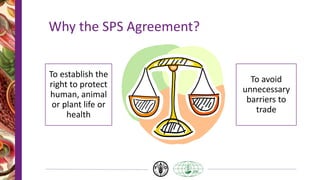
Why the SPS Agreement?
To establish the
right to protect
human, animal
or plant life or
health
To avoid
unnecessary
barriers to
trade
The three Departments of the SPS
Agreement
International standard setting bodies
 Codex Alimentarius Commission (CAC)
 World Organization for Animal Health (OIE)
 International Plant Protection Convention (IPPC)
Codex Alimentarius Commission (CAC)
Sets standards, guidelines and recommendations for
food safety
 Food additives
 Veterinary drugs and pesticide residues
 Contaminants
 Methods of analysis and sampling
 Codes of hygiene practices
World Organization for Animal Health (OIE)
 Sets international standards, guidelines and
recommendations for animal health
 Informs governments of occurrence and control of animal
diseases worldwide
 Coordinates studies on surveillance and control of animal
diseases
 Facilitates trade in animals and animal products
The International Plant
Protection Convention
Sets international standards, guidelines and
recommendations for plant health
 To prevent the spread and introduction of pests of plants and
plant products
 To cooperate in controlling pests of plants and plant products
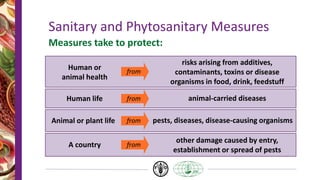
Sanitary and Phytosanitary Measures
Measures take to protect:
Human life animal-carried diseases
from
Animal or plant life pests, diseases, disease-causing organisms
from
Human or
animal health
risks arising from additives,
contaminants, toxins or disease
organisms in food, drink, feedstuff
from
A country
other damage caused by entry,
establishment or spread of pests
from
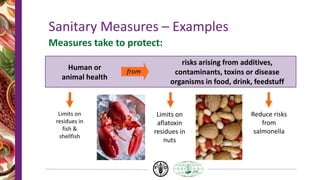
Sanitary Measures – Examples
Measures take to protect:
Human or
animal health
risks arising from additives,
contaminants, toxins or disease
organisms in food, drink, feedstuff
from
Limits on
residues in
fish &
shellfish
Limits on
aflatoxin
residues in
nuts
Reduce risks
from
salmonella
Sanitary Measures – Examples
Measures take to protect:
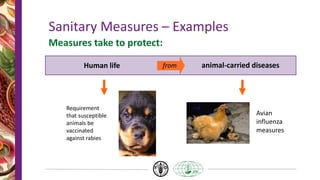
Requirement
that susceptible
animals be
vaccinated
against rabies
Avian
influenza
measures
Human life animal-carried diseases
from
Sanitary Measures – Examples
Measures take to protect:
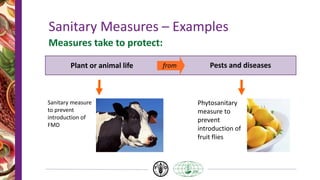
Sanitary measure
to prevent
introduction of
FMD
Phytosanitary
measure to
prevent
introduction of
fruit flies
Plant or animal life Pests and diseases
from
What is the IPPC?
 A multilateral treaty for international cooperation in plant
protection
 The global instrument for the development and application of
harmonized phytosanitary measures
 The phytosanitary standard-setting organization named in
the WTO SPS Agreement and recognized by the CBD
IPPC historical timeline
12 Country
Agreement
Phylloxera
vastatrix
Convention
IPPC text
Revised
182 Contracting
Parties, RPPOs.
WTO and CBD
recognized
Original Text
Adopted
1952 Plant
Health
Agreement
IPPC revised
WTO – SPS
Agreement
(1995)
1881 1951 1979 1997 2015
IPPC revision
Revised in 1997 to align the Convention with the
Agreement on the Application of Sanitary and
Phytosanitary Measures
Revised text of the IPPC
Article 1: Purpose and Responsibility
To secure common and effective action to prevent the spread
and introduction of pests of plants and plant products and to
promote appropriate measures for their control, the contracting
parties undertake to adopt the legislative, technical and
administrative measures specified in this Convention and in
supplementary agreements
Achieving the aims of the IPPC
 Contracting parties establish National Plant Protection
Organizations (NPPOs) as the sole national authorities for
plant health
 Regional Plant Protection Organizations (RPPOs) assist their
regions to implement the IPPC and its International Standards
for Phytosanitary Measures (ISPMs)
Principles underlying
phytosanitary measures
Phytosanitary measures should
 Not be trade barriers in disguise
 Not discriminate among trading partners
 Be harmonized and based on science
 Be submitted to a process of recognition of equivalence, if
requested by the exporting country
 Be established through a transparent process
Other international treaties
The Convention on Biological Diversity (CBD)
 The CBD and IPPC share key objectives of protecting the
environment and biodiversity.
 Among others, Article 8(h) of the CBD requires each contracting
party to “prevent the introduction of, control or eradicate those
alien species which threaten ecosystems, habitats or species.”
 Since most invasive species can be categorized as plant pests, the
CBD reinforces governments’ responsibility to address those threats
through phytosanitary legislation.
Other international treaties
Cartagena Protocol (CP)
 Adopted in Montreal on 29 January 2000
 To contribute to ensuring an adequate level of protection in
the field of the safe transfer, handling and use of living
modified organisms resulting from modern biotechnology that
may have adverse effects on the conservation and sustainable
use of biological diversity, taking also into account risks to
human health, and specifically focusing on transboundary
movements
Other international treaties
The Convention on International Trade in Endangered
Species of Wild Fauna and Flora (CITES)
 Aims to ensure that international trade in wild animals and
plants does not threaten their survival
 Cross border trade involves, for example, plants including
food products, exotic leather goods, wooden musical
instruments, timber and tourist curios, all of which may be
regulated by the NPPO.
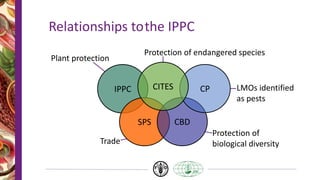
Relationships tothe IPPC
IPPC
SPS CBD
CP
CITES
Plant protection
Protection of endangered species
LMOs identified
as pests
Protection of
biological diversity
Trade
THANKS

PLANT QUARANTINE & SPS MEASURES

  • 1.
    PLANT QUARANTINE &SPS MEASURES By Abdul Haseeb
  • 2.
    What will Studentslearn?  The Agreement on the Application of Sanitary and Phytosanitary Measures (SPS)  The IPPC and international bodies involved in the implementation of sanitary and phytosanitary measures  IPPC and its relationship with other relevant international treaties
  • 3.
    Background Focus:  Market access Direct and indirect subsidies  Sanitary and phytosanitary (SPS) measures
  • 4.
    Background Conclusion of UruguayRound  Governments meet to sign concluding deal in Marrakech, 1994.  Agreement on the Application of Sanitary and Phytosanitary Measures is approved.  The Agreement enters into force January 1, 1995.  WTO is established as an international organization dealing with the rules of trade between nations.
  • 5.
    The World TradeOrganization (WTO) Functions  Administers WTO trade agreements  Serves as a forum for trade negotiations  Handles trade disputes  Monitors national trade policies  Provides technical assistance to developing countries  Cooperates with other international organizations
  • 6.
    Why the SPSAgreement? To establish the right to protect human, animal or plant life or health To avoid unnecessary barriers to trade
  • 7.
    The three Departmentsof the SPS Agreement International standard setting bodies  Codex Alimentarius Commission (CAC)  World Organization for Animal Health (OIE)  International Plant Protection Convention (IPPC)
  • 8.
    Codex Alimentarius Commission(CAC) Sets standards, guidelines and recommendations for food safety  Food additives  Veterinary drugs and pesticide residues  Contaminants  Methods of analysis and sampling  Codes of hygiene practices
  • 9.
    World Organization forAnimal Health (OIE)  Sets international standards, guidelines and recommendations for animal health  Informs governments of occurrence and control of animal diseases worldwide  Coordinates studies on surveillance and control of animal diseases  Facilitates trade in animals and animal products
  • 10.
    The International Plant ProtectionConvention Sets international standards, guidelines and recommendations for plant health  To prevent the spread and introduction of pests of plants and plant products  To cooperate in controlling pests of plants and plant products
  • 11.
    Sanitary and PhytosanitaryMeasures Measures take to protect: Human life animal-carried diseases from Animal or plant life pests, diseases, disease-causing organisms from Human or animal health risks arising from additives, contaminants, toxins or disease organisms in food, drink, feedstuff from A country other damage caused by entry, establishment or spread of pests from
  • 12.
    Sanitary Measures –Examples Measures take to protect: Human or animal health risks arising from additives, contaminants, toxins or disease organisms in food, drink, feedstuff from Limits on residues in fish & shellfish Limits on aflatoxin residues in nuts Reduce risks from salmonella
  • 13.
    Sanitary Measures –Examples Measures take to protect: Requirement that susceptible animals be vaccinated against rabies Avian influenza measures Human life animal-carried diseases from
  • 14.
    Sanitary Measures –Examples Measures take to protect: Sanitary measure to prevent introduction of FMD Phytosanitary measure to prevent introduction of fruit flies Plant or animal life Pests and diseases from
  • 15.
    What is theIPPC?  A multilateral treaty for international cooperation in plant protection  The global instrument for the development and application of harmonized phytosanitary measures  The phytosanitary standard-setting organization named in the WTO SPS Agreement and recognized by the CBD
  • 16.
    IPPC historical timeline 12Country Agreement Phylloxera vastatrix Convention IPPC text Revised 182 Contracting Parties, RPPOs. WTO and CBD recognized Original Text Adopted 1952 Plant Health Agreement IPPC revised WTO – SPS Agreement (1995) 1881 1951 1979 1997 2015
  • 17.
    IPPC revision Revised in1997 to align the Convention with the Agreement on the Application of Sanitary and Phytosanitary Measures
  • 18.
    Revised text ofthe IPPC Article 1: Purpose and Responsibility To secure common and effective action to prevent the spread and introduction of pests of plants and plant products and to promote appropriate measures for their control, the contracting parties undertake to adopt the legislative, technical and administrative measures specified in this Convention and in supplementary agreements
  • 19.
    Achieving the aimsof the IPPC  Contracting parties establish National Plant Protection Organizations (NPPOs) as the sole national authorities for plant health  Regional Plant Protection Organizations (RPPOs) assist their regions to implement the IPPC and its International Standards for Phytosanitary Measures (ISPMs)
  • 20.
    Principles underlying phytosanitary measures Phytosanitarymeasures should  Not be trade barriers in disguise  Not discriminate among trading partners  Be harmonized and based on science  Be submitted to a process of recognition of equivalence, if requested by the exporting country  Be established through a transparent process
  • 21.
    Other international treaties TheConvention on Biological Diversity (CBD)  The CBD and IPPC share key objectives of protecting the environment and biodiversity.  Among others, Article 8(h) of the CBD requires each contracting party to “prevent the introduction of, control or eradicate those alien species which threaten ecosystems, habitats or species.”  Since most invasive species can be categorized as plant pests, the CBD reinforces governments’ responsibility to address those threats through phytosanitary legislation.
  • 22.
    Other international treaties CartagenaProtocol (CP)  Adopted in Montreal on 29 January 2000  To contribute to ensuring an adequate level of protection in the field of the safe transfer, handling and use of living modified organisms resulting from modern biotechnology that may have adverse effects on the conservation and sustainable use of biological diversity, taking also into account risks to human health, and specifically focusing on transboundary movements
  • 23.
    Other international treaties TheConvention on International Trade in Endangered Species of Wild Fauna and Flora (CITES)  Aims to ensure that international trade in wild animals and plants does not threaten their survival  Cross border trade involves, for example, plants including food products, exotic leather goods, wooden musical instruments, timber and tourist curios, all of which may be regulated by the NPPO.
  • 24.
    Relationships tothe IPPC IPPC SPSCBD CP CITES Plant protection Protection of endangered species LMOs identified as pests Protection of biological diversity Trade
  • 25.