PHYTOSANITARY REGIMES OF THE
INTERNATIONAL PLANT PROTECTION
CONVENTION (IPPC)
BY
VINCENT OCHIENG OTIENO
MSC. PLANT BREEDING
BIO-POLICY, SAFETY AND ETHICS
CONTENTS
• INTRODUCTION
• VISION AND MISSION
• HISTORY
• ROLES OF IPPC
• PRINCIPLES AND OBLIGATIONS OF IPPC
• GOVERNANCE STRUCTURE OF IPPC
• PHYTOSANITARY TREATMENTS
• CONCLUSION
INTRODUCTION
The International Plant Protection
Convention (IPPC) is an
intergovernmental treaty signed by
over 180 countries, aiming to
protecting the world's plant resources
from the spread and introduction of
pests, and promoting safe trade.
VISION AND MISSION
Vision
Protecting the world’s plant resources from pests
Mission
To secure cooperation among nations in protecting global plant
resources from the introduction and spread of plant pests, in
order to preserve food security, biodiversity and facilitate
trade.
HISTORY
• 1951: FAO conference initially adopted the convention
• 1979: First revision
• 1992: The IPPC Secretariat was established
• 1997: Revised to be consistent with principles of the WTO-
SPS agreement
• 1997: Current text was adopted in order to align the
convention with WTO SPS agreement
• 2001:The Standards Committee (SC) was established
HISTORY
● 2003: The Subsidiary Body on Dispute Settlement (SBDS)
was established
● 2006: The First Session of the CPM took place when the
CPM accepted all previous decision made by the ICPM
● 2010: The Implementation Review and Support System
(IRSS) was implemented
● 2012: The Financial Committee (FC) and Capacity
Development Committee (CDC) were set up
ROLES OF IPPC
• International framework for protection
of plants from pests
• Standard setting organization
• Facilitates exchange of information
related to import and export
requirements
• Support for capacity development
PRINCIPLES OF IPPC
• Sovereign right to regulate
• Regulate only when necessary
• Measures should be:
• consistent with risk, technically justified, and least
restrictive
• non-discriminatory between countries of same status
• transparent (published)
OBLIGATIONS OF IPPC
• Set up and administer a National Plant Protection
Organization (NPPO)
• Designate an official IPPC contact point
• Certify exports and regulate imports
• Develop and take into account phytosanitary standards
• Meet basic reporting obligations
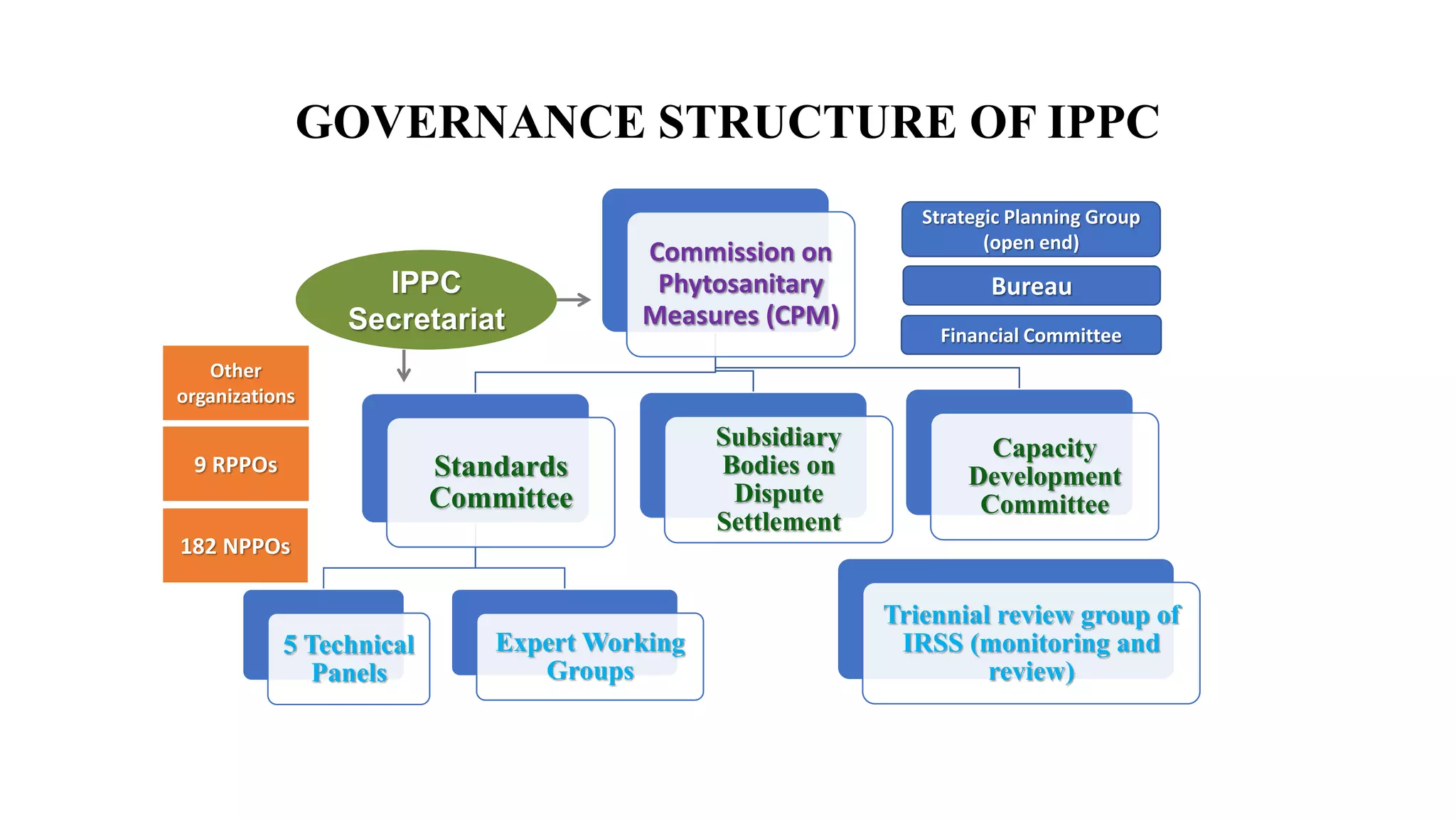
GOVERNANCE STRUCTURE OF IPPC
Commission on
Phytosanitary
Measures (CPM)
Standards
Committee
5 Technical
Panels
Expert Working
Groups
Subsidiary
Bodies on
Dispute
Settlement
Capacity
Development
Committee
Triennial review group of
IRSS (monitoring and
review)
IPPC
Secretariat
Other
organizations
9 RPPOs
182 NPPOs
Strategic Planning Group
(open end)
Bureau
Financial Committee
COMMISSION ON PHYTOSANITARY MEASURES
(CPM)
• Governing body for the IPPC (182 member countries)
• Adopts International Standards for Phytosanitary Measures
(ISPMs)
• Promotes technical assistance and information exchange
• Meets annually
ADMINISTRATIVE BODIES OF CPM
• Bureau (7 members)
• Standards Committee (25 members)
• Subsidiary Body on Dispute Settlement
• Working Groups
STANDARD COMMITTEE (SC)
• Group of 25 international experts from the 7 FAO regions
• Meets two times annually (May, November)
• Oversees the standard setting process
• Approves specifications for ISPMs, approves draft ISPMs for
member consultation, reviews member comments,
recommends ISPMs for adoption by the CPM
• Oversees work of EWGs and TPs
WORKING GROUPS AND PANELS
• Expert working groups
• Many, but small number each year
• Technical Panels
• Technical panel on forest quarantine (TPFQ)
• Technical panel on diagnostic protocols (TPDP)
• Technical panel on phytosanitary treatments (TPPT)
• Technical panel on fruit flies (TPFF)
• Technical panel on glossary (TPG)
SUBSIDIARY BODY ON DISPUTE SETTLEMENT
Activities include:
• Development of dispute settlement procedures
• Maintenance of roster of phytosanitary experts
• Provision of information for the effective preparation of a
dispute settlement
• Group of 7 international experts from the 7 FAO regions
NATIONAL PLANT PROTECTION ORGANIZATION
(NPPO)
• Role: to protect national plant resources from the risks
associated with pests
• Food security: Protect crops to ensure an abundant, high-
quality, and varied food supply
• International trade: Strengthen the marketability of
agriculture in international commerce by meeting import
requirements, including pest risk analysis
• Environmental protection: Preserve natural ecosystems
and horticultural plant resources
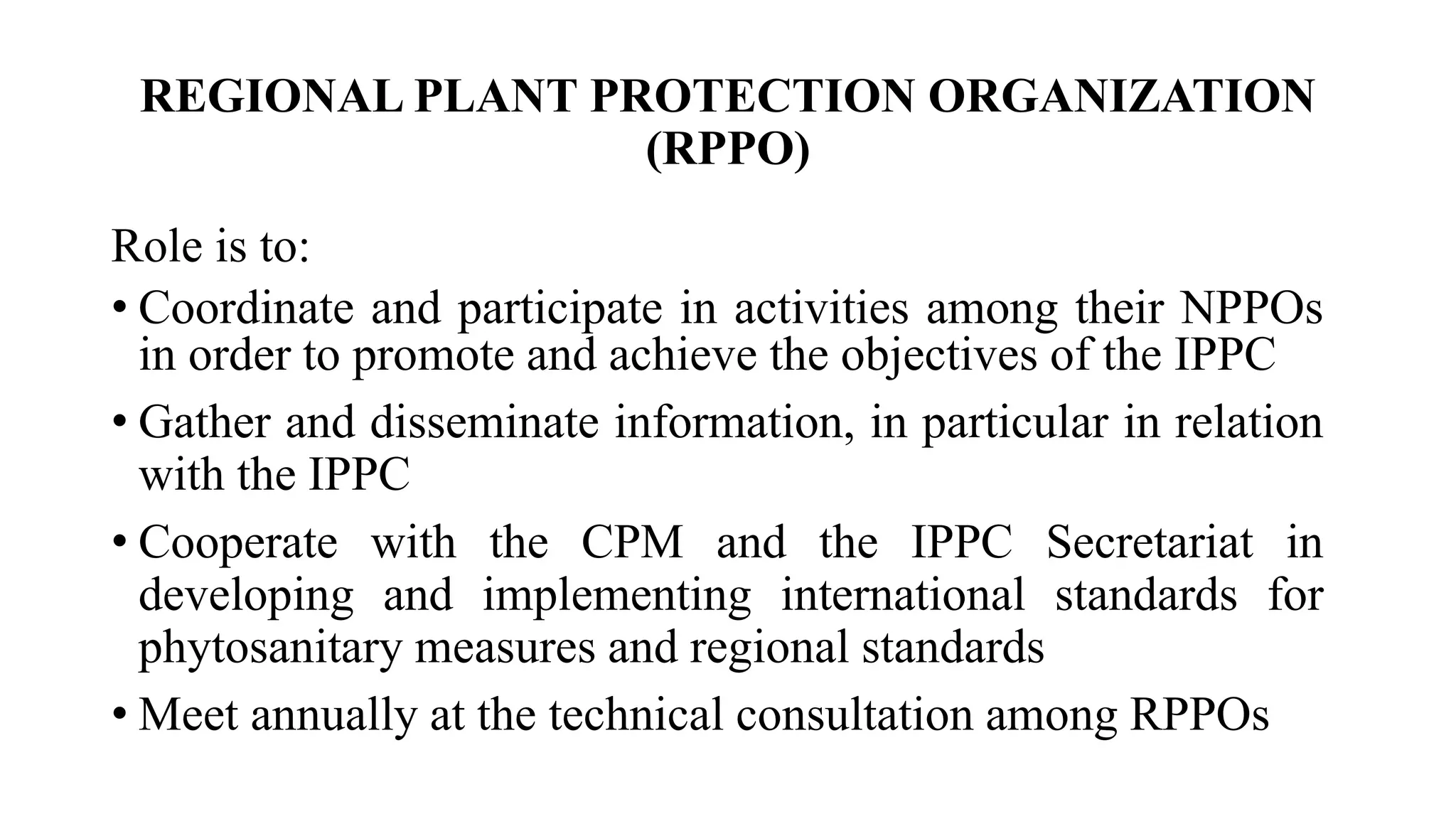
REGIONAL PLANT PROTECTION ORGANIZATION
(RPPO)
Role is to:
• Coordinate and participate in activities among their NPPOs
in order to promote and achieve the objectives of the IPPC
• Gather and disseminate information, in particular in relation
with the IPPC
• Cooperate with the CPM and the IPPC Secretariat in
developing and implementing international standards for
phytosanitary measures and regional standards
• Meet annually at the technical consultation among RPPOs
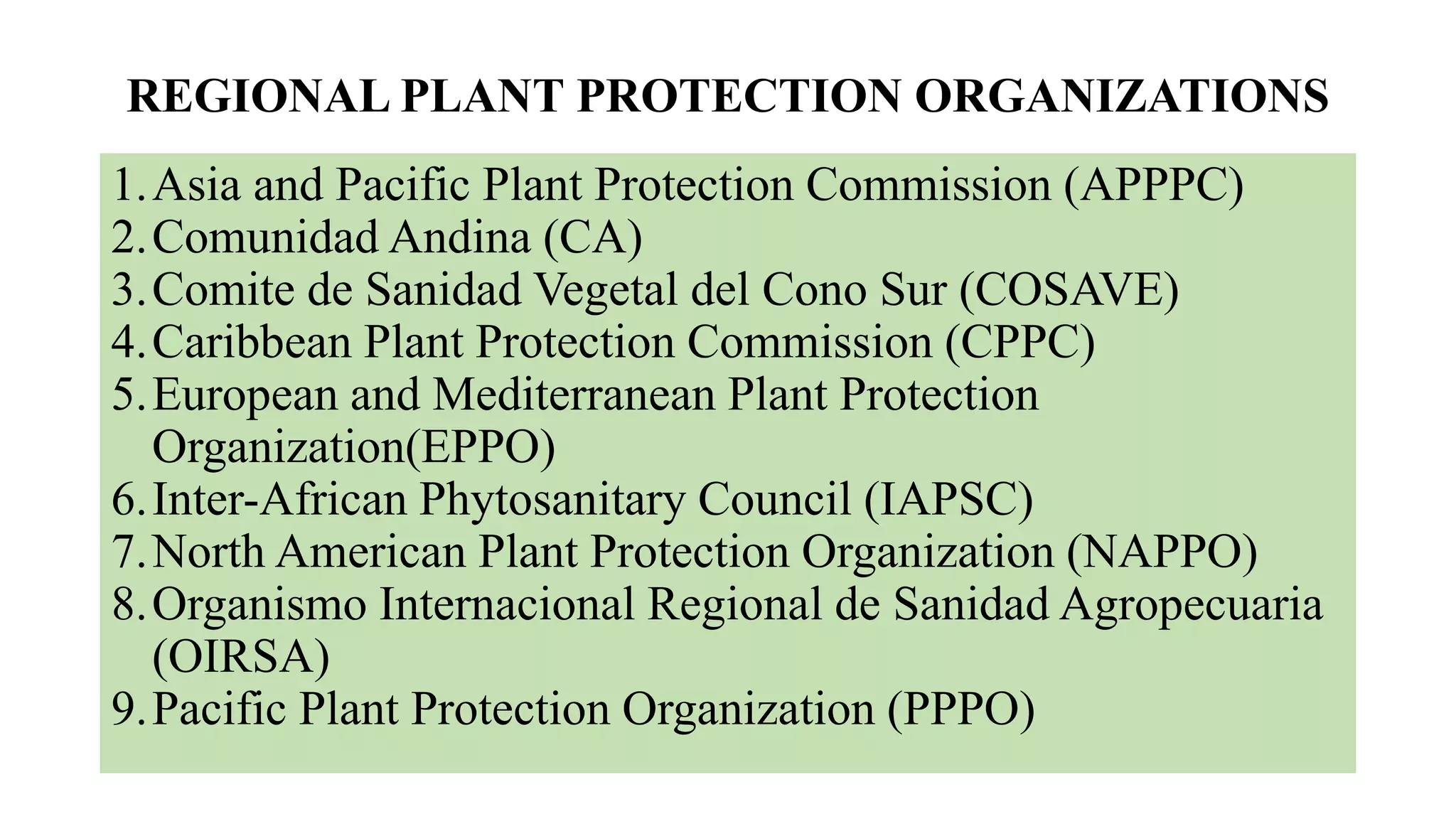
REGIONAL PLANT PROTECTION ORGANIZATIONS
1.Asia and Pacific Plant Protection Commission (APPPC)
2.Comunidad Andina (CA)
3.Comite de Sanidad Vegetal del Cono Sur (COSAVE)
4.Caribbean Plant Protection Commission (CPPC)
5.European and Mediterranean Plant Protection
Organization(EPPO)
6.Inter-African Phytosanitary Council (IAPSC)
7.North American Plant Protection Organization (NAPPO)
8.Organismo Internacional Regional de Sanidad Agropecuaria
(OIRSA)
9.Pacific Plant Protection Organization (PPPO)
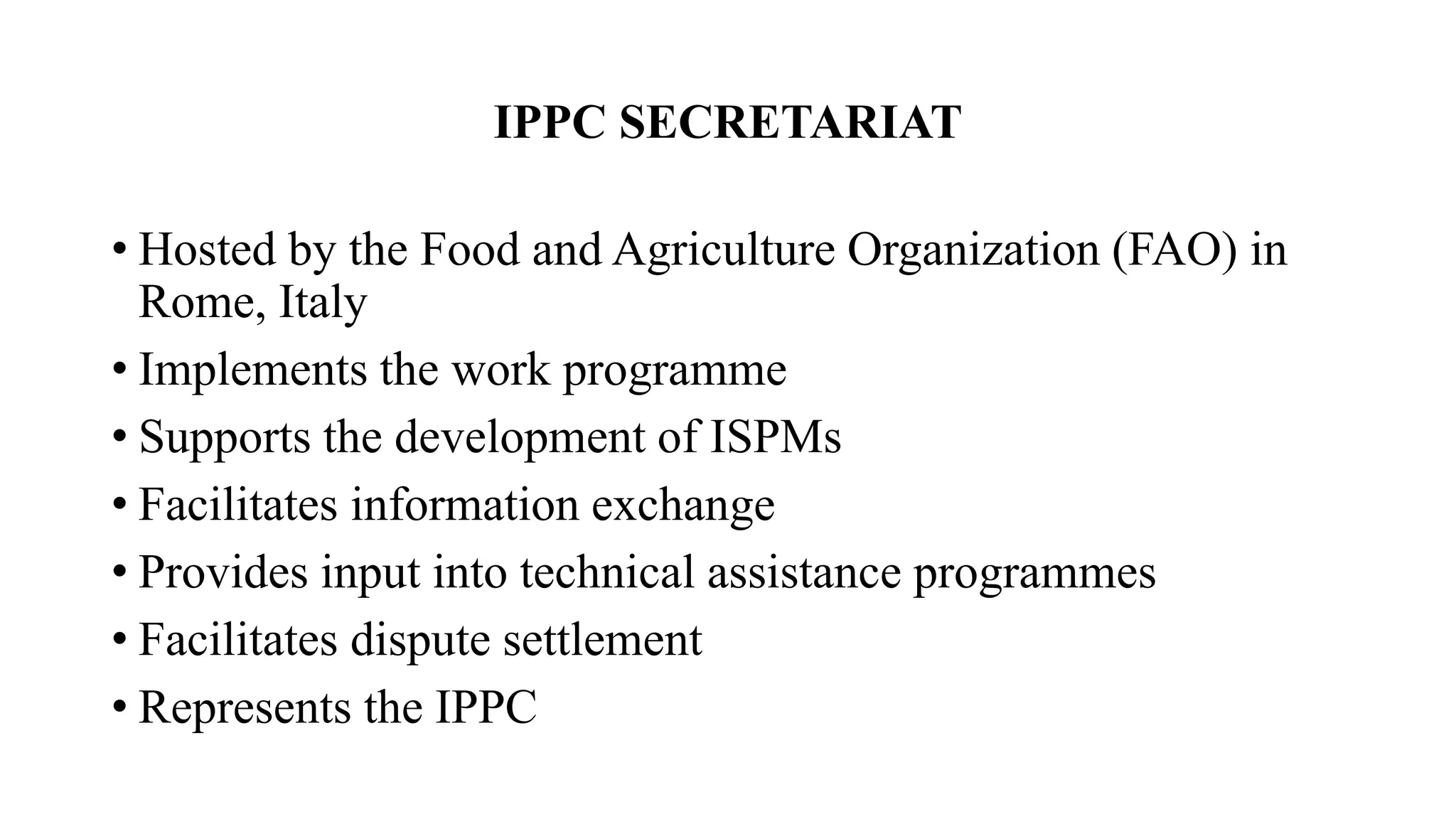
IPPC SECRETARIAT
• Hosted by the Food and Agriculture Organization (FAO) in
Rome, Italy
• Implements the work programme
• Supports the development of ISPMs
• Facilitates information exchange
• Provides input into technical assistance programmes
• Facilitates dispute settlement
• Represents the IPPC
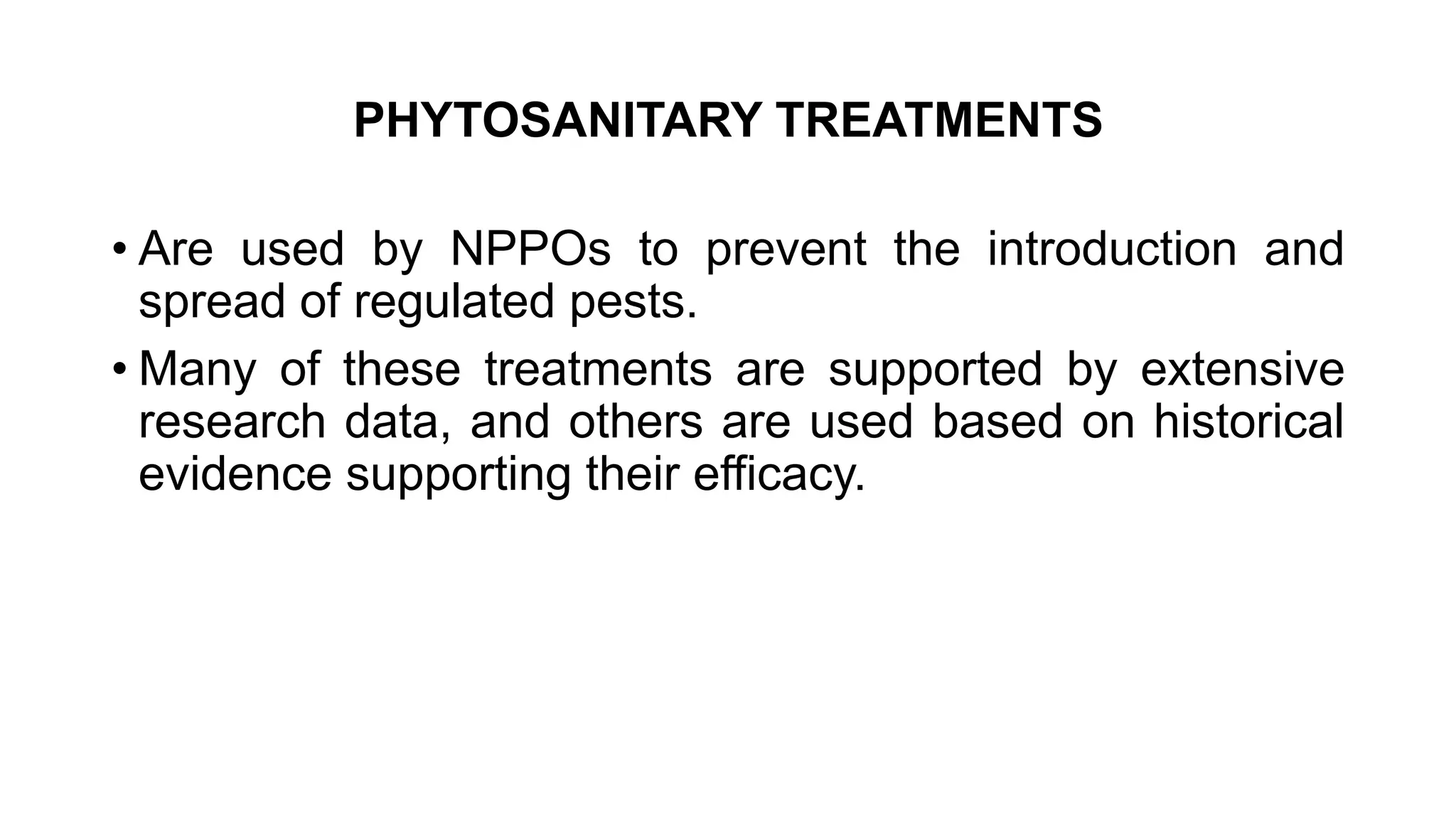
PHYTOSANITARY TREATMENTS
• Are used by NPPOs to prevent the introduction and
spread of regulated pests.
• Many of these treatments are supported by extensive
research data, and others are used based on historical
evidence supporting their efficacy.
REQUIREMENTS
• Purpose and use
• Process for treatment submission
• Requirements for phytosanitary treatments
• Summary information
• Efficacy data
• Feasibility and applicability
• Evaluation of submitted treatments
• Publication of phytosanitary treatments
• Treatment review and re-evaluations
CONCLUSION
The International Plant Protection Convention (IPPC) is an
international plant health agreement that aims to protect
cultivated and wild plants by preventing the introduction and
spread of pests. As people and commodities move around the
world, organisms that present risks to plants travel with them.
International travel and trade are greater than ever before.
THANK YOU

Vincent ippc presentation 2

  • 1.
    PHYTOSANITARY REGIMES OFTHE INTERNATIONAL PLANT PROTECTION CONVENTION (IPPC) BY VINCENT OCHIENG OTIENO MSC. PLANT BREEDING BIO-POLICY, SAFETY AND ETHICS
  • 2.
    CONTENTS • INTRODUCTION • VISIONAND MISSION • HISTORY • ROLES OF IPPC • PRINCIPLES AND OBLIGATIONS OF IPPC • GOVERNANCE STRUCTURE OF IPPC • PHYTOSANITARY TREATMENTS • CONCLUSION
  • 3.
    INTRODUCTION The International PlantProtection Convention (IPPC) is an intergovernmental treaty signed by over 180 countries, aiming to protecting the world's plant resources from the spread and introduction of pests, and promoting safe trade.
  • 4.
    VISION AND MISSION Vision Protectingthe world’s plant resources from pests Mission To secure cooperation among nations in protecting global plant resources from the introduction and spread of plant pests, in order to preserve food security, biodiversity and facilitate trade.
  • 6.
    HISTORY • 1951: FAOconference initially adopted the convention • 1979: First revision • 1992: The IPPC Secretariat was established • 1997: Revised to be consistent with principles of the WTO- SPS agreement • 1997: Current text was adopted in order to align the convention with WTO SPS agreement • 2001:The Standards Committee (SC) was established
  • 7.
    HISTORY ● 2003: TheSubsidiary Body on Dispute Settlement (SBDS) was established ● 2006: The First Session of the CPM took place when the CPM accepted all previous decision made by the ICPM ● 2010: The Implementation Review and Support System (IRSS) was implemented ● 2012: The Financial Committee (FC) and Capacity Development Committee (CDC) were set up
  • 8.
    ROLES OF IPPC •International framework for protection of plants from pests • Standard setting organization • Facilitates exchange of information related to import and export requirements • Support for capacity development
  • 9.
    PRINCIPLES OF IPPC •Sovereign right to regulate • Regulate only when necessary • Measures should be: • consistent with risk, technically justified, and least restrictive • non-discriminatory between countries of same status • transparent (published)
  • 10.
    OBLIGATIONS OF IPPC •Set up and administer a National Plant Protection Organization (NPPO) • Designate an official IPPC contact point • Certify exports and regulate imports • Develop and take into account phytosanitary standards • Meet basic reporting obligations
  • 11.
    GOVERNANCE STRUCTURE OFIPPC Commission on Phytosanitary Measures (CPM) Standards Committee 5 Technical Panels Expert Working Groups Subsidiary Bodies on Dispute Settlement Capacity Development Committee Triennial review group of IRSS (monitoring and review) IPPC Secretariat Other organizations 9 RPPOs 182 NPPOs Strategic Planning Group (open end) Bureau Financial Committee
  • 12.
    COMMISSION ON PHYTOSANITARYMEASURES (CPM) • Governing body for the IPPC (182 member countries) • Adopts International Standards for Phytosanitary Measures (ISPMs) • Promotes technical assistance and information exchange • Meets annually
  • 13.
    ADMINISTRATIVE BODIES OFCPM • Bureau (7 members) • Standards Committee (25 members) • Subsidiary Body on Dispute Settlement • Working Groups
  • 14.
    STANDARD COMMITTEE (SC) •Group of 25 international experts from the 7 FAO regions • Meets two times annually (May, November) • Oversees the standard setting process • Approves specifications for ISPMs, approves draft ISPMs for member consultation, reviews member comments, recommends ISPMs for adoption by the CPM • Oversees work of EWGs and TPs
  • 15.
    WORKING GROUPS ANDPANELS • Expert working groups • Many, but small number each year • Technical Panels • Technical panel on forest quarantine (TPFQ) • Technical panel on diagnostic protocols (TPDP) • Technical panel on phytosanitary treatments (TPPT) • Technical panel on fruit flies (TPFF) • Technical panel on glossary (TPG)
  • 16.
    SUBSIDIARY BODY ONDISPUTE SETTLEMENT Activities include: • Development of dispute settlement procedures • Maintenance of roster of phytosanitary experts • Provision of information for the effective preparation of a dispute settlement • Group of 7 international experts from the 7 FAO regions
  • 17.
    NATIONAL PLANT PROTECTIONORGANIZATION (NPPO) • Role: to protect national plant resources from the risks associated with pests • Food security: Protect crops to ensure an abundant, high- quality, and varied food supply • International trade: Strengthen the marketability of agriculture in international commerce by meeting import requirements, including pest risk analysis • Environmental protection: Preserve natural ecosystems and horticultural plant resources
  • 18.
    REGIONAL PLANT PROTECTIONORGANIZATION (RPPO) Role is to: • Coordinate and participate in activities among their NPPOs in order to promote and achieve the objectives of the IPPC • Gather and disseminate information, in particular in relation with the IPPC • Cooperate with the CPM and the IPPC Secretariat in developing and implementing international standards for phytosanitary measures and regional standards • Meet annually at the technical consultation among RPPOs
  • 19.
    REGIONAL PLANT PROTECTIONORGANIZATIONS 1.Asia and Pacific Plant Protection Commission (APPPC) 2.Comunidad Andina (CA) 3.Comite de Sanidad Vegetal del Cono Sur (COSAVE) 4.Caribbean Plant Protection Commission (CPPC) 5.European and Mediterranean Plant Protection Organization(EPPO) 6.Inter-African Phytosanitary Council (IAPSC) 7.North American Plant Protection Organization (NAPPO) 8.Organismo Internacional Regional de Sanidad Agropecuaria (OIRSA) 9.Pacific Plant Protection Organization (PPPO)
  • 20.
    IPPC SECRETARIAT • Hostedby the Food and Agriculture Organization (FAO) in Rome, Italy • Implements the work programme • Supports the development of ISPMs • Facilitates information exchange • Provides input into technical assistance programmes • Facilitates dispute settlement • Represents the IPPC
  • 21.
    PHYTOSANITARY TREATMENTS • Areused by NPPOs to prevent the introduction and spread of regulated pests. • Many of these treatments are supported by extensive research data, and others are used based on historical evidence supporting their efficacy.
  • 22.
    REQUIREMENTS • Purpose anduse • Process for treatment submission • Requirements for phytosanitary treatments • Summary information • Efficacy data • Feasibility and applicability • Evaluation of submitted treatments • Publication of phytosanitary treatments • Treatment review and re-evaluations
  • 23.
    CONCLUSION The International PlantProtection Convention (IPPC) is an international plant health agreement that aims to protect cultivated and wild plants by preventing the introduction and spread of pests. As people and commodities move around the world, organisms that present risks to plants travel with them. International travel and trade are greater than ever before.
  • 24.