Plant Disease Detection Using Machine
Learning
A project Submitted in partial fulfillment of the
requirements
for the award of the Degree of
MASTER OF COMPUTER APPLICATION
By
Guide: Prof. Manabendra Nath
 Name of Student: KOUSHIK HAZRA
Roll Num: 12021010010006
 Name of Student: DIBAS KUMAR SHYAMAL
Roll Num: 12021010010008
 Name of Student: DEBODIP HAIT
Roll Num: 12021010010050
 Name of Student: SUBHA CHATTERJEE
Roll Num:12021010010023
 Name of Student: JINIYA MANDAL
Roll Num: 12021010010035
 Name of Student: ADREJA SAHA
Roll Num: 12021010010030
TABLE OF CONTENTS
 INTRODUCTION
 PROPOSED METHODOLOGY
 IMAGE ACQUISITION
 DATASET PREPARATION
 IMAGE PREPROCESSING
 IMAGE SEGMENTATION
 FEATURE EXTRACTION
 TESTING & VALIDATION
 RESULT
 NECESSARY LIBRARIES
 FUTURE SCOPE
 CONCLUSION
INTRODUCTION
 In this project, we have created a
convolutional neural network which will be able
to predict whether a plant is suffering from a
disease or not.
 We used different layers and other
hyperperameters for building, training, and
testing this classification model.
 We have used Tensorflow and Keras for this
project.
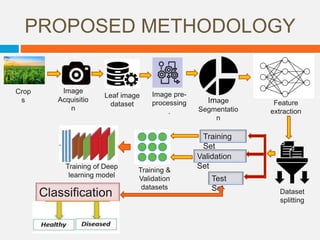
PROPOSED METHODOLOGY
Crop
s
Image
Acquisitio
n
Leaf image
dataset
Image pre-
processing
.
Image
Segmentatio
n
Feature
extraction
Dataset
splitting
Training
Set
Validation
Set
Test
Set
Training &
Validation
datasets
Training of Deep
learning model
Classification
.
IMAGE ACQUISITION
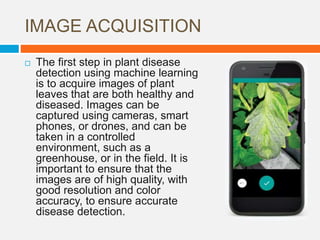
 The first step in plant disease
detection using machine learning
is to acquire images of plant
leaves that are both healthy and
diseased. Images can be
captured using cameras, smart
phones, or drones, and can be
taken in a controlled
environment, such as a
greenhouse, or in the field. It is
important to ensure that the
images are of high quality, with
good resolution and color
accuracy, to ensure accurate
disease detection.
DATASET PREPARATION
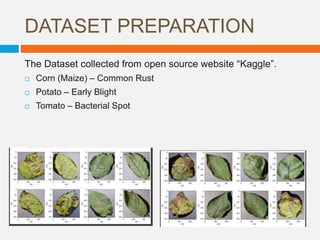
The Dataset collected from open source website “Kaggle”.
 Corn (Maize) – Common Rust
 Potato – Early Blight
 Tomato – Bacterial Spot
IMAGE PREPROCESSING
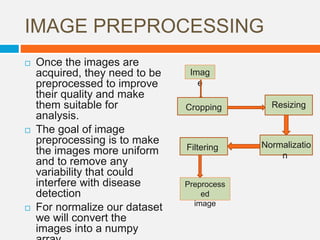
 Once the images are
acquired, they need to be
preprocessed to improve
their quality and make
them suitable for
analysis.
 The goal of image
preprocessing is to make
the images more uniform
and to remove any
variability that could
interfere with disease
detection
 For normalize our dataset
we will convert the
images into a numpy
Cropping
Filtering
Resizing
Normalizatio
n
Imag
e
Preprocess
ed
image
IMAGE SEGMENTATION
 After preprocessing, the images are
segmented to separate the plant leaves
from the background.
 Image segmentation involves dividing the
image into multiple regions, each of which
contains pixels with similar properties.
 This allows the machine learning algorithm
to focus on the plant leaves and ignore the
background, which can improve disease
detection accuracy.
FEATURE EXTRACTION
Once the plant leaves are segmented, the next
step is to extract features from the image that
can be used to train the machine learning model.
These features might include color histograms,
texture features, or shape descriptors.
DATASET SPLITTING
The preprocessed images are labeled as
healthy or diseased and used to create a
dataset. The dataset is divided into training,
validation, and testing sets.
To split the dataset into testing and training
data. Here we have taken test size as 0.2 so my
data will be divided into 80% training and 20%
testing data.
MODEL TRAINING
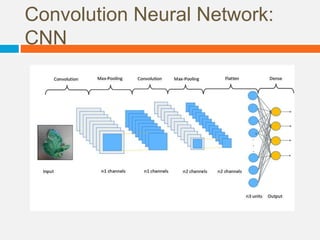
Convolutional Neural Networks (CNNs) is chosen to train the
model and extracted features to recognize the visual symptoms
of plant diseases.
We have used different types of layers according to their
features namely
 Conv_2d (It is used to create a convolutional kernel that is
convolved with the input layer to produce the output tensor)
 max_pooling2d (It is a down sampling technique which takes
out the maximum value over the window defined by poolsize)
 flatten (It flattens the input and creates a 1D output)
 Dense (Dense layer produce the output as the dot product of
input and kernel).
Convolution Neural Network:
CNN
TESTING AND VALIDATION
 Fitting the model with the data and finding out
the accuracy at each epoch to see how our
model is learning.
 The trained model is then tested on a separate
dataset of images to evaluate its accuracy in
detecting plant diseases.
RESULT
FUTURE SCOPE OF
PROJECT
 Our project have shown pretty good accuracy,
it can be implemented in real time mobile
applications and web services, so that formers
can identify diseases simply by taking photo of
suspected leaves of plants.
 Other than plant leaf disease identification, it
can also be used for identification and
classification of nutrients deficiency of plant
leaves.
THE STEPS TAKEN TO SOLVE THE
PROBLEM
 We started with loading the dataset into googlecolab
using Google drive and visualizing the images.
Normalizing is an important step when working with any
type of dataset. After that we created a CNN Model
which is further used for predicting the plant diseases
using the image supplied to model.
 This model is highly beneficial as it can be used by
different agricultural firms and farmers to increase their
yield and stop wastage of crops due to disease.
CONCLUSION
Plant Disease Detection Using ML.pptx

Plant Disease Detection Using ML.pptx

  • 1.
    Plant Disease DetectionUsing Machine Learning A project Submitted in partial fulfillment of the requirements for the award of the Degree of MASTER OF COMPUTER APPLICATION By Guide: Prof. Manabendra Nath  Name of Student: KOUSHIK HAZRA Roll Num: 12021010010006  Name of Student: DIBAS KUMAR SHYAMAL Roll Num: 12021010010008  Name of Student: DEBODIP HAIT Roll Num: 12021010010050  Name of Student: SUBHA CHATTERJEE Roll Num:12021010010023  Name of Student: JINIYA MANDAL Roll Num: 12021010010035  Name of Student: ADREJA SAHA Roll Num: 12021010010030
  • 2.
    TABLE OF CONTENTS INTRODUCTION  PROPOSED METHODOLOGY  IMAGE ACQUISITION  DATASET PREPARATION  IMAGE PREPROCESSING  IMAGE SEGMENTATION  FEATURE EXTRACTION  TESTING & VALIDATION  RESULT  NECESSARY LIBRARIES  FUTURE SCOPE  CONCLUSION
  • 3.
    INTRODUCTION  In thisproject, we have created a convolutional neural network which will be able to predict whether a plant is suffering from a disease or not.  We used different layers and other hyperperameters for building, training, and testing this classification model.  We have used Tensorflow and Keras for this project.
  • 4.
    PROPOSED METHODOLOGY Crop s Image Acquisitio n Leaf image dataset Imagepre- processing . Image Segmentatio n Feature extraction Dataset splitting Training Set Validation Set Test Set Training & Validation datasets Training of Deep learning model Classification .
  • 5.
    IMAGE ACQUISITION  Thefirst step in plant disease detection using machine learning is to acquire images of plant leaves that are both healthy and diseased. Images can be captured using cameras, smart phones, or drones, and can be taken in a controlled environment, such as a greenhouse, or in the field. It is important to ensure that the images are of high quality, with good resolution and color accuracy, to ensure accurate disease detection.
  • 6.
    DATASET PREPARATION The Datasetcollected from open source website “Kaggle”.  Corn (Maize) – Common Rust  Potato – Early Blight  Tomato – Bacterial Spot
  • 7.
    IMAGE PREPROCESSING  Oncethe images are acquired, they need to be preprocessed to improve their quality and make them suitable for analysis.  The goal of image preprocessing is to make the images more uniform and to remove any variability that could interfere with disease detection  For normalize our dataset we will convert the images into a numpy Cropping Filtering Resizing Normalizatio n Imag e Preprocess ed image
  • 8.
    IMAGE SEGMENTATION  Afterpreprocessing, the images are segmented to separate the plant leaves from the background.  Image segmentation involves dividing the image into multiple regions, each of which contains pixels with similar properties.  This allows the machine learning algorithm to focus on the plant leaves and ignore the background, which can improve disease detection accuracy.
  • 9.
    FEATURE EXTRACTION Once theplant leaves are segmented, the next step is to extract features from the image that can be used to train the machine learning model. These features might include color histograms, texture features, or shape descriptors.
  • 10.
    DATASET SPLITTING The preprocessedimages are labeled as healthy or diseased and used to create a dataset. The dataset is divided into training, validation, and testing sets. To split the dataset into testing and training data. Here we have taken test size as 0.2 so my data will be divided into 80% training and 20% testing data.
  • 11.
    MODEL TRAINING Convolutional NeuralNetworks (CNNs) is chosen to train the model and extracted features to recognize the visual symptoms of plant diseases. We have used different types of layers according to their features namely  Conv_2d (It is used to create a convolutional kernel that is convolved with the input layer to produce the output tensor)  max_pooling2d (It is a down sampling technique which takes out the maximum value over the window defined by poolsize)  flatten (It flattens the input and creates a 1D output)  Dense (Dense layer produce the output as the dot product of input and kernel).
  • 12.
  • 13.
    TESTING AND VALIDATION Fitting the model with the data and finding out the accuracy at each epoch to see how our model is learning.  The trained model is then tested on a separate dataset of images to evaluate its accuracy in detecting plant diseases.
  • 14.
  • 15.
    FUTURE SCOPE OF PROJECT Our project have shown pretty good accuracy, it can be implemented in real time mobile applications and web services, so that formers can identify diseases simply by taking photo of suspected leaves of plants.  Other than plant leaf disease identification, it can also be used for identification and classification of nutrients deficiency of plant leaves.
  • 16.
    THE STEPS TAKENTO SOLVE THE PROBLEM  We started with loading the dataset into googlecolab using Google drive and visualizing the images. Normalizing is an important step when working with any type of dataset. After that we created a CNN Model which is further used for predicting the plant diseases using the image supplied to model.  This model is highly beneficial as it can be used by different agricultural firms and farmers to increase their yield and stop wastage of crops due to disease. CONCLUSION