What is
research???
Research is an organized ,
systematic, data-based,
critical, objective enquiry
into a specific
problem……….or finding
solutions to a problem.
Types of research
Applied vs. Fundamental/Basic/Pure Research
Internal vs. External Research
Descriptive vs. Analytical Research
Quantitative vs. Qualitative
Conceptual vs. Empirical Research
One time vs Longitudinal Research
Types of Research contd.
Field Research vs. Simulation
Clinical / Diagnostic research
Exploratory research
Historical Research
Important parameters of
research
Reliability
Objectivity
Validity
 Suitability
Substantiality
Research Process
Define
Research
Problem
Review
Literature
Formulate
hypothesi
s
Develop
resaerch
design
Collect
data
Data
Analysis
Data inter-
pretation
&
Reporting
Defining a Research Problem
Pre-requisites
Some individual or group with a problem
Some objective
Alternative means
Choice of alternatives
Environment
Classifying the problem stages
Stage I Problem understanding stage
Establishing the objectives of the research
Determining potential
Stage II Problem selection stage
Selection of opportunity to pursue
Develop the best-suited alternatives
Stage III Problem Redefining Stage
Evaluating the research problem statements
Selection of the best research problem statement
Caselet 1
Online Booking Presently, Indian travelers can criss-cross the globe with just a few clicks by using various online
portals for booking airline tickets, hotel reservations, etc. Online booking involves pursuing of available information
on travel websites and then making a reservation. You can check out various travel sites, which collate the flight
details of all airlines. These sites are the apt place to book or bid for air tickets. Travel portals, such as
makemytrip.com, travelguru.com, arzoo.com, yatra.com, indiatimes.com, rediff.com, or cleartrip.com, would provide
you all details of flights along with their fares. The fares are reflected in ascending order by the lowest priced
featuring first. The number of customers who book travel tickets by the online method is growing day by day.
However, a switch from the offline environment to the online environment creates certain doubts in the minds of
consumers. Such doubts in literature are termed as perceived risks. Also, the Internet revolution has helped in
bringing significant changes in market transparency, defined as the availability and accessibility of information to
market participants. For example, air travellers can use online travel agencies for hundreds of travel offers, compared
to typically few offers from travel agents or airlines prior to the Internet era. With the traditional queuing system, the
advent of e-ticket booking over a decade has led to the mushrooming of online travel agencies offering a wide variety
of services for a faster and more convenient mode of ticket booking of a train or flight ticket to something as exotic as
a holiday. They offer various packages with holiday itineraries and a convenient pick-up and drop service. Presented
with the scenario analysis as put forth, Anita Desai, CEO of Gheri.com, a travel portal that has been in existence since
2017, wondered whether she could now look at a bigger customer base.
1. What is the kind of research study that you can undertake for Ms.Anita ?
2. Formulate the research problem and the objectives of your study.
Defining a Research Problem
(contd.)
Precautions
Avoid controversial topics
Avoid too narrow or too vast topics
Select familiar subjects
Cost, time, researcher capability
Preliminary study
Setting up the scope of the
problem
 Specify the Research Objectives
Review the problem context
Examine the nature of the problem
Define Variable Relationships
 Evaluating the alternate courses of action
Research Objectives
Generic research objectives:
• To explore a new idea.
• To gain insights into the occurrence of a phenomenon.
• To understand the characteristics of an individual, situation, or event
correctly & with accuracy.
• To identify the frequencies of occurrence of events.
• To establish a cause and effect relationship.
• To test the relationship between two variables.
Types of Variables
Dependant vs. independent variables
Extraneous variables
Moderator Variables
Intervening Variables
Control Variables
Research Design
Parts of a research design
-the sampling design
-the observational design
-the statistical design
-the operational design
Research Designs
I Research design in case of exploratory research
II Research design in case of descriptive/ diagnostic research
III Research design in case of hypothesis testing research
Research design in case of
exploratory research
Survey of concerning literature
Experience survey
Analysis of ‘insight stimulating’ examples
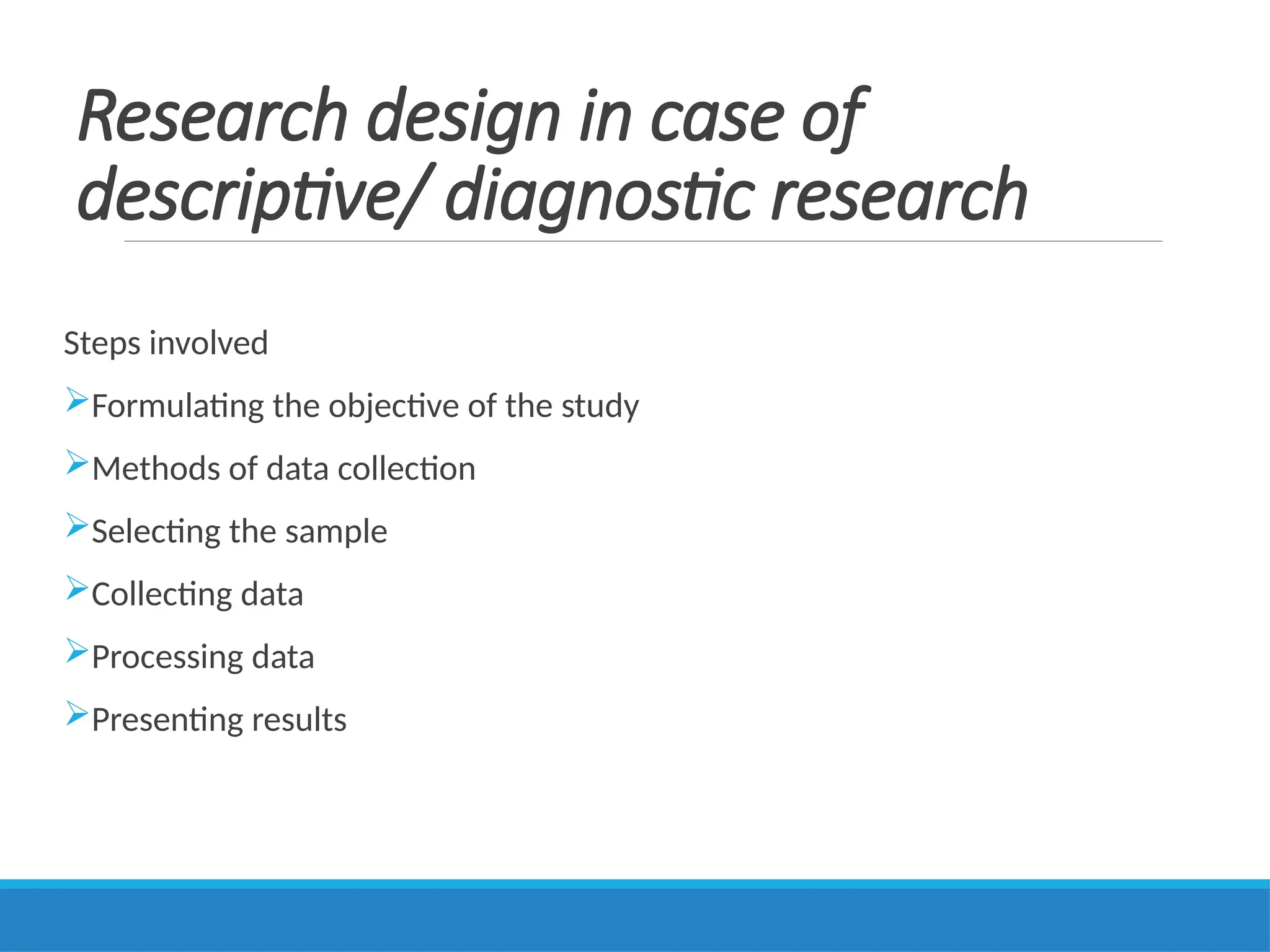
Research design in case of
descriptive/ diagnostic research
Steps involved
Formulating the objective of the study
Methods of data collection
Selecting the sample
Collecting data
Processing data
Presenting results
Research design in case of
hypothesis testing research
I Informal experimental designs
II Formal experimental Designs
Experimental designs
• Before-and-after without control design
• After-only with control design
• Before-and-after with control design
Caselet 2 –
AR’s International:
Vishal had joined a month back and was due to meet Tanvir. Vishal opened the door and walked
into Tanvir’s room. Tanvir asked him to be seated and said, “so doctor, what is the diagnosis?”
Vishal Nair had been recently hired as the company Leadership Coach at AR’s International. The
need for the hiring came, Tanvir Narang, the MD, felt that he was fed up with the team of non-
performers. He had hired the assistant managers, managers and decision-makers from the most
prestigious institutions having 5yrs of minimum work-experience. Each one came with a proven
track record. The compensation was competitive, yet nothing was moving. When Vishal went to
meet Himanshu Chabbra, the bright star who had joined three months, back, Himanshu was
reported absent and seemed to be suffering from hypertension and sugar. His colleagues were
not aware that Himanshu had not come for the past one week. During his conversation with
Tanvir’s secretary, he could hear Ms.Kajol, the HR head, yelling at the top of her voice at a new
recruit. After 4 weeks of joining, she was sharing his job role. Managers were laid-back,
extremely critical, and not moving. Tanvir also made some structural changes as per the nature
of a business once it merged with a couple of startups. The company offers good infrastructure,
attractive compensation, but it is like a stagnant pool of the best talent.
Questions
1. Formulate the above case into a research problem and state the objectives of the study. 2.
Develop the working hypothesis for the study

Planning research project and developing research questions-II.pptx

  • 1.
  • 2.
    Research is anorganized , systematic, data-based, critical, objective enquiry into a specific problem……….or finding solutions to a problem.
  • 3.
    Types of research Appliedvs. Fundamental/Basic/Pure Research Internal vs. External Research Descriptive vs. Analytical Research Quantitative vs. Qualitative Conceptual vs. Empirical Research One time vs Longitudinal Research
  • 4.
    Types of Researchcontd. Field Research vs. Simulation Clinical / Diagnostic research Exploratory research Historical Research
  • 5.
  • 6.
  • 7.
    Defining a ResearchProblem Pre-requisites Some individual or group with a problem Some objective Alternative means Choice of alternatives Environment
  • 8.
    Classifying the problemstages Stage I Problem understanding stage Establishing the objectives of the research Determining potential Stage II Problem selection stage Selection of opportunity to pursue Develop the best-suited alternatives Stage III Problem Redefining Stage Evaluating the research problem statements Selection of the best research problem statement
  • 9.
    Caselet 1 Online BookingPresently, Indian travelers can criss-cross the globe with just a few clicks by using various online portals for booking airline tickets, hotel reservations, etc. Online booking involves pursuing of available information on travel websites and then making a reservation. You can check out various travel sites, which collate the flight details of all airlines. These sites are the apt place to book or bid for air tickets. Travel portals, such as makemytrip.com, travelguru.com, arzoo.com, yatra.com, indiatimes.com, rediff.com, or cleartrip.com, would provide you all details of flights along with their fares. The fares are reflected in ascending order by the lowest priced featuring first. The number of customers who book travel tickets by the online method is growing day by day. However, a switch from the offline environment to the online environment creates certain doubts in the minds of consumers. Such doubts in literature are termed as perceived risks. Also, the Internet revolution has helped in bringing significant changes in market transparency, defined as the availability and accessibility of information to market participants. For example, air travellers can use online travel agencies for hundreds of travel offers, compared to typically few offers from travel agents or airlines prior to the Internet era. With the traditional queuing system, the advent of e-ticket booking over a decade has led to the mushrooming of online travel agencies offering a wide variety of services for a faster and more convenient mode of ticket booking of a train or flight ticket to something as exotic as a holiday. They offer various packages with holiday itineraries and a convenient pick-up and drop service. Presented with the scenario analysis as put forth, Anita Desai, CEO of Gheri.com, a travel portal that has been in existence since 2017, wondered whether she could now look at a bigger customer base. 1. What is the kind of research study that you can undertake for Ms.Anita ? 2. Formulate the research problem and the objectives of your study.
  • 10.
    Defining a ResearchProblem (contd.) Precautions Avoid controversial topics Avoid too narrow or too vast topics Select familiar subjects Cost, time, researcher capability Preliminary study
  • 11.
    Setting up thescope of the problem  Specify the Research Objectives Review the problem context Examine the nature of the problem Define Variable Relationships  Evaluating the alternate courses of action
  • 12.
    Research Objectives Generic researchobjectives: • To explore a new idea. • To gain insights into the occurrence of a phenomenon. • To understand the characteristics of an individual, situation, or event correctly & with accuracy. • To identify the frequencies of occurrence of events. • To establish a cause and effect relationship. • To test the relationship between two variables.
  • 13.
    Types of Variables Dependantvs. independent variables Extraneous variables Moderator Variables Intervening Variables Control Variables
  • 14.
    Research Design Parts ofa research design -the sampling design -the observational design -the statistical design -the operational design
  • 15.
    Research Designs I Researchdesign in case of exploratory research II Research design in case of descriptive/ diagnostic research III Research design in case of hypothesis testing research
  • 16.
    Research design incase of exploratory research Survey of concerning literature Experience survey Analysis of ‘insight stimulating’ examples
  • 17.
    Research design incase of descriptive/ diagnostic research Steps involved Formulating the objective of the study Methods of data collection Selecting the sample Collecting data Processing data Presenting results
  • 18.
    Research design incase of hypothesis testing research I Informal experimental designs II Formal experimental Designs
  • 19.
    Experimental designs • Before-and-afterwithout control design • After-only with control design • Before-and-after with control design
  • 20.
    Caselet 2 – AR’sInternational: Vishal had joined a month back and was due to meet Tanvir. Vishal opened the door and walked into Tanvir’s room. Tanvir asked him to be seated and said, “so doctor, what is the diagnosis?” Vishal Nair had been recently hired as the company Leadership Coach at AR’s International. The need for the hiring came, Tanvir Narang, the MD, felt that he was fed up with the team of non- performers. He had hired the assistant managers, managers and decision-makers from the most prestigious institutions having 5yrs of minimum work-experience. Each one came with a proven track record. The compensation was competitive, yet nothing was moving. When Vishal went to meet Himanshu Chabbra, the bright star who had joined three months, back, Himanshu was reported absent and seemed to be suffering from hypertension and sugar. His colleagues were not aware that Himanshu had not come for the past one week. During his conversation with Tanvir’s secretary, he could hear Ms.Kajol, the HR head, yelling at the top of her voice at a new recruit. After 4 weeks of joining, she was sharing his job role. Managers were laid-back, extremely critical, and not moving. Tanvir also made some structural changes as per the nature of a business once it merged with a couple of startups. The company offers good infrastructure, attractive compensation, but it is like a stagnant pool of the best talent. Questions 1. Formulate the above case into a research problem and state the objectives of the study. 2. Develop the working hypothesis for the study