1 Copyright 2016 FairPoint Communications
Planning for Today's (and Tomorrow's) K-12
eLearning Bandwidth Requirements
2 Copyright 2016 FairPoint Communications
Obective
Learn about the growing impact of eLearning technologies
and devices (laptops, tablets, cloud-based applications,
and BYOD) on bandwidth requirements for K-12 schools.
While the federal E-Rate program provides subsidies to
help address these requirements, schools must consider
how best to implement and manage these new LAN,
WLAN, and WAN solutions. We'll provide guidance on best
practices for designing, managing, and securing a school's
LAN and WAN environments, while discussing why
schools should start thinking about data center services as
part of a comprehensive disaster recovery strategy.
3 Copyright 2016 FairPoint Communications
Agenda
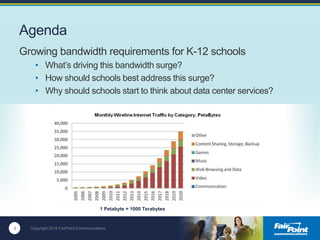
Growing bandwidth requirements for K-12 schools
• What’s driving this bandwidth surge?
• How should schools best address this surge?
• Why should schools start to think about data center services?
1 Petabyte = 1000 Terabytes
4 Copyright 2016 FairPoint Communications
What’s driving the bandwidth surge?
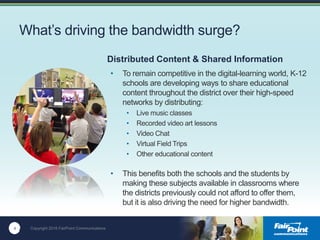
• To remain competitive in the digital-learning world, K-12
schools are developing ways to share educational
content throughout the district over their high-speed
networks by distributing:
• Live music classes
• Recorded video art lessons
• Video Chat
• Virtual Field Trips
• Other educational content
• This benefits both the schools and the students by
making these subjects available in classrooms where
the districts previously could not afford to offer them,
but it is also driving the need for higher bandwidth.
4
Distributed Content & Shared Information
5 Copyright 2016 FairPoint Communications
What’s driving the bandwidth surge?
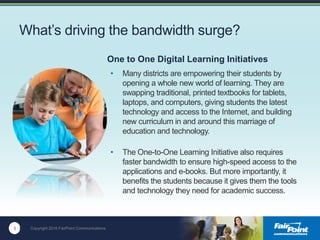
• Many districts are empowering their students by
opening a whole new world of learning. They are
swapping traditional, printed textbooks for tablets,
laptops, and computers, giving students the latest
technology and access to the Internet, and building
new curriculum in and around this marriage of
education and technology.
• The One-to-One Learning Initiative also requires
faster bandwidth to ensure high-speed access to the
applications and e-books. But more importantly, it
benefits the students because it gives them the tools
and technology they need for academic success.
5
One to One Digital Learning Initiatives
6 Copyright 2016 FairPoint Communications
What’s driving the bandwidth surge?
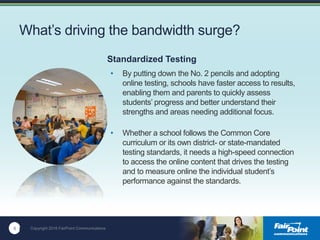
• By putting down the No. 2 pencils and adopting
online testing, schools have faster access to results,
enabling them and parents to quickly assess
students’ progress and better understand their
strengths and areas needing additional focus.
• Whether a school follows the Common Core
curriculum or its own district- or state-mandated
testing standards, it needs a high-speed connection
to access the online content that drives the testing
and to measure online the individual student’s
performance against the standards.
6
Standardized Testing
7 Copyright 2016 FairPoint Communications
What’s driving the bandwidth surge?
Bring Your Own Device (BYOD)
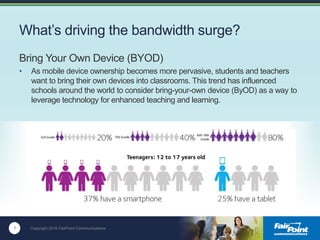
• As mobile device ownership becomes more pervasive, students and teachers
want to bring their own devices into classrooms. This trend has influenced
schools around the world to consider bring-your-own device (ByOD) as a way to
leverage technology for enhanced teaching and learning.
8 Copyright 2016 FairPoint Communications
What’s driving the bandwidth surge?
8
ConnectED
“In June of 2013, the President announced an initiative called
ConnectED, and it had a bold goal: Connecting 99 percent of
American students to high-speed broadband in their classrooms
by 2018.
Today, we’re well on our way to reaching that goal. Because of
ConnectED’s public and private sector commitments, billions of
additional dollars will help wire America’s schools and libraries,
and over 3 million students, across all 50 states, are using new
educational tools that leverage higher-speed connections.”
9 Copyright 2016 FairPoint Communications
How do schools address the surge?
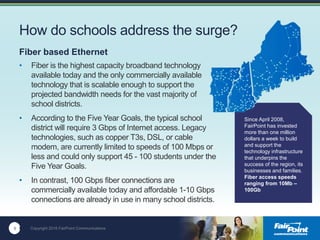
• Fiber is the highest capacity broadband technology
available today and the only commercially available
technology that is scalable enough to support the
projected bandwidth needs for the vast majority of
school districts.
• According to the Five Year Goals, the typical school
district will require 3 Gbps of Internet access. Legacy
technologies, such as copper T3s, DSL, or cable
modem, are currently limited to speeds of 100 Mbps or
less and could only support 45 - 100 students under the
Five Year Goals.
• In contrast, 100 Gbps fiber connections are
commercially available today and affordable 1-10 Gbps
connections are already in use in many school districts.
9
Fiber based Ethernet
Since April 2008,
FairPoint has invested
more than one million
dollars a week to build
and support the
technology infrastructure
that underpins the
success of the region, its
businesses and families.
Fiber access speeds
ranging from 10Mb –
100Gb
10 Copyright 2016 FairPoint Communications
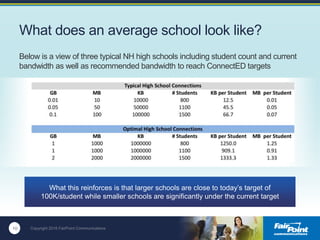
What does an average school look like?
Below is a view of three typical NH high schools including student count and current
bandwidth as well as recommended bandwidth to reach ConnectED targets
10
What this reinforces is that larger schools are close to today’s target of
100K/student while smaller schools are significantly under the current target
11 Copyright 2016 FairPoint Communications
How do schools address the surge?
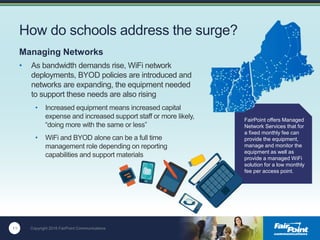
• As bandwidth demands rise, WiFi network
deployments, BYOD policies are introduced and
networks are expanding, the equipment needed
to support these needs are also rising
• Increased equipment means increased capital
expense and increased support staff or more likely,
“doing more with the same or less”
• WiFi and BYOD alone can be a full time
management role depending on reporting
capabilities and support materials
11
Managing Networks
FairPoint offers Managed
Network Services that for
a fixed monthly fee can
provide the equipment,
manage and monitor the
equipment as well as
provide a managed WiFi
solution for a low monthly
fee per access point.
12 Copyright 2016 FairPoint Communications
Think about Data Center & Cloud Services
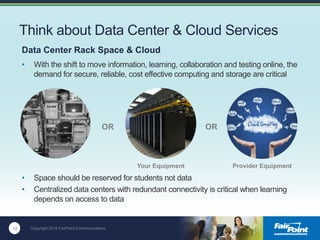
• With the shift to move information, learning, collaboration and testing online, the
demand for secure, reliable, cost effective computing and storage are critical
• Space should be reserved for students not data
• Centralized data centers with redundant connectivity is critical when learning
depends on access to data
12
Data Center Rack Space & Cloud
OR
Your Equipment Provider Equipment
OR
13 Copyright 2016 FairPoint Communications
How do schools address the surge?
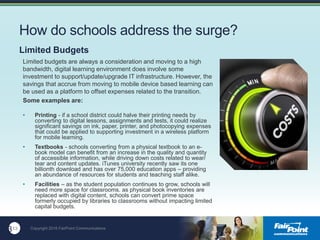
Limited budgets are always a consideration and moving to a high
bandwidth, digital learning environment does involve some
investment to support/update/upgrade IT infrastructure. However, the
savings that accrue from moving to mobile device based learning can
be used as a platform to offset expenses related to the transition.
Some examples are:
• Printing - if a school district could halve their printing needs by
converting to digital lessons, assignments and tests, it could realize
significant savings on ink, paper, printer, and photocopying expenses
that could be applied to supporting investment in a wireless platform
for mobile learning.
• Textbooks - schools converting from a physical textbook to an e-
book model can benefit from an increase in the quality and quantity
of accessible information, while driving down costs related to wear/
tear and content updates. iTunes university recently saw its one
billionth download and has over 75,000 education apps – providing
an abundance of resources for students and teaching staff alike.
• Facilities – as the student population continues to grow, schools will
need more space for classrooms. as physical book inventories are
replaced with digital content, schools can convert prime space
formerly occupied by libraries to classrooms without impacting limited
capital budgets.
13
Limited Budgets
14 Copyright 2016 FairPoint Communications
How do schools address the surge?
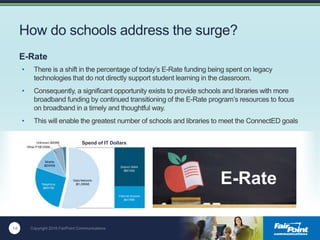
• There is a shift in the percentage of today’s E-Rate funding being spent on legacy
technologies that do not directly support student learning in the classroom.
• Consequently, a significant opportunity exists to provide schools and libraries with more
broadband funding by continued transitioning of the E-Rate program’s resources to focus
on broadband in a timely and thoughtful way.
• This will enable the greatest number of schools and libraries to meet the ConnectED goals
14
E-Rate
Spend of IT Dollars
E-Rate
15 Copyright 2016 FairPoint Communications
Thank youTHANK YOU

Planning for bandwidth slideshare version

  • 1.
    1 Copyright 2016FairPoint Communications Planning for Today's (and Tomorrow's) K-12 eLearning Bandwidth Requirements
  • 2.
    2 Copyright 2016FairPoint Communications Obective Learn about the growing impact of eLearning technologies and devices (laptops, tablets, cloud-based applications, and BYOD) on bandwidth requirements for K-12 schools. While the federal E-Rate program provides subsidies to help address these requirements, schools must consider how best to implement and manage these new LAN, WLAN, and WAN solutions. We'll provide guidance on best practices for designing, managing, and securing a school's LAN and WAN environments, while discussing why schools should start thinking about data center services as part of a comprehensive disaster recovery strategy.
  • 3.
    3 Copyright 2016FairPoint Communications Agenda Growing bandwidth requirements for K-12 schools • What’s driving this bandwidth surge? • How should schools best address this surge? • Why should schools start to think about data center services? 1 Petabyte = 1000 Terabytes
  • 4.
    4 Copyright 2016FairPoint Communications What’s driving the bandwidth surge? • To remain competitive in the digital-learning world, K-12 schools are developing ways to share educational content throughout the district over their high-speed networks by distributing: • Live music classes • Recorded video art lessons • Video Chat • Virtual Field Trips • Other educational content • This benefits both the schools and the students by making these subjects available in classrooms where the districts previously could not afford to offer them, but it is also driving the need for higher bandwidth. 4 Distributed Content & Shared Information
  • 5.
    5 Copyright 2016FairPoint Communications What’s driving the bandwidth surge? • Many districts are empowering their students by opening a whole new world of learning. They are swapping traditional, printed textbooks for tablets, laptops, and computers, giving students the latest technology and access to the Internet, and building new curriculum in and around this marriage of education and technology. • The One-to-One Learning Initiative also requires faster bandwidth to ensure high-speed access to the applications and e-books. But more importantly, it benefits the students because it gives them the tools and technology they need for academic success. 5 One to One Digital Learning Initiatives
  • 6.
    6 Copyright 2016FairPoint Communications What’s driving the bandwidth surge? • By putting down the No. 2 pencils and adopting online testing, schools have faster access to results, enabling them and parents to quickly assess students’ progress and better understand their strengths and areas needing additional focus. • Whether a school follows the Common Core curriculum or its own district- or state-mandated testing standards, it needs a high-speed connection to access the online content that drives the testing and to measure online the individual student’s performance against the standards. 6 Standardized Testing
  • 7.
    7 Copyright 2016FairPoint Communications What’s driving the bandwidth surge? Bring Your Own Device (BYOD) • As mobile device ownership becomes more pervasive, students and teachers want to bring their own devices into classrooms. This trend has influenced schools around the world to consider bring-your-own device (ByOD) as a way to leverage technology for enhanced teaching and learning.
  • 8.
    8 Copyright 2016FairPoint Communications What’s driving the bandwidth surge? 8 ConnectED “In June of 2013, the President announced an initiative called ConnectED, and it had a bold goal: Connecting 99 percent of American students to high-speed broadband in their classrooms by 2018. Today, we’re well on our way to reaching that goal. Because of ConnectED’s public and private sector commitments, billions of additional dollars will help wire America’s schools and libraries, and over 3 million students, across all 50 states, are using new educational tools that leverage higher-speed connections.”
  • 9.
    9 Copyright 2016FairPoint Communications How do schools address the surge? • Fiber is the highest capacity broadband technology available today and the only commercially available technology that is scalable enough to support the projected bandwidth needs for the vast majority of school districts. • According to the Five Year Goals, the typical school district will require 3 Gbps of Internet access. Legacy technologies, such as copper T3s, DSL, or cable modem, are currently limited to speeds of 100 Mbps or less and could only support 45 - 100 students under the Five Year Goals. • In contrast, 100 Gbps fiber connections are commercially available today and affordable 1-10 Gbps connections are already in use in many school districts. 9 Fiber based Ethernet Since April 2008, FairPoint has invested more than one million dollars a week to build and support the technology infrastructure that underpins the success of the region, its businesses and families. Fiber access speeds ranging from 10Mb – 100Gb
  • 10.
    10 Copyright 2016FairPoint Communications What does an average school look like? Below is a view of three typical NH high schools including student count and current bandwidth as well as recommended bandwidth to reach ConnectED targets 10 What this reinforces is that larger schools are close to today’s target of 100K/student while smaller schools are significantly under the current target
  • 11.
    11 Copyright 2016FairPoint Communications How do schools address the surge? • As bandwidth demands rise, WiFi network deployments, BYOD policies are introduced and networks are expanding, the equipment needed to support these needs are also rising • Increased equipment means increased capital expense and increased support staff or more likely, “doing more with the same or less” • WiFi and BYOD alone can be a full time management role depending on reporting capabilities and support materials 11 Managing Networks FairPoint offers Managed Network Services that for a fixed monthly fee can provide the equipment, manage and monitor the equipment as well as provide a managed WiFi solution for a low monthly fee per access point.
  • 12.
    12 Copyright 2016FairPoint Communications Think about Data Center & Cloud Services • With the shift to move information, learning, collaboration and testing online, the demand for secure, reliable, cost effective computing and storage are critical • Space should be reserved for students not data • Centralized data centers with redundant connectivity is critical when learning depends on access to data 12 Data Center Rack Space & Cloud OR Your Equipment Provider Equipment OR
  • 13.
    13 Copyright 2016FairPoint Communications How do schools address the surge? Limited budgets are always a consideration and moving to a high bandwidth, digital learning environment does involve some investment to support/update/upgrade IT infrastructure. However, the savings that accrue from moving to mobile device based learning can be used as a platform to offset expenses related to the transition. Some examples are: • Printing - if a school district could halve their printing needs by converting to digital lessons, assignments and tests, it could realize significant savings on ink, paper, printer, and photocopying expenses that could be applied to supporting investment in a wireless platform for mobile learning. • Textbooks - schools converting from a physical textbook to an e- book model can benefit from an increase in the quality and quantity of accessible information, while driving down costs related to wear/ tear and content updates. iTunes university recently saw its one billionth download and has over 75,000 education apps – providing an abundance of resources for students and teaching staff alike. • Facilities – as the student population continues to grow, schools will need more space for classrooms. as physical book inventories are replaced with digital content, schools can convert prime space formerly occupied by libraries to classrooms without impacting limited capital budgets. 13 Limited Budgets
  • 14.
    14 Copyright 2016FairPoint Communications How do schools address the surge? • There is a shift in the percentage of today’s E-Rate funding being spent on legacy technologies that do not directly support student learning in the classroom. • Consequently, a significant opportunity exists to provide schools and libraries with more broadband funding by continued transitioning of the E-Rate program’s resources to focus on broadband in a timely and thoughtful way. • This will enable the greatest number of schools and libraries to meet the ConnectED goals 14 E-Rate Spend of IT Dollars E-Rate
  • 15.
    15 Copyright 2016FairPoint Communications Thank youTHANK YOU

Editor's Notes

  • #4 With the use of technology increasing dramatically in classrooms and on school campuses nationwide, it's not surprising that 80 percent of school districts report that their broadband connections don't fully meet their current needs, according to an FCC report, "Measuring Broadband America." The majority (55 percent) cite slow connection speed; other barriers include the cost of service (39 percent) and installation (27 percent).
  • #5 To audience – What other items do you distribute in your classrooms across your networks? Have you seen an incremental growth in your district?
  • #6 To audience – What other items do you distribute in your classrooms across your networks? Have you seen an incremental growth in your district?
  • #7 To audience – What other items do you distribute in your classrooms across your networks? Have you seen an incremental growth in your district?
  • #8 With the use of technology increasing dramatically in classrooms and on school campuses nationwide, it's not surprising that 80 percent of school districts report that their broadband connections don't fully meet their current needs, according to an FCC report, "Measuring Broadband America." The majority (55 percent) cite slow connection speed; other barriers include the cost of service (39 percent) and installation (27 percent).
  • #9 To audience – who in the room is meeting the 2014 goals? Do you have a roadmap to meet the 2019 goals?
  • #10 Fairpoint has 1G service capabilities in place in 72 markets across North New England today and expanding monthly. We can get just about anywhere with the right amount of time and capital investment.
  • #11 To audience – Does this look like any of your schools? Are you in the typical or optimal?
  • #12 Fairpoint has 1G service capabilities in place in 72 markets across North New England today and expanding monthly. We can get just about anywhere with the right amount of time and capital investment.
  • #13 To audience - How are you dealing with this in your districts and schools? Do you have campus, district or offsite data centers?
  • #14 To audience – What other items do you distribute in your classrooms across your networks? Have you seen an incremental growth in your district?
  • #15 To audience – Where are the majority of your erate dollars spent today?