Planning DPS
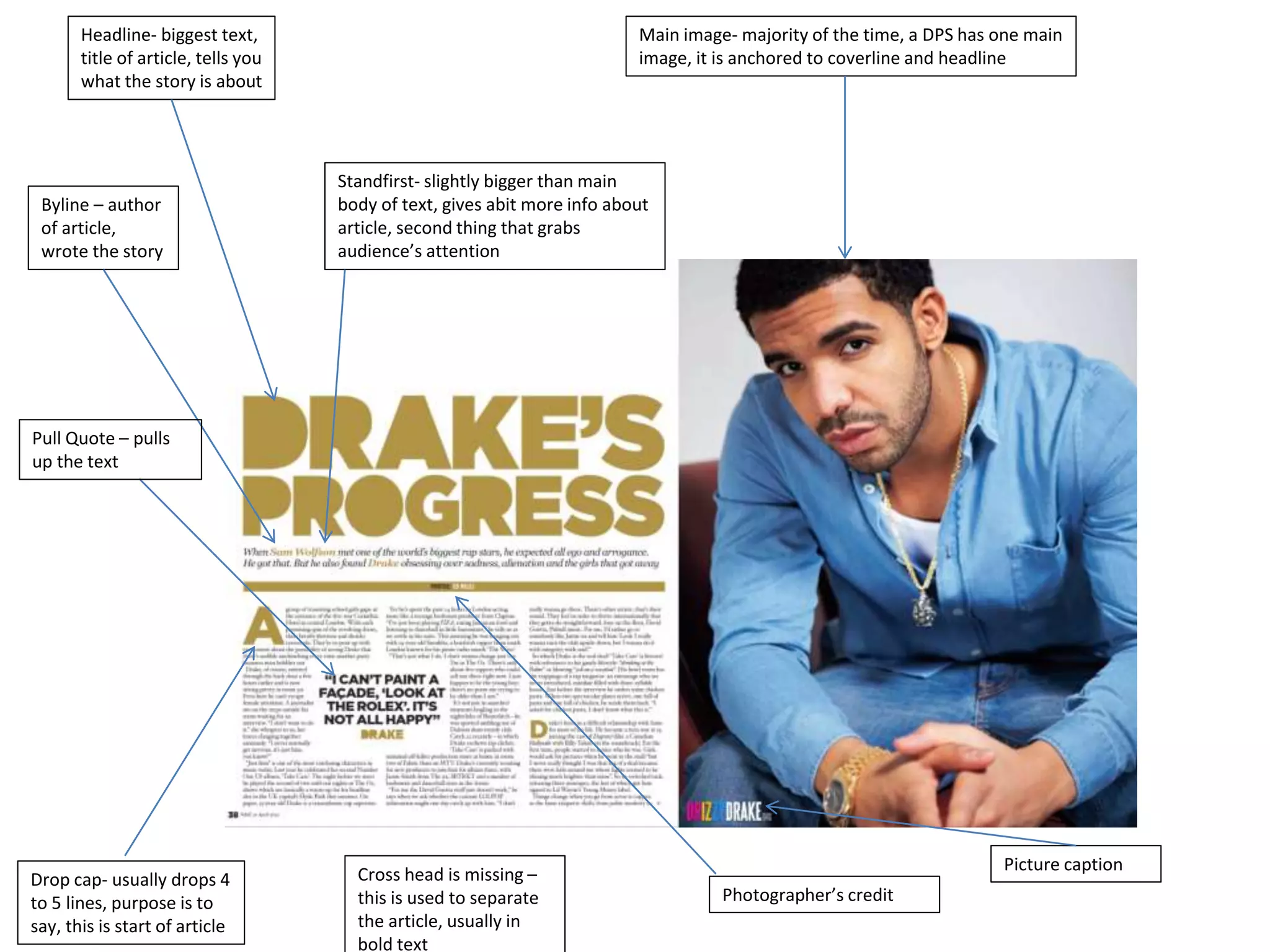
Headline- biggest text,
title of article, tells you
what the story is about
Standfirst- slightly bigger than main
body of text, gives abit more info about
article, second thing that grabs
audience’s attention
Byline – author
of article,
wrote the story
Drop cap- usually drops 4
to 5 lines, purpose is to
say, this is start of article
Cross head is missing –
this is used to separate
the article, usually in
bold text
Photographer’s credit
Main image- majority of the time, a DPS has one main
image, it is anchored to coverline and headline
Picture caption
Pull Quote – pulls
up the text
This biography will help me decide what to write for my article, I have to decide whether I want to choose a free flowing article or
a question and answer article. A free flowing article is descriptive and is in detail about the person and my own emotions as a
journalist, a Q&A is just a question and answer type article.
Analysis of free flowing article
• Since graduating from Hogwarts, the decidedly unstarry Daniel Radcliffe has played devils, confused poets and, now, Frankenstein’s
hunchbacked sidekick. Olly Richards meets Britain’s oddest film star.
• Fame teaches you many things: how to outrun paparazzi, how to respond to mobs of fans, how to endure a breakfast TV interview without
screaming. It does not, apparently, prepare you for the complexities of making coffee. Bouncing into a huge wood-panelled conference room
above the photography studio where he’s just been shot for NME’s cover, Daniel Radcliffe is presented with a cup and reaches for the
sweeteners. “How many of these are you supposed to use?” he asks, merrily clicking little white pellets into his drink. Each of those is one
sugar, we tell him. You’ve just given yourself seven sugars. “Oh, right,” he laughs. “Well, we’ll leave that then.” This gives me the impression
that Daniel Radcliffe has a sense of humour to him, judging by the way he responds to the interviewer.
• You half-expect Daniel Radcliffe to have an entourage of people to dispense his sweeteners for him. He is stupidly famous. Playing Harry
Potter, he led one of the biggest film series in history to take over £5billion at the world box office. He is worth, according to the Sunday Times
Rich List, around £69million. He should be swaggering around in furs, eating swans and doing drugs off antique mirrors. But Radcliffe’s the
antithesis of all that. He is not like other movie stars. We don’t mean that in the usual clichéd way, as when a celebrity profile declares its
subject “down to earth” because they ate carbohydrates and weren’t paraded in on a throne. Daniel Radcliffe is odd. Good odd. He is Britain’s
weirdest film star and we love him for it.
This gives me the impression that Daniel is humble, as he does not show off his wealth to the public eye.
• Dean Chalkley/NME
• Consider the evidence: Since Potter ended, his roles have included a haunted lawyer (The Woman In Black), a man turning into a devil (Horns),
a singing corporate climber (How To Succeed In Business Without Really Trying, on stage), a sexually confused beat poet (Kill Your Darlings)
and a doctor who has imaginary conversations with his older self (The Young Doctor’s Notebook). Then there’s his latest role in Victor
Frankenstein, his first studio movie since Potter. He plays Igor, the otherworldly, hunchbacked assistant in an imagined origin story that details
the peculiar early experiments of young Frankenstein (played by James McAvoy). These are the career choices of a burgeoning indie actor, not
a man so famous he has his own Lego range and has been parodied on The Simpsons.
• “No, I don’t really have mainstream tastes,” he says. “People do ask me, ‘Why do you choose such weird movies?’ but I don’t think they’re
weird, they’re just stories I’m interested in. Isn’t having weird tastes good, though? I think so. I think that’s better than always wanting to play
the handsome hero. You think I’m weird? I’ll take that.” This tells me that Daniel is not like the other actors as he prefers having a variety of
different roles in his movies, which is what makes him so popular.
• Radcliffe is handsome but in quite a normal way – he has what your mum might call “a nice face” – which means he’s not obvious leading man
material, and at around 5’5”, he’s a bit small to be an action star (though that never stopped Tom Cruise). Today, dressed all in black and with
his hair sharply cropped as a souvenir from a recently completed role in Imperium, playing an FBI agent posing as a neo-Nazi, he should look
intimidating. Yet he’s so effusively cheerful that he just looks… tidy. He’s 26 now, but clean-shaven, he could pass for much younger. He’s got
a character actor’s face, which means he can do those strange lead roles your more traditional leading man couldn’t.
• “I had a huge amount to prove [after Potter],” continues Radcliffe. “Proving that you can be a young actor and not be a complete fucking
disaster when you grow up. That is the – quite unfair I think – image that people have of young actors. There are a huge number of child
actors who grow up fine. Always with my career in film, I saw Potter as an amazing beginning to it. I’m sure I’ll never hit that kind of
commercial peak again but very, very few people will.”
• Dean Chalkley/NME
• He doesn’t, however, agree that coming back to studio films is a sign he’s ready to accept being ‘a big deal’ again. “No,
although that’s a nice theory,” he smiles. “There’s no significance to it. Doing studio movies is fun because you get to do
stuff that you mostly wouldn’t get to do on an indie movie, in terms of action. There is a part of me that, because I grew up
doing it, loves that stuff and really misses it. Frankenstein was just the most interesting and original script I’d seen from a
studio. It looked like fun to make, and it was.”
• It is, as rollicking blockbusters go, smarter than most, playing with ideas of science vs religion, heart vs mind, while also
finding room for a fight with a zombie monkey. “It doesn’t take itself too seriously, but it has a nice intellectual debate at the
heart of it,” says Radcliffe.
• This tells me that Daniel actually analyses his role in detail, seeing how original and crazy the movie is.
• For someone who has lived with press intrusion since the age of 11, Radcliffe is an open interviewee. What was he into as a
kid? “The Simpsons… but I was also obsessed with Yes, Minister.” The 1980s sitcom that was made before you were born?
“Yes!” He puts his hands on the arms of his chair, as he does whenever he’s about to launch into a subject that really excites
him. “I used to watch that every night before I went to bed when I was about 15. I still think it’s one of the best British
sitcoms ever… And one of my favourite films is A Matter Of Life And Death, with David Niven… He has to go to court in
Heaven. It’s sweet and funny but so weird.” These are the kind of references you’d expect from someone twice Radcliffe’s
age. He shrugs. “I like things that do whatever the fuck they want at all times.” This tells me that he prefers classic shows,
• Radcliffe’s frankness extends to discussing more personal matters, which in the past have included losing his virginity to an
older woman and problems with alcohol, long since given up. Most recently, in an interview with Playboy, there was the
surprising admission of masturbating during the production of Harry Potter…
• “What?” he says, confused, but not angry. “I didn’t say I wanked on set!”
• He gets out his phone to find the interview, which doesn’t take long as there are many, many Google hits. “Oh God,” he says,
flopping back in his seat. “It’s frustrating when you tell a story and say, ‘Yes, I wanked a lot when I was a teenager,’ but
clearly I didn’t mean on set.” He straightens up in his seat. “Can you make this clear for me: I was not wanking during the
filming of Potter – I managed to restrain myself until I got home.” Consider the matter closed. Let’s wash our hands of it, so
to speak. This is another sign that shows that Daniel has a sense of humour, as he says he restraine dhimself till he got
home.
• Radcliffe wears his fame lightly, remembering a key incident from the height of Pottermania. “I was at Reading Festival and I
was standing behind a guy who’d been on reality TV. He was really, really hated and I saw the shit he took from that crowd.
Stuff chucked at him, people swearing at him… I was 16 and was all, ‘Oh man I can’t go anywhere.’ Then I had that moment
of realisation that, holy sh*t, I am really lucky to be famous for something that people really like. There are far worse things
to be famous for, and this is something that still seems to be genuinely important to so many people in a really sweet way.”
• If Radcliffe is fed up with discussing Potter, and he has every reason to be, he doesn’t show it. In fact, he brings up the
subject, talking about how strange it is that it’s only four years since the film series ended, because it feels so long ago. He
can’t escape it, but he doesn’t want to. Which is good because the Potter universe has started expanding again.
• We meet on the day that the first images were revealed of Fantastic Beasts And Where To Find Them, the 1920s-set Potter
spin-off that stars Eddie Redmayne as a magical explorer who collects bizarre creatures. Radcliffe hasn’t seen the pictures
and jumps up to look at them on my phone, clocking Redmayne’s swishy cerulean coat and barking, “Oh fuck you, Eddie, in
your brilliant costume… I got jeans and a zip top for 10 years and you’ve got a greatcoat already?” His language suggests that
e is very casual and that he is comfortable with interviews, as he has had so many
• JK Rowling is not just expanding into the Potter universe’s past, but also its future. Next year will see the West End opening
of the play Harry Potter And The Cursed Child, not a sequel to Potter but a continuation of Harry’s story, focusing on his
youngest son, Albus, who is struggling with all that comes with the Potter name. Harry is now unhappily employed at the
Ministry of Magic (basically a wizard civil servant).
• Dean Chalkley/NME
• What’s it like knowing someone else is going to play Harry? “It’s weird,” he says. “But I’m happy for it to go on without me.
I’ve no ownership of it.” Would he go and see it? “Now that I know [Harry’s in it] I actually really want to see it. It would be a
mental thing to try and see it with lots of very excited Harry Potter fans. But I kind of would like to know what happens
now.”
• He goes all wistful for a minute. “I’d always thought in the years after Potter finished that it would die down, but it’s just
grown more because the people who were massive Harry Potter fans in their teens are now adults. So you meet them more.
They’re not at home with their parents, they’re out in the world. It always amazes me when someone says what a huge part
of their childhood it was. I still have a natural reserve that makes me go, ‘Oh don’t be so silly, I wasn’t responsible for your
childhood.’ But I think about the stuff that means a lot for me from my childhood, like The Simpsons, and how, when I did a
voice on The Simpsons I got a signed thing from Matt Groening and that was so fucking exciting. The thought that I might
occupy that space in somebody else’s childhood…” This shows that Daniel actually supports his fans, and takes them into
consideration.
• Maybe it’s not the roles he’s taken since Potter that make him unusual. Maybe it’s not even his bizarre affinity for granddad
TV shows. Maybe the thing that makes Daniel Radcliffe Britain’s oddest film star is that he hasn’t ever quite realised that he’s
a film star at all. It doesn’t seem to have sunk in that he’s Daniel bloody Radcliffe.
This conclusion is very effective because it is slightly informal, this means that it would reach out to the reader more as if he was
talking to them. Also, he has used short- humorous sentences that link back to the interview, that readers can then understand
and smile. It also questions the reader’s thought as the author gives three options to choose from, and slightly describes them,
which suggests something to us. This then pressurises an opinion on the reader which makes them more intrigued by the
interview. The last sentence is effective because it is a quirky yet funny thing to say, as he insists that Daniel Radcliffe doesn’t
believe he is actually this world renowned famous actor.
Quotations in red
Descriptions of him and what's happening in blue
Personal views, judgements and opinions in green
4 effective bits of language= underlined
Detailed comment of description of conclusion, whats
in it and how the writer makes it effective
• Harry Styles has the devil may care hair, a dimple that's melted a million hearts, and now that girlfriend, Taylor Swift. The 18-
year-old Englishman is also a member of One Direction, the saviors of boy band virtue and Billboard's Top New Artist of
2012 . We caught up with Styles, briefly, on the phone recently.
• Congrats on being named Billboard's Top New Artist of 2012. How does it feel?
It's been an amazing year for us. We've been having such a great time since when we first came to the U.S. It's been (it has)
absolutely crazy and amazing.
• At this time last year, what was your outlook on 2012 and possibly cracking America?
We looked at this album as a very big deal. It's a good feeling obviously to work with everyone and put everything out with
the team that's worked so hard to get us this far. It's (it has) been absolutely incredible.
• I'm told you're the music guy in the groups who's always turning others on to new bands. What's your personal taste
like?
I actually get a lot of music from my sister, who's into all these bands. She's been listening to and downloading stuff (music)
that I get from her. A lot of times suggested stuff comes on iTunes I'll have a look at it, or the fans will send me things. But
I've been listening to The Lumineers. I love their album and also Elvis Perkins, he's great.
• You guys accomplished a lot in 2012, but what's your personal highlight?
For me the Olympics literally can't be topped (slightly casual and laidback, could have used “could not be beaten” or give a
further opinion such as “I prefer the olympics over any other world wide event”). Just the feeling of being in that room, all
our families were there. The whole feeling was just unbelievable.
• What about performing at the VMAs, where you also won three awards?
There was something about being in the room and the whole kind of atmosphere (could have described the atmosphere e.g.
“the buzzing and chaotic atmosphere”) that really surprised me. To be on that stage and perform was unbelievable. I think it
kind of felt like people learned a bit more about the One Direction thing (In my opinion, I felt as though the fans slightly liked
the VMAs because of one direction performing). It felt like we were making music where people of all kinds could
appreciate.
• You've got a concert film up next. What can we expect?
We're excited. I think we've had cameras on us for a long time, we've just been filming a lot of stuff (he could have gone into
detail e.g. “filming a lot of content for our music video’s”). It's just gonna (it is just going to) be exciting to watch it back. Just
to have the ability to be able to kind of look back (almost look back) at that while we're older and to have your children see
it will be amazing.
Which article and why?
Overall, I would rather choose to do a Q&A type article for my artist. Firstly, this is because the questions are
straight forward, and therefore my artist can reply with an answer that is related to a question. As opposed to a
free flowing article, where the reader’s would want specific questions answered by the artist, but instead they
get to read an article where the artist talks continuously usually about a certain topic. For example, the Daniel
Radcliffe article was focused on Harry Potter and him leaving the set, however the Harry Styles interview is
about his career as a whole, and his band. Secondly, a Q&A type article would be best suited for me because it
is very quick and easy for my artist to answer the questions, therefore more questions can be asked with
straightforward answers, so that more text can be put into my double page spread. If there is more specific
information about my artist on the double page spread, my audience will be able to read more information
about my artist. However with a free flowing article, it leaves more room for a reply that isnt related to the
question, which may annoy the reader of my magazine.
The purpose of doing this is to understand the mode of language that I will need to use for the creation of my
double page spread.

Planning dps

  • 1.
  • 2.
    Headline- biggest text, titleof article, tells you what the story is about Standfirst- slightly bigger than main body of text, gives abit more info about article, second thing that grabs audience’s attention Byline – author of article, wrote the story Drop cap- usually drops 4 to 5 lines, purpose is to say, this is start of article Cross head is missing – this is used to separate the article, usually in bold text Photographer’s credit Main image- majority of the time, a DPS has one main image, it is anchored to coverline and headline Picture caption Pull Quote – pulls up the text
  • 3.
    This biography willhelp me decide what to write for my article, I have to decide whether I want to choose a free flowing article or a question and answer article. A free flowing article is descriptive and is in detail about the person and my own emotions as a journalist, a Q&A is just a question and answer type article.
  • 4.
    Analysis of freeflowing article • Since graduating from Hogwarts, the decidedly unstarry Daniel Radcliffe has played devils, confused poets and, now, Frankenstein’s hunchbacked sidekick. Olly Richards meets Britain’s oddest film star. • Fame teaches you many things: how to outrun paparazzi, how to respond to mobs of fans, how to endure a breakfast TV interview without screaming. It does not, apparently, prepare you for the complexities of making coffee. Bouncing into a huge wood-panelled conference room above the photography studio where he’s just been shot for NME’s cover, Daniel Radcliffe is presented with a cup and reaches for the sweeteners. “How many of these are you supposed to use?” he asks, merrily clicking little white pellets into his drink. Each of those is one sugar, we tell him. You’ve just given yourself seven sugars. “Oh, right,” he laughs. “Well, we’ll leave that then.” This gives me the impression that Daniel Radcliffe has a sense of humour to him, judging by the way he responds to the interviewer. • You half-expect Daniel Radcliffe to have an entourage of people to dispense his sweeteners for him. He is stupidly famous. Playing Harry Potter, he led one of the biggest film series in history to take over £5billion at the world box office. He is worth, according to the Sunday Times Rich List, around £69million. He should be swaggering around in furs, eating swans and doing drugs off antique mirrors. But Radcliffe’s the antithesis of all that. He is not like other movie stars. We don’t mean that in the usual clichéd way, as when a celebrity profile declares its subject “down to earth” because they ate carbohydrates and weren’t paraded in on a throne. Daniel Radcliffe is odd. Good odd. He is Britain’s weirdest film star and we love him for it. This gives me the impression that Daniel is humble, as he does not show off his wealth to the public eye. • Dean Chalkley/NME • Consider the evidence: Since Potter ended, his roles have included a haunted lawyer (The Woman In Black), a man turning into a devil (Horns), a singing corporate climber (How To Succeed In Business Without Really Trying, on stage), a sexually confused beat poet (Kill Your Darlings) and a doctor who has imaginary conversations with his older self (The Young Doctor’s Notebook). Then there’s his latest role in Victor Frankenstein, his first studio movie since Potter. He plays Igor, the otherworldly, hunchbacked assistant in an imagined origin story that details the peculiar early experiments of young Frankenstein (played by James McAvoy). These are the career choices of a burgeoning indie actor, not a man so famous he has his own Lego range and has been parodied on The Simpsons. • “No, I don’t really have mainstream tastes,” he says. “People do ask me, ‘Why do you choose such weird movies?’ but I don’t think they’re weird, they’re just stories I’m interested in. Isn’t having weird tastes good, though? I think so. I think that’s better than always wanting to play the handsome hero. You think I’m weird? I’ll take that.” This tells me that Daniel is not like the other actors as he prefers having a variety of different roles in his movies, which is what makes him so popular. • Radcliffe is handsome but in quite a normal way – he has what your mum might call “a nice face” – which means he’s not obvious leading man material, and at around 5’5”, he’s a bit small to be an action star (though that never stopped Tom Cruise). Today, dressed all in black and with his hair sharply cropped as a souvenir from a recently completed role in Imperium, playing an FBI agent posing as a neo-Nazi, he should look intimidating. Yet he’s so effusively cheerful that he just looks… tidy. He’s 26 now, but clean-shaven, he could pass for much younger. He’s got a character actor’s face, which means he can do those strange lead roles your more traditional leading man couldn’t. • “I had a huge amount to prove [after Potter],” continues Radcliffe. “Proving that you can be a young actor and not be a complete fucking disaster when you grow up. That is the – quite unfair I think – image that people have of young actors. There are a huge number of child actors who grow up fine. Always with my career in film, I saw Potter as an amazing beginning to it. I’m sure I’ll never hit that kind of commercial peak again but very, very few people will.”
  • 5.
    • Dean Chalkley/NME •He doesn’t, however, agree that coming back to studio films is a sign he’s ready to accept being ‘a big deal’ again. “No, although that’s a nice theory,” he smiles. “There’s no significance to it. Doing studio movies is fun because you get to do stuff that you mostly wouldn’t get to do on an indie movie, in terms of action. There is a part of me that, because I grew up doing it, loves that stuff and really misses it. Frankenstein was just the most interesting and original script I’d seen from a studio. It looked like fun to make, and it was.” • It is, as rollicking blockbusters go, smarter than most, playing with ideas of science vs religion, heart vs mind, while also finding room for a fight with a zombie monkey. “It doesn’t take itself too seriously, but it has a nice intellectual debate at the heart of it,” says Radcliffe. • This tells me that Daniel actually analyses his role in detail, seeing how original and crazy the movie is. • For someone who has lived with press intrusion since the age of 11, Radcliffe is an open interviewee. What was he into as a kid? “The Simpsons… but I was also obsessed with Yes, Minister.” The 1980s sitcom that was made before you were born? “Yes!” He puts his hands on the arms of his chair, as he does whenever he’s about to launch into a subject that really excites him. “I used to watch that every night before I went to bed when I was about 15. I still think it’s one of the best British sitcoms ever… And one of my favourite films is A Matter Of Life And Death, with David Niven… He has to go to court in Heaven. It’s sweet and funny but so weird.” These are the kind of references you’d expect from someone twice Radcliffe’s age. He shrugs. “I like things that do whatever the fuck they want at all times.” This tells me that he prefers classic shows, • Radcliffe’s frankness extends to discussing more personal matters, which in the past have included losing his virginity to an older woman and problems with alcohol, long since given up. Most recently, in an interview with Playboy, there was the surprising admission of masturbating during the production of Harry Potter… • “What?” he says, confused, but not angry. “I didn’t say I wanked on set!” • He gets out his phone to find the interview, which doesn’t take long as there are many, many Google hits. “Oh God,” he says, flopping back in his seat. “It’s frustrating when you tell a story and say, ‘Yes, I wanked a lot when I was a teenager,’ but clearly I didn’t mean on set.” He straightens up in his seat. “Can you make this clear for me: I was not wanking during the filming of Potter – I managed to restrain myself until I got home.” Consider the matter closed. Let’s wash our hands of it, so to speak. This is another sign that shows that Daniel has a sense of humour, as he says he restraine dhimself till he got home. • Radcliffe wears his fame lightly, remembering a key incident from the height of Pottermania. “I was at Reading Festival and I was standing behind a guy who’d been on reality TV. He was really, really hated and I saw the shit he took from that crowd. Stuff chucked at him, people swearing at him… I was 16 and was all, ‘Oh man I can’t go anywhere.’ Then I had that moment of realisation that, holy sh*t, I am really lucky to be famous for something that people really like. There are far worse things to be famous for, and this is something that still seems to be genuinely important to so many people in a really sweet way.”
  • 6.
    • If Radcliffeis fed up with discussing Potter, and he has every reason to be, he doesn’t show it. In fact, he brings up the subject, talking about how strange it is that it’s only four years since the film series ended, because it feels so long ago. He can’t escape it, but he doesn’t want to. Which is good because the Potter universe has started expanding again. • We meet on the day that the first images were revealed of Fantastic Beasts And Where To Find Them, the 1920s-set Potter spin-off that stars Eddie Redmayne as a magical explorer who collects bizarre creatures. Radcliffe hasn’t seen the pictures and jumps up to look at them on my phone, clocking Redmayne’s swishy cerulean coat and barking, “Oh fuck you, Eddie, in your brilliant costume… I got jeans and a zip top for 10 years and you’ve got a greatcoat already?” His language suggests that e is very casual and that he is comfortable with interviews, as he has had so many • JK Rowling is not just expanding into the Potter universe’s past, but also its future. Next year will see the West End opening of the play Harry Potter And The Cursed Child, not a sequel to Potter but a continuation of Harry’s story, focusing on his youngest son, Albus, who is struggling with all that comes with the Potter name. Harry is now unhappily employed at the Ministry of Magic (basically a wizard civil servant). • Dean Chalkley/NME • What’s it like knowing someone else is going to play Harry? “It’s weird,” he says. “But I’m happy for it to go on without me. I’ve no ownership of it.” Would he go and see it? “Now that I know [Harry’s in it] I actually really want to see it. It would be a mental thing to try and see it with lots of very excited Harry Potter fans. But I kind of would like to know what happens now.” • He goes all wistful for a minute. “I’d always thought in the years after Potter finished that it would die down, but it’s just grown more because the people who were massive Harry Potter fans in their teens are now adults. So you meet them more. They’re not at home with their parents, they’re out in the world. It always amazes me when someone says what a huge part of their childhood it was. I still have a natural reserve that makes me go, ‘Oh don’t be so silly, I wasn’t responsible for your childhood.’ But I think about the stuff that means a lot for me from my childhood, like The Simpsons, and how, when I did a voice on The Simpsons I got a signed thing from Matt Groening and that was so fucking exciting. The thought that I might occupy that space in somebody else’s childhood…” This shows that Daniel actually supports his fans, and takes them into consideration. • Maybe it’s not the roles he’s taken since Potter that make him unusual. Maybe it’s not even his bizarre affinity for granddad TV shows. Maybe the thing that makes Daniel Radcliffe Britain’s oddest film star is that he hasn’t ever quite realised that he’s a film star at all. It doesn’t seem to have sunk in that he’s Daniel bloody Radcliffe. This conclusion is very effective because it is slightly informal, this means that it would reach out to the reader more as if he was talking to them. Also, he has used short- humorous sentences that link back to the interview, that readers can then understand and smile. It also questions the reader’s thought as the author gives three options to choose from, and slightly describes them, which suggests something to us. This then pressurises an opinion on the reader which makes them more intrigued by the interview. The last sentence is effective because it is a quirky yet funny thing to say, as he insists that Daniel Radcliffe doesn’t believe he is actually this world renowned famous actor.
  • 7.
    Quotations in red Descriptionsof him and what's happening in blue Personal views, judgements and opinions in green 4 effective bits of language= underlined Detailed comment of description of conclusion, whats in it and how the writer makes it effective
  • 8.
    • Harry Styleshas the devil may care hair, a dimple that's melted a million hearts, and now that girlfriend, Taylor Swift. The 18- year-old Englishman is also a member of One Direction, the saviors of boy band virtue and Billboard's Top New Artist of 2012 . We caught up with Styles, briefly, on the phone recently. • Congrats on being named Billboard's Top New Artist of 2012. How does it feel? It's been an amazing year for us. We've been having such a great time since when we first came to the U.S. It's been (it has) absolutely crazy and amazing. • At this time last year, what was your outlook on 2012 and possibly cracking America? We looked at this album as a very big deal. It's a good feeling obviously to work with everyone and put everything out with the team that's worked so hard to get us this far. It's (it has) been absolutely incredible. • I'm told you're the music guy in the groups who's always turning others on to new bands. What's your personal taste like? I actually get a lot of music from my sister, who's into all these bands. She's been listening to and downloading stuff (music) that I get from her. A lot of times suggested stuff comes on iTunes I'll have a look at it, or the fans will send me things. But I've been listening to The Lumineers. I love their album and also Elvis Perkins, he's great. • You guys accomplished a lot in 2012, but what's your personal highlight? For me the Olympics literally can't be topped (slightly casual and laidback, could have used “could not be beaten” or give a further opinion such as “I prefer the olympics over any other world wide event”). Just the feeling of being in that room, all our families were there. The whole feeling was just unbelievable. • What about performing at the VMAs, where you also won three awards? There was something about being in the room and the whole kind of atmosphere (could have described the atmosphere e.g. “the buzzing and chaotic atmosphere”) that really surprised me. To be on that stage and perform was unbelievable. I think it kind of felt like people learned a bit more about the One Direction thing (In my opinion, I felt as though the fans slightly liked the VMAs because of one direction performing). It felt like we were making music where people of all kinds could appreciate. • You've got a concert film up next. What can we expect? We're excited. I think we've had cameras on us for a long time, we've just been filming a lot of stuff (he could have gone into detail e.g. “filming a lot of content for our music video’s”). It's just gonna (it is just going to) be exciting to watch it back. Just to have the ability to be able to kind of look back (almost look back) at that while we're older and to have your children see it will be amazing.
  • 9.
    Which article andwhy? Overall, I would rather choose to do a Q&A type article for my artist. Firstly, this is because the questions are straight forward, and therefore my artist can reply with an answer that is related to a question. As opposed to a free flowing article, where the reader’s would want specific questions answered by the artist, but instead they get to read an article where the artist talks continuously usually about a certain topic. For example, the Daniel Radcliffe article was focused on Harry Potter and him leaving the set, however the Harry Styles interview is about his career as a whole, and his band. Secondly, a Q&A type article would be best suited for me because it is very quick and easy for my artist to answer the questions, therefore more questions can be asked with straightforward answers, so that more text can be put into my double page spread. If there is more specific information about my artist on the double page spread, my audience will be able to read more information about my artist. However with a free flowing article, it leaves more room for a reply that isnt related to the question, which may annoy the reader of my magazine. The purpose of doing this is to understand the mode of language that I will need to use for the creation of my double page spread.