Planning an Essay
You will be able to…
Explain the stages of planning and
structuring an essay
Apply and evaluate the processes
Start planning for your next essay
How have you been planning so far? Let’s
take a few minutes to reflect….
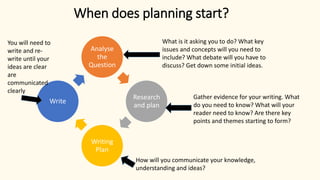
Analyse
the
Question
Research
and plan
Writing
Plan
Write
When does planning start?
What is it asking you to do? What key
issues and concepts will you need to
include? What debate will you have to
discuss? Get down some initial ideas.
Gather evidence for your writing. What
do you need to know? What will your
reader need to know? Are there key
points and themes starting to form?
How will you communicate your knowledge,
understanding and ideas?
You will need to
write and re-
write until your
ideas are clear
are
communicated
clearly
Planning: each stage is essential
• Think of planning an essay as going for a walk….you need to get to
your destination logically and not take any detours.
e.g. “Discuss the role of Higher Education in the UK in the 21st
Century”
THEN:
 Think about what you already know
about the topic
Make a rough plan or diagram of all
relevant material
Ask yourself: What do I need to find
out? Where might I look for information?
FIRST:
Identify the subject,
key terms and
instructional words.
Analyse
the
Question
e.g. “Discuss the role of Higher Education in the UK in the 21st
Century”
In your groups, start to plan out
the type of theme/information you
would include. How will you
decide?
Analyse
the
Question
Make a rough plan based on themes/factors
• Now make a rough outline plan at this stage, before you do your
research. The aim of this is to help you focus your reading, and make
some decisions about how to structure the material.
• Use this as a guide when you map out the main sections of your
essay.
Analyse
the
Question
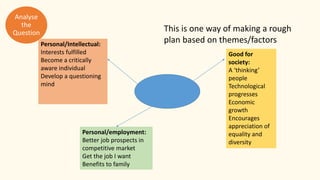
Good for
society:
A ‘thinking’
people
Technological
progresses
Economic
growth
Encourages
appreciation of
equality and
diversity
Personal/Intellectual:
Interests fulfilled
Become a critically
aware individual
Develop a questioning
mind
Personal/employment:
Better job prospects in
competitive market
Get the job I want
Benefits to family
This is one way of making a rough
plan based on themes/factors
Analyse
the
Question
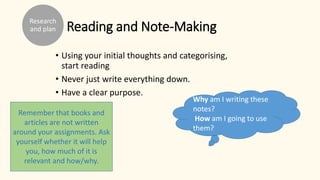
Reading and Note-Making
• Using your initial thoughts and categorising,
start reading
• Never just write everything down.
• Have a clear purpose.
Why am I writing these
notes?
How am I going to use
them?
Remember that books and
articles are not written
around your assignments. Ask
yourself whether it will help
you, how much of it is
relevant and how/why.
Research
and plan
Is your reading relevant?
• Skim titles, chapter heading, content pages, abstracts, and opening
paragraphs.
Research
and plan
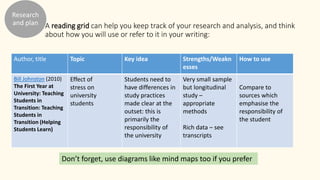
A reading grid can help you keep track of your research and analysis, and think
about how you will use or refer to it in your writing:
Author, title Topic Key idea Strengths/Weakn
esses
How to use
Bill Johnston (2010)
The First Year at
University: Teaching
Students in
Transition: Teaching
Students in
Transition (Helping
Students Learn)
Effect of
stress on
university
students
Students need to
have differences in
study practices
made clear at the
outset: this is
primarily the
responsibility of
the university
Very small sample
but longitudinal
study –
appropriate
methods
Rich data – see
transcripts
Compare to
sources which
emphasise the
responsibility of
the student
Don’t forget, use diagrams like mind maps too if you prefer
Research
and plan
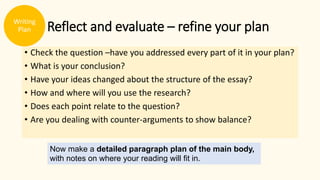
Reflect and evaluate – refine your plan
• Check the question –have you addressed every part of it in your plan?
• What is your conclusion?
• Have your ideas changed about the structure of the essay?
• How and where will you use the research?
• Does each point relate to the question?
• Are you dealing with counter-arguments to show balance?
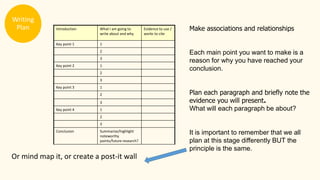
Now make a detailed paragraph plan of the main body,
with notes on where your reading will fit in.
Writing
Plan
Introduction What I am going to
write about and why.
Evidence to use /
works to cite
Key point 1 1
2
3
Key point 2 1
2
3
Key point 3 1
2
3
Key point 4 1
2
3
Conclusion Summarise/highlight
noteworthy
points/future research?
Make associations and relationships
Each main point you want to make is a
reason for why you have reached your
conclusion.
Plan each paragraph and briefly note the
evidence you will present.
What will each paragraph be about?
It is important to remember that we all
plan at this stage differently BUT the
principle is the same.
Or mind map it, or create a post-it wall
Writing
Plan
Planning your paragraphs: WEED
What is your paragraph about? This will be
your topic sentence. Try writing each of
these first
Explanation: what do you mean? Offer some
evidence and explanation
Examples: make sure that you illustrate your
point with examples.
Do: What do I do with this information? How
is it relevant? Keep thinking ‘So what?’
Writing
Plan
Writing
Plan
This online planning tool can help you with
this.
So, thinking back to your reflections
at the start of this presentation,
what will you start trying to do to
make improvements to your essay
planning?

Planning an essay

  • 1.
    Planning an Essay Youwill be able to… Explain the stages of planning and structuring an essay Apply and evaluate the processes Start planning for your next essay
  • 2.
    How have youbeen planning so far? Let’s take a few minutes to reflect….
  • 3.
    Analyse the Question Research and plan Writing Plan Write When doesplanning start? What is it asking you to do? What key issues and concepts will you need to include? What debate will you have to discuss? Get down some initial ideas. Gather evidence for your writing. What do you need to know? What will your reader need to know? Are there key points and themes starting to form? How will you communicate your knowledge, understanding and ideas? You will need to write and re- write until your ideas are clear are communicated clearly
  • 4.
    Planning: each stageis essential • Think of planning an essay as going for a walk….you need to get to your destination logically and not take any detours.
  • 5.
    e.g. “Discuss therole of Higher Education in the UK in the 21st Century” THEN:  Think about what you already know about the topic Make a rough plan or diagram of all relevant material Ask yourself: What do I need to find out? Where might I look for information? FIRST: Identify the subject, key terms and instructional words. Analyse the Question
  • 6.
    e.g. “Discuss therole of Higher Education in the UK in the 21st Century” In your groups, start to plan out the type of theme/information you would include. How will you decide? Analyse the Question
  • 7.
    Make a roughplan based on themes/factors • Now make a rough outline plan at this stage, before you do your research. The aim of this is to help you focus your reading, and make some decisions about how to structure the material. • Use this as a guide when you map out the main sections of your essay. Analyse the Question
  • 8.
    Good for society: A ‘thinking’ people Technological progresses Economic growth Encourages appreciationof equality and diversity Personal/Intellectual: Interests fulfilled Become a critically aware individual Develop a questioning mind Personal/employment: Better job prospects in competitive market Get the job I want Benefits to family This is one way of making a rough plan based on themes/factors Analyse the Question
  • 9.
    Reading and Note-Making •Using your initial thoughts and categorising, start reading • Never just write everything down. • Have a clear purpose. Why am I writing these notes? How am I going to use them? Remember that books and articles are not written around your assignments. Ask yourself whether it will help you, how much of it is relevant and how/why. Research and plan
  • 10.
    Is your readingrelevant? • Skim titles, chapter heading, content pages, abstracts, and opening paragraphs. Research and plan
  • 11.
    A reading gridcan help you keep track of your research and analysis, and think about how you will use or refer to it in your writing: Author, title Topic Key idea Strengths/Weakn esses How to use Bill Johnston (2010) The First Year at University: Teaching Students in Transition: Teaching Students in Transition (Helping Students Learn) Effect of stress on university students Students need to have differences in study practices made clear at the outset: this is primarily the responsibility of the university Very small sample but longitudinal study – appropriate methods Rich data – see transcripts Compare to sources which emphasise the responsibility of the student Don’t forget, use diagrams like mind maps too if you prefer Research and plan
  • 12.
    Reflect and evaluate– refine your plan • Check the question –have you addressed every part of it in your plan? • What is your conclusion? • Have your ideas changed about the structure of the essay? • How and where will you use the research? • Does each point relate to the question? • Are you dealing with counter-arguments to show balance? Now make a detailed paragraph plan of the main body, with notes on where your reading will fit in. Writing Plan
  • 13.
    Introduction What Iam going to write about and why. Evidence to use / works to cite Key point 1 1 2 3 Key point 2 1 2 3 Key point 3 1 2 3 Key point 4 1 2 3 Conclusion Summarise/highlight noteworthy points/future research? Make associations and relationships Each main point you want to make is a reason for why you have reached your conclusion. Plan each paragraph and briefly note the evidence you will present. What will each paragraph be about? It is important to remember that we all plan at this stage differently BUT the principle is the same. Or mind map it, or create a post-it wall Writing Plan
  • 14.
    Planning your paragraphs:WEED What is your paragraph about? This will be your topic sentence. Try writing each of these first Explanation: what do you mean? Offer some evidence and explanation Examples: make sure that you illustrate your point with examples. Do: What do I do with this information? How is it relevant? Keep thinking ‘So what?’ Writing Plan
  • 15.
    Writing Plan This online planningtool can help you with this.
  • 16.
    So, thinking backto your reflections at the start of this presentation, what will you start trying to do to make improvements to your essay planning?

Editor's Notes

  • #9 Poss ideas and ways of mapping it out
  • #10 Avoid reading through whole books and chapters which you hope will be useful. Instead, use your rough plan as a guide and search for relevant pages/paragraphs. Skim and scan for information, and use the index of a book to find relevant pages and paragraphs. Read in short bursts – 15-20 minutes - then stop and ask yourself: how is this relevant to my essay? How does it link to what I already know? What more do I need to find out on this and why? Take notes with the essay title in mind. What might be useful? How will I use this? And remember to record the source of information when you take the note.
  • #11 Use th two – Washington and friere
  • #12 Mind mapping also works but use the same features
  • #13 Check the question –have you addressed every part of it in your plan? It is easy to overlook parts of the question, especially if your reading has led you in new directions. You may need to go back and think about a new area of the question, or do some more reading to fill a gap. Have your ideas changed about the structure of the essay? If you have changed your mind about your main points, or want to find space for some new material from your reading, you may need to cut down some sections and expand others. Decisions made now will save a lot of confusion when you start to write. How and where will you use the research? Is it really all useful? Decide where you will use the points as evidence or examples in your essay and put notes in your detailed plan. Do not be afraid to leave some things out altogether. Keep all your research notes, but be selective about what goes into the final essay plan. Can you express each main point as a topic sentence? Specify each point the essay will make by writing the main point of each paragraph in a single sentence. You may end up with 8-12 sentences that give you a summary or ‘overview’ of the whole argument, and tell you that you have a well-structured essay plan. Does each point relate to the question? Check you have not gone off track, and that the paragraphs are in the most logical order.
  • #14 Ask them for some egs from their planning so far – what are their premises, turn them into sentences