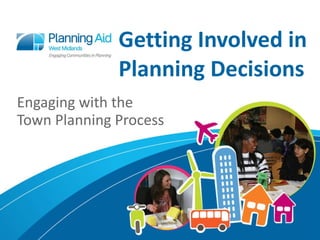
Getting Involved in Planning Decisions Engaging with the Town Planning Process
Getting Involved in Planning Decisions Why should people be involved in planning decision-making? 3 good reasons : - enhancing democracy and empowering people  - using the planning system to achieve  community objectives and projects, enabling  the Big Society to function properly - using local knowledge to improve what  actually happens.
Getting Involved in Planning Decisions What gets in the way of community involvement? lack of awareness of what can be done to respond to issues.  lack of awareness of ways to face up to private developers and public bureaucrats. lack of resources to access appropriate expertise.
Getting Involved in Planning Decisions Communities need a little help in overcoming the barriers to involvement. For the Big Society to work, communities need to access expertise. For town planning expertise, there is  Planning Aid .
What is Planning Aid? A service providing  free, independent   and professional  advice on town planning issues to community groups and individuals who cannot afford professional fees. A national service of the Royal Town Planning Institute, delivered regionally. Funded partly by CLG and partly from donations.
How do we do it? A small core of paid staff with volunteers who provide advice and support through: explaining procedures and policies helping write letters and statements helping communities develop their own ideas assisting in facilitating community/local planning authority participation events  educational projects with young and old offering training to community groups.
Getting Involved in Planning Decisions What sorts of planning decisions are there? Policies :  the basis and guidelines for making decisions about individual projects – mostly found in national “ Policy Statements ” and local “ Development Plans/ Frameworks ” (including ‘Core Strategies’ and ‘Supplementary Planning Documents’) Permissions : granting or refusing applications to carry out a project, plus all the negotiations leading up that decision (“ Development Management ”).
Influencing Planning Decisions: Policies Reasons for wanting to influence decisions relating to  Development Plans : Decisions  on individual planning applications should ‘conform’ to Development Plan  policies  if a Development Plan says “ yes ”, then it is difficult for a Planning Authority to say “ no ” Objecting to a Planning Application may be TOO LATE!
Influencing Planning Decisions: Policies A further reason : Development Plan processes are also a mechanism for  committing  the Council (and other public agencies) to  address issues , such as new roads, housing renewal, environmental improvements – and can pave the way to, say, a Development Trust project. A  Development Plan policy  is a major step towards seeing things happen!
Influencing Planning Decisions: Planning Applications Reasons for wanting to influence decisions relating to  Development Management :  Oppose  proposals  in principle  as being in the wrong place and/or at the wrong time. Amend  proposals  in design and detail. Enabling opportunities for improvements to your community and environment.
Influencing Planning Decisions: Planning Applications Using development to   enable (finance)  new local infrastructure  – physical and social: roads/traffic management, flood barriers … schools, clinics, community centres … open space, leisure centres, nature conservation … affordable housing. Mechanisms: s106 Agreements, Community Infrastructure Levy (CIL)
Influencing Planning Decisions:  Making A Case Make your comments as  clear and concise  as you can, focusing on your particular objection/ idea, but referring to the wider context.  Be prepared to find  evidence  to back up your arguments – do your own research: egs affordable housing: find out how many potential households there are (Housing Department) protect an area of open space: find out if there is a local deficiency (NPFA/Sport England) and guidance from Planning Aid!

Planning Aid - an introduction

  • 1.
    Getting Involved inPlanning Decisions Engaging with the Town Planning Process
  • 2.
    Getting Involved inPlanning Decisions Why should people be involved in planning decision-making? 3 good reasons : - enhancing democracy and empowering people - using the planning system to achieve community objectives and projects, enabling the Big Society to function properly - using local knowledge to improve what actually happens.
  • 3.
    Getting Involved inPlanning Decisions What gets in the way of community involvement? lack of awareness of what can be done to respond to issues. lack of awareness of ways to face up to private developers and public bureaucrats. lack of resources to access appropriate expertise.
  • 4.
    Getting Involved inPlanning Decisions Communities need a little help in overcoming the barriers to involvement. For the Big Society to work, communities need to access expertise. For town planning expertise, there is Planning Aid .
  • 5.
    What is PlanningAid? A service providing free, independent and professional advice on town planning issues to community groups and individuals who cannot afford professional fees. A national service of the Royal Town Planning Institute, delivered regionally. Funded partly by CLG and partly from donations.
  • 6.
    How do wedo it? A small core of paid staff with volunteers who provide advice and support through: explaining procedures and policies helping write letters and statements helping communities develop their own ideas assisting in facilitating community/local planning authority participation events educational projects with young and old offering training to community groups.
  • 7.
    Getting Involved inPlanning Decisions What sorts of planning decisions are there? Policies : the basis and guidelines for making decisions about individual projects – mostly found in national “ Policy Statements ” and local “ Development Plans/ Frameworks ” (including ‘Core Strategies’ and ‘Supplementary Planning Documents’) Permissions : granting or refusing applications to carry out a project, plus all the negotiations leading up that decision (“ Development Management ”).
  • 8.
    Influencing Planning Decisions:Policies Reasons for wanting to influence decisions relating to Development Plans : Decisions on individual planning applications should ‘conform’ to Development Plan policies if a Development Plan says “ yes ”, then it is difficult for a Planning Authority to say “ no ” Objecting to a Planning Application may be TOO LATE!
  • 9.
    Influencing Planning Decisions:Policies A further reason : Development Plan processes are also a mechanism for committing the Council (and other public agencies) to address issues , such as new roads, housing renewal, environmental improvements – and can pave the way to, say, a Development Trust project. A Development Plan policy is a major step towards seeing things happen!
  • 10.
    Influencing Planning Decisions:Planning Applications Reasons for wanting to influence decisions relating to Development Management : Oppose proposals in principle as being in the wrong place and/or at the wrong time. Amend proposals in design and detail. Enabling opportunities for improvements to your community and environment.
  • 11.
    Influencing Planning Decisions:Planning Applications Using development to enable (finance) new local infrastructure – physical and social: roads/traffic management, flood barriers … schools, clinics, community centres … open space, leisure centres, nature conservation … affordable housing. Mechanisms: s106 Agreements, Community Infrastructure Levy (CIL)
  • 12.
    Influencing Planning Decisions: Making A Case Make your comments as clear and concise as you can, focusing on your particular objection/ idea, but referring to the wider context. Be prepared to find evidence to back up your arguments – do your own research: egs affordable housing: find out how many potential households there are (Housing Department) protect an area of open space: find out if there is a local deficiency (NPFA/Sport England) and guidance from Planning Aid!