WHOLLY	
  GRAAL:	
  ENABLING	
  GPU	
  ACCELERATION	
  OF	
  JAVA	
  	
  USING	
  
THE	
  OPENJDK	
  GRAAL	
  COMPILER.	
  	
  
VASANTH	
  VENKATACHALAM	
  
AGENDA	
  
!  Why	
  should	
  you	
  be	
  interested	
  in	
  GPU	
  offload?	
  
!  Java	
  execuQon	
  model	
  
!  Requirements	
  for	
  Java	
  GPU	
  enablement	
  
!  Sumatra	
  OpenJDK	
  Project	
  for	
  Java	
  GPU	
  enablement	
  
!  Heterogeneous	
  System	
  Architecture	
  (HSA)	
  
!  IntroducQon	
  to	
  Graal	
  
!  JDK8	
  based	
  Graal	
  prototype	
  for	
  Java	
  GPU	
  offload	
  
!  Future	
  work	
  
!  Summary	
  

2	
   |	
  	
  	
  PRESENTATION	
  TITLE	
  	
  	
  |	
  	
  	
  November	
  20,	
  2013	
  	
  	
  |	
  	
  	
  CONFIDENTIAL	
  
WHY	
  SHOULD	
  YOU	
  BE	
  INTERESTED	
  IN	
  GPU	
  OFFLOAD?	
  
!  In	
  many	
  instances,	
  offloading	
  the	
  data-­‐parallel	
  parts	
  of	
  a	
  program	
  to	
  a	
  GPU	
  will	
  improve	
  the	
  performance	
  
compared	
  to	
  running	
  the	
  enQre	
  program	
  on	
  the	
  CPU	
  
‒ A	
  	
  typical	
  GPU	
  offers	
  more	
  cores	
  for	
  the	
  same	
  density	
  than	
  a	
  CPU	
  
‒ AMD	
  Radeon™	
  HD	
  7750	
  features	
  512	
  Stream	
  Processors!	
  
‒ In	
  a	
  data-­‐parallel	
  computaQon	
  in	
  which	
  the	
  same	
  computaQon	
  is	
  repeated	
  over	
  different	
  data	
  (and	
  the	
  
results	
  are	
  not	
  dependent	
  on	
  each	
  other),	
  the	
  individual	
  computaQons	
  can	
  be	
  executed	
  in	
  parallel	
  on	
  
mulQple	
  cores	
  
!  Example:	
  Squaring	
  array	
  elements	
  
for(int	
  i	
  =	
  0;	
  i	
  <	
  in.length;	
  i++)	
  	
  {	


  out[i]	
  =	
  in[i]	
  *	
  in[i];	
  
	
  }	
  

In[0]*in[0],	
  in[1]*in[1],	
  in[2]*in[2]…	
  

core0	
  

3	
   |	
  	
  	
  PRESENTATION	
  TITLE	
  	
  	
  |	
  	
  	
  November	
  20,	
  2013	
  	
  	
  |	
  	
  	
  CONFIDENTIAL	
  

core1	
  

core2	
  
JAVA	
  EXECUTION	
  MODEL	
  
!  Java	
  is	
  a	
  managed	
  run*me	
  language	
  ,	
  a	
  language	
  that	
  runs	
  
on	
  top	
  of	
  a	
  virtual	
  machine	
  (VM)	
  
‒ Other	
  managed	
  runQme	
  languages	
  include	
  Ruby,	
  
JavaScript,	
  Python,	
  Scala	
  
!  Java	
  source	
  is	
  compiled	
  into	
  an	
  intermediate	
  format	
  called	
  	
  
bytecode	
  
!  The	
  Java	
  virtual	
  machine	
  (JVM)	
  executes	
  the	
  bytecodes	
  
using	
  interpreta*on	
  or	
  just-­‐in-­‐*me	
  compila*on.	
  
‒  InterpretaQon	
  	
  involves	
  a	
  straight	
  	
  bytecode	
  to	
  machine	
  	
  code	
  
translaQon,	
  instrucQon	
  by	
  instrucQon	
  
‒  Just-­‐in-­‐Time	
  CompilaQon	
  (JIT)	
  involves	
  compiling	
  bytecodes	
  into	
  
machine	
  code	
  at	
  runQme	
  and	
  execuQng	
  the	
  machine	
  codes.	
  

!  Examples	
  of	
  JVMs	
  include:	
  
‒  Oracle	
  Hotspot™	
  JVM	
  
‒  IBM	
  J9	
  VM	
  
4	
   |	
  	
  	
  PRESENTATION	
  TITLE	
  	
  	
  |	
  	
  	
  November	
  20,	
  2013	
  	
  	
  |	
  	
  	
  CONFIDENTIAL	


Java	
  Source	
  Code	
  (Hello	
  World)	
  
public	
  staQc	
  void	
  main(String[]	
  args)	
  {	


  System.out.println(“Hello”);	
  
}	


Java	
  Source	
  Compiler	
  

Java	
  Bytecodes	
  (Hello	
  World)	


  0:	
  getstaQc	


  #13	


  3:	
  ldc	


  #19	


  5:	
  invokevirtual	
  #21	


  8:	
  return	
  

Java	
  Virtual	
  Machine	
  

Machine	
  code	
  
REQUIREMENTS	
  FOR	
  JAVA	
  GPU	
  ENABLEMENT	
  
!  Java	
  needs	
  a	
  programming	
  model	
  to	
  express	
  data-­‐parallel	
  workloads	
  
‒  Java	
  	
  8	
  for	
  example	
  has	
  the	
  Stream	
  API	
  with	
  support	
  for	
  Lambda	
  constructs	


!  The	
  Java	
  Virtual	
  Machine	
  (JVM)	
  needs	
  to	
  generate	
  code	
  for	
  the	
  GPU	
  as	
  well	
  as	
  the	
  CPU	
  
‒ The	
  JVM	
  has	
  to	
  target	
  mulQple	
  InstrucQon	
  Set	
  Architectures	
  (ISAs)	


!  Ideally,	
  the	
  JVM	
  can	
  generate	
  code	
  in	
  a	
  standard	
  intermediate	
  language	
  that	
  can	
  be	
  translated	
  into	
  the	
  
naQve	
  machine	
  instrucQons	
  of	
  each	
  GPU	
  target	
  
‒ This	
  allows	
  for	
  portability	
  
‒ Any	
  update	
  to	
  the	
  GPU	
  ISA	
  affects	
  only	
  the	
  translaQon	
  of	
  this	
  intermediate	
  language	
  into	
  the	
  GPU	
  
machine	
  instrucQons	
  

5	
   |	
  	
  	
  PRESENTATION	
  TITLE	
  	
  	
  |	
  	
  	
  November	
  20,	
  2013	
  	
  	
  |	
  	
  	
  CONFIDENTIAL	
  
SUMATRA	
  OPENJDK	
  PROJECT	
  FOR	
  JAVA	
  GPU	
  ENABLEMENT	
  
!  Open	
  source	
  project	
  intending	
  to	
  enable	
  Java	
  applicaQons	
  to	
  take	
  advantage	
  of	
  	
  the	
  GPU	
  
‒  More	
  or	
  less	
  transparently	
  to	
  the	
  applicaQon	


!  Project	
  started	
  by	
  Oracle	
  and	
  AMD	
  shortly	
  before	
  JavaOne	
  2012	


!  We	
  are	
  developing	
  a	
  prototype	
  of	
  Sumatra	
  using	
  the	
  Heterogeneous	
  System	
  Architecture	
  (HSA)	
  and	
  the	
  
Graal	
  OpenJDK	
  project	
  
‒  Backend	
  for	
  Graal	
  Just-­‐In-­‐Time	
  (JIT)	
  Compiler	
  which	
  compiles	
  Java	
  into	
  HSAIL	
  for	
  GPU	
  execuQon	
  
‒  Project	
  home	
  page:	
  hwp://openjdk.java.net/projects/graal/	


6	
   |	
  	
  	
  PRESENTATION	
  TITLE	
  	
  	
  |	
  	
  	
  November	
  20,	
  2013	
  	
  	
  |	
  	
  	
  CONFIDENTIAL	
  
EXAMPLE	
  OF	
  THE	
  KINDS	
  OF	
  CODE	
  WE’D	
  LIKE	
  TO	
  RUN	
  ON	
  THE	
  GPU	
  	
  
class NameInfo {
private String name;
private boolean exists;
public void checkExistsIn(String text) {
exists = text.contains(name);
}
};
NameInfo allNames[];
String longText;
IntStream istr = IntStream.range(0, allNames.length);
istr.forEach(i -> {
allNames[i].checkExistsIn(longText);
});

Our	
  prototype	
  can	
  handle	
  this	
  today!	
  

7	
   |	
  	
  	
  PRESENTATION	
  TITLE	
  	
  	
  |	
  	
  	
  November	
  20,	
  2013	
  	
  	
  |	
  	
  	
  CONFIDENTIAL	
  
HETEROGENEOUS	
  SYSTEM	
  ARCHITECTURE	
  (HSA)	
  
!  Heterogeneous	
  System	
  Architecture	
  standardizes	
  CPU/GPU	
  funcQonality	
  via	
  a	
  common	
  intermediate	
  
language	
  (HSAIL)	
  and	
  runQme	
  (the	
  HSA	
  stack)	
  
‒ ISA-­‐agnosQc	
  for	
  both	
  CPUs	
  and	
  accelerators	
  
‒ Support	
  high-­‐level	
  programming	
  languages	
  
!  HSA	
  makes	
  a	
  great	
  plazorm	
  for	
  GPU	
  offload	
  
‒ Shared	
  Virtual	
  Memory	
  
‒ Direct	
  access	
  to	
  heap	
  objects	
  in	
  main	
  memory	
  from	
  GPU	
  cores	
  	
  
‒ In	
  other	
  words,	
  “a	
  pointer	
  is	
  a	
  pointer”	
  
‒ Eliminates	
  the	
  overhead	
  of	
  copying	
  data	
  from	
  CPU	
  to	
  GPU	
  
‒ Eliminates	
  the	
  overhead	
  of	
  bookkeeping	
  pointers	
  
!  SpecificaQons	
  and	
  simulator	
  available	
  from	
  HSA	
  FoundaQon	
  
‒  hwp://hsafoundaQon.com/	
  
‒  hwp://hsafoundaQon.com/standards/	
  

8	
   |	
  	
  	
  PRESENTATION	
  TITLE	
  	
  	
  |	
  	
  	
  November	
  20,	
  2013	
  	
  	
  |	
  	
  	
  CONFIDENTIAL	
  
HSA	
  PARALLEL	
  EXECUTION	
  MODEL	
  
!  Grid	
  based	
  execuQon	
  model	
  
!  Programmer	
  supplies	
  a	
  “kernel”	
  that	
  is	
  run	
  on	
  each	
  work-­‐item	
  
!  	
  Kernel	
  is	
  wriwen	
  as	
  a	
  single	
  thread	
  of	
  execuQon	
  and	
  represents	
  the	
  main	
  body	
  of	
  work	
  each	
  work-­‐item	
  
will	
  execute	
  
!  Each	
  work-­‐item	
  has	
  a	
  unique	
  id	
  
!  Programmer	
  specifies	
  the	
  number	
  of	
  work-­‐items	
  (for	
  scope	
  of	
  problem)	


for(int	
  i	
  =	
  0;	
  i	
  <	
  in.length;	
  i++)	
  	
  {	


  out[i]	
  =	
  in[i]	
  *	
  in[i];	
  
	
  }	
  

work-­‐item	
  
(in[i]*in[i)]	
  

9	
   |	
  	
  	
  PRESENTATION	
  TITLE	
  	
  	
  |	
  	
  	
  November	
  20,	
  2013	
  	
  	
  |	
  	
  	
  CONFIDENTIAL	
  

Grid	
  size	
  
(number	
  of	
  mulQplicaQons	
  to	
  
be	
  done)	
  
HSAIL	
  PRIMER	
  
" HSAIL	
  is	
  the	
  code	
  that	
  the	
  Graal	
  backend	
  will	
  emit	
  
" Gets	
  translated	
  to	
  the	
  ISA	
  of	
  the	
  GPU	
  device	
  by	
  a	
  runQme	
  layer	
  known	
  as	
  the	
  “finalizer”	
  
" Generated	
  code	
  is	
  ASCII	
  text	
  form,	
  which	
  aids	
  in	
  debugging	
  
" Example:	
  signed	
  32-­‐bit	
  mulQplicaQon	


mul_s32	
  $s3,	
  $s0,	
  $s1	


Mnemonic	
  
(mul,	
  add,	
  
sub,	
  div,	
  
Etc.)	
  

DesQnaQon	
  
Type	
  modifier	
  
(s,	
  u,	
  b,	
  f)	
  

Length	
  modifier	
  
(1,	
  8.,	
  16,	
  32,	
  64	
  etc)	
  

10	
   |	
  	
  	
  PRESENTATION	
  TITLE	
  	
  	
  |	
  	
  	
  November	
  20,	
  2013	
  	
  	
  |	
  	
  	
  CONFIDENTIAL	
  

Source1	
  

Source2	
  
INTRODUCTION	
  TO	
  GRAAL	
  
!  Graal	
  is	
  a	
  highly	
  extensible,	
  open-­‐source,	
  just-­‐in-­‐Qme	
  compiler	
  for	
  Java	
  
‒  Project	
  home	
  page:	
  hwp://openjdk.java.net/projects/graal/	


!  Graal	
  is	
  wriwen	
  in	
  Java	
  
‒  Graal	
  can	
  be	
  developed	
  using	
  exisQng	
  Java	
  	
  IDEs	
  (e.g.,	
  Eclipse,	
  NetBeans)	
  making	
  it	
  straighzorward	
  to	
  debug	
  
‒  Because	
  Graal	
  is	
  wriwen	
  in	
  Java,	
  it	
  can	
  run	
  on	
  any	
  plazorm	
  and	
  be	
  treated	
  as	
  a	
  cross-­‐compiler	
  
‒  In	
  parQcular,	
  Graal	
  can	
  compile	
  	
  Java	
  for	
  the	
  GPU	
  while	
  running	
  on	
  the	
  CPU	
  

!  Graal	
  is	
  being	
  used	
  to	
  develop	
  a	
  centralized	
  framework	
  (Truffle)	
  for	
  execuQng	
  JVM	
  languages	
  
‒  hwp://www.oracle.com/technetwork/java/jvmls2013wimmer-­‐2014084.pdf	
  

‒  Adding	
  a	
  GPU	
  backend	
  to	
  Graal	
  potenQally	
  opens	
  the	
  door	
  to	
  GPU	
  enablement	
  of	
  other	
  JVM	
  languages	
  using	
  a	
  
centralized	
  framework,	
  but	
  this	
  is	
  an	
  area	
  for	
  future	
  work	
  

11	
   |	
  	
  	
  PRESENTATION	
  TITLE	
  	
  	
  |	
  	
  	
  November	
  20,	
  2013	
  	
  	
  |	
  	
  	
  CONFIDENTIAL	
  
JDK8	
  BASED	
  GRAAL	
  PROTOTYPE	
  FOR	
  JAVA	
  GPU	
  ENABLEMENT	


!  Graal	
  has	
  been	
  extended	
  with	
  a	
  prototype	
  backend	
  that	
  generates	
  HSAIL	
  code	
  for	
  GPU	
  execuQon	
  
!  This	
  allows	
  porQons	
  of	
  Java	
  8	
  programs	
  using	
  the	
  Stream	
  API	
  to	
  be	
  compiled	
  into	
  HSAIL	
  
!  This	
  prototype	
  has	
  been	
  tested	
  using	
  a	
  simulator	
  as	
  well	
  as	
  real	
  hardware	
  
‒ On	
  Mandelbrot	
  we	
  get	
  a	
  speedup	
  of	
  10x	
  running	
  on	
  the	
  GPU	
  versus	
  running	
  using	
  Java	
  threads	
  on	
  the	
  
x86	
  CPU	
  
!  The	
  HSAIL	
  backend	
  has	
  been	
  checked	
  into	
  the	
  Graal	
  OpenJDK	
  repository	


12	
   |	
  	
  	
  PRESENTATION	
  TITLE	
  	
  	
  |	
  	
  	
  November	
  20,	
  2013	
  	
  	
  |	
  	
  	
  CONFIDENTIAL	
  
HOW	
  GRAAL	
  WORKS	
  WITH	
  THE	
  HSA	
  RUNTIME	
  STACK	
  FOR	
  	
  A	
  JAVA	
  PROGRAM	


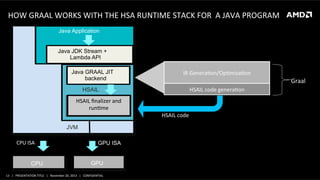
Java Application
Java JDK Stream +
Lambda API


Java GRAAL JIT
backend
HSAIL

IR	
  GeneraQon/OpQmizaQon	
  

Graal	
  
HSAIL	
  code	
  generaQon	
  

HSAIL	
  finalizer	
  and	
  
runQme	
  
HSAIL	
  code	
  
JVM
CPU	
  ISA

CPU

GPU ISA
GPU

13	
   |	
  	
  	
  PRESENTATION	
  TITLE	
  	
  	
  |	
  	
  	
  November	
  20,	
  2013	
  	
  	
  |	
  	
  	
  CONFIDENTIAL	
  
EXAMPLE	
  HSAIL	
  CODE	
  GENERATED	
  FOR	
  A	
  SAMPLE	
  JAVA	
  PROGRAM	
  	
  
Intstream	
  forEach	
  (i-­‐>	
  {	


  out[i]	
  =	
  in[i]	
  *	
  in[i];	
  
	
  });	
  

What	
  the	
  compiler	
  sees!	
  

private	
  staQc	
  void	
  lambda$67(int[]	
  out,	
  int[]	
  in,,	
  int	
  i)	
  	
  {	


  out[i]	
  =	
  in[i]	
  *	
  in[i];	
  
}	
  
Parameter	
  passed	
  to	
  lambda	
  

" Data-­‐parallel	
  execuPon	
  model	
  
" Each	
  workitem	
  has	
  a	
  unique	
  id	
  	
  
" workitemabsid	
  instrucPon	
  returns	
  the	
  id	
  of	
  the	
  current	
  
workitem	
  

14	
   |	
  	
  	
  PRESENTATION	
  TITLE	
  	
  	
  |	
  	
  	
  November	
  20,	
  2013	
  	
  	
  |	
  	
  	
  CONFIDENTIAL	
  

kernel	
  &run	
  (	


  kernarg_u64	
  %_arg0,	


  kernarg_u64	
  %_arg1	


  )	
  {	


  ld_kernarg_u64	
  	
  $d6,	
  [%_arg0];	
  
Parameter	
  passing	


  ld_kernarg_u64	
  	
  $d2,	
  [%_arg1];	


  workitemabsid_u32	
  $s1,	
  0;	


Load	
  id	
  of	


current	
  workitem	


  cvt_s64_s32	
  $d0,	
  $s1;	


  mul_s64	
  $d0,	
  $d0,	
  4;	


  add_u64	
  $d2,	
  $d2,	
  $d0;	
  
Load	
  in[i]	


  ld_global_s32	
  $s0,	
  [$d2	
  +	
  24];	


  mul_s32	
  $s3,	
  $s0,	
  $s0;	
  
in[i]	
  *	
  in[i]	


  cvt_s64_s32	
  $d1,	
  $s1;	


  mul_s64	
  $d1,	
  $d1,	
  4;	


  add_u64	
  $d6,	
  $d6,	
  $d1;	


  st_global_s32	
  $s3,	
  [$d6	
  +	
  24];	
  
Store	
  to	
  out[i]	


  ret;	
  
};	
  
EXAMPLES	
  OF	
  FUNCTIONALITY	
  WE	
  SUPPORT	


•  some	
  Math	
  intrinsics:	


Intstream.range(0, in.length).forEach(i->
{ 	
  
out[i] = Math.sqrt( in[i] )*in[i];
});

•  arrays,	
  string	
  manipulaQon	
  rouQnes,	
  calls	
  to	
  some	
  JDK	
  methods	
  
Intstream.range(0, boolArray.length).forEach(i-{
boolArray[i] = (inArray[i]).contains(“hello”);
});

•  instanceOf	
  operator	
  
Shape shapeArray[];
return shapeArray[i] instanceof Circle;


15	
   |	
  	
  	
  PRESENTATION	
  TITLE	
  	
  	
  |	
  	
  	
  November	
  20,	
  2013	
  	
  	
  |	
  	
  	
  CONFIDENTIAL	
  
EXAMPLES	
  OF	
  FUNCTIONALITY	
  WE	
  SUPPORT	
  
•  IntStream use case


   Public class Point {
public double x;
	
  
public double y;

}
Point[] pointArray;
Intstream.range(0, pointArray.length).forEach(i -> {
pointArray[i].x ++;
});
•  ObjectStream from Array
Arrays.stream(pointArray).forEach(p -> {
p.x ++;
});

16	
   |	
  	
  	
  PRESENTATION	
  TITLE	
  	
  	
  |	
  	
  	
  November	
  20,	
  2013	
  	
  	
  |	
  	
  	
  CONFIDENTIAL	
  
EXAMPLES	
  OF	
  FUNCTIONALITY	
  WE	
  SUPPORT	
  
•  ObjectStream from ArrayList


ArrayList<Point> pointList;
pointList.stream().forEach(p ->
	
  
{
p.x ++;
});

•  Atomic operations (patch forthcoming)
AtomicInteger atomicInt;
i -> {
outArray[i] = atomicInt.incrementAndGet( );
}

17	
   |	
  	
  	
  PRESENTATION	
  TITLE	
  	
  	
  |	
  	
  	
  November	
  20,	
  2013	
  	
  	
  |	
  	
  	
  CONFIDENTIAL	
  
FUTURE	
  WORK	
  
!  GPU	
  enablement	
  for	
  managed	
  runQme	
  languages	
  other	
  than	
  Java	
  is	
  an	
  area	
  for	
  future	
  work	
  
!  One	
  path	
  is	
  to	
  develop	
  a	
  mechanism	
  that	
  allows	
  other	
  languages	
  to	
  call	
  the	
  Java	
  8	
  Stream	
  API	
  
‒  This	
  could	
  leverage	
  exisQng	
  work	
  to	
  make	
  other	
  JVM	
  languages	
  interoperable	
  with	
  Java	
  
‒  hwp://agiledeveloper.com/presentaQons/integraQng_jvm_languages_javaone.zip	


!  Another	
  path	
  is	
  to	
  develop	
  a	
  centralized	
  framework	
  that	
  allows	
  JVM	
  languages	
  to	
  be	
  compiled	
  into	
  a	
  
format	
  that	
  Graal	
  can	
  take	
  as	
  input	
  
!  Truffle	
  is	
  a	
  prototype	
  language	
  implementaQon	
  framework	
  wriwen	
  in	
  Java	
  that	
  uses	
  the	
  Graal	
  JIT	
  compiler	
  
‒  hwps://wiki.openjdk.java.net/display/Graal/Truffle+FAQ+and+Guidelines	
  
‒  The	
  OpenJDK	
  community	
  has	
  developed	
  prototype	
  implementaQons	
  of	
  JavaScript,	
  Ruby	
  and	
  R	
  on	
  Truffle	
  
‒  hwp://www.oracle.com/technetwork/java/jvmls2013wimmer-­‐2014084.pdf	
  
‒  hwp://www.oracle.com/technetwork/java/jvmls2013vitek-­‐2013524.pdf	
  

‒  Using	
  Graal	
  as	
  the	
  JIT	
  compiler	
  potenQally	
  allows	
  other	
  JVM	
  languages	
  to	
  take	
  advantage	
  of	
  Graal’s	
  HSAIL	
  backend	
  
18	
   |	
  	
  	
  PRESENTATION	
  TITLE	
  	
  	
  |	
  	
  	
  November	
  20,	
  2013	
  	
  	
  |	
  	
  	
  CONFIDENTIAL	
  
SUMMARY	
  
!  GPU	
  offload	
  is	
  beneficial	
  for	
  improved	
  performance	
  
!  We	
  have	
  extended	
  the	
  Graal	
  Just-­‐In-­‐Time	
  compiler	
  with	
  a	
  	
  prototype	
  backend	
  that	
  generates	
  HSAIL	
  code	
  
!  This	
  work	
  opens	
  the	
  door	
  to	
  GPU	
  acceleraQon	
  for	
  Java	
  
!  GPU	
  acceleraQon	
  for	
  other	
  managed	
  runQme	
  languages	
  is	
  an	
  area	
  for	
  future	
  work	
  
‒  Truffle	
  may	
  make	
  this	
  possible	
  by	
  providing	
  	
  a	
  centralized	
  framework	
  for	
  language	
  implementaQon	
  using	
  the	
  Graal	
  
JIT	
  compiler	
  

!  We	
  encourage	
  OpenJDK	
  community	
  feedback	
  and	
  contribuQons	


19	
   |	
  	
  	
  PRESENTATION	
  TITLE	
  	
  	
  |	
  	
  	
  November	
  20,	
  2013	
  	
  	
  |	
  	
  	
  CONFIDENTIAL	
  
REFERENCES	
  
!  AMD	
  DevCentral	
  blog	
  on	
  HSAIL-­‐based	
  GPU	
  Offload	
  
‒  hwp://developer.amd.com/community/blog/hsail-­‐based-­‐gpu-­‐offload-­‐the-­‐quest-­‐for-­‐java-­‐performance-­‐begins/	
  

!  Sumatra	
  OpenJDK	
  GPU/APU	
  offload	
  project	
  
‒  Project	
  home	
  page:	
  hwp://openjdk.java.net/projects/sumatra/	
  
‒  Wiki:	
  hwps://wiki.openjdk.java.net/display/Sumatra/Main	


!  Graal	
  JIT	
  compiler	
  and	
  runQme	
  project	
  
‒  Project	
  home	
  page:	
  hwp://openjdk.java.net/projects/graal/	
  

!  HSA	
  FoundaQon:	
  	
  
‒  hwp://hsafoundaQon.com/	
  
‒  hwp://hsafoundaQon.com/standards/	


20	
   |	
  	
  	
  PRESENTATION	
  TITLE	
  	
  	
  |	
  	
  	
  November	
  20,	
  2013	
  	
  	
  |	
  	
  	
  CONFIDENTIAL	
  
REFERENCES	
  
!  JVM	
  Language	
  Summit	
  	
  2013	
  (JVMLS	
  2013)	
  
‒  Wimmer	
  and	
  Seaton,	
  “One	
  VM	
  to	
  Rule	
  them	
  all”	
  :	
  
‒  	
  hwp://www.oracle.com/technetwork/java/jvmls2013wimmer-­‐2014084.pdf	


‒  Wuerthinger	
  and	
  Venkatachalam,	
  “Graal	
  and	
  GPU	
  offload”	
  
‒  hwp://www.oracle.com/technetwork/java/jvmls2913wuerth-­‐2013918.pdf	
  

‒  Vitek,	
  “R	
  in	
  Java”	
  
‒  hwp://www.oracle.com/technetwork/java/jvmls2013vitek-­‐2013524.pdf	


!  JavaOne	
  2013	
  
‒  Thalinger,	
  Wimmer,	
  and	
  Venkatachalam,	
  “Wholly	
  Graal:	
  AcceleraQng	
  GPU	
  offload	
  for	
  Java”:	
  
‒  hwps://oracleus.acQveevents.com/2013/connect/fileDownload/session/C2A34A60DEDE1B2D9FE9D87733345017/
CON6419_Wimmer.pdf	
  

21	
   |	
  	
  	
  PRESENTATION	
  TITLE	
  	
  	
  |	
  	
  	
  November	
  20,	
  2013	
  	
  	
  |	
  	
  	
  CONFIDENTIAL	
  
DISCLAIMER	
  &	
  ATTRIBUTION	
  

The	
  informaQon	
  presented	
  in	
  this	
  document	
  is	
  for	
  informaQonal	
  purposes	
  only	
  and	
  may	
  contain	
  technical	
  inaccuracies,	
  omissions	
  and	
  typographical	
  errors.	


The	
  informaQon	
  contained	
  herein	
  is	
  subject	
  to	
  change	
  and	
  may	
  be	
  rendered	
  inaccurate	
  for	
  many	
  reasons,	
  including	
  but	
  not	
  limited	
  to	
  product	
  and	
  roadmap	
  
changes,	
  component	
  and	
  motherboard	
  version	
  changes,	
  new	
  model	
  and/or	
  product	
  releases,	
  product	
  differences	
  between	
  differing	
  manufacturers,	
  so•ware	
  
changes,	
  BIOS	
  flashes,	
  firmware	
  upgrades,	
  or	
  the	
  like.	
  AMD	
  assumes	
  no	
  obligaQon	
  to	
  update	
  or	
  otherwise	
  correct	
  or	
  revise	
  this	
  informaQon.	
  However,	
  AMD	
  
reserves	
  the	
  right	
  to	
  revise	
  this	
  informaQon	
  and	
  to	
  make	
  changes	
  from	
  Qme	
  to	
  Qme	
  to	
  the	
  content	
  hereof	
  without	
  obligaQon	
  of	
  AMD	
  to	
  noQfy	
  any	
  person	
  of	
  
such	
  revisions	
  or	
  changes.	


AMD	
  MAKES	
  NO	
  REPRESENTATIONS	
  OR	
  WARRANTIES	
  WITH	
  RESPECT	
  TO	
  THE	
  CONTENTS	
  HEREOF	
  AND	
  ASSUMES	
  NO	
  RESPONSIBILITY	
  FOR	
  ANY	
  
INACCURACIES,	
  ERRORS	
  OR	
  OMISSIONS	
  THAT	
  MAY	
  APPEAR	
  IN	
  THIS	
  INFORMATION.	


AMD	
  SPECIFICALLY	
  DISCLAIMS	
  ANY	
  IMPLIED	
  WARRANTIES	
  OF	
  MERCHANTABILITY	
  OR	
  FITNESS	
  FOR	
  ANY	
  PARTICULAR	
  PURPOSE.	
  IN	
  NO	
  EVENT	
  WILL	
  AMD	
  BE	
  
LIABLE	
  TO	
  ANY	
  PERSON	
  FOR	
  ANY	
  DIRECT,	
  INDIRECT,	
  SPECIAL	
  OR	
  OTHER	
  CONSEQUENTIAL	
  DAMAGES	
  ARISING	
  FROM	
  THE	
  USE	
  OF	
  ANY	
  INFORMATION	
  
CONTAINED	
  HEREIN,	
  EVEN	
  IF	
  AMD	
  IS	
  EXPRESSLY	
  ADVISED	
  OF	
  THE	
  POSSIBILITY	
  OF	
  SUCH	
  DAMAGES.	


ATTRIBUTION	
  
©	
  2013	
  Advanced	
  Micro	
  Devices,	
  Inc.	
  All	
  rights	
  reserved.	
  AMD,	
  the	
  AMD	
  Arrow	
  logo	
  and	
  combinaQons	
  thereof	
  are	
  trademarks	
  of	
  Advanced	
  Micro	
  Devices,	
  
Inc.	
  in	
  the	
  United	
  States	
  and/or	
  other	
  jurisdicQons.	
  	
  SPEC	
  	
  is	
  a	
  registered	
  trademark	
  of	
  the	
  Standard	
  Performance	
  EvaluaQon	
  CorporaQon	
  (SPEC).	
  Other	
  
names	
  are	
  for	
  informaQonal	
  purposes	
  only	
  and	
  may	
  be	
  trademarks	
  of	
  their	
  respecQve	
  owners.	
  
22	
   |	
  	
  	
  PRESENTATION	
  TITLE	
  	
  	
  |	
  	
  	
  November	
  20,	
  2013	
  	
  	
  |	
  	
  	
  CONFIDENTIAL	
  

PL-4042, Wholly Graal: Accelerating GPU offload for Java/Sumatra using the OpenJDK Graal infrastructure, by Vasanth Venkatachalam

  • 1.
    WHOLLY  GRAAL:  ENABLING  GPU  ACCELERATION  OF  JAVA    USING   THE  OPENJDK  GRAAL  COMPILER.     VASANTH  VENKATACHALAM  
  • 2.
    AGENDA   !  Why  should  you  be  interested  in  GPU  offload?   !  Java  execuQon  model   !  Requirements  for  Java  GPU  enablement   !  Sumatra  OpenJDK  Project  for  Java  GPU  enablement   !  Heterogeneous  System  Architecture  (HSA)   !  IntroducQon  to  Graal   !  JDK8  based  Graal  prototype  for  Java  GPU  offload   !  Future  work   !  Summary   2   |      PRESENTATION  TITLE      |      November  20,  2013      |      CONFIDENTIAL  
  • 3.
    WHY  SHOULD  YOU  BE  INTERESTED  IN  GPU  OFFLOAD?   !  In  many  instances,  offloading  the  data-­‐parallel  parts  of  a  program  to  a  GPU  will  improve  the  performance   compared  to  running  the  enQre  program  on  the  CPU   ‒ A    typical  GPU  offers  more  cores  for  the  same  density  than  a  CPU   ‒ AMD  Radeon™  HD  7750  features  512  Stream  Processors!   ‒ In  a  data-­‐parallel  computaQon  in  which  the  same  computaQon  is  repeated  over  different  data  (and  the   results  are  not  dependent  on  each  other),  the  individual  computaQons  can  be  executed  in  parallel  on   mulQple  cores   !  Example:  Squaring  array  elements   for(int  i  =  0;  i  <  in.length;  i++)    {              out[i]  =  in[i]  *  in[i];    }   In[0]*in[0],  in[1]*in[1],  in[2]*in[2]…   core0   3   |      PRESENTATION  TITLE      |      November  20,  2013      |      CONFIDENTIAL   core1   core2  
  • 4.
    JAVA  EXECUTION  MODEL   !  Java  is  a  managed  run*me  language  ,  a  language  that  runs   on  top  of  a  virtual  machine  (VM)   ‒ Other  managed  runQme  languages  include  Ruby,   JavaScript,  Python,  Scala   !  Java  source  is  compiled  into  an  intermediate  format  called     bytecode   !  The  Java  virtual  machine  (JVM)  executes  the  bytecodes   using  interpreta*on  or  just-­‐in-­‐*me  compila*on.   ‒  InterpretaQon    involves  a  straight    bytecode  to  machine    code   translaQon,  instrucQon  by  instrucQon   ‒  Just-­‐in-­‐Time  CompilaQon  (JIT)  involves  compiling  bytecodes  into   machine  code  at  runQme  and  execuQng  the  machine  codes.   !  Examples  of  JVMs  include:   ‒  Oracle  Hotspot™  JVM   ‒  IBM  J9  VM   4   |      PRESENTATION  TITLE      |      November  20,  2013      |      CONFIDENTIAL     Java  Source  Code  (Hello  World)   public  staQc  void  main(String[]  args)  {        System.out.println(“Hello”);   }     Java  Source  Compiler   Java  Bytecodes  (Hello  World)              0:  getstaQc                    #13                3:  ldc                                        #19                5:  invokevirtual  #21                8:  return   Java  Virtual  Machine   Machine  code  
  • 5.
    REQUIREMENTS  FOR  JAVA  GPU  ENABLEMENT   !  Java  needs  a  programming  model  to  express  data-­‐parallel  workloads   ‒  Java    8  for  example  has  the  Stream  API  with  support  for  Lambda  constructs     !  The  Java  Virtual  Machine  (JVM)  needs  to  generate  code  for  the  GPU  as  well  as  the  CPU   ‒ The  JVM  has  to  target  mulQple  InstrucQon  Set  Architectures  (ISAs)     !  Ideally,  the  JVM  can  generate  code  in  a  standard  intermediate  language  that  can  be  translated  into  the   naQve  machine  instrucQons  of  each  GPU  target   ‒ This  allows  for  portability   ‒ Any  update  to  the  GPU  ISA  affects  only  the  translaQon  of  this  intermediate  language  into  the  GPU   machine  instrucQons   5   |      PRESENTATION  TITLE      |      November  20,  2013      |      CONFIDENTIAL  
  • 6.
    SUMATRA  OPENJDK  PROJECT  FOR  JAVA  GPU  ENABLEMENT   !  Open  source  project  intending  to  enable  Java  applicaQons  to  take  advantage  of    the  GPU   ‒  More  or  less  transparently  to  the  applicaQon       !  Project  started  by  Oracle  and  AMD  shortly  before  JavaOne  2012     !  We  are  developing  a  prototype  of  Sumatra  using  the  Heterogeneous  System  Architecture  (HSA)  and  the   Graal  OpenJDK  project   ‒  Backend  for  Graal  Just-­‐In-­‐Time  (JIT)  Compiler  which  compiles  Java  into  HSAIL  for  GPU  execuQon   ‒  Project  home  page:  hwp://openjdk.java.net/projects/graal/     6   |      PRESENTATION  TITLE      |      November  20,  2013      |      CONFIDENTIAL  
  • 7.
    EXAMPLE  OF  THE  KINDS  OF  CODE  WE’D  LIKE  TO  RUN  ON  THE  GPU     class NameInfo { private String name; private boolean exists; public void checkExistsIn(String text) { exists = text.contains(name); } }; NameInfo allNames[]; String longText; IntStream istr = IntStream.range(0, allNames.length); istr.forEach(i -> { allNames[i].checkExistsIn(longText); }); Our  prototype  can  handle  this  today!   7   |      PRESENTATION  TITLE      |      November  20,  2013      |      CONFIDENTIAL  
  • 8.
    HETEROGENEOUS  SYSTEM  ARCHITECTURE  (HSA)   !  Heterogeneous  System  Architecture  standardizes  CPU/GPU  funcQonality  via  a  common  intermediate   language  (HSAIL)  and  runQme  (the  HSA  stack)   ‒ ISA-­‐agnosQc  for  both  CPUs  and  accelerators   ‒ Support  high-­‐level  programming  languages   !  HSA  makes  a  great  plazorm  for  GPU  offload   ‒ Shared  Virtual  Memory   ‒ Direct  access  to  heap  objects  in  main  memory  from  GPU  cores     ‒ In  other  words,  “a  pointer  is  a  pointer”   ‒ Eliminates  the  overhead  of  copying  data  from  CPU  to  GPU   ‒ Eliminates  the  overhead  of  bookkeeping  pointers   !  SpecificaQons  and  simulator  available  from  HSA  FoundaQon   ‒  hwp://hsafoundaQon.com/   ‒  hwp://hsafoundaQon.com/standards/   8   |      PRESENTATION  TITLE      |      November  20,  2013      |      CONFIDENTIAL  
  • 9.
    HSA  PARALLEL  EXECUTION  MODEL   !  Grid  based  execuQon  model   !  Programmer  supplies  a  “kernel”  that  is  run  on  each  work-­‐item   !   Kernel  is  wriwen  as  a  single  thread  of  execuQon  and  represents  the  main  body  of  work  each  work-­‐item   will  execute   !  Each  work-­‐item  has  a  unique  id   !  Programmer  specifies  the  number  of  work-­‐items  (for  scope  of  problem)     for(int  i  =  0;  i  <  in.length;  i++)    {              out[i]  =  in[i]  *  in[i];    }   work-­‐item   (in[i]*in[i)]   9   |      PRESENTATION  TITLE      |      November  20,  2013      |      CONFIDENTIAL   Grid  size   (number  of  mulQplicaQons  to   be  done)  
  • 10.
    HSAIL  PRIMER   " HSAIL  is  the  code  that  the  Graal  backend  will  emit   " Gets  translated  to  the  ISA  of  the  GPU  device  by  a  runQme  layer  known  as  the  “finalizer”   " Generated  code  is  ASCII  text  form,  which  aids  in  debugging   " Example:  signed  32-­‐bit  mulQplicaQon     mul_s32  $s3,  $s0,  $s1                 Mnemonic   (mul,  add,   sub,  div,   Etc.)   DesQnaQon   Type  modifier   (s,  u,  b,  f)   Length  modifier   (1,  8.,  16,  32,  64  etc)   10   |      PRESENTATION  TITLE      |      November  20,  2013      |      CONFIDENTIAL   Source1   Source2  
  • 11.
    INTRODUCTION  TO  GRAAL   !  Graal  is  a  highly  extensible,  open-­‐source,  just-­‐in-­‐Qme  compiler  for  Java   ‒  Project  home  page:  hwp://openjdk.java.net/projects/graal/     !  Graal  is  wriwen  in  Java   ‒  Graal  can  be  developed  using  exisQng  Java    IDEs  (e.g.,  Eclipse,  NetBeans)  making  it  straighzorward  to  debug   ‒  Because  Graal  is  wriwen  in  Java,  it  can  run  on  any  plazorm  and  be  treated  as  a  cross-­‐compiler   ‒  In  parQcular,  Graal  can  compile    Java  for  the  GPU  while  running  on  the  CPU   !  Graal  is  being  used  to  develop  a  centralized  framework  (Truffle)  for  execuQng  JVM  languages   ‒  hwp://www.oracle.com/technetwork/java/jvmls2013wimmer-­‐2014084.pdf   ‒  Adding  a  GPU  backend  to  Graal  potenQally  opens  the  door  to  GPU  enablement  of  other  JVM  languages  using  a   centralized  framework,  but  this  is  an  area  for  future  work   11   |      PRESENTATION  TITLE      |      November  20,  2013      |      CONFIDENTIAL  
  • 12.
    JDK8  BASED  GRAAL  PROTOTYPE  FOR  JAVA  GPU  ENABLEMENT     !  Graal  has  been  extended  with  a  prototype  backend  that  generates  HSAIL  code  for  GPU  execuQon   !  This  allows  porQons  of  Java  8  programs  using  the  Stream  API  to  be  compiled  into  HSAIL   !  This  prototype  has  been  tested  using  a  simulator  as  well  as  real  hardware   ‒ On  Mandelbrot  we  get  a  speedup  of  10x  running  on  the  GPU  versus  running  using  Java  threads  on  the   x86  CPU   !  The  HSAIL  backend  has  been  checked  into  the  Graal  OpenJDK  repository     12   |      PRESENTATION  TITLE      |      November  20,  2013      |      CONFIDENTIAL  
  • 13.
    HOW  GRAAL  WORKS  WITH  THE  HSA  RUNTIME  STACK  FOR    A  JAVA  PROGRAM     Java Application Java JDK Stream + Lambda API   Java GRAAL JIT backend HSAIL IR  GeneraQon/OpQmizaQon   Graal   HSAIL  code  generaQon   HSAIL  finalizer  and   runQme   HSAIL  code   JVM CPU  ISA CPU GPU ISA GPU 13   |      PRESENTATION  TITLE      |      November  20,  2013      |      CONFIDENTIAL  
  • 14.
    EXAMPLE  HSAIL  CODE  GENERATED  FOR  A  SAMPLE  JAVA  PROGRAM     Intstream  forEach  (i-­‐>  {              out[i]  =  in[i]  *  in[i];    });   What  the  compiler  sees!   private  staQc  void  lambda$67(int[]  out,  int[]  in,,  int  i)    {            out[i]  =  in[i]  *  in[i];   }   Parameter  passed  to  lambda   " Data-­‐parallel  execuPon  model   " Each  workitem  has  a  unique  id     " workitemabsid  instrucPon  returns  the  id  of  the  current   workitem   14   |      PRESENTATION  TITLE      |      November  20,  2013      |      CONFIDENTIAL   kernel  &run  (                  kernarg_u64  %_arg0,                  kernarg_u64  %_arg1                  )  {                  ld_kernarg_u64    $d6,  [%_arg0];   Parameter  passing                  ld_kernarg_u64    $d2,  [%_arg1];                  workitemabsid_u32  $s1,  0;                                                                     Load  id  of                         current  workitem                  cvt_s64_s32  $d0,  $s1;                  mul_s64  $d0,  $d0,  4;                  add_u64  $d2,  $d2,  $d0;   Load  in[i]                  ld_global_s32  $s0,  [$d2  +  24];                  mul_s32  $s3,  $s0,  $s0;   in[i]  *  in[i]                  cvt_s64_s32  $d1,  $s1;                  mul_s64  $d1,  $d1,  4;                  add_u64  $d6,  $d6,  $d1;                  st_global_s32  $s3,  [$d6  +  24];   Store  to  out[i]                  ret;   };  
  • 15.
    EXAMPLES  OF  FUNCTIONALITY  WE  SUPPORT     •  some  Math  intrinsics:     Intstream.range(0, in.length).forEach(i-> {   out[i] = Math.sqrt( in[i] )*in[i]; }); •  arrays,  string  manipulaQon  rouQnes,  calls  to  some  JDK  methods   Intstream.range(0, boolArray.length).forEach(i-{ boolArray[i] = (inArray[i]).contains(“hello”); }); •  instanceOf  operator   Shape shapeArray[]; return shapeArray[i] instanceof Circle;   15   |      PRESENTATION  TITLE      |      November  20,  2013      |      CONFIDENTIAL  
  • 16.
    EXAMPLES  OF  FUNCTIONALITY  WE  SUPPORT   •  IntStream use case     Public class Point { public double x;   public double y; } Point[] pointArray; Intstream.range(0, pointArray.length).forEach(i -> { pointArray[i].x ++; }); •  ObjectStream from Array Arrays.stream(pointArray).forEach(p -> { p.x ++; }); 16   |      PRESENTATION  TITLE      |      November  20,  2013      |      CONFIDENTIAL  
  • 17.
    EXAMPLES  OF  FUNCTIONALITY  WE  SUPPORT   •  ObjectStream from ArrayList     ArrayList<Point> pointList; pointList.stream().forEach(p ->   { p.x ++; }); •  Atomic operations (patch forthcoming) AtomicInteger atomicInt; i -> { outArray[i] = atomicInt.incrementAndGet( ); } 17   |      PRESENTATION  TITLE      |      November  20,  2013      |      CONFIDENTIAL  
  • 18.
    FUTURE  WORK   ! GPU  enablement  for  managed  runQme  languages  other  than  Java  is  an  area  for  future  work   !  One  path  is  to  develop  a  mechanism  that  allows  other  languages  to  call  the  Java  8  Stream  API   ‒  This  could  leverage  exisQng  work  to  make  other  JVM  languages  interoperable  with  Java   ‒  hwp://agiledeveloper.com/presentaQons/integraQng_jvm_languages_javaone.zip     !  Another  path  is  to  develop  a  centralized  framework  that  allows  JVM  languages  to  be  compiled  into  a   format  that  Graal  can  take  as  input   !  Truffle  is  a  prototype  language  implementaQon  framework  wriwen  in  Java  that  uses  the  Graal  JIT  compiler   ‒  hwps://wiki.openjdk.java.net/display/Graal/Truffle+FAQ+and+Guidelines   ‒  The  OpenJDK  community  has  developed  prototype  implementaQons  of  JavaScript,  Ruby  and  R  on  Truffle   ‒  hwp://www.oracle.com/technetwork/java/jvmls2013wimmer-­‐2014084.pdf   ‒  hwp://www.oracle.com/technetwork/java/jvmls2013vitek-­‐2013524.pdf   ‒  Using  Graal  as  the  JIT  compiler  potenQally  allows  other  JVM  languages  to  take  advantage  of  Graal’s  HSAIL  backend   18   |      PRESENTATION  TITLE      |      November  20,  2013      |      CONFIDENTIAL  
  • 19.
    SUMMARY   !  GPU  offload  is  beneficial  for  improved  performance   !  We  have  extended  the  Graal  Just-­‐In-­‐Time  compiler  with  a    prototype  backend  that  generates  HSAIL  code   !  This  work  opens  the  door  to  GPU  acceleraQon  for  Java   !  GPU  acceleraQon  for  other  managed  runQme  languages  is  an  area  for  future  work   ‒  Truffle  may  make  this  possible  by  providing    a  centralized  framework  for  language  implementaQon  using  the  Graal   JIT  compiler   !  We  encourage  OpenJDK  community  feedback  and  contribuQons     19   |      PRESENTATION  TITLE      |      November  20,  2013      |      CONFIDENTIAL  
  • 20.
    REFERENCES   !  AMD  DevCentral  blog  on  HSAIL-­‐based  GPU  Offload   ‒  hwp://developer.amd.com/community/blog/hsail-­‐based-­‐gpu-­‐offload-­‐the-­‐quest-­‐for-­‐java-­‐performance-­‐begins/   !  Sumatra  OpenJDK  GPU/APU  offload  project   ‒  Project  home  page:  hwp://openjdk.java.net/projects/sumatra/   ‒  Wiki:  hwps://wiki.openjdk.java.net/display/Sumatra/Main     !  Graal  JIT  compiler  and  runQme  project   ‒  Project  home  page:  hwp://openjdk.java.net/projects/graal/   !  HSA  FoundaQon:     ‒  hwp://hsafoundaQon.com/   ‒  hwp://hsafoundaQon.com/standards/     20   |      PRESENTATION  TITLE      |      November  20,  2013      |      CONFIDENTIAL  
  • 21.
    REFERENCES   !  JVM  Language  Summit    2013  (JVMLS  2013)   ‒  Wimmer  and  Seaton,  “One  VM  to  Rule  them  all”  :   ‒   hwp://www.oracle.com/technetwork/java/jvmls2013wimmer-­‐2014084.pdf     ‒  Wuerthinger  and  Venkatachalam,  “Graal  and  GPU  offload”   ‒  hwp://www.oracle.com/technetwork/java/jvmls2913wuerth-­‐2013918.pdf   ‒  Vitek,  “R  in  Java”   ‒  hwp://www.oracle.com/technetwork/java/jvmls2013vitek-­‐2013524.pdf     !  JavaOne  2013   ‒  Thalinger,  Wimmer,  and  Venkatachalam,  “Wholly  Graal:  AcceleraQng  GPU  offload  for  Java”:   ‒  hwps://oracleus.acQveevents.com/2013/connect/fileDownload/session/C2A34A60DEDE1B2D9FE9D87733345017/ CON6419_Wimmer.pdf   21   |      PRESENTATION  TITLE      |      November  20,  2013      |      CONFIDENTIAL  
  • 22.
    DISCLAIMER  &  ATTRIBUTION   The  informaQon  presented  in  this  document  is  for  informaQonal  purposes  only  and  may  contain  technical  inaccuracies,  omissions  and  typographical  errors.     The  informaQon  contained  herein  is  subject  to  change  and  may  be  rendered  inaccurate  for  many  reasons,  including  but  not  limited  to  product  and  roadmap   changes,  component  and  motherboard  version  changes,  new  model  and/or  product  releases,  product  differences  between  differing  manufacturers,  so•ware   changes,  BIOS  flashes,  firmware  upgrades,  or  the  like.  AMD  assumes  no  obligaQon  to  update  or  otherwise  correct  or  revise  this  informaQon.  However,  AMD   reserves  the  right  to  revise  this  informaQon  and  to  make  changes  from  Qme  to  Qme  to  the  content  hereof  without  obligaQon  of  AMD  to  noQfy  any  person  of   such  revisions  or  changes.     AMD  MAKES  NO  REPRESENTATIONS  OR  WARRANTIES  WITH  RESPECT  TO  THE  CONTENTS  HEREOF  AND  ASSUMES  NO  RESPONSIBILITY  FOR  ANY   INACCURACIES,  ERRORS  OR  OMISSIONS  THAT  MAY  APPEAR  IN  THIS  INFORMATION.     AMD  SPECIFICALLY  DISCLAIMS  ANY  IMPLIED  WARRANTIES  OF  MERCHANTABILITY  OR  FITNESS  FOR  ANY  PARTICULAR  PURPOSE.  IN  NO  EVENT  WILL  AMD  BE   LIABLE  TO  ANY  PERSON  FOR  ANY  DIRECT,  INDIRECT,  SPECIAL  OR  OTHER  CONSEQUENTIAL  DAMAGES  ARISING  FROM  THE  USE  OF  ANY  INFORMATION   CONTAINED  HEREIN,  EVEN  IF  AMD  IS  EXPRESSLY  ADVISED  OF  THE  POSSIBILITY  OF  SUCH  DAMAGES.     ATTRIBUTION   ©  2013  Advanced  Micro  Devices,  Inc.  All  rights  reserved.  AMD,  the  AMD  Arrow  logo  and  combinaQons  thereof  are  trademarks  of  Advanced  Micro  Devices,   Inc.  in  the  United  States  and/or  other  jurisdicQons.    SPEC    is  a  registered  trademark  of  the  Standard  Performance  EvaluaQon  CorporaQon  (SPEC).  Other   names  are  for  informaQonal  purposes  only  and  may  be  trademarks  of  their  respecQve  owners.   22   |      PRESENTATION  TITLE      |      November  20,  2013      |      CONFIDENTIAL