Seaport	
  West,	
  155	
  Seaport	
  Boulevard,	
  Boston	
  MA	
  02210	
  	
  www.nutter.com	
  
Jeremy	
  Halpern	
  
Partner,	
  Nutter	
  McClennen	
  &	
  Fish	
  	
  
Director,	
  MassVentures	
  
@startupboston	
  
Matt	
  Douglas	
  
Founder/CEO,	
  Punchbowl	
  
@mattdouglas	
  
TCN	
  Venture	
  Fast	
  Track	
  
Pitching	
  the	
  Plan:	
  The	
  Deck
›  Nutter,	
  McClennen	
  &	
  Fish,	
  LLP	
  -­‐	
  Partner;	
  Director	
  of	
  Biz	
  Dev,	
  ECG	
  
•  Top	
  10	
  Boston	
  law	
  firm	
  
•  Represent	
  clients	
  in	
  technology,	
  hardware,	
  software,	
  mobile,	
  	
  medtech	


  health	
  
IT,	
  biotechnology,	
  cleantech	
  CPG,	
  consumer	
  electronics	
  
›  MassVentures	
  –	
  Director	
  &	
  Investment	
  Committee	
  Member	
  
•  The	
  Venture	
  Arm	
  of	
  the	
  Commonwealth:	
  providing	
  seed	
  and	
  early	
  stage	
  venture	
  funding	
  
to	
  high	
  growth	
  technology	
  startups	
  
›  Angel	
  Investor	
  –	
  Private	
  investor	
  in	
  multiple	
  technology	
  and	
  consumer	
  products	
  companies	
  
›  The	
  Capital	
  Network	
  –	
  Director;	
  Past	
  Executive	
  Chairman	
  
•  Providing	
  education,	
  resources	
  and	
  community	
  to	
  high	
  growth	
  entrepreneurs	
  and	
  angel	
  
investors	
  as	
  they	
  navigate	
  the	
  early	
  stage	
  capital	
  process	
  
›  Previously:	
  Co-­‐Founder/VP	
  Biz	
  Dev	
  MobileTek	
  Corporation	
  
›  UC	
  Berkeley,	
  B.A.	
  (Go	
  Bears!);	
  UCLA	
  School	
  of	
  Law,	
  J.D.;	
  Admitted	
  to	
  practice,	
  CA	
  and	
  MA	
  
Jeremy	
  Halpern	
  
Biography	
  
#TCNlive
›  Founder/CEO	
  Punchbowl	
  
›  Technology	
  company	
  creating	
  best-­‐in-­‐class	
  digital	
  solutions	
  for	
  events	
  and	
  celebrations.	
  
›  2011	
  MITX	
  Innovation	
  Award,	
  Best	
  Consumer	
  Tech	
  that	
  Makes	
  Life	
  Easier	
  
›  2009	
  Webby	
  Award	
  Official	
  Honoree,	
  Services	
  &	
  Applications	
  
›  2009	
  Communicator	
  Awards,	
  Interactive	
  -­‐	
  Events	
  Winner	
  
›  Blogger:	
  Startup	
  Swami	
  
›  Bose	
  Corporation,	
  Sr.	
  Product	
  Manager	
  	
  
›  Adobe	
  Systems,	
  Product	
  Manager	
  
›  University	
  of	
  North	
  Carolina,	
  Chapel	
  Hill,	
  MBA	
  
›  University	
  Rochester,	
  B.A.,	
  Music	
  
Matt	
  Douglas	
  
Biography	
  
#TCNlive
The	
  Deck	
  
What	
  should	
  be	
  in	
  a	
  presentation	
  deck?	
  
#TCNlive
Cover	
  Slide	
  Introduction	
  
•  1	
  Minute	
  Elevator	
  Pitch	
  
–  Get	
  their	
  attention!	
  	
  
•  Introduce	
  company	
  without	
  distracting	
  from	
  spoken	
  introduction	
  
•  Sets	
  the	
  tempo	
  
•  Content:	
  
–  Logo	
  	
  
–  Tag	
  Line	
  –	
  should	
  explain	
  business	
  and	
  begin	
  to	
  differentiate	
  
–  Contact	
  information	
  
‒  Name	
  of	
  the	
  investor/group	
  to	
  whom	
  presentation	
  is	
  delivered	
  
‒  Possibly	
  a	
  non-­‐distracting	
  picture	


•  Be	
  enthusiastic	
  –	
  people	
  buy	
  from	
  people	
  not	
  PowerPoint	
  
#TCNlive
Problem	
  
•  What	
  is	
  the	
  unsolved	
  problem	
  or	
  need?	


•  Who	
  has	
  this	
  problem?	
  	
  Define	
  your	
  Core	
  Customer	
  and	
  their	
  attributes	
  
•  How	
  serious	
  is	
  it?	
  Do	
  you	
  have	
  Metrics?	


–  Magnitude	
  :	
  How	
  significant	
  is	
  it?	
  	
  Can	
  you	
  quantify	
  it?	
  
–  Frequency:	
  	
  How	
  often	
  is	
  pain	
  experienced	
  (life	
  insurance	
  vs.	
  coffee)	
  
–  Criticality:	
  	
  Will	
  the	
  pain	
  disrupt	
  the	
  business	
  (e.g.,	
  IT	
  outage)	
  
Cancer	
  Drug	
  vs.	
  Aspirin	
  vs.	
  Vitamin?	
  	
  
•  How	
  have	
  the	
  alternative	
  offerings	
  failed	
  to	
  meet	
  the	
  need?	
  
•  Analysis	
  of	
  why	
  has	
  the	
  problem	
  not	
  been	
  solved	
  until	
  now?	
  
•  Remember!	
  
–  Customers	
  buy	
  if	
  they	
  experience	
  need,	
  not	
  if	
  society	
  does.	
  
–  Business	
  customer	
  buy	
  to	
  make	
  money	
  or	
  solve	
  problems.	
  
#TCNlive
•  Describe	
  your	
  product	
  or	
  service?	


•  What	
  does	
  it	
  do	
  and	
  how	
  does	
  it	
  work?	
  
•  Do	
  not	
  get	
  too	
  detailed?	
  	
  Assume	
  technical	
  matters	
  will	
  be	
  validated	
  later.	
  
•  Use	
  pictures	
  or	
  diagrams	
  where	
  possible.	


•  Demo	
  /	
  screen	
  shots,	
  etc.	
  if	
  necessary.	
  
•  How	
  does	
  it	
  fit	
  within	
  the	
  customer's	
  environment?	
  
•  What	
  proof	
  of	
  concept	
  have	
  you	
  achieved?	
  Prototype?	
  	
  Beta?	
  	
  
•  Small	
  /	
  Large	
  Animals,	
  En	
  Vitro,	
  En	
  Vivo	
  
•  What	
  proof	
  do	
  you	
  have	
  of	
  its	
  effectiveness?	
  
•  Use	
  accurate	
  words	
  to	
  describe	
  phase	
  of	
  development:	
  	
  
•  “it	
  does”	
  vs.	
  “it	
  will”	
  vs.	
  “it	
  may”	
  
Solution	
  
#TCNlive
•  Are	
  you	
  IND	
  or	
  510k?	
  	
  Any	
  additional	
  details?	
  
•  Costs	
  and	
  timing	
  and	
  patient	
  population	
  of	
  trials	
  needed	
  to	
  obtain	
  approval?	
  
•  Phase	
  1,	
  Phase	
  2	
  (2b),	
  Phase	
  III	
  
•  Strategy?	
  
•  	
  Team	
  or	
  consultants	
  with	
  experience	
  in	
  obtaining	
  approval?	
  
•  Roadblocks	
  or	
  risks?	
  
•  Relationship	
  of	
  path	
  to	
  exit	
  timing	
  
Regulatory	
  Path	
  and	
  Progress	
  
#TCNlive
•  How	
  is	
  your	
  solution	
  better,	
  faster	
  or	
  cheaper	
  than	
  the	
  existing	
  solutions	
  
for	
  your	
  customer?	
  	
  **Remember	
  Different	
  ≠	
  Better**	
  
–  Saves	
  costs	
  -­‐	
  
–  Drives	
  revenue	
  or	
  customer	
  acquisition	
  
–  Allows	
  customer	
  to	
  offer	
  its	
  customers	
  a	
  superior	
  value	
  proposition	
  	
  
–  Decreases	
  risks	
  
–  Leverages	
  customer's	
  existing	
  customers	
  or	
  solutions	
  
–  Provides	
  enjoyment,	
  recreation,	
  education,	
  time	
  saving…	
  (consumer	
  
product)	
  
•  How	
  much	
  better,	
  faster,	
  cheaper?	
  Can	
  you	
  quantify	
  the	
  value	
  proposition	
  
to	
  the	
  customer?	
  	
  
–  Can	
  you	
  validate	
  that	
  your	
  solution	
  is	
  better?	
  	
  Do	
  you	
  have	
  data	
  to	
  
indicate	
  that	
  such	
  items	
  are	
  meaningful	
  to	
  the	
  customer?	
  	
  
–  Can	
  you	
  quantify	
  a	
  Return	
  on	
  Investment	
  (ROI)	
  for	
  your	
  customer.	
  	
  
Competitive	
  Advantage	
  
#TCNlive
•  Who	
  is	
  competing	
  with	
  you?	
  	
  
•  Barriers	
  	
  to	
  entry	
  for	
  you?	
  For	
  others?	
  	
  Ones	
  that	
  you	
  are	
  creating?	
  	
  
•  Blocking	
  IP	
  
•  Startup	
  	
  Cost	
  to	
  competition	
  	
  
•  Change	
  Cost	
  to	
  customers	
  
•  Geography	
  
•  Contract	
  exclusivity	
  or	
  change	
  penalties	
  
•  Market	
  dominating	
  companies	
  (“800lb	
  Gorillas”)	
  
•  Competitive Advantage revisited - Why will you be able to win (not “cooler”)
•  Points solution vs. total solutions
•  Current major competitors and why you will beat them
•  Avoiding the “no-competition trap”
•  Explaining their trends of growth or contraction
•  On a matrix – show advantages and areas where you don't compete
•  Pick metrics your customers care about not just those you “win” at!
•  Avoid upper right quadrant graphs
Competitive	
  Landscape	
  
#TCNlive
Comparative	
  Effectiveness	
  &	
  Focus	
  
Criteria	
  1	
   Criteria	
  2	
   Criteria	
  3	
   Criteria	
  4	
  
You	
  
Competitor	
  1	
  
Competitor	
  2	
  
Competitor	
  3	
  
•  Choose criteria important to your customers and end users / patients
•  Show focus: being best in class in only certain things
•  Show where you are not competing
#TCNlive
•  How	
  and	
  when	
  will	
  you	
  make	
  money?	
  
•  Who	
  is	
  going	
  to	
  pay	
  (i.e,	
  what	
  is	
  the	
  “Revenue	
  Model”)?	
  	
  Explain	
  are	
  YOUR	
  customers?	
  
•  Manufacturing	
  and	
  commercialization	
  strategies	
  
•  Timing	
  and	
  frequency	
  of	
  buying	
  decision	
  and	
  payments	
  
•  Average	
  $/purchase?	
  	
  	
  Likely	
  to	
  increase	
  or	
  decrease?	
  
•  Fixed	
  vs.	
  variable	
  costs	
  
•  Revenue	
  Model	
  –	
  and	
  consequences	
  to	
  volume,	
  price,	
  margin	
  etc.	
  of	
  each:	
  
•  Direct	
  Sales	
  
•  Indirect	
  Sales	
  
•  Razor	
  and	
  Blade	
  
•  Professional	
  Services	
  
•  SAAS	
  
•  Licensing	
  
•  Government	
  Contractor	
  
Business	
  and	
  Revenue	
  Model	
  
#TCNlive
•  How	
  you	
  get	
  your	
  customers	
  and	
  costs	
  	
  
•  How	
  you	
  actually	
  deliver	
  solution	
  to	
  customers	
  (trucks,	
  distributors	
  or	
  click?)	
  
•  Go-­‐to-­‐Market	
  and	
  General	
  Marketing	
  strategies	
  
•  How	
  you	
  incentivize	
  and	
  compensate	
  sales	
  (if	
  applicable)	
  
•  Explain	
  geography	
  and	
  expansion	
  strategy	
  (scaling	
  or	
  growth	
  issues)	
  
•  Discuss	
  critical	
  distribution	
  partners,	
  options	
  and	
  roadblocks	
  
•  Core	
  business	
  vs.	
  non-­‐core	
  business	
  	
  
•  potential	
  licensing	
  or	
  spin-­‐off	
  opportunity	
  
•  Conversion	
  metrics	
  (identification	
  >	
  lead	
  >	
  sales	
  process	
  >	
  conversion)	
  
Sales	
  and	
  Distribution	
  Model	
  
#TCNlive
Cost	
  vs.	
  Revenue	
  /	
  Role	
  of	
  Reimbursement	
  
•  You	
  cannot	
  “help	
  the	
  system	
  save	
  money”	
  	
  
–  if	
  your	
  solution	
  is	
  cheaper	
  than	
  	
  the	
  competition,	
  understanding	
  the	
  motivation	
  of	
  
the	
  payor	
  vs	
  the	
  provider	
  (to	
  whom	
  cost	
  may	
  equal	
  revenue)	
  
•  Who	
  saves?	
  Who's	
  business	
  does	
  this	
  hurt?	
  
•  Will	
  you	
  need	
  reimbursement?	
  
–  Status	
  of	
  code	
  designation?	
  Strategy?	
  
•  Comparables	
  for	
  reimbursement	
  pricing?	
  
•  If	
  deployed	
  onto	
  patients,	
  the	
  long	
  term	
  savings	
  to	
  payor?	
  
#TCNlive
•  Industry	
  size	
  =	
  the	
  total	
  revenue	
  generated	
  in	
  a	
  segment	
  of	
  the	
  economy.	
  	
  
•  These	
  are	
  what	
  are	
  tracked	
  by	
  Forrester,	
  Gartner,	
  Thomson	
  etc.	
  
•  Only	
  useful	
  for	
  trend	
  analysis,	
  not	
  for	
  evaluating	
  investability.	
  	
  
•  Example:	
  “The	
  internet	
  advertising	
  industry	
  is	
  an	
  $X	
  billion	
  industry”	
  
•  Addressable	
  Market	
  =	
  the	
  total	
  amount	
  of	
  revenue	
  that	
  your	
  company	
  could	
  generate	
  
if	
  it	
  acquired	
  every	
  potential	
  customer	
  (the	
  “Addressable	
  Population”).	
  
•  Willing	
  and	
  able	
  buyers	
  that	
  you	
  can	
  reach	
  
•  Initial	
  Target	
  Market:	
  	
  subset	
  of	
  the	
  addressable	
  market	
  for	
  whom	
  the	
  value	
  
proposition	
  is	
  truly	
  compelling	
  and	
  obvious	
  at	
  product	
  introduction.	
  
•  Annual	
  Sales:	
  	
  that	
  subset	
  of	
  the	
  addressable	
  market	
  or	
  the	
  initial	
  target	
  market	
  
who	
  buy	
  or	
  who	
  are	
  likely	
  to	
  buy	
  each	
  year.	
  
•  Explain	
  how	
  the	
  market	
  is	
  changing	
  and	
  why.	


•  Customers,	
  pricing,	
  competition,	
  new	
  technology,	
  etc.	
  	
  
•  $500m	
  TAM	
  vs.	
  $50m	
  TAM	
  –	
  know	
  your	
  investors!	
  
Addressable	
  Market	
  /	
  Segmentation	
  Analysis	
  
#TCNlive
•  Intellectual	
  Property:	
  Patents,	
  Trademarks,	
  Copyrights,	
  Trade	
  Secret	
  
•  Difference	
  between	
  provisional,	
  applications	
  and	
  granted	
  patents	
  
•  Patent	
  strategy	
  
•  IP	
  that	
  covers	
  advantage	
  vs.	
  extraneous	
  claims/assets	
  
•  How	
  unique	
  is	
  your	
  solution?	
  
•  Trade	
  Secret	
  and	
  development	
  lead;	
  Ease	
  of	
  replication	
  
•  Cost/Ability	
  of	
  customer	
  to	
  replace	
  your	
  Solution	
  
•  Key	
  relationships	
  	
  
•  Contractual	
  protection	
  
•  FDA	
  approval	
  designations	
  
Defensibility	
  
#TCNlive
Management	
  Team	
  and	
  Advisors	
  
•  Top	
  executives,	
  Board	
  of	
  Directors,	
  Board	
  of	
  Advisors	
  &	
  SAB	
  
•  Startup,	
  domain,	
  customers	
  or	
  key	
  opinion	
  experience	
  
•  Prior	
  success	
  
•  Balance	
  
•  Cohesiveness	
  
•  Don't	
  put	
  their	
  whole	
  resume	
  on	
  the	
  slide	
  
•  Only	
  show	
  actives	
  
•  Current	
  staffing	
  gaps	
  and	
  strategy	
  for	
  filling	
  
•  Orientation	
  towards	
  success	
  not	
  control	
  (“Rich”	
  not	
  “Monarch”)	
  
#TCNlive
Current	
  Status:	
  	
  	
  Achievements,	
  Upcoming	
  Milestones	
  
•  Demonstrate	
  current	
  progress	
  and	
  achievement	
  of	
  milestones	
  
•  Development	
  partnerships	
  
•  Distribution	
  partnerships	
  
•  Customer	
  acquisition	
  progress	
  (conversion	
  rates)	
  
•  Publications	
  
•  Financing	
  
•  Team	
  Developments	
  
•  Upcoming	
  milestones	
  and	
  Challenges	
  	
  
•  Gant-­‐style	
  Charts	
  
•  How	
  you	
  will	
  overcome	
  the	
  challenges/weakness	
  	
  (ex.	
  key	
  hire)	
  
•  Often	
  integrated	
  with	
  use	
  of	
  proceeds	
  slide	
  
#TCNlive
•  Identify	
  existing/timing	
  of	
  prior	
  preferred	
  stock	
  deals	
  
•  Cash	
  and	
  monthly	
  cash	
  burn	
  
•  How	
  much	
  of	
  burn	
  is	
  variable	
  vs.	
  fixed	
  	
  
•  Lowest	
  you	
  can	
  the	
  Burn	
  without	
  killing	
  the	
  company	
  
•  Time	
  and	
  investment	
  dollars	
  to	
  reach	
  exit	
  
•  Timing	
  and	
  quantity	
  of	
  future	
  rounds	
  
•  Current	
  round	
  size	
  and	
  timing	
  
•  Use	
  of	
  proceeds	
  -­‐	
  what	
  will	
  it	
  be	
  used	
  for?	
  What	
  will	
  it	
  buy?	
  	
  
•  Optimal	
  deal	
  structure	
  
•  Pre	
  Money	
  Valuation	
  
•  Dangers	
  of	
  including	
  suggested	
  valuations	
  
•  Dangers	
  of	
  not	
  knowing	
  the	
  appropriate	
  valuations	
  
Funding,	
  Cash	
  and	
  Use	
  of	
  Proceeds	
  
#TCNlive
Risks	
  and	
  Plans	
  
•  Technology	
  	
  /	
  Product	
  –	
  Will	
  the	
  solution	
  work?	
  	
  Can	
  you	
  build	
  it?	
  	
  
•  Business	
  Model	
  –	
  Can	
  you	
  sell	
  the	
  solution	
  at	
  margin?	
  
•  Supply	
  –	
  Can	
  you	
  acquire	
  and	
  manage	
  critical	
  vendors	
  
•  Customer	
  Adoption	
  Risk	
  –	
  Will	
  the	
  Dogs	
  eat	
  the	
  Dog	
  Food?	
  
•  Market	
  Dynamics	
  –	
  Do	
  customers	
  have	
  cash	
  and	
  the	
  will	
  to	
  spend?	
  
•  Distribution	
  Risk	
  -­‐	
  Can	
  you	
  acquire	
  and	
  run	
  critical	
  distribution	
  and	
  sales	
  points?	
  
•  Competition	
  Risk	
  –	
  Is	
  there	
  an	
  opportunity	
  in	
  the	
  marketplace?	
  Will	
  an	
  800lb	
  gorilla	
  eat	
  
your	
  lunch?	
  
•  Financial	
  risks	
  –Will	
  you	
  have	
  sufficient	
  capital	
  now	
  and	
  in	
  the	
  future?	
  
•  Legal	
  risks	
  –Freedom	
  to	
  operate	
  ?	
  Do	
  you	
  have	
  the	
  ability	
  to	
  defend	
  your	
  IP?	
  
•  Regulatory	
  risks	
  –	
  Are	
  there	
  barriers	
  beyond	
  your	
  ability	
  to	
  influence?	
  FDA?	
  	
  
•  Team	
  risks	
  –	
  Is	
  our	
  product	
  or	
  customer	
  knowledge	
  distributed	
  and	
  accessible?	
  	
  
•  Exit	
  Risk	
  –	
  Are	
  there	
  willing	
  buyers	
  (or	
  a	
  public	
  market)	
  for	
  your	
  company?	
  
#TCNlive
Exit	
  Strategy	
  and	
  Options	
  
•  Length	
  to	
  liquidity	
  
•  IPO	
  vs.	
  M&A	
  vs.	
  Licensing	
  (vs.	
  other)	
  
•  Potential	
  Acquirers	
  
•  Acquirer	
  characteristics	
  and	
  rationale	
  for	
  acquisition	
  
•  How	
  frothy	
  is	
  the	
  current/expected	
  market	
  now	
  and	
  at	
  maturity	
  
•  Recent	
  exits	
  for	
  similarly	
  situated	
  companies	
  
•  Valuations	
  (if	
  available)	
  
•  Counterpoint:	
  Building	
  a	
  company	
  vs.	
  building	
  an	
  exit	
  
#TCNlive
Summary	
  Slide	
  /	
  Investment	
  Rationale	
  
•  End	
  with	
  a	
  summary	
  of	
  what	
  you	
  have	
  just	
  said.	
  
•  Leave	
  them	
  with	
  the	
  key	
  message	
  points	
  you	
  are	
  trying	
  to	
  convey.	
  
•  Be	
  prepared	
  for	
  questions	
  
•  	
  Appendices	
  
•  All	
  of	
  the	
  information	
  that	
  may	
  backstop	
  your	
  conclusions	
  
•  Case	
  studies	
  
•  Customer	
  testimonials	
  
•  More	
  detailed	
  technical	
  or	
  product	
  information	
  
•  More	
  detailed	
  market	
  or	
  customer	
  information	
  	
  
•  Demo	
  videos	
  
#TCNlive
•  P&L	
  –	
  Historical	
  +	
  3-­‐5yrs;	
  Often	
  with	
  cash,	
  customers	
  and	
  headcount	
  
•  Segment	
  revenue	
  by	
  type	
  of	
  revenue	
  
•  Fixed	
  vs.	
  Variable	
  cost	
  structure	
  
•  Revenue	
  and	
  Margin	
  Ratios	
  
•  Think	
  about	
  cash	
  flow	
  timing	
  issues	
  –	
  see	
  revenue	
  model	
  (e.g.,	
  direct/
reimbursement)	
  
•  Bottom-­‐Up	
  vs.	
  Top-­‐Down	
  projections	
  
•  Assumption	
  tab	
  in	
  the	
  Excel	
  build	
  
•  What	
  does	
  “conservative”	
  mean:	
  Use	
  of	
  High	
  /	
  Medium	
  /	
  Low	
  
•  Perfect	
  vs.	
  Functional	
  –	
  Running	
  your	
  business	
  vs.	
  Building	
  a	
  model	
  
•  Anticipating	
  investor	
  cutback	
  
•  Risks	
  of	
  projections	
  being	
  tied	
  to	
  equity	
  and	
  compensation	
  
•  Valuation	
  Issues	
  
Financials	
  and	
  Projections	
  
#TCNlive
General	
  Dos	
  and	
  Don'ts:	
  	
  
“Presentation	
  is	
  a	
  visual	
  not	
  a	
  reference”	
  
Do	
  
•  Use	
  one	
  topic	
  per	
  slide	
  
•  Limit	
  text	
  on	
  each	
  slide	
  
•  Use	
  pictures,	
  graphs,	
  video's	
  
–  Not	
  all	
  bullets	
  
•  Choose	
  fonts	
  and	
  colors	
  that	
  are	
  easy	
  
to	
  read	
  
•  PowerPoint	
  is	
  the	
  accessory	
  to	
  YOUR	
  
presentation	
  
•  Spell	
  Check	
  
Don't	
  
•  Use	
  sounds	
  with	
  slide	
  transitions	
  
•  Overdo	
  the	
  ALL	
  CAPS,	
  bolded,	
  
italicized	
  or	
  underlined	
  text	
  
•  Use	
  too	
  many	
  different	
  	
  fonts	
  
•  Overuse	
  special	
  effects	
  –	
  focus	
  on	
  the	
  
content	
  
•  Have	
  technical	
  difficulties	
  –	
  test	
  before	
  
the	
  meeting	
  
#TCNlive
•  Know	
  your	
  material	
  cold!	
  	
  Don't	
  wing	
  it.	
  	
  
•  DON'T	
  READ	
  your	
  presentation.	


•  You	
  should	
  have	
  answers	
  to	
  likely	
  questions.	
  
•  Be	
  clear	
  when	
  you	
  don't	
  know	
  an	
  answer	
  –	
  then	
  follow	
  up.	
  	
  
•  When	
  possible,	
  know	
  the	
  room.	
  Arrive	
  early,	
  walk	
  around	
  the	
  speaking	
  area	
  and	
  
practice	
  using	
  the	
  microphone	
  and	
  any	
  visual	
  aids.	
  	
  
•  Body	
  language	
  and	
  appearance	
  =	
  50%	
  of	
  the	
  pitch	
  
•  Prioritize	
  and	
  eliminate	
  less	
  critical	
  points.	


•  Be	
  flexible	
  –	
  be	
  prepared	
  to	
  be	
  interrupted.	
  	
  
•  Understand	
  the	
  goal	
  of	
  your	
  presentation.	
  	
  	
  Is	
  it	
  to	
  inspire,	
  to	
  educate,	
  to	
  
connect,	
  to	
  get	
  attention,	
  to	
  get	
  a	
  second	
  more	
  personal	
  meeting?	


Presentation	
  Skills:	
  Part	
  I	
  
#TCNlive
•  Modulate	
  your	
  pace,	
  pitch,	
  volume,	
  tone	
  and	
  enthusiasm	
  –	
  like	
  when	
  you	
  are	
  
telling	
  a	
  story.	
  	
  This	
  helps	
  keep	
  the	
  audience	
  focused.	


•  Use	
  humor,	
  personal	
  stories	
  and	
  conversational	
  language	
  where	
  possible.	
  Use	
  
easy	
  to	
  understand	
  analogies.	
  
•  Practice.	
  Practice.	
  Practice!	
  	
  GO	
  SEE	
  OTHER	
  PRESENTATIONS!	
  
•  Slides	
  should	
  HELP	
  the	
  oral	
  presentation,	
  not	
  BE	
  the	
  presentation.	
  	
  
•  Bring	
  a	
  backup	
  copy	
  on	
  a	
  flash	
  drive	
  and	
  via	
  cloud	
  	
  
•  Slides	
  should	
  be	
  professional	
  and	
  consistent	
  with	
  your	
  image.	
  	
  
•  Spend	
  more	
  time	
  building	
  the	
  business	
  than	
  the	
  presentation	
  
•  Leave	
  time	
  for	
  questions.	
  
•  RELAX,	
  BREATHE	
  and	
  SLOW	
  DOWN	
  
Presentation	
  Skills:	
  Part	
  II	
  
#TCNlive
Interacting	
  with	
  Investors	
  
Basic	
  Principles	
  -­‐	
  Overview	
  	
  
•  Research	
  the	
  investor	
  in	
  advance	
  
•  Pay	
  attention	
  to	
  what	
  you	
  say	
  during	
  the	
  presentation	
  banter	
  
•  Communicate	
  
•  Be	
  likeable	
  	
  
•  State	
  your	
  value	
  proposition	
  up	
  front	
  
•  Come	
  prepared	
  with	
  sufficient	
  data	
  (including	
  back	
  up	
  slides)	
  
•  Enjoy	
  yourself	
  and	
  let	
  it	
  show	
  
•  Keep	
  the	
  presentation	
  within	
  allotted	
  time	
  
•  Be	
  realistic	
  about	
  valuations	
  in	
  the	
  market	
  
•  Make	
  due	
  diligence	
  easy	
  
•  Realize	
  investors	
  are	
  thinking	
  about	
  exit	
  strategy	
  
#TCNlive
•  Bash	
  the	
  competition	
  
•  Hype	
  
•  Condescend	
  or	
  talk	
  down	
  
•  Be	
  arrogant	
  
•  Be	
  vague	
  about	
  your	
  technology	
  	
  
•  Underestimate	
  the	
  importance	
  of	
  the	
  core	
  science/development	
  
•  Deluge	
  investors	
  with	
  facts	
  
•  Act	
  desperate	
  for	
  funding	
  (even	
  if	
  you	
  are)	
  
•  Act	
  like	
  you	
  don't	
  need	
  money	
  
•  List	
  'the	
  company	
  is	
  undervalued'	
  as	
  a	
  reason	
  to	
  invest	
  
•  Overprice	
  your	
  rounds	
  so	
  you	
  can	
  keep	
  stepping	
  up	
  valuation	
  
•  Give	
  investors	
  a	
  reason	
  to	
  turn	
  you	
  down	
  
Interacting	
  with	
  Investors	


  Cautionary	
  Overview	
  –	
  Don't	
  do	
  the	
  following	
  
#TCNlive
Seaport	
  West,	
  155	
  Seaport	
  Boulevard,	
  Boston	
  MA	
  02210	
  	
  www.nutter.com	
  
Jeremy	
  Halpern	
  
Partner,	
  Nutter	
  McClennen	
  &	
  Fish	
  
Director,	
  MassVentures	
  
jhalpern@nutter.com	
  
@startupboston	
  
TCN	
  Venture	
  Fast	
  Track	
  
Pitching	
  the	
  Plan:	
  The	
  Deck
Matt	
  Douglas	
  
CEO	
  Punchbowl	
  
@mattdouglas

Perfect Pitch

  • 1.
    Seaport  West,  155  Seaport  Boulevard,  Boston  MA  02210    www.nutter.com   Jeremy  Halpern   Partner,  Nutter  McClennen  &  Fish     Director,  MassVentures   @startupboston   Matt  Douglas   Founder/CEO,  Punchbowl   @mattdouglas   TCN  Venture  Fast  Track   Pitching  the  Plan:  The  Deck
  • 2.
    ›  Nutter,  McClennen  &  Fish,  LLP  -­‐  Partner;  Director  of  Biz  Dev,  ECG   •  Top  10  Boston  law  firm   •  Represent  clients  in  technology,  hardware,  software,  mobile,    medtech                                                      health   IT,  biotechnology,  cleantech  CPG,  consumer  electronics   ›  MassVentures  –  Director  &  Investment  Committee  Member   •  The  Venture  Arm  of  the  Commonwealth:  providing  seed  and  early  stage  venture  funding   to  high  growth  technology  startups   ›  Angel  Investor  –  Private  investor  in  multiple  technology  and  consumer  products  companies   ›  The  Capital  Network  –  Director;  Past  Executive  Chairman   •  Providing  education,  resources  and  community  to  high  growth  entrepreneurs  and  angel   investors  as  they  navigate  the  early  stage  capital  process   ›  Previously:  Co-­‐Founder/VP  Biz  Dev  MobileTek  Corporation   ›  UC  Berkeley,  B.A.  (Go  Bears!);  UCLA  School  of  Law,  J.D.;  Admitted  to  practice,  CA  and  MA   Jeremy  Halpern   Biography   #TCNlive
  • 3.
    ›  Founder/CEO  Punchbowl   ›  Technology  company  creating  best-­‐in-­‐class  digital  solutions  for  events  and  celebrations.   ›  2011  MITX  Innovation  Award,  Best  Consumer  Tech  that  Makes  Life  Easier   ›  2009  Webby  Award  Official  Honoree,  Services  &  Applications   ›  2009  Communicator  Awards,  Interactive  -­‐  Events  Winner   ›  Blogger:  Startup  Swami   ›  Bose  Corporation,  Sr.  Product  Manager     ›  Adobe  Systems,  Product  Manager   ›  University  of  North  Carolina,  Chapel  Hill,  MBA   ›  University  Rochester,  B.A.,  Music   Matt  Douglas   Biography   #TCNlive
  • 4.
    The  Deck   What  should  be  in  a  presentation  deck?   #TCNlive
  • 5.
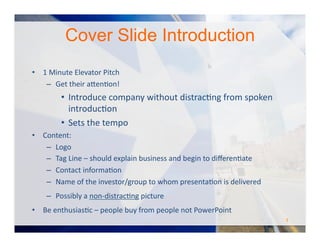
    Cover  Slide  Introduction   •  1  Minute  Elevator  Pitch   –  Get  their  attention!     •  Introduce  company  without  distracting  from  spoken  introduction   •  Sets  the  tempo   •  Content:   –  Logo     –  Tag  Line  –  should  explain  business  and  begin  to  differentiate   –  Contact  information   ‒  Name  of  the  investor/group  to  whom  presentation  is  delivered   ‒  Possibly  a  non-­‐distracting  picture       •  Be  enthusiastic  –  people  buy  from  people  not  PowerPoint   #TCNlive
  • 6.
    Problem   •  What  is  the  unsolved  problem  or  need?       •  Who  has  this  problem?    Define  your  Core  Customer  and  their  attributes   •  How  serious  is  it?  Do  you  have  Metrics?       –  Magnitude  :  How  significant  is  it?    Can  you  quantify  it?   –  Frequency:    How  often  is  pain  experienced  (life  insurance  vs.  coffee)   –  Criticality:    Will  the  pain  disrupt  the  business  (e.g.,  IT  outage)   Cancer  Drug  vs.  Aspirin  vs.  Vitamin?     •  How  have  the  alternative  offerings  failed  to  meet  the  need?   •  Analysis  of  why  has  the  problem  not  been  solved  until  now?   •  Remember!   –  Customers  buy  if  they  experience  need,  not  if  society  does.   –  Business  customer  buy  to  make  money  or  solve  problems.   #TCNlive
  • 7.
    •  Describe  your  product  or  service?       •  What  does  it  do  and  how  does  it  work?   •  Do  not  get  too  detailed?    Assume  technical  matters  will  be  validated  later.   •  Use  pictures  or  diagrams  where  possible.       •  Demo  /  screen  shots,  etc.  if  necessary.   •  How  does  it  fit  within  the  customer's  environment?   •  What  proof  of  concept  have  you  achieved?  Prototype?    Beta?     •  Small  /  Large  Animals,  En  Vitro,  En  Vivo   •  What  proof  do  you  have  of  its  effectiveness?   •  Use  accurate  words  to  describe  phase  of  development:     •  “it  does”  vs.  “it  will”  vs.  “it  may”   Solution   #TCNlive
  • 8.
    •  Are  you  IND  or  510k?    Any  additional  details?   •  Costs  and  timing  and  patient  population  of  trials  needed  to  obtain  approval?   •  Phase  1,  Phase  2  (2b),  Phase  III   •  Strategy?   •   Team  or  consultants  with  experience  in  obtaining  approval?   •  Roadblocks  or  risks?   •  Relationship  of  path  to  exit  timing   Regulatory  Path  and  Progress   #TCNlive
  • 9.
    •  How  is  your  solution  better,  faster  or  cheaper  than  the  existing  solutions   for  your  customer?    **Remember  Different  ≠  Better**   –  Saves  costs  -­‐   –  Drives  revenue  or  customer  acquisition   –  Allows  customer  to  offer  its  customers  a  superior  value  proposition     –  Decreases  risks   –  Leverages  customer's  existing  customers  or  solutions   –  Provides  enjoyment,  recreation,  education,  time  saving…  (consumer   product)   •  How  much  better,  faster,  cheaper?  Can  you  quantify  the  value  proposition   to  the  customer?     –  Can  you  validate  that  your  solution  is  better?    Do  you  have  data  to   indicate  that  such  items  are  meaningful  to  the  customer?     –  Can  you  quantify  a  Return  on  Investment  (ROI)  for  your  customer.     Competitive  Advantage   #TCNlive
  • 10.
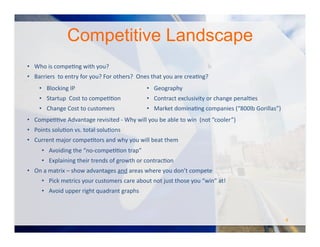
    •  Who  is  competing  with  you?     •  Barriers    to  entry  for  you?  For  others?    Ones  that  you  are  creating?     •  Blocking  IP   •  Startup    Cost  to  competition     •  Change  Cost  to  customers   •  Geography   •  Contract  exclusivity  or  change  penalties   •  Market  dominating  companies  (“800lb  Gorillas”)   •  Competitive Advantage revisited - Why will you be able to win (not “cooler”) •  Points solution vs. total solutions •  Current major competitors and why you will beat them •  Avoiding the “no-competition trap” •  Explaining their trends of growth or contraction •  On a matrix – show advantages and areas where you don't compete •  Pick metrics your customers care about not just those you “win” at! •  Avoid upper right quadrant graphs Competitive  Landscape   #TCNlive
  • 11.
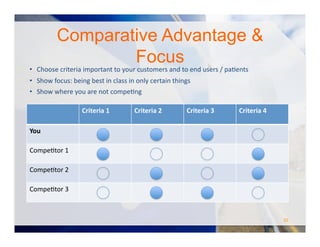
    Comparative  Effectiveness  &  Focus   Criteria  1   Criteria  2   Criteria  3   Criteria  4   You   Competitor  1   Competitor  2   Competitor  3   •  Choose criteria important to your customers and end users / patients •  Show focus: being best in class in only certain things •  Show where you are not competing #TCNlive
  • 12.
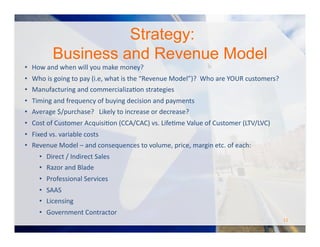
    •  How  and  when  will  you  make  money?   •  Who  is  going  to  pay  (i.e,  what  is  the  “Revenue  Model”)?    Explain  are  YOUR  customers?   •  Manufacturing  and  commercialization  strategies   •  Timing  and  frequency  of  buying  decision  and  payments   •  Average  $/purchase?      Likely  to  increase  or  decrease?   •  Fixed  vs.  variable  costs   •  Revenue  Model  –  and  consequences  to  volume,  price,  margin  etc.  of  each:   •  Direct  Sales   •  Indirect  Sales   •  Razor  and  Blade   •  Professional  Services   •  SAAS   •  Licensing   •  Government  Contractor   Business  and  Revenue  Model   #TCNlive
  • 13.
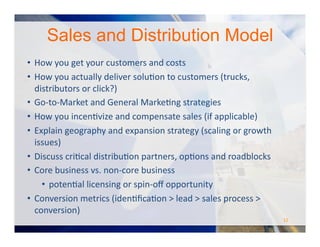
    •  How  you  get  your  customers  and  costs     •  How  you  actually  deliver  solution  to  customers  (trucks,  distributors  or  click?)   •  Go-­‐to-­‐Market  and  General  Marketing  strategies   •  How  you  incentivize  and  compensate  sales  (if  applicable)   •  Explain  geography  and  expansion  strategy  (scaling  or  growth  issues)   •  Discuss  critical  distribution  partners,  options  and  roadblocks   •  Core  business  vs.  non-­‐core  business     •  potential  licensing  or  spin-­‐off  opportunity   •  Conversion  metrics  (identification  >  lead  >  sales  process  >  conversion)   Sales  and  Distribution  Model   #TCNlive
  • 14.
    Cost  vs.  Revenue  /  Role  of  Reimbursement   •  You  cannot  “help  the  system  save  money”     –  if  your  solution  is  cheaper  than    the  competition,  understanding  the  motivation  of   the  payor  vs  the  provider  (to  whom  cost  may  equal  revenue)   •  Who  saves?  Who's  business  does  this  hurt?   •  Will  you  need  reimbursement?   –  Status  of  code  designation?  Strategy?   •  Comparables  for  reimbursement  pricing?   •  If  deployed  onto  patients,  the  long  term  savings  to  payor?   #TCNlive
  • 15.
    •  Industry  size  =  the  total  revenue  generated  in  a  segment  of  the  economy.     •  These  are  what  are  tracked  by  Forrester,  Gartner,  Thomson  etc.   •  Only  useful  for  trend  analysis,  not  for  evaluating  investability.     •  Example:  “The  internet  advertising  industry  is  an  $X  billion  industry”   •  Addressable  Market  =  the  total  amount  of  revenue  that  your  company  could  generate   if  it  acquired  every  potential  customer  (the  “Addressable  Population”).   •  Willing  and  able  buyers  that  you  can  reach   •  Initial  Target  Market:    subset  of  the  addressable  market  for  whom  the  value   proposition  is  truly  compelling  and  obvious  at  product  introduction.   •  Annual  Sales:    that  subset  of  the  addressable  market  or  the  initial  target  market   who  buy  or  who  are  likely  to  buy  each  year.   •  Explain  how  the  market  is  changing  and  why.       •  Customers,  pricing,  competition,  new  technology,  etc.     •  $500m  TAM  vs.  $50m  TAM  –  know  your  investors!   Addressable  Market  /  Segmentation  Analysis   #TCNlive
  • 16.
    •  Intellectual  Property:  Patents,  Trademarks,  Copyrights,  Trade  Secret   •  Difference  between  provisional,  applications  and  granted  patents   •  Patent  strategy   •  IP  that  covers  advantage  vs.  extraneous  claims/assets   •  How  unique  is  your  solution?   •  Trade  Secret  and  development  lead;  Ease  of  replication   •  Cost/Ability  of  customer  to  replace  your  Solution   •  Key  relationships     •  Contractual  protection   •  FDA  approval  designations   Defensibility   #TCNlive
  • 17.
    Management  Team  and  Advisors   •  Top  executives,  Board  of  Directors,  Board  of  Advisors  &  SAB   •  Startup,  domain,  customers  or  key  opinion  experience   •  Prior  success   •  Balance   •  Cohesiveness   •  Don't  put  their  whole  resume  on  the  slide   •  Only  show  actives   •  Current  staffing  gaps  and  strategy  for  filling   •  Orientation  towards  success  not  control  (“Rich”  not  “Monarch”)   #TCNlive
  • 18.
    Current  Status:      Achievements,  Upcoming  Milestones   •  Demonstrate  current  progress  and  achievement  of  milestones   •  Development  partnerships   •  Distribution  partnerships   •  Customer  acquisition  progress  (conversion  rates)   •  Publications   •  Financing   •  Team  Developments   •  Upcoming  milestones  and  Challenges     •  Gant-­‐style  Charts   •  How  you  will  overcome  the  challenges/weakness    (ex.  key  hire)   •  Often  integrated  with  use  of  proceeds  slide   #TCNlive
  • 19.
    •  Identify  existing/timing  of  prior  preferred  stock  deals   •  Cash  and  monthly  cash  burn   •  How  much  of  burn  is  variable  vs.  fixed     •  Lowest  you  can  the  Burn  without  killing  the  company   •  Time  and  investment  dollars  to  reach  exit   •  Timing  and  quantity  of  future  rounds   •  Current  round  size  and  timing   •  Use  of  proceeds  -­‐  what  will  it  be  used  for?  What  will  it  buy?     •  Optimal  deal  structure   •  Pre  Money  Valuation   •  Dangers  of  including  suggested  valuations   •  Dangers  of  not  knowing  the  appropriate  valuations   Funding,  Cash  and  Use  of  Proceeds   #TCNlive
  • 20.
    Risks  and  Plans   •  Technology    /  Product  –  Will  the  solution  work?    Can  you  build  it?     •  Business  Model  –  Can  you  sell  the  solution  at  margin?   •  Supply  –  Can  you  acquire  and  manage  critical  vendors   •  Customer  Adoption  Risk  –  Will  the  Dogs  eat  the  Dog  Food?   •  Market  Dynamics  –  Do  customers  have  cash  and  the  will  to  spend?   •  Distribution  Risk  -­‐  Can  you  acquire  and  run  critical  distribution  and  sales  points?   •  Competition  Risk  –  Is  there  an  opportunity  in  the  marketplace?  Will  an  800lb  gorilla  eat   your  lunch?   •  Financial  risks  –Will  you  have  sufficient  capital  now  and  in  the  future?   •  Legal  risks  –Freedom  to  operate  ?  Do  you  have  the  ability  to  defend  your  IP?   •  Regulatory  risks  –  Are  there  barriers  beyond  your  ability  to  influence?  FDA?     •  Team  risks  –  Is  our  product  or  customer  knowledge  distributed  and  accessible?     •  Exit  Risk  –  Are  there  willing  buyers  (or  a  public  market)  for  your  company?   #TCNlive
  • 21.
    Exit  Strategy  and  Options   •  Length  to  liquidity   •  IPO  vs.  M&A  vs.  Licensing  (vs.  other)   •  Potential  Acquirers   •  Acquirer  characteristics  and  rationale  for  acquisition   •  How  frothy  is  the  current/expected  market  now  and  at  maturity   •  Recent  exits  for  similarly  situated  companies   •  Valuations  (if  available)   •  Counterpoint:  Building  a  company  vs.  building  an  exit   #TCNlive
  • 22.
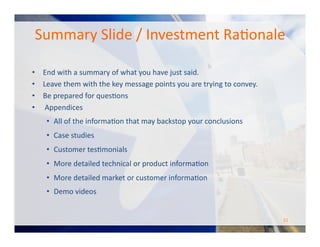
    Summary  Slide  /  Investment  Rationale   •  End  with  a  summary  of  what  you  have  just  said.   •  Leave  them  with  the  key  message  points  you  are  trying  to  convey.   •  Be  prepared  for  questions   •   Appendices   •  All  of  the  information  that  may  backstop  your  conclusions   •  Case  studies   •  Customer  testimonials   •  More  detailed  technical  or  product  information   •  More  detailed  market  or  customer  information     •  Demo  videos   #TCNlive
  • 23.
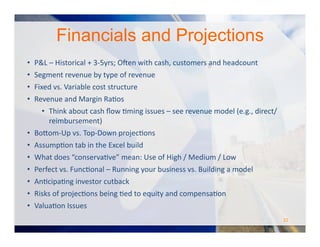
    •  P&L  –  Historical  +  3-­‐5yrs;  Often  with  cash,  customers  and  headcount   •  Segment  revenue  by  type  of  revenue   •  Fixed  vs.  Variable  cost  structure   •  Revenue  and  Margin  Ratios   •  Think  about  cash  flow  timing  issues  –  see  revenue  model  (e.g.,  direct/ reimbursement)   •  Bottom-­‐Up  vs.  Top-­‐Down  projections   •  Assumption  tab  in  the  Excel  build   •  What  does  “conservative”  mean:  Use  of  High  /  Medium  /  Low   •  Perfect  vs.  Functional  –  Running  your  business  vs.  Building  a  model   •  Anticipating  investor  cutback   •  Risks  of  projections  being  tied  to  equity  and  compensation   •  Valuation  Issues   Financials  and  Projections   #TCNlive
  • 24.
    General  Dos  and  Don'ts:     “Presentation  is  a  visual  not  a  reference”   Do   •  Use  one  topic  per  slide   •  Limit  text  on  each  slide   •  Use  pictures,  graphs,  video's   –  Not  all  bullets   •  Choose  fonts  and  colors  that  are  easy   to  read   •  PowerPoint  is  the  accessory  to  YOUR   presentation   •  Spell  Check   Don't   •  Use  sounds  with  slide  transitions   •  Overdo  the  ALL  CAPS,  bolded,   italicized  or  underlined  text   •  Use  too  many  different    fonts   •  Overuse  special  effects  –  focus  on  the   content   •  Have  technical  difficulties  –  test  before   the  meeting   #TCNlive
  • 25.
    •  Know  your  material  cold!    Don't  wing  it.     •  DON'T  READ  your  presentation.       •  You  should  have  answers  to  likely  questions.   •  Be  clear  when  you  don't  know  an  answer  –  then  follow  up.     •  When  possible,  know  the  room.  Arrive  early,  walk  around  the  speaking  area  and   practice  using  the  microphone  and  any  visual  aids.     •  Body  language  and  appearance  =  50%  of  the  pitch   •  Prioritize  and  eliminate  less  critical  points.       •  Be  flexible  –  be  prepared  to  be  interrupted.     •  Understand  the  goal  of  your  presentation.      Is  it  to  inspire,  to  educate,  to   connect,  to  get  attention,  to  get  a  second  more  personal  meeting?       Presentation  Skills:  Part  I   #TCNlive
  • 26.
    •  Modulate  your  pace,  pitch,  volume,  tone  and  enthusiasm  –  like  when  you  are   telling  a  story.    This  helps  keep  the  audience  focused.       •  Use  humor,  personal  stories  and  conversational  language  where  possible.  Use   easy  to  understand  analogies.   •  Practice.  Practice.  Practice!    GO  SEE  OTHER  PRESENTATIONS!   •  Slides  should  HELP  the  oral  presentation,  not  BE  the  presentation.     •  Bring  a  backup  copy  on  a  flash  drive  and  via  cloud     •  Slides  should  be  professional  and  consistent  with  your  image.     •  Spend  more  time  building  the  business  than  the  presentation   •  Leave  time  for  questions.   •  RELAX,  BREATHE  and  SLOW  DOWN   Presentation  Skills:  Part  II   #TCNlive
  • 27.
    Interacting  with  Investors   Basic  Principles  -­‐  Overview     •  Research  the  investor  in  advance   •  Pay  attention  to  what  you  say  during  the  presentation  banter   •  Communicate   •  Be  likeable     •  State  your  value  proposition  up  front   •  Come  prepared  with  sufficient  data  (including  back  up  slides)   •  Enjoy  yourself  and  let  it  show   •  Keep  the  presentation  within  allotted  time   •  Be  realistic  about  valuations  in  the  market   •  Make  due  diligence  easy   •  Realize  investors  are  thinking  about  exit  strategy   #TCNlive
  • 28.
    •  Bash  the  competition   •  Hype   •  Condescend  or  talk  down   •  Be  arrogant   •  Be  vague  about  your  technology     •  Underestimate  the  importance  of  the  core  science/development   •  Deluge  investors  with  facts   •  Act  desperate  for  funding  (even  if  you  are)   •  Act  like  you  don't  need  money   •  List  'the  company  is  undervalued'  as  a  reason  to  invest   •  Overprice  your  rounds  so  you  can  keep  stepping  up  valuation   •  Give  investors  a  reason  to  turn  you  down   Interacting  with  Investors      Cautionary  Overview  –  Don't  do  the  following   #TCNlive
  • 29.
    Seaport  West,  155  Seaport  Boulevard,  Boston  MA  02210    www.nutter.com   Jeremy  Halpern   Partner,  Nutter  McClennen  &  Fish   Director,  MassVentures   jhalpern@nutter.com   @startupboston   TCN  Venture  Fast  Track   Pitching  the  Plan:  The  Deck Matt  Douglas   CEO  Punchbowl   @mattdouglas