PILOT PLANT SCALE UP TECHNIQUES ,CASE STUDY OF
HERBAL EXTRACTS ,FORMULATION PRODUCTION
MANAGEMENT.
DATE OF SUBMISSION: 01/10/2018
SUBMITTED TO: Dr. ROOPASHREE .T. S.
HOD
DEPT OF PHARMACOGNOSY
GOVT COLLEGE OF PHARMACY
PRESENTED BY : PRAKRUTHI D J
1ST
M PHARM
 Definition
 Objectives
 Significance
 General and GMP Considerations
 Management
 Formulation
 Advantages
 Disadvantages
 Case study of herbal extracts
 References
 Plant:- It is a place where the 3 M’s that are Man,
Material and Money are brought together for the
manufacturing of products.
 Pilot Plant:- It is the part of the pharmaceutical
industry where a lab scale formula is transformed
into a viable product by development of liable
practical procedure of manufacturing.
 Scale-up:- The art for designing of prototype using
the data obtained from the pilot plant model.
 Prototype: A large scale apparatus or full size
plant is called prototype.
DEFINITIONS
 A pilot plant allows investigation of a product
and process on an intermediate scale before
large amounts of money are committed to full-
scale production.
 It is usually not possible to predict the effects
of a many-fold increase in scale.
 It is not possible to design a large scale
processing plant from laboratory data alone
with any degree of success.
 To produce physically and chemically stable
products.
 Review of the processing equipment.
 Guidelines for production and process control.
 Evaluation and Validation.
 To identify the critical features of the process.
 To provide master manufacturing formula.
 Permits close examination of formulae to determine its
ability to withstand batch scale and process modification.
 Review of Equipment - most compatible with the
formulation & most economical, simple and reliable in
producing product.
 Raw materials - consistently meet the specifications
required to produce the product can be determined.
 Production rate adjustment after considering marketing
requirements.
 Give rough idea about physical space required and of
related functions.
 Appropriate records and reports are issued to support
good manufacturing practices.
 Procedure can be developed and validated
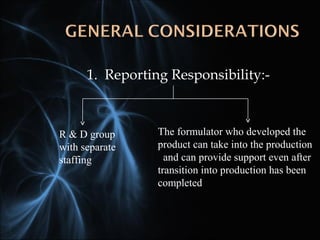
1. Reporting Responsibility:-
R & D group
with separate
staffing
The formulator who developed the
product can take into the production
and can provide support even after
transition into production has been
completed
* Scientists with experience
in pilot plant operations as
well as in actual production
area are the most
preferable.
* As they have to
understand the intent of the
formulator as well as
understand the perspective
of the production
personnel.
* Engineering principles
* Knowledge of computers
& electronics
2. Personnel Requirement:-
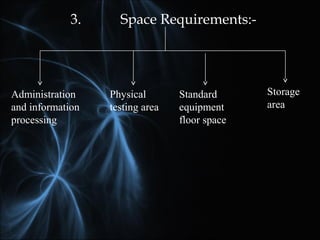
3. Space Requirements:-
Administration
and information
processing
Physical
testing area
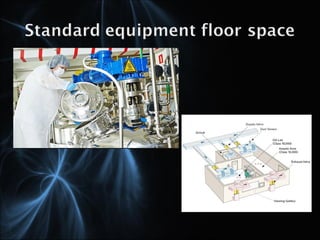
Standard
equipment
floor space
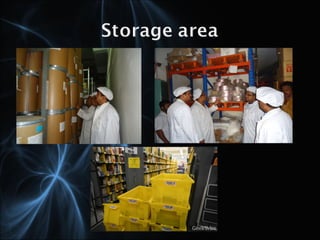
Storage
area
 A thorough review of the each aspect of formulation is
important.
 The purpose of each ingredient and it’s contribution to
the final product manufactured on the small-scale
laboratory equipment should be understood.
 Then the effect of scale-up using equipment that may
subject the product to stresses of different types and
degrees can more readily be predicted or recognized.
4. Review of the formula:-
 One purpose/responsibility of the pilot-plant is the
approval & validation of the active ingredient &
excipients raw materials.
 Raw materials used in the small scale production cannot
necessarily be the representative for the large scale
production.
 Ingredients may change in particle size, shape or
morphology which result in differences in bulk density,
static charges, rate of solubility, flow properties, color,
etc.
5. Raw materials :-
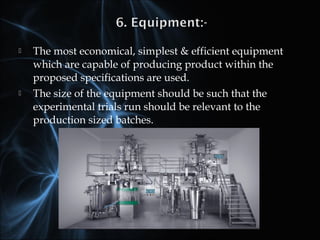
 The most economical, simplest & efficient equipment
which are capable of producing product within the
proposed specifications are used.
 The size of the equipment should be such that the
experimental trials run should be relevant to the
production sized batches.
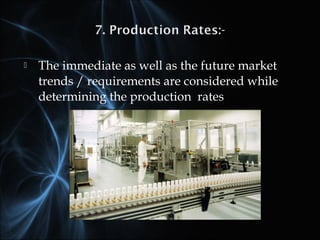
 The immediate as well as the future market
trends / requirements are considered while
determining the production rates
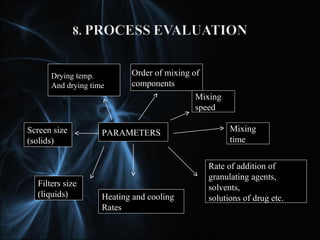
PARAMETERS
Order of mixing of
components
Mixing
speed
Mixing
time
Rate of addition of
granulating agents,
solvents,
solutions of drug etc.Heating and cooling
Rates
Filters size
(liquids)
Screen size
(solids)
Drying temp.
And drying time
The three important aspects
Weight sheet Processing &
Sampling directions
Manufacturing
procedure
9. Master Manufacturing Procedures:-
 The primary objective of the pilot plant is the
physical as well as chemical stability of the
products.
 Hence each pilot batch representing the final
formulation and manufacturing procedure should
be studied for stability.
 Stability studies should be carried out in finished
packages as well.
10. Product Stability And Uniformity:-
 Equipment qualification
 Process validation
 Regularly process review & revalidation
 Relevant written standard operating procedures
 The use of competent technically qualified personnel
 Adequate provision for training of personnel
 A well-defined technology transfer system
 Validated cleaning procedures
 An orderly arrangement of equipment so as to ease
material flow & prevent cross-contamination
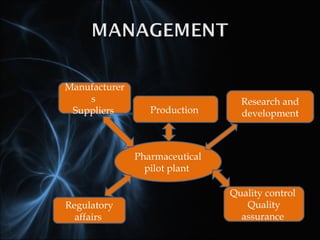
Pharmaceutical
pilot plant
Manufacturer
s
Suppliers
Research and
developmentProduction
Regulatory
affairs
Quality control
Quality
assurance
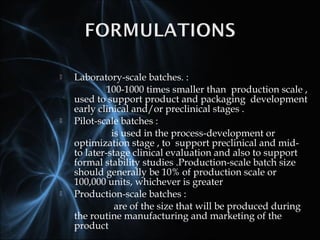
 Laboratory-scale batches. :
100-1000 times smaller than production scale ,
used to support product and packaging development
early clinical and/or preclinical stages .
 Pilot-scale batches :
is used in the process-development or
optimization stage , to support preclinical and mid-
to later-stage clinical evaluation and also to support
formal stability studies .Production-scale batch size
should generally be 10% of production scale or
100,000 units, whichever is greater
 Production-scale batches :
are of the size that will be produced during
the routine manufacturing and marketing of the
product
 SOLID DOSAGE FORMS
 LIQUID DOSAGE FORMS
 SEMISOLID DOSAGE FORMS
CAPSULES
 To produce capsules on high-speed equipment, the
powder blend must have,
* uniform particle size distribution
* bulk density
* formation of compact of the right size and of sufficient
cohesiveness to be filled into capsule shells.
 Equipments :-
1. Zanasi or Mertalli – Dosator(hollow tube)
2. Hoflinger – Karg – Tamping pins
 Weight variation problem can be encountered with these
two methods.
 Overly lubricated granules – delaying disintegration.
 Humidity affect moisture content of –
* granulation
* on the empty gelatin capsules
 Empty gelatin capsules have a recommended storage
condition of 15-25 ºC temperature & humidity 35-65 %
RH.
 At high humidity – capsule swells make separation of the
capsule parts difficult to interfere with the transport of the
capsule through the process.
 At low humidity – capsule brittle increased static charge
interfere with the encapsulation operation.
Cont….
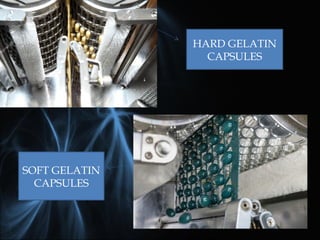
HARD GELATIN
CAPSULES
SOFT GELATIN
CAPSULES
LIQUID ORALS
 Simple solutions are the straight forward to scale up but
they require tanks of adequate size and suitable mixing
capability.
 Most equipment has heating or cooling capabilities to
effect rapid disollution of components of the system.
 All the equipments must be made up of suitable non-
reactive material and be designed and constructed to
facilitate easy cleaning.
 Liquid pharmaceutical processing tank, kettles, pipes,
mills, filter houses etc. are most frequently fabricated
from stainless steel
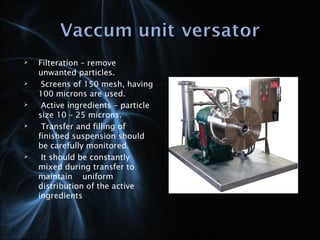
 Filteration – remove
unwanted particles.
 Screens of 150 mesh, having
100 microns are used.
 Active ingredients – particle
size 10 – 25 microns.
 Transfer and filling of
finished suspension should
be carefully monitored.
 It should be constantly
mixed during transfer to
maintain uniform
distribution of the active
ingredients
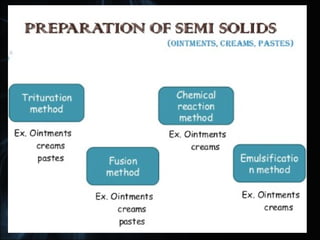
SEMI SOLID PRODUCTS
 The main difference of semi solid formulation with
comparison to suspensions, liquids and emulsions is their
higher viscosity.
 Viscosity renders certain aspects of the scale-up of semi
solid products more critical.
 Equipments :-
* blenders
* mixers
* pressure filling equipments
 Members of the production and quality control
divisions can readily observe scale up runs.
 Supplies of excipients & drugs, cleared by the
quality control division, can be drawn from the
more spacious areas provided to the production
division.
 Access to engineering department personnel is
provided for equipment installation, maintenance
and repair.
 The frequency of direct interaction of the
formulator with the production personnel in
the manufacturing area will be reduced.
 Any problem in manufacturing will be
directed towards it’s own pilot-plant
personnel.
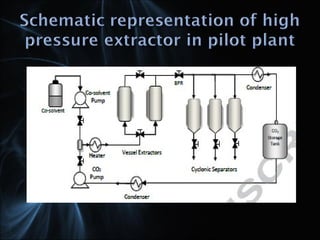
Extraction of phenolic compounds from mango leaves
 Mangifera indica L., is one of the most popular tropical fruits
 Large amounts of crop residues, such as flowers, leaves, stems and
barks, are generated during the pruning period and this causes a
serious disposal problem in farmlands because of their richness in
valuable compounds such as phenolics and flavonoids, these mango
by-Products.
 Mangiferin is one of the predominant polyphenols in mango leaves
and it has multiple pharmaceutical properties such as antioxidant,
antibacterial, antifungal, antidiabetic, immunomodulatory, anti-
inflammatory, and analgesic properties with potential use in the
treatment or prevention of chronic diseases including cancer,
neurodegenerative and cardiovascular diseases
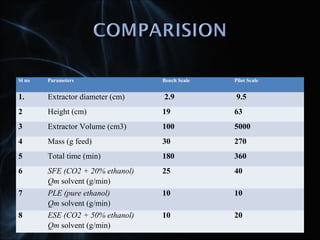
Sl no Parameters Bench Scale Pilot Scale
1. Extractor diameter (cm) 2.9 9.5
2 Height (cm) 19 63
3 Extractor Volume (cm3) 100 5000
4 Mass (g feed) 30 270
5 Total time (min) 180 360
6 SFE (CO2 + 20% ethanol)
Qm solvent (g/min)
25 40
7 PLE (pure ethanol)
Qm solvent (g/min)
10 10
8 ESE (CO2 + 50% ethanol)
Qm solvent (g/min)
10 20
 1. Journel by :Md. Khairul Isalm, Deptt. of
ACCE, RU
 2. The Theory and Practice of Industrial
Pharmacy
 Leon Lachman, A.Liberman.
 3. Textbook of Pharmaceutical Product
Development by N.K.Jain
 4. Pharmaceutical dosage forms: Tablets.
Volume 3. second edition. Leon Lachman,
Herbert A. Lieberman, Joseph B. Schwartz.
Page no. 303-365.
 5. Pharmaceutical process scale –up edited
by Michael Levin.
 6. Modern pharmaceutics. Edited by Gilbert
S. Banker & Christopher T. Rhodes. 4th
edition.
 7. www.gooogle.com.
 8. Journal of Food and Drug Analysis, Vol.
15, No. 4, 2007
Pilot final 1