Pilot Farmer Field School on Climate Smart
Vegetable Growing and Chicken Rearing
Integration of Climate Change Adaptation/Climate Smart Agriculture
into the pilot farmer field school
February - May 2016
Life and Nature project
By Yim Soksophors, National Agronomist
Contents
1. Description of the problem
2. Objectives of pilot FFS
3. What is Climate Smart Agriculture (CSA)
4. Farmer Field School Brief
5. Implementation process of the pilot FFS
6. Immediate outputs from the pilot FFS
7. Lessons-learned
8. Next Action
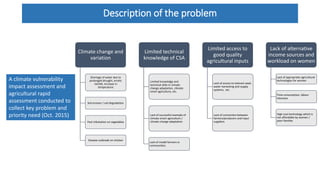
Description of the problem
Climate change and
variation
Shortage of water due to
prolonged drought, erratic
rainfall, increase in
temperature
Soil erosion / soil degradation
Pest infestation on vegetables
Disease outbreak on chicken
Limited technical
knowledge of CSA
Limited knowledge and
technical skills in climate
change adaptation, climate
smart agriculture, etc.
Lack of successful example of
climate smart agriculture /
climate change adaptation
Lack of model farmers in
communities
Limited access to
good quality
agricultural inputs
Lack of access to tolerant seed,
water harvesting and supply
systems, etc.
Lack of connection between
farmers/producers and input
suppliers
Lack of alternative
income sources and
workload on women
Lack of appropriate agricultural
technologies for women
Time consumption, labour
intensive
High cost technology which is
not affordable by women /
poor families
A climate vulnerability
impact assessment and
agricultural rapid
assessment conducted to
collect key problem and
priority need (Oct. 2015)
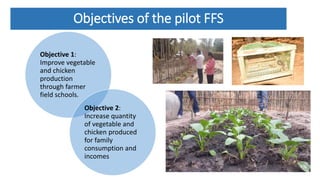
Objectives of the pilot FFS
Objective 1:
Improve vegetable
and chicken
production
through farmer
field schools.
Objective 2:
Increase quantity
of vegetable and
chicken produced
for family
consumption and
incomes
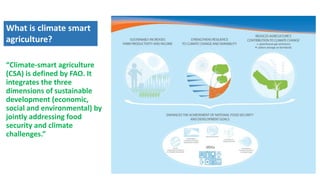
“Climate-smart agriculture
(CSA) is defined by FAO. It
integrates the three
dimensions of sustainable
development (economic,
social and environmental) by
jointly addressing food
security and climate
challenges.”
What is climate smart
agriculture?
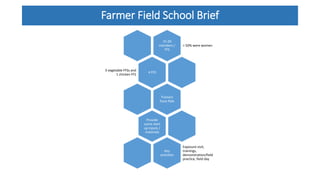
Farmer Field School Brief
15-20
members /
FFS
> 50% were women
4 FFS
3 vegetable FFSs and
1 chicken FFS
Trainers
from PDA
Provide
some start
up inputs /
materials
Key
activities
Exposure visit,
trainings,
demonstration/field
practice, field day
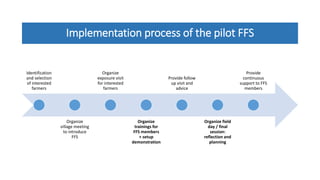
Implementation process of the pilot FFS
Identification
and selection
of interested
farmers
Organize
village meeting
to introduce
FFS
Organize
exposure visit
for interested
farmers
Organize
trainings for
FFS members
+ setup
demonstration
Provide follow
up visit and
advice
Organize field
day / final
session:
reflection and
planning
Provide
continuous
support to FFS
members
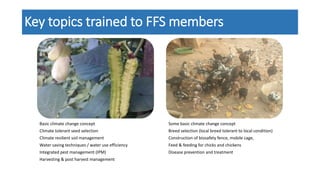
Key topics trained to FFS members
Basic climate change concept
Climate tolerant seed selection
Climate resilient soil management
Water saving techniques / water use efficiency
Integrated pest management (IPM)
Harvesting & post harvest management
Some basic climate change concept
Breed selection (local breed tolerant to local condition)
Construction of biosafety fence, mobile cage,
Feed & feeding for chicks and chickens
Disease prevention and treatment
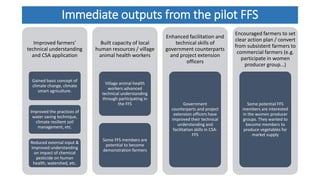
Immediate outputs from the pilot FFS
Improved farmers’
technical understanding
and CSA application
Gained basic concept of
climate change, climate
smart agriculture.
Improved the practices of
water saving technique,
climate resilient soil
management, etc.
Reduced external input &
Improved understanding
on impact of chemical
pesticide on human
health, watershed, etc.
Built capacity of local
human resources / village
animal health workers
Village animal health
workers advanced
technical understanding
through participating in
the FFS
Some FFS members are
potential to become
demonstration farmers
Enhanced facilitation and
technical skills of
government counterparts
and project extension
officers
Government
counterparts and project
extension officers have
improved their technical
understanding and
facilitation skills in CSA-
FFS
Encouraged farmers to set
clear action plan / convert
from subsistent farmers to
commercial farmers (e.g.
participate in women
producer group…)
Some potential FFS
members are interested
in the women producer
groups. They wanted to
become members to
produce vegetables for
market supply
Immediate outputs from the pilot FFS (Cont.…)
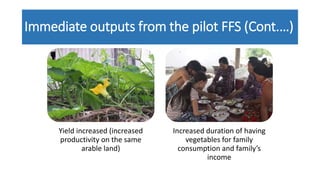
Yield increased (increased
productivity on the same
arable land)
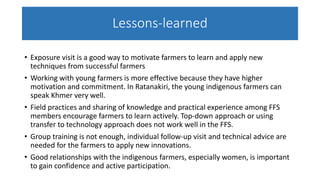
Increased duration of having
vegetables for family
consumption and family’s
income
Lessons-learned
• Exposure visit is a good way to motivate farmers to learn and apply new
techniques from successful farmers
• Working with young farmers is more effective because they have higher
motivation and commitment. In Ratanakiri, the young indigenous farmers can
speak Khmer very well.
• Field practices and sharing of knowledge and practical experience among FFS
members encourage farmers to learn actively. Top-down approach or using
transfer to technology approach does not work well in the FFS.
• Group training is not enough, individual follow-up visit and technical advice are
needed for the farmers to apply new innovations.
• Good relationships with the indigenous farmers, especially women, is important
to gain confidence and active participation.
Lessons-learned (continued)
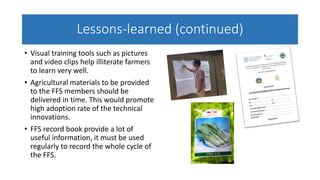
• Visual training tools such as pictures
and video clips help illiterate farmers
to learn very well.
• Agricultural materials to be provided
to the FFS members should be
delivered in time. This would promote
high adoption rate of the technical
innovations.
• FFS record book provide a lot of
useful information, it must be used
regularly to record the whole cycle of
the FFS.
Conclusion
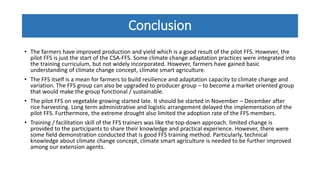
• The farmers have improved production and yield which is a good result of the pilot FFS. However, the
pilot FFS is just the start of the CSA-FFS. Some climate change adaptation practices were integrated into
the training curriculum, but not widely incorporated. However, farmers have gained basic
understanding of climate change concept, climate smart agriculture.
• The FFS itself is a mean for farmers to build resilience and adaptation capacity to climate change and
variation. The FFS group can also be upgraded to producer group – to become a market oriented group
that would make the group functional / sustainable.
• The pilot FFS on vegetable growing started late. It should be started in November – December after
rice harvesting. Long term administrative and logistic arrangement delayed the implementation of the
pilot FFS. Furthermore, the extreme drought also limited the adoption rate of the FFS members.
• Training / facilitation skill of the FFS trainers was like the top-down approach. limited change is
provided to the participants to share their knowledge and practical experience. However, there were
some field demonstration conducted that is good FFS training method. Particularly, technical
knowledge about climate change concept, climate smart agriculture is needed to be further improved
among our extension agents.
Next Action / Recommendation
• Continue providing technical follow-up support and technical advice for the FFS members
• Select leaders of FFS group. The FFS group needs to be well organized for further development.
• Integrate concept of climate change, climate change adaptation, climate smart agriculture, and
gender mainstreaming into all FFS training curriculum. At the same time, make linkage between
agriculture / FFS and watershed management.
• Participatory and discovery-based approach: Field trial led by farmers should be conducted to
discover technical innovations adaptable to climate change and variation. Students from research
and training institutions can also be involved in the trials.
• Provide TOT training for FFS trainers / FFS facilitators to improve their knowledge of climate smart
agriculture, climate change concept and facilitation of CSA-FFS.
• Promote further dissemination / diffusion of successful technical innovations from FFS members
to non-FFS members.
• To promote vegetable growing, improved water storage and supply systems are necessary. The
project’s intervention can be different depending on the site specific.
Next Action / Recommendation (Continued)
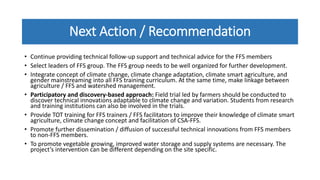
• Promote participation of the most vulnerable
people in the FFS. For example, the women
headed households, families with disabled
people, etc.
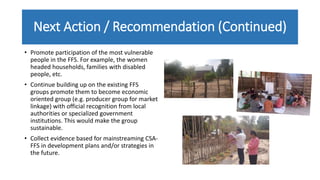
• Continue building up on the existing FFS
groups promote them to become economic
oriented group (e.g. producer group for market
linkage) with official recognition from local
authorities or specialized government
institutions. This would make the group
sustainable.
• Collect evidence based for mainstreaming CSA-
FFS in development plans and/or strategies in
the future.
Thank you for your attention!

Pilot farmer field school (ffs)

  • 1.
    Pilot Farmer FieldSchool on Climate Smart Vegetable Growing and Chicken Rearing Integration of Climate Change Adaptation/Climate Smart Agriculture into the pilot farmer field school February - May 2016 Life and Nature project By Yim Soksophors, National Agronomist
  • 2.
    Contents 1. Description ofthe problem 2. Objectives of pilot FFS 3. What is Climate Smart Agriculture (CSA) 4. Farmer Field School Brief 5. Implementation process of the pilot FFS 6. Immediate outputs from the pilot FFS 7. Lessons-learned 8. Next Action
  • 3.
    Description of theproblem Climate change and variation Shortage of water due to prolonged drought, erratic rainfall, increase in temperature Soil erosion / soil degradation Pest infestation on vegetables Disease outbreak on chicken Limited technical knowledge of CSA Limited knowledge and technical skills in climate change adaptation, climate smart agriculture, etc. Lack of successful example of climate smart agriculture / climate change adaptation Lack of model farmers in communities Limited access to good quality agricultural inputs Lack of access to tolerant seed, water harvesting and supply systems, etc. Lack of connection between farmers/producers and input suppliers Lack of alternative income sources and workload on women Lack of appropriate agricultural technologies for women Time consumption, labour intensive High cost technology which is not affordable by women / poor families A climate vulnerability impact assessment and agricultural rapid assessment conducted to collect key problem and priority need (Oct. 2015)
  • 4.
    Objectives of thepilot FFS Objective 1: Improve vegetable and chicken production through farmer field schools. Objective 2: Increase quantity of vegetable and chicken produced for family consumption and incomes
  • 5.
    “Climate-smart agriculture (CSA) isdefined by FAO. It integrates the three dimensions of sustainable development (economic, social and environmental) by jointly addressing food security and climate challenges.” What is climate smart agriculture?
  • 6.
    Farmer Field SchoolBrief 15-20 members / FFS > 50% were women 4 FFS 3 vegetable FFSs and 1 chicken FFS Trainers from PDA Provide some start up inputs / materials Key activities Exposure visit, trainings, demonstration/field practice, field day
  • 7.
    Implementation process ofthe pilot FFS Identification and selection of interested farmers Organize village meeting to introduce FFS Organize exposure visit for interested farmers Organize trainings for FFS members + setup demonstration Provide follow up visit and advice Organize field day / final session: reflection and planning Provide continuous support to FFS members
  • 8.
    Key topics trainedto FFS members Basic climate change concept Climate tolerant seed selection Climate resilient soil management Water saving techniques / water use efficiency Integrated pest management (IPM) Harvesting & post harvest management Some basic climate change concept Breed selection (local breed tolerant to local condition) Construction of biosafety fence, mobile cage, Feed & feeding for chicks and chickens Disease prevention and treatment
  • 9.
    Immediate outputs fromthe pilot FFS Improved farmers’ technical understanding and CSA application Gained basic concept of climate change, climate smart agriculture. Improved the practices of water saving technique, climate resilient soil management, etc. Reduced external input & Improved understanding on impact of chemical pesticide on human health, watershed, etc. Built capacity of local human resources / village animal health workers Village animal health workers advanced technical understanding through participating in the FFS Some FFS members are potential to become demonstration farmers Enhanced facilitation and technical skills of government counterparts and project extension officers Government counterparts and project extension officers have improved their technical understanding and facilitation skills in CSA- FFS Encouraged farmers to set clear action plan / convert from subsistent farmers to commercial farmers (e.g. participate in women producer group…) Some potential FFS members are interested in the women producer groups. They wanted to become members to produce vegetables for market supply
  • 10.
    Immediate outputs fromthe pilot FFS (Cont.…) Yield increased (increased productivity on the same arable land) Increased duration of having vegetables for family consumption and family’s income
  • 11.
    Lessons-learned • Exposure visitis a good way to motivate farmers to learn and apply new techniques from successful farmers • Working with young farmers is more effective because they have higher motivation and commitment. In Ratanakiri, the young indigenous farmers can speak Khmer very well. • Field practices and sharing of knowledge and practical experience among FFS members encourage farmers to learn actively. Top-down approach or using transfer to technology approach does not work well in the FFS. • Group training is not enough, individual follow-up visit and technical advice are needed for the farmers to apply new innovations. • Good relationships with the indigenous farmers, especially women, is important to gain confidence and active participation.
  • 12.
    Lessons-learned (continued) • Visualtraining tools such as pictures and video clips help illiterate farmers to learn very well. • Agricultural materials to be provided to the FFS members should be delivered in time. This would promote high adoption rate of the technical innovations. • FFS record book provide a lot of useful information, it must be used regularly to record the whole cycle of the FFS.
  • 13.
    Conclusion • The farmershave improved production and yield which is a good result of the pilot FFS. However, the pilot FFS is just the start of the CSA-FFS. Some climate change adaptation practices were integrated into the training curriculum, but not widely incorporated. However, farmers have gained basic understanding of climate change concept, climate smart agriculture. • The FFS itself is a mean for farmers to build resilience and adaptation capacity to climate change and variation. The FFS group can also be upgraded to producer group – to become a market oriented group that would make the group functional / sustainable. • The pilot FFS on vegetable growing started late. It should be started in November – December after rice harvesting. Long term administrative and logistic arrangement delayed the implementation of the pilot FFS. Furthermore, the extreme drought also limited the adoption rate of the FFS members. • Training / facilitation skill of the FFS trainers was like the top-down approach. limited change is provided to the participants to share their knowledge and practical experience. However, there were some field demonstration conducted that is good FFS training method. Particularly, technical knowledge about climate change concept, climate smart agriculture is needed to be further improved among our extension agents.
  • 14.
    Next Action /Recommendation • Continue providing technical follow-up support and technical advice for the FFS members • Select leaders of FFS group. The FFS group needs to be well organized for further development. • Integrate concept of climate change, climate change adaptation, climate smart agriculture, and gender mainstreaming into all FFS training curriculum. At the same time, make linkage between agriculture / FFS and watershed management. • Participatory and discovery-based approach: Field trial led by farmers should be conducted to discover technical innovations adaptable to climate change and variation. Students from research and training institutions can also be involved in the trials. • Provide TOT training for FFS trainers / FFS facilitators to improve their knowledge of climate smart agriculture, climate change concept and facilitation of CSA-FFS. • Promote further dissemination / diffusion of successful technical innovations from FFS members to non-FFS members. • To promote vegetable growing, improved water storage and supply systems are necessary. The project’s intervention can be different depending on the site specific.
  • 15.
    Next Action /Recommendation (Continued) • Promote participation of the most vulnerable people in the FFS. For example, the women headed households, families with disabled people, etc. • Continue building up on the existing FFS groups promote them to become economic oriented group (e.g. producer group for market linkage) with official recognition from local authorities or specialized government institutions. This would make the group sustainable. • Collect evidence based for mainstreaming CSA- FFS in development plans and/or strategies in the future.
  • 16.
    Thank you foryour attention!

Editor's Notes

  • #4 Prolonged drought / erratic rainfall was seen as the main climate issues in most of the project’s target communes.
  • #7 Four pilot FFS (3 vegetable FFSs in Kampong Thom, Siem Reap, and Preah Vihear, 1 Chicken FFS in Ratanakiri) Key activities: an exposure visit organized after the selection of the FFS members (Ratanakiri), 8-12 training sessions organized (one every week), field day, etc. Provide some materials that farmers could not find in their communities (e.g. vegetable seed, materials for making chicken fence, mobile cage…)
  • #10 Improved farmers’ understanding on Climate smart agriculture (e.g. Selection of climate tolerant varieties, water saving techniques, soil preparation adaptable to dry condition, improve soil organic matter in order to improve soil-water holding capacity, reduce / stop using chemical fertilizer and pesticide (to reduce greenhouse gas emission). Chicken rearing: Separate big and small chickens, Build biosafety fence and mobile cage, Provide mixed feed, Strengthen capacity of the village animal health worker
  • #11 Yield/Productivity is increased on the same arable land. The duration of having vegetables for family consumption has increased from 3 months per year (before attending the FFS) to 4 months per year (after attending the FFS) Farmers could make an income from vegetables. For example, a farmer in Popok commune could make at least 30000 riels from water convolvulus. Farmers in Siem Reap also gained some incomes from vegetables.