4 
Building on traditional gardening to improve 
household food security 
R. Marsh 
Robin Marsh is an agricultural economist currently co-coordinating research for the Rural Institutions and Participation Service 
of FAO’s Sustainable Development Department. 
needed by the household, the garden supplements the diet 
with vitamin-rich vegetables and fruits, energy-rich vegetable 
staples, animal sources of protein and herbs and condiments. 
DEVELOPMENT DEBATE 
The multiple potential benefits of home gardening, of which 
the most important is increased direct access to nutritious 
foods by the food insecure, have spurred the sponsorship of 
numerous gardening projects by non-governmental 
organizations (NGOs), governments and United Nations 
agencies. Nevertheless, promotion of gardening as a nutrition 
or community development strategy is controversial, with 
strong advocates and opponents. 
Critics point to poor project design, management and 
monitoring, unrealized expectations and lack of sustainability: 
“… the frequent failure of garden projects to achieve significant, 
cost-effective, sustained and positive changes is due in large part 
to the familiar litany of development project errors. Foremost among 
FNA/ANA 22, 1998 
Whether they are known as home, mixed, backyard, 
kitchen, farmyard, compound or homestead gardens, 
family food production systems are found in most regions of 
most countries worldwide. They may be the oldest production 
system known and their very persistence is proof of their 
intrinsic economic and nutritional merit. Traditional tropical 
gardens typically exhibit a wide diversity of perennial and 
semi-perennial crops, trees and shrubs, well adapted to local 
microclimates and maintained with a minimum of purchased 
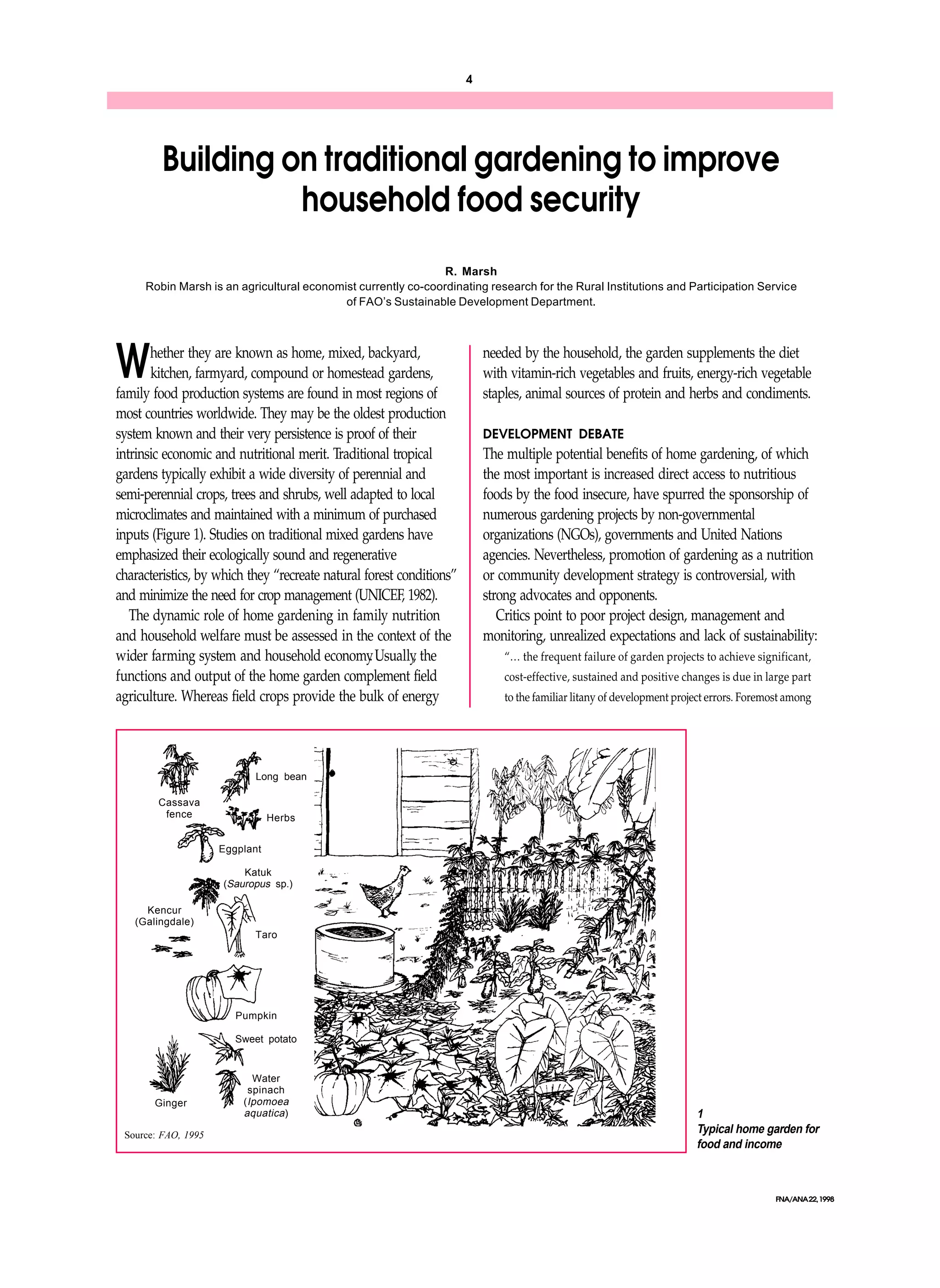
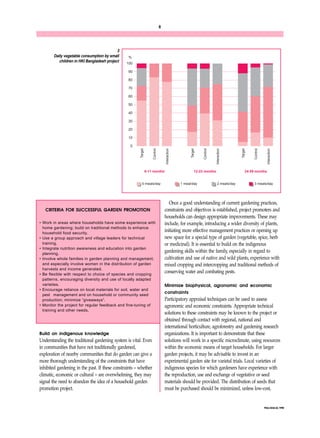
inputs (Figure 1). Studies on traditional mixed gardens have 
emphasized their ecologically sound and regenerative 
characteristics, by which they “recreate natural forest conditions” 
and minimize the need for crop management (UNICEF, 1982). 
The dynamic role of home gardening in family nutrition 
and household welfare must be assessed in the context of the 
wider farming system and household economy. Usually, the 
functions and output of the home garden complement field 
agriculture. Whereas field crops provide the bulk of energy 
1 
Typical home garden for 
food and income 
Cassava 
fence 
Source: FAO, 1995 
Long bean 
Herbs 
Eggplant 
Katuk 
(Sauropus sp.) 
Kencur 
(Galingdale) 
Taro 
Pumpkin 
Sweet potato 
Ginger 
Water 
spinach 
(Ipomoea 
aquatica)
FNA/ANA 22, 1998 
5 
them is a lack of understanding of and adaptation to local conditions, 
resulting in extension agents, demonstration gardens, planting 
materials and garden establishment and management strategies 
unsuited for local environmental, social and resource supply 
conditions” (Brownrigg, 1985). 
Some studies indicate that gardening is not cost-effective as 
a nutrition intervention as compared with fortification, 
supplementation and targeted subsidies (Popkin et al., 1980; 
Brownrigg, 1985). Another common criticism is that gardening 
is only feasible for households with access to land, water and 
technical assistance, leaving out many of the food insecure. 
Further, opponents claim that homestead production is often 
embraced as a panacea for food insecurity, when in fact it has 
proved unreliable as a steady source of food and income for 
poor households. 
Advocates of gardening cite evidence that home gardening 
can be a sustainable strategy for improving food security and 
incomes when gardens are well adapted to local agronomic 
and resource conditions, cultural traditions and preferences 
(Midmore, Niñez and Venkataraman, 1991; IIRR, 1991). This 
type of gardening is accessible to the poorest people since it 
relies on low-cost, low-risk technology and may be adapted to 
hostile environments (e.g. dryland gardens, flooding gardens). 
Landless households also benefit from simple hydroponics, 
container gardening and community or school gardening. 
Finally, proponents note that comparative cost-effectiveness 
studies tend to focus on narrow achievements, such as 
reduction in vitamin A deficiency, and fail to account for the 
full array of home gardening benefits. Were these benefits 
considered, the benefit/cost ratio of gardening projects would 
be likely to compare more favourably with alternative 
interventions. Moreover, in terms of alleviating food insecurity, 
advocates claim that food production controlled by 
households is more reliable and sustainable than nutrition 
interventions that rely on government goodwill and financial 
support (Niñez, 1984; Von Braun et al., 1993; Moskow, 1996). 
Supporters of gardening do not refute the evidence on 
mismanagement of gardening projects. Many believe that 
mismanagement and lack of sustainability are largely results of 
failure to invest the necessary resources in understanding the 
existing garden system in the context of changing household 
objectives (Niñez, 1984; Brownrigg, 1985; UNICEF, 1982; 
Midmore, Niñez and Venkataraman, 1991). Therefore, 
“improved” gardens are planned and developed for which the 
effort and costs for the household often outweigh the benefits, 
leading to eventual abandonment of the gardens after the 
project subsidies terminate. Were the improved gardens to 
build on the characteristics and objectives of traditional 
gardens in the region, many resource constraint problems 
could be anticipated and avoided. 
CONTRIBUTION TO FOOD SECURITY 
Home gardening contributes to household food security by 
providing direct access to food that can be harvested, 
prepared and fed to family members, often on a daily basis. 
Even very poor, landless or near landless people practise 
gardening on small patches of homestead land, vacant lots, 
roadsides or edges of a field, or in containers. Gardening may 
be done with virtually no economic resources, using locally 
available planting materials, green manures, “live” fencing and 
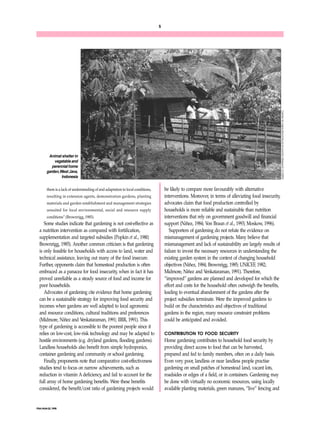
Animal shelter in 
vegetable and 
perennial home 
garden, West Java, 
Indonesia 
Center for Agricultural Socio-Economic Research (CASER)
6 
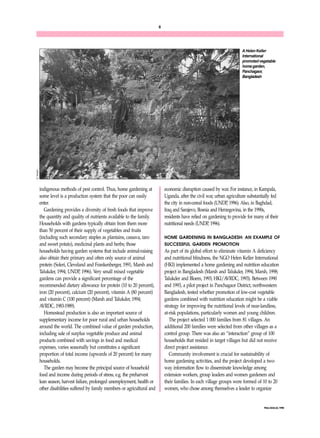
A Helen Keller 
International 
promoted vegetable 
home garden, 
Panchagaor, 
Bangladesh 
FNA/ANA 22, 1998 
indigenous methods of pest control. Thus, home gardening at 
some level is a production system that the poor can easily 
enter. 
Gardening provides a diversity of fresh foods that improve 
the quantity and quality of nutrients available to the family. 
Households with gardens typically obtain from them more 
than 50 percent of their supply of vegetables and fruits 
(including such secondary staples as plantains, cassava, taro 
and sweet potato), medicinal plants and herbs; those 
households having garden systems that include animal-raising 
also obtain their primary and often only source of animal 
protein (Soleri, Cleveland and Frankenberger, 1991; Marsh and 
Talukder, 1994; UNDP, 1996). Very small mixed vegetable 
gardens can provide a significant percentage of the 
recommended dietary allowance for protein (10 to 20 percent), 
iron (20 percent), calcium (20 percent), vitamin A (80 percent) 
and vitamin C (100 percent) (Marsh and Talukder, 1994; 
AVRDC, 1983-1989). 
Homestead production is also an important source of 
supplementary income for poor rural and urban households 
around the world. The combined value of garden production, 
including sale of surplus vegetable produce and animal 
products combined with savings in food and medical 
expenses, varies seasonally but constitutes a significant 
proportion of total income (upwards of 20 percent) for many 
households. 
The garden may become the principal source of household 
food and income during periods of stress, e.g. the preharvest 
lean season, harvest failure, prolonged unemployment, health or 
other disabilities suffered by family members or agricultural and 
economic disruption caused by war. For instance, in Kampala, 
Uganda, after the civil war, urban agriculture substantially fed 
the city in non-cereal foods (UNDP, 1996). Also, in Baghdad, 
Iraq and Sarajevo, Bosnia and Herzegovina, in the 1990s, 
residents have relied on gardening to provide for many of their 
nutritional needs (UNDP, 1996). 
HOME GARDENING IN BANGLADESH: AN EXAMPLE OF 
SUCCESSFUL GARDEN PROMOTION 
As part of its global effort to eliminate vitamin A deficiency 
and nutritional blindness, the NGO Helen Keller International 
(HKI) implemented a home gardening and nutrition education 
project in Bangladesh (Marsh and Talukder, 1994; Marsh, 1998; 
Talukder and Bloem, 1993; HKI/AVRDC, 1993). Between 1990 
and 1993, a pilot project in Panchagaor District, northwestern 
Bangladesh, tested whether promotion of low-cost vegetable 
gardens combined with nutrition education might be a viable 
strategy for improving the nutritional levels of near-landless, 
at-risk populations, particularly women and young children. 
The project selected 1 000 families from 81 villages. An 
additional 200 families were selected from other villages as a 
control group. There was also an “interaction” group of 100 
households that resided in target villages but did not receive 
direct project assistance. 
Community involvement is crucial for sustainability of 
home gardening activities, and the project developed a two-way 
information flow to disseminate knowledge among 
extension workers, group leaders and women gardeners and 
their families. In each village groups were formed of 10 to 20 
women, who chose among themselves a leader to organize 
R. Marsh
100 
90 
80 
70 
60 
50 
40 
30 
20 
10 
FNA/ANA 22, 1998 
7 
technical assistance and seed distribution for the project and 
to motivate mothers for home gardening. The extension staff 
were trained in the cultivation of primarily indigenous 
vitamin-rich vegetables using low-cost, low-risk methods. They 
also learned processing and cooking methods that optimize the 
nutritional value of foods. “Nursery” women were selected to 
grow vegetable seeds into seedlings for project-wide 
distribution with subsidies covering about 30 percent of the 
price. 
When the pilot project began, 50 percent of the target 
households reported having a home garden of mean size 61 m2 
with an average of 3.1 varieties of vegetables; after two years 
with the HKI project, 100 percent of the households had 
gardens of mean size 138 m2 with the average number of 
varieties increased dramatically to 17. Among the households 
selling garden produce (54 percent), average monthly income 
earned from sales was 85 taka (about US$2.15), equal to 14.8 
percent of total average monthly income, which is spent 
primarily on food, especially rice. The income value increased 
to 25 percent when savings on purchased fruits and vegetables 
were considered. 
Women in target households were more than twice as likely 
as control households to make the decisions about distribution 
of garden produce for home consumption or sale (making 65 
and 25 percent of the decisions, respectively). Also, women in 
the target group were more than twice as likely as those in the 
control group to receive income and to exercise control over 
funds earned from garden sales (67 compared with 31 percent). 
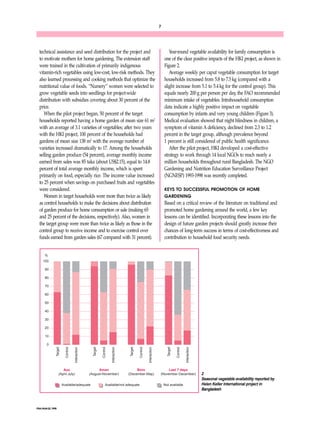
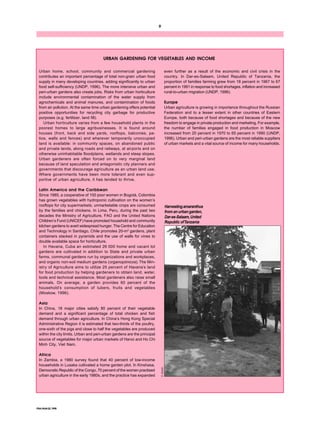
Year-round vegetable availability for family consumption is 
one of the clear positive impacts of the HKI project, as shown in 
Figure 2. 
Average weekly per caput vegetable consumption for target 
households increased from 5.8 to 7.5 kg (compared with a 
slight increase from 5.1 to 5.4 kg for the control group). This 
equals nearly 200 g per person per day, the FAO recommended 
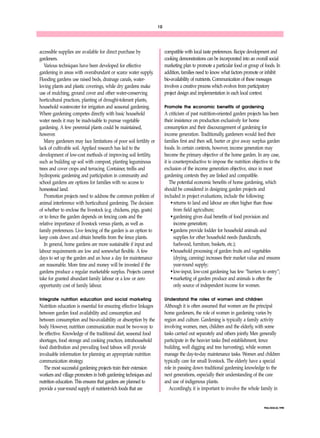
minimum intake of vegetables. Intrahousehold consumption 
data indicate a highly positive impact on vegetable 
consumption by infants and very young children (Figure 3). 
Medical evaluation showed that night blindness in children, a 
symptom of vitamin A deficiency, declined from 2.3 to 1.2 
percent in the target group, although prevalence beyond 
1 percent is still considered of public health significance. 
After the pilot project, HKI developed a cost-effective 
strategy to work through 14 local NGOs to reach nearly a 
million households throughout rural Bangladesh. The NGO 
Gardening and Nutrition Education Surveillance Project 
(NGNESP) 1993-1998 was recently completed. 
KEYS TO SUCCESSFUL PROMOTION OF HOME 
GARDENING 
Based on a critical review of the literature on traditional and 
promoted home gardening around the world, a few key 
lessons can be identified. Incorporating these lessons into the 
design of future garden projects should greatly increase their 
chances of long-term success in terms of cost-effectiveness and 
contribution to household food security needs. 
2 
Seasonal vegetable availability reported by 
Helen Keller International project in 
Bangladesh 
Target 
Control 
Interaction 
Target 
Control 
Interaction 
Target 
Control 
Interaction 
Target 
Control 
Interaction 
0 
Available/adequate Available/not adequate Not available 
% 
Aus 
(April-July) 
Aman 
(August-November) 
Boro 
(December-May) 
Last 7 days 
(November-December)
8 
Once a good understanding of current gardening practices, 
constraints and objectives is established, project promoters and 
households can design appropriate improvements. These may 
include, for example, introducing a wider diversity of plants, 
initiating more effective management practices or opening up 
new space for a special type of garden (vegetable, spice, herb 
or medicinal). It is essential to build on the indigenous 
gardening skills within the family, especially in regard to 
cultivation and use of native and wild plants, experience with 
mixed cropping and intercropping and traditional methods of 
conserving water and combating pests. 
Minimize biophysical, agronomic and economic 
constraints 
Participatory appraisal techniques can be used to assess 
agronomic and economic constraints. Appropriate technical 
solutions to these constraints may be known to the project or 
obtained through contact with regional, national and 
international horticulture, agroforestry and gardening research 
organizations. It is important to demonstrate that these 
solutions will work in a specific microclimate, using resources 
within the economic means of target households. For larger 
garden projects, it may be advisable to invest in an 
experimental garden site for varietal trials. Local varieties of 
indigenous species for which gardeners have experience with 
the reproduction, use and exchange of vegetative or seed 
materials should be provided. The distribution of seeds that 
must be purchased should be minimized, unless low-cost, 
FNA/ANA 22, 1998 
3 
Daily vegetable consumption by small 
children in HKI Bangladesh project 
Target 
100 
90 
80 
70 
60 
50 
40 
30 
20 
10 
CRITERIA FOR SUCCESSFUL GARDEN PROMOTION 
• Work in areas where households have some experience with 
home gardening; build on traditional methods to enhance 
household food security. 
• Use a group approach and village leaders for technical 
training. 
• Integrate nutrition awareness and education into garden 
planning. 
• Involve whole families in garden planning and management, 
and especially involve women in the distribution of garden 
harvests and income generated. 
• Be flexible with respect to choice of species and cropping 
patterns, encouraging diversity and use of locally adapted 
varieties. 
• Encourage reliance on local materials for soil, water and 
pest management and on household or community seed 
production; minimize “giveaways”. 
• Monitor the project for regular feedback and fine-tuning of 
training and other needs. 
Build on indigenous knowledge 
Understanding the traditional gardening system is vital. Even 
in communities that have not traditionally gardened, 
exploration of nearby communities that do garden can give a 
more thorough understanding of the constraints that have 
inhibited gardening in the past. If these constraints – whether 
climatic, economic or cultural – are overwhelming, they may 
signal the need to abandon the idea of a household garden 
promotion project. 
Control 
Interaction 
Target 
Control 
Interaction 
Target 
Control 
Interaction 
0 
0 meals/day 1 meal/day 2 meals/day 3 meals/day 
% 
6-11 months 12-23 months 24-59 months
FNA/ANA 22, 1998 
9 
URBAN GARDENING FOR VEGETABLES AND INCOME 
Urban home, school, community and commercial gardening 
contributes an important percentage of total non-grain urban food 
supply in many developing countries, adding significantly to urban 
food self-sufficiency (UNDP, 1996). The more intensive urban and 
peri-urban gardens also create jobs. Risks from urban horticulture 
include environmental contamination of the water supply from 
agrochemicals and animal manures, and contamination of foods 
from air pollution. At the same time urban gardening offers potential 
positive opportunities for recycling city garbage for productive 
purposes (e.g. fertilizer, land fill). 
Urban horticulture varies from a few household plants in the 
poorest homes to large agribusinesses. It is found around 
houses (front, back and side yards, rooftops, balconies, pa-tios, 
walls and fences) and wherever temporarily unoccupied 
land is available: in community spaces, on abandoned public 
and private lands, along roads and railways, at airports and on 
otherwise uninhabitable floodplains, wetlands and steep slopes. 
Urban gardeners are often forced on to very marginal land 
because of land speculation and antagonistic city planners and 
governments that discourage agriculture as an urban land use. 
Where governments have been more tolerant and even sup-portive 
of urban agriculture, it has tended to thrive. 
Latin America and the Caribbean 
Since 1985, a cooperative of 100 poor women in Bogotá, Colombia 
has grown vegetables with hydroponic cultivation on the women’s 
rooftops for city supermarkets; unmarketable crops are consumed 
by the families and chickens. In Lima, Peru, during the past two 
decades the Ministry of Agriculture, FAO and the United Nations 
Children’s Fund (UNICEF) have promoted household and community 
kitchen gardens to avert widespread hunger. The Centre for Education 
and Technology in Santiago, Chile promotes 20-m2 gardens, plant 
containers stacked in pyramids and the use of walls for vines to 
double available space for horticulture. 
In Havana, Cuba an estimated 26 000 home and vacant lot 
gardens are cultivated in addition to State and private urban 
farms, communal gardens run by organizations and workplaces, 
and organic non-soil medium gardens (organopónicos). The Min-istry 
of Agriculture aims to utilize 25 percent of Havana’s land 
for food production by helping gardeners to obtain land, water, 
tools and technical assistance. Most gardeners also raise small 
animals. On average, a garden provides 60 percent of the 
household’s consumption of tubers, fruits and vegetables 
(Moskow, 1996). 
Asia 
In China, 18 major cities satisfy 80 percent of their vegetable 
demand and a significant percentage of total chicken and fish 
demand through urban agriculture. In China’s Hong Kong Special 
Administrative Region it is estimated that two-thirds of the poultry, 
one-sixth of the pigs and close to half the vegetables are produced 
within the city limits. Urban and peri-urban gardens are the principal 
source of vegetables for major urban markets of Hanoi and Ho Chi 
Minh City, Viet Nam. 
Africa 
In Zambia, a 1980 survey found that 40 percent of low-income 
households in Lusaka cultivated a home garden plot. In Kinshasa, 
Democratic Republic of the Congo, 70 percent of the women practised 
urban agriculture in the early 1980s, and the practice has expanded 
even further as a result of the economic and civil crisis in the 
country. In Dar-es-Salaam, United Republic of Tanzania, the 
proportion of families farming grew from 18 percent in 1967 to 67 
percent in 1991 in response to food shortages, inflation and increased 
rural-to-urban migration (UNDP, 1996). 
Europe 
Urban agriculture is growing in importance throughout the Russian 
Federation and to a lesser extent in other countries of Eastern 
Europe, both because of food shortages and because of the new 
freedom to engage in private production and marketing. For example, 
the number of families engaged in food production in Moscow 
increased from 20 percent in 1970 to 65 percent in 1990 (UNDP, 
1996). Urban and peri-urban gardens are the most reliable suppliers 
of urban markets and a vital source of income for many households. 
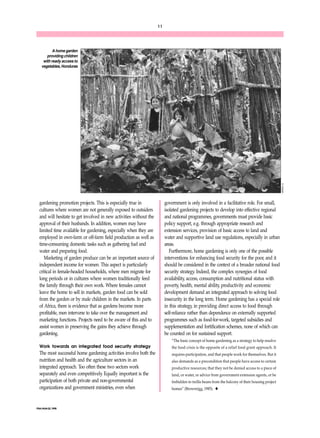
R. Marsh 
Harvesting amaranthus 
from an urban garden, 
Dar-es-Salaam, United 
Republic of Tanzania
10 
FNA/ANA 22, 1998 
accessible supplies are available for direct purchase by 
gardeners. 
Various techniques have been developed for effective 
gardening in areas with overabundant or scarce water supply. 
Flooding gardens use raised beds, drainage canals, water-loving 
plants and plastic coverings, while dry gardens make 
use of mulching, ground cover and other water-conserving 
horticultural practices, planting of drought-tolerant plants, 
household wastewater for irrigation and seasonal gardening. 
Where gardening competes directly with basic household 
water needs it may be inadvisable to pursue vegetable 
gardening. A few perennial plants could be maintained, 
however. 
Many gardeners may face limitations of poor soil fertility or 
lack of cultivable soil. Applied research has led to the 
development of low-cost methods of improving soil fertility, 
such as building up soil with compost, planting leguminous 
trees and cover crops and terracing. Container, trellis and 
hydroponic gardening and participation in community and 
school gardens are options for families with no access to 
homestead land. 
Promotion projects need to address the common problem of 
animal interference with horticultural gardening. The decision 
of whether to enclose the livestock (e.g. chickens, pigs, goats) 
or to fence the garden depends on fencing costs and the 
relative importance of livestock versus plants, as well as 
family preferences. Live fencing of the garden is an option to 
keep costs down and obtain benefits from the fence plants. 
In general, home gardens are more sustainable if input and 
labour requirements are low and somewhat flexible. A few 
days to set up the garden and an hour a day for maintenance 
are reasonable. More time and money will be invested if the 
gardens produce a regular marketable surplus. Projects cannot 
take for granted abundant family labour or a low or zero 
opportunity cost of family labour. 
Integrate nutrition education and social marketing 
Nutrition education is essential for ensuring effective linkages 
between garden food availability and consumption and 
between consumption and bio-availability or absorption by the 
body. However, nutrition communication must be two-way to 
be effective. Knowledge of the traditional diet, seasonal food 
shortages, food storage and cooking practices, intrahousehold 
food distribution and prevailing food taboos will provide 
invaluable information for planning an appropriate nutrition 
communication strategy. 
The most successful gardening projects train their extension 
workers and village promoters in both gardening techniques and 
nutrition education. This ensures that gardens are planned to 
provide a year-round supply of nutrient-rich foods that are 
compatible with local taste preferences. Recipe development and 
cooking demonstrations can be incorporated into an overall social 
marketing plan to promote a particular food or group of foods. In 
addition, families need to know what factors promote or inhibit 
bio-availability of nutrients. Communication of these messages 
involves a creative process which evolves from participatory 
project design and implementation in each local context. 
Promote the economic benefits of gardening 
A criticism of past nutrition-oriented garden projects has been 
their insistence on production exclusively for home 
consumption and their discouragement of gardening for 
income generation. Traditionally, gardeners would feed their 
families first and then sell, barter or give away surplus garden 
foods. In certain contexts, however, income generation may 
become the primary objective of the home garden. In any case, 
it is counterproductive to impose the nutrition objective to the 
exclusion of the income generation objective, since in most 
gardening contexts they are linked and compatible. 
The potential economic benefits of home gardening, which 
should be considered in designing garden projects and 
included in project evaluations, include the following: 
•returns to land and labour are often higher than those 
from field agriculture; 
•gardening gives dual benefits of food provision and 
income generation; 
•gardens provide fodder for household animals and 
supplies for other household needs (handicrafts, 
fuelwood, furniture, baskets, etc.); 
•household processing of garden fruits and vegetables 
(drying, canning) increases their market value and ensures 
year-round supply; 
•low-input, low-cost gardening has few “barriers to entry”; 
•marketing of garden produce and animals is often the 
only source of independent income for women. 
Understand the roles of women and children 
Although it is often assumed that women are the principal 
home gardeners, the role of women in gardening varies by 
region and culture. Gardening is typically a family activity 
involving women, men, children and the elderly, with some 
tasks carried out separately and others jointly. Men generally 
participate in the heavier tasks (bed establishment, fence 
building, well digging and tree harvesting), while women 
manage the day-to-day maintenance tasks. Women and children 
typically care for small livestock. The elderly have a special 
role in passing down traditional gardening knowledge to the 
next generations, especially their understanding of the care 
and use of indigenous plants. 
Accordingly, it is important to involve the whole family in
FNA/ANA 22, 1998 
11 
gardening promotion projects. This is especially true in 
cultures where women are not generally exposed to outsiders 
and will hesitate to get involved in new activities without the 
approval of their husbands. In addition, women may have 
limited time available for gardening, especially when they are 
employed in own-farm or off-farm field production as well as 
time-consuming domestic tasks such as gathering fuel and 
water and preparing food. 
Marketing of garden produce can be an important source of 
independent income for women. This aspect is particularly 
critical in female-headed households, where men migrate for 
long periods or in cultures where women traditionally feed 
the family through their own work. Where females cannot 
leave the home to sell in markets, garden food can be sold 
from the garden or by male children in the markets. In parts 
of Africa, there is evidence that as gardens become more 
profitable, men intervene to take over the management and 
marketing functions. Projects need to be aware of this and to 
assist women in preserving the gains they achieve through 
gardening. 
Work towards an integrated food security strategy 
The most successful home gardening activities involve both the 
nutrition and health and the agriculture sectors in an 
integrated approach. Too often these two sectors work 
separately and even competitively. Equally important is the 
participation of both private and non-governmental 
organizations and government ministries, even when 
government is only involved in a facilitative role. For small, 
isolated gardening projects to develop into effective regional 
and national programmes, governments must provide basic 
policy support, e.g. through appropriate research and 
extension services, provision of basic access to land and 
water and supportive land use regulations, especially in urban 
areas. 
Furthermore, home gardening is only one of the possible 
interventions for enhancing food security for the poor, and it 
should be considered in the context of a broader national food 
security strategy. Indeed, the complex synergies of food 
availability, access, consumption and nutritional status with 
poverty, health, mental ability, productivity and economic 
development demand an integrated approach to solving food 
insecurity in the long term. Home gardening has a special role 
in this strategy, in providing direct access to food through 
self-reliance rather than dependence on externally supported 
programmes such as food-for-work, targeted subsidies and 
supplementation and fortification schemes, none of which can 
be counted on for sustained support. 
“The basic concept of home gardening as a strategy to help resolve 
the food crisis is the opposite of a relief food grant approach. It 
requires participation, and that people work for themselves. But it 
also demands as a precondition that people have access to certain 
productive resources; that they not be denied access to a piece of 
land, or water, or advice from government extension agents, or be 
forbidden to trellis beans from the balcony of their housing project 
homes” (Brownrigg, 1985). u 
A home garden 
providing children 
with ready access to 
vegetables, Honduras 
R. Marsh
12 
FNA/ANA 22, 1998 
REFERENCES 
Asian Vegetable Research and Development Center (AVRDC). 
1983-1989. Annual Progress Report. Shanhua, Taiwan 
Province of China. 
Brownrigg, L. 1985. Home gardening in international 
development: what the literature shows. Washington, DC, 
USA, League for International Food Education. 
FAO. 1995. Improving nutrition through home gardening: a 
training package for preparing field workers in Southeast 
Asia. Rome. 
Helen Keller International (HKI)/AVRDC. 1993. Home 
gardening in Bangladesh: an evaluation report. Dhaka, 
Bangladesh, HKI Bangladesh. 
International Institute of Rural Reconstruction (IIRR). 1991. A 
family food production program in Negros Occidental, 
1986-1990. Silang Cavite, the Philippines. 
Marsh, R. & Talukder, A. 1994. Production and consumption 
effects of the introduction of home gardening on target, 
interaction and control groups: a case study from 
Bangladesh. In Proceedings of the International Symposium 
on Systems-Oriented Research, November 1994, 
Montpellier, France. Montpellier, France, Association for 
Farming Systems Research/Extension (AFSR/E). 
Marsh, R. 1998. Household food security through home 
gardening: evidence from Bangladesh and Central 
America. In Proceedings of an International Livestock 
Research Institute (ILRI)-Rockefeller Foundation 
Workshop, November 1994, Addis Ababa, Ethiopia. 
Midmore, D.J., Niñez, V. & Venkataraman, R. 1991. Household 
gardening projects in Asia: past experience and future 
directions. AVRDC Technical Bulletin No. 19. Shanhua, 
Taiwan Province of China, AVRDC. 
Moskow, A.L. 1996. The contributions of urban agriculture in 
Havana, Cuba to individual control and community 
enhancement. Unpublished M.A. thesis, University of 
California, Davis, USA. 
Niñez, V.K. 1984. Household gardens: theoretical considerations on 
an old survival strategy. Lima, Peru, International Potato 
Center. 
Popkin, B.M., Solon, F.S., Fernandez, T. & Latham, M.C. 1980. 
Benefit-cost analysis in the nutrition area: a project in the 
Philippines. Soc. Sci. Med., 14C: 207-216. 
Soleri, D., Cleveland, D.A. & Frankenberger, T.R. 1991. Gardens 
and vitamin A: a review of recent literature. Prepared for 
Vitamin A Field Support Project (VITAL). Washington, 
DC, USA, United States Agency for International 
Development (USAID) Office of Nutrition, Bureau for 
Science and Technology. 
Talukder, A. & Bloem, M.W. 1993. Homegardening activities in 
Bangladesh. Dhaka, Bangladesh, HKI. 
United Nations Children’s Fund (UNICEF). 1982. The UNICEF 
home gardens handbook: for people promoting mixed 
gardening in the humid tropics, by P. Sommers. New York, 
NY, USA. 
United Nations Development Programme (UNDP). 1996. Urban 
agriculture: food, jobs and sustainable cities. New York, 
NY, USA. 
Von Braun, J., McComb, J., Fred-Mensah, B.K. & Pandya-Lorch, 
R. 1993. Urban food insecurity and malnutrition in 
developing countries: trends, policies and research 
implications. Washington, DC, USA, International Food 
Policy Research Institute (IFPRI). u
13 
Summary/Résumé/Resumen 
FNA/ANA 22, 1998 
Family food production systems are found in most regions of most countries worldwide. Traditional 
tropical gardens have a great diversity of crops, are well adapted to local microclimates and require a 
minimum of purchased inputs. Field crops provide the bulk of energy needed by the household, while the 
garden supplements the diet with vitamin-rich vegetables and fruits, energy-rich vegetable staples, animal 
sources of protein and herbs and condiments. 
The many potential benefits of home gardening have led to numerous gardening projects sponsored by 
non-governmental organizations, governments and United Nations agencies. Nevertheless, promotion of 
gardening as a nutrition or community development strategy is controversial. Many believe that 
disappointing results of gardening projects stem from a failure to understand the existing garden system in 
the context of changing household objectives. If improved gardens could build upon the characteristics and 
objectives of traditional gardens, many problems could be avoided. 
Home gardening contributes to household food security and nutrition by providing direct access to 
diverse foods that can be harvested, prepared and fed to family members, often on a daily basis. Even very 
poor and landless people can practice gardening since it may be done with virtually no economic 
resources. Homestead production is also an important source of supplementary income for poor rural and 
urban households around the world. The garden may become the principal source of household food and 
income during periods of stress. 
Experiences of gardening projects around the world illustrate the importance of building on indigenous 
knowledge; reducing biophysical, agronomic and economic constraints; integrating nutrition education and 
social marketing in gardening projects; promoting the economic benefits of gardening; understanding the 
roles of women and children; and working towards an integrated food security strategy. 
On trouve les systèmes familiaux de production vivrière un peu partout dans le monde. Les jardins 
tropicaux traditionnels regorgent de cultures diverses, sont bien adaptés aux microclimats locaux et 
nécessitent un achat minimal d’intrants. Les cultures de plein champ fournissent la majeure partie de 
l’énergie nécessaire au ménage, tandis que le potager complète le régime alimentaire avec des fruits et des 
légumes riches en vitamines, des végétaux de base énergétiques, des sources animales de protéines et des 
herbes aromatiques et condiments. 
Le potentiel important des jardins familiaux a donné lieu à de nombreux projets de jardinage parrainés 
par les organisations non gouvernementales (ONG), les gouvernements et les organismes des Nations Unies. 
Néanmoins, la promotion du jardinage en tant que stratégie de nutrition ou de développement 
communautaire est controversée. Nombreux sont ceux qui estiment que les résultats décevants des projets 
de jardinage sont dus à l’incapacité de comprendre le système existant dans un contexte d’objectifs des 
ménages en pleine évolution. Si les jardins améliorés renforceront les caractéristiques et les objectifs des 
jardins traditionnels, de nombreux problèmes pourront être évités. 
Les jardins familiaux contribuent à la sécurité alimentaire et à la nutrition des ménages en leur offrant un 
accès direct à des aliments variés pouvant être récoltés et préparés pour les membres de la famille, souvent 
tous les jours. Même les personnes dénuées de ressources et de terres peuvent pratiquer le jardinage qui ne 
nécessite pratiquement aucune ressource économique. La production familiale est également une source 
importante de revenus supplémentaires pour les ménages urbains et ruraux pauvres du monde entier. Le 
jardin peut devenir la source principale de nourriture et de revenus du ménage durant les périodes 
difficiles. 
Les expériences concernant des projets de potagers dans le monde entier mettent en évidence 
l’importance de: tirer parti des connaissances des autochtones; réduire les obstacles biophysiques, 
agronomiques et économiques; regrouper l’éducation nutritionnelle et le marketing social dans les projets 
de jardinage; promouvoir les avantages économiques de celui-ci; comprendre le rôle des femmes et des 
enfants; et viser une stratégie intégrée de sécurité alimentaire. 
Building on 
traditional 
gardening to 
improve 
household food 
security 
Améliorer 
la sécurité 
alimentaire des 
ménages grâce 
au jardinage 
traditionnel
14 
Summary/Résumé/Resumen 
En casi todas las regiones de la mayor parte de los países del mundo existen sistemas de producción 
familiar de alimentos. Los huertos tropicales tradicionales poseen una gran diversidad de cultivos, se 
adaptan perfectamente a los microclimas locales, y quienes los cultivan necesitan comprar poquísimos 
insumos. Los cultivos extensivos aportan el grueso de la energía que requiere el hogar, mientras que el 
huerto complementa el régimen alimenticio con hortalizas y frutas ricas en vitaminas, productos hortícolas 
abundantes en energía, fuentes animales de proteínas, así como hierbas y condimentos. 
Los muchos beneficios que en potencia puede producir la horticultura doméstica han dado lugar a 
proyectos de horticultura patrocinados por organizaciones no gubernamentales, gobiernos y organismos de 
las Naciones Unidas. Sin embargo, se presta a discusión el fomento de la horticultura como estrategia de 
desarrollo nutricional o comunitario. Los resultados decepcionantes de los proyectos en este sector se deben 
a no integrar el actual sistema de horticultura en el marco de objetivos domésticos variables. Si en la 
mejora de los huertos se aprovecharan las características y los objetivos de los huertos tradicionales, 
podrían evitarse muchos problemas. 
La horticultura doméstica contribuye a la seguridad alimentaria familiar y a la nutrición al proporcionar 
acceso directo a una variedad de alimentos que pueden recolectarse, prepararse y servirse a los miembros 
de la familia, muchas veces a diario. Incluso la gente menesterosa y sin tierras puede practicar la 
horticultura ya que puede hacerse casi sin necesidad de recursos económicos. La producción hortícola 
constituye también una fuente importante de ingresos complementarios para los campesinos pobres y los 
hogares urbanos de todo el mundo. El huerto puede convertirse en la fuente principal de alimentos e 
ingresos para la familia en épocas de apuros. 
Las experiencias hortícolas de todo el mundo ilustran la importancia que revisten los conocimientos 
autóctonos al reducir las limitaciones de orden biofísico, agronómico y económico; integrar la educación 
nutricional y la comercialización social; fomentar los beneficios económicos de la horticultura; comprender 
las funciones de la mujer y de los niños; y trabajar por una estrategia integrada de la seguridad 
alimentaria. u 
FNA/ANA 22, 1998 
La horticultura 
tradicional 
como base para 
mejorar la 
seguridad 
alimentaria 
de los hogares

Building on Traditional Gardening to Improve Household Food Security

  • 1.
    4 Building ontraditional gardening to improve household food security R. Marsh Robin Marsh is an agricultural economist currently co-coordinating research for the Rural Institutions and Participation Service of FAO’s Sustainable Development Department. needed by the household, the garden supplements the diet with vitamin-rich vegetables and fruits, energy-rich vegetable staples, animal sources of protein and herbs and condiments. DEVELOPMENT DEBATE The multiple potential benefits of home gardening, of which the most important is increased direct access to nutritious foods by the food insecure, have spurred the sponsorship of numerous gardening projects by non-governmental organizations (NGOs), governments and United Nations agencies. Nevertheless, promotion of gardening as a nutrition or community development strategy is controversial, with strong advocates and opponents. Critics point to poor project design, management and monitoring, unrealized expectations and lack of sustainability: “… the frequent failure of garden projects to achieve significant, cost-effective, sustained and positive changes is due in large part to the familiar litany of development project errors. Foremost among FNA/ANA 22, 1998 Whether they are known as home, mixed, backyard, kitchen, farmyard, compound or homestead gardens, family food production systems are found in most regions of most countries worldwide. They may be the oldest production system known and their very persistence is proof of their intrinsic economic and nutritional merit. Traditional tropical gardens typically exhibit a wide diversity of perennial and semi-perennial crops, trees and shrubs, well adapted to local microclimates and maintained with a minimum of purchased inputs (Figure 1). Studies on traditional mixed gardens have emphasized their ecologically sound and regenerative characteristics, by which they “recreate natural forest conditions” and minimize the need for crop management (UNICEF, 1982). The dynamic role of home gardening in family nutrition and household welfare must be assessed in the context of the wider farming system and household economy. Usually, the functions and output of the home garden complement field agriculture. Whereas field crops provide the bulk of energy 1 Typical home garden for food and income Cassava fence Source: FAO, 1995 Long bean Herbs Eggplant Katuk (Sauropus sp.) Kencur (Galingdale) Taro Pumpkin Sweet potato Ginger Water spinach (Ipomoea aquatica)
  • 2.
    FNA/ANA 22, 1998 5 them is a lack of understanding of and adaptation to local conditions, resulting in extension agents, demonstration gardens, planting materials and garden establishment and management strategies unsuited for local environmental, social and resource supply conditions” (Brownrigg, 1985). Some studies indicate that gardening is not cost-effective as a nutrition intervention as compared with fortification, supplementation and targeted subsidies (Popkin et al., 1980; Brownrigg, 1985). Another common criticism is that gardening is only feasible for households with access to land, water and technical assistance, leaving out many of the food insecure. Further, opponents claim that homestead production is often embraced as a panacea for food insecurity, when in fact it has proved unreliable as a steady source of food and income for poor households. Advocates of gardening cite evidence that home gardening can be a sustainable strategy for improving food security and incomes when gardens are well adapted to local agronomic and resource conditions, cultural traditions and preferences (Midmore, Niñez and Venkataraman, 1991; IIRR, 1991). This type of gardening is accessible to the poorest people since it relies on low-cost, low-risk technology and may be adapted to hostile environments (e.g. dryland gardens, flooding gardens). Landless households also benefit from simple hydroponics, container gardening and community or school gardening. Finally, proponents note that comparative cost-effectiveness studies tend to focus on narrow achievements, such as reduction in vitamin A deficiency, and fail to account for the full array of home gardening benefits. Were these benefits considered, the benefit/cost ratio of gardening projects would be likely to compare more favourably with alternative interventions. Moreover, in terms of alleviating food insecurity, advocates claim that food production controlled by households is more reliable and sustainable than nutrition interventions that rely on government goodwill and financial support (Niñez, 1984; Von Braun et al., 1993; Moskow, 1996). Supporters of gardening do not refute the evidence on mismanagement of gardening projects. Many believe that mismanagement and lack of sustainability are largely results of failure to invest the necessary resources in understanding the existing garden system in the context of changing household objectives (Niñez, 1984; Brownrigg, 1985; UNICEF, 1982; Midmore, Niñez and Venkataraman, 1991). Therefore, “improved” gardens are planned and developed for which the effort and costs for the household often outweigh the benefits, leading to eventual abandonment of the gardens after the project subsidies terminate. Were the improved gardens to build on the characteristics and objectives of traditional gardens in the region, many resource constraint problems could be anticipated and avoided. CONTRIBUTION TO FOOD SECURITY Home gardening contributes to household food security by providing direct access to food that can be harvested, prepared and fed to family members, often on a daily basis. Even very poor, landless or near landless people practise gardening on small patches of homestead land, vacant lots, roadsides or edges of a field, or in containers. Gardening may be done with virtually no economic resources, using locally available planting materials, green manures, “live” fencing and Animal shelter in vegetable and perennial home garden, West Java, Indonesia Center for Agricultural Socio-Economic Research (CASER)
  • 3.
    6 A HelenKeller International promoted vegetable home garden, Panchagaor, Bangladesh FNA/ANA 22, 1998 indigenous methods of pest control. Thus, home gardening at some level is a production system that the poor can easily enter. Gardening provides a diversity of fresh foods that improve the quantity and quality of nutrients available to the family. Households with gardens typically obtain from them more than 50 percent of their supply of vegetables and fruits (including such secondary staples as plantains, cassava, taro and sweet potato), medicinal plants and herbs; those households having garden systems that include animal-raising also obtain their primary and often only source of animal protein (Soleri, Cleveland and Frankenberger, 1991; Marsh and Talukder, 1994; UNDP, 1996). Very small mixed vegetable gardens can provide a significant percentage of the recommended dietary allowance for protein (10 to 20 percent), iron (20 percent), calcium (20 percent), vitamin A (80 percent) and vitamin C (100 percent) (Marsh and Talukder, 1994; AVRDC, 1983-1989). Homestead production is also an important source of supplementary income for poor rural and urban households around the world. The combined value of garden production, including sale of surplus vegetable produce and animal products combined with savings in food and medical expenses, varies seasonally but constitutes a significant proportion of total income (upwards of 20 percent) for many households. The garden may become the principal source of household food and income during periods of stress, e.g. the preharvest lean season, harvest failure, prolonged unemployment, health or other disabilities suffered by family members or agricultural and economic disruption caused by war. For instance, in Kampala, Uganda, after the civil war, urban agriculture substantially fed the city in non-cereal foods (UNDP, 1996). Also, in Baghdad, Iraq and Sarajevo, Bosnia and Herzegovina, in the 1990s, residents have relied on gardening to provide for many of their nutritional needs (UNDP, 1996). HOME GARDENING IN BANGLADESH: AN EXAMPLE OF SUCCESSFUL GARDEN PROMOTION As part of its global effort to eliminate vitamin A deficiency and nutritional blindness, the NGO Helen Keller International (HKI) implemented a home gardening and nutrition education project in Bangladesh (Marsh and Talukder, 1994; Marsh, 1998; Talukder and Bloem, 1993; HKI/AVRDC, 1993). Between 1990 and 1993, a pilot project in Panchagaor District, northwestern Bangladesh, tested whether promotion of low-cost vegetable gardens combined with nutrition education might be a viable strategy for improving the nutritional levels of near-landless, at-risk populations, particularly women and young children. The project selected 1 000 families from 81 villages. An additional 200 families were selected from other villages as a control group. There was also an “interaction” group of 100 households that resided in target villages but did not receive direct project assistance. Community involvement is crucial for sustainability of home gardening activities, and the project developed a two-way information flow to disseminate knowledge among extension workers, group leaders and women gardeners and their families. In each village groups were formed of 10 to 20 women, who chose among themselves a leader to organize R. Marsh
  • 4.
    100 90 80 70 60 50 40 30 20 10 FNA/ANA 22, 1998 7 technical assistance and seed distribution for the project and to motivate mothers for home gardening. The extension staff were trained in the cultivation of primarily indigenous vitamin-rich vegetables using low-cost, low-risk methods. They also learned processing and cooking methods that optimize the nutritional value of foods. “Nursery” women were selected to grow vegetable seeds into seedlings for project-wide distribution with subsidies covering about 30 percent of the price. When the pilot project began, 50 percent of the target households reported having a home garden of mean size 61 m2 with an average of 3.1 varieties of vegetables; after two years with the HKI project, 100 percent of the households had gardens of mean size 138 m2 with the average number of varieties increased dramatically to 17. Among the households selling garden produce (54 percent), average monthly income earned from sales was 85 taka (about US$2.15), equal to 14.8 percent of total average monthly income, which is spent primarily on food, especially rice. The income value increased to 25 percent when savings on purchased fruits and vegetables were considered. Women in target households were more than twice as likely as control households to make the decisions about distribution of garden produce for home consumption or sale (making 65 and 25 percent of the decisions, respectively). Also, women in the target group were more than twice as likely as those in the control group to receive income and to exercise control over funds earned from garden sales (67 compared with 31 percent). Year-round vegetable availability for family consumption is one of the clear positive impacts of the HKI project, as shown in Figure 2. Average weekly per caput vegetable consumption for target households increased from 5.8 to 7.5 kg (compared with a slight increase from 5.1 to 5.4 kg for the control group). This equals nearly 200 g per person per day, the FAO recommended minimum intake of vegetables. Intrahousehold consumption data indicate a highly positive impact on vegetable consumption by infants and very young children (Figure 3). Medical evaluation showed that night blindness in children, a symptom of vitamin A deficiency, declined from 2.3 to 1.2 percent in the target group, although prevalence beyond 1 percent is still considered of public health significance. After the pilot project, HKI developed a cost-effective strategy to work through 14 local NGOs to reach nearly a million households throughout rural Bangladesh. The NGO Gardening and Nutrition Education Surveillance Project (NGNESP) 1993-1998 was recently completed. KEYS TO SUCCESSFUL PROMOTION OF HOME GARDENING Based on a critical review of the literature on traditional and promoted home gardening around the world, a few key lessons can be identified. Incorporating these lessons into the design of future garden projects should greatly increase their chances of long-term success in terms of cost-effectiveness and contribution to household food security needs. 2 Seasonal vegetable availability reported by Helen Keller International project in Bangladesh Target Control Interaction Target Control Interaction Target Control Interaction Target Control Interaction 0 Available/adequate Available/not adequate Not available % Aus (April-July) Aman (August-November) Boro (December-May) Last 7 days (November-December)
  • 5.
    8 Once agood understanding of current gardening practices, constraints and objectives is established, project promoters and households can design appropriate improvements. These may include, for example, introducing a wider diversity of plants, initiating more effective management practices or opening up new space for a special type of garden (vegetable, spice, herb or medicinal). It is essential to build on the indigenous gardening skills within the family, especially in regard to cultivation and use of native and wild plants, experience with mixed cropping and intercropping and traditional methods of conserving water and combating pests. Minimize biophysical, agronomic and economic constraints Participatory appraisal techniques can be used to assess agronomic and economic constraints. Appropriate technical solutions to these constraints may be known to the project or obtained through contact with regional, national and international horticulture, agroforestry and gardening research organizations. It is important to demonstrate that these solutions will work in a specific microclimate, using resources within the economic means of target households. For larger garden projects, it may be advisable to invest in an experimental garden site for varietal trials. Local varieties of indigenous species for which gardeners have experience with the reproduction, use and exchange of vegetative or seed materials should be provided. The distribution of seeds that must be purchased should be minimized, unless low-cost, FNA/ANA 22, 1998 3 Daily vegetable consumption by small children in HKI Bangladesh project Target 100 90 80 70 60 50 40 30 20 10 CRITERIA FOR SUCCESSFUL GARDEN PROMOTION • Work in areas where households have some experience with home gardening; build on traditional methods to enhance household food security. • Use a group approach and village leaders for technical training. • Integrate nutrition awareness and education into garden planning. • Involve whole families in garden planning and management, and especially involve women in the distribution of garden harvests and income generated. • Be flexible with respect to choice of species and cropping patterns, encouraging diversity and use of locally adapted varieties. • Encourage reliance on local materials for soil, water and pest management and on household or community seed production; minimize “giveaways”. • Monitor the project for regular feedback and fine-tuning of training and other needs. Build on indigenous knowledge Understanding the traditional gardening system is vital. Even in communities that have not traditionally gardened, exploration of nearby communities that do garden can give a more thorough understanding of the constraints that have inhibited gardening in the past. If these constraints – whether climatic, economic or cultural – are overwhelming, they may signal the need to abandon the idea of a household garden promotion project. Control Interaction Target Control Interaction Target Control Interaction 0 0 meals/day 1 meal/day 2 meals/day 3 meals/day % 6-11 months 12-23 months 24-59 months
  • 6.
    FNA/ANA 22, 1998 9 URBAN GARDENING FOR VEGETABLES AND INCOME Urban home, school, community and commercial gardening contributes an important percentage of total non-grain urban food supply in many developing countries, adding significantly to urban food self-sufficiency (UNDP, 1996). The more intensive urban and peri-urban gardens also create jobs. Risks from urban horticulture include environmental contamination of the water supply from agrochemicals and animal manures, and contamination of foods from air pollution. At the same time urban gardening offers potential positive opportunities for recycling city garbage for productive purposes (e.g. fertilizer, land fill). Urban horticulture varies from a few household plants in the poorest homes to large agribusinesses. It is found around houses (front, back and side yards, rooftops, balconies, pa-tios, walls and fences) and wherever temporarily unoccupied land is available: in community spaces, on abandoned public and private lands, along roads and railways, at airports and on otherwise uninhabitable floodplains, wetlands and steep slopes. Urban gardeners are often forced on to very marginal land because of land speculation and antagonistic city planners and governments that discourage agriculture as an urban land use. Where governments have been more tolerant and even sup-portive of urban agriculture, it has tended to thrive. Latin America and the Caribbean Since 1985, a cooperative of 100 poor women in Bogotá, Colombia has grown vegetables with hydroponic cultivation on the women’s rooftops for city supermarkets; unmarketable crops are consumed by the families and chickens. In Lima, Peru, during the past two decades the Ministry of Agriculture, FAO and the United Nations Children’s Fund (UNICEF) have promoted household and community kitchen gardens to avert widespread hunger. The Centre for Education and Technology in Santiago, Chile promotes 20-m2 gardens, plant containers stacked in pyramids and the use of walls for vines to double available space for horticulture. In Havana, Cuba an estimated 26 000 home and vacant lot gardens are cultivated in addition to State and private urban farms, communal gardens run by organizations and workplaces, and organic non-soil medium gardens (organopónicos). The Min-istry of Agriculture aims to utilize 25 percent of Havana’s land for food production by helping gardeners to obtain land, water, tools and technical assistance. Most gardeners also raise small animals. On average, a garden provides 60 percent of the household’s consumption of tubers, fruits and vegetables (Moskow, 1996). Asia In China, 18 major cities satisfy 80 percent of their vegetable demand and a significant percentage of total chicken and fish demand through urban agriculture. In China’s Hong Kong Special Administrative Region it is estimated that two-thirds of the poultry, one-sixth of the pigs and close to half the vegetables are produced within the city limits. Urban and peri-urban gardens are the principal source of vegetables for major urban markets of Hanoi and Ho Chi Minh City, Viet Nam. Africa In Zambia, a 1980 survey found that 40 percent of low-income households in Lusaka cultivated a home garden plot. In Kinshasa, Democratic Republic of the Congo, 70 percent of the women practised urban agriculture in the early 1980s, and the practice has expanded even further as a result of the economic and civil crisis in the country. In Dar-es-Salaam, United Republic of Tanzania, the proportion of families farming grew from 18 percent in 1967 to 67 percent in 1991 in response to food shortages, inflation and increased rural-to-urban migration (UNDP, 1996). Europe Urban agriculture is growing in importance throughout the Russian Federation and to a lesser extent in other countries of Eastern Europe, both because of food shortages and because of the new freedom to engage in private production and marketing. For example, the number of families engaged in food production in Moscow increased from 20 percent in 1970 to 65 percent in 1990 (UNDP, 1996). Urban and peri-urban gardens are the most reliable suppliers of urban markets and a vital source of income for many households. R. Marsh Harvesting amaranthus from an urban garden, Dar-es-Salaam, United Republic of Tanzania
  • 7.
    10 FNA/ANA 22,1998 accessible supplies are available for direct purchase by gardeners. Various techniques have been developed for effective gardening in areas with overabundant or scarce water supply. Flooding gardens use raised beds, drainage canals, water-loving plants and plastic coverings, while dry gardens make use of mulching, ground cover and other water-conserving horticultural practices, planting of drought-tolerant plants, household wastewater for irrigation and seasonal gardening. Where gardening competes directly with basic household water needs it may be inadvisable to pursue vegetable gardening. A few perennial plants could be maintained, however. Many gardeners may face limitations of poor soil fertility or lack of cultivable soil. Applied research has led to the development of low-cost methods of improving soil fertility, such as building up soil with compost, planting leguminous trees and cover crops and terracing. Container, trellis and hydroponic gardening and participation in community and school gardens are options for families with no access to homestead land. Promotion projects need to address the common problem of animal interference with horticultural gardening. The decision of whether to enclose the livestock (e.g. chickens, pigs, goats) or to fence the garden depends on fencing costs and the relative importance of livestock versus plants, as well as family preferences. Live fencing of the garden is an option to keep costs down and obtain benefits from the fence plants. In general, home gardens are more sustainable if input and labour requirements are low and somewhat flexible. A few days to set up the garden and an hour a day for maintenance are reasonable. More time and money will be invested if the gardens produce a regular marketable surplus. Projects cannot take for granted abundant family labour or a low or zero opportunity cost of family labour. Integrate nutrition education and social marketing Nutrition education is essential for ensuring effective linkages between garden food availability and consumption and between consumption and bio-availability or absorption by the body. However, nutrition communication must be two-way to be effective. Knowledge of the traditional diet, seasonal food shortages, food storage and cooking practices, intrahousehold food distribution and prevailing food taboos will provide invaluable information for planning an appropriate nutrition communication strategy. The most successful gardening projects train their extension workers and village promoters in both gardening techniques and nutrition education. This ensures that gardens are planned to provide a year-round supply of nutrient-rich foods that are compatible with local taste preferences. Recipe development and cooking demonstrations can be incorporated into an overall social marketing plan to promote a particular food or group of foods. In addition, families need to know what factors promote or inhibit bio-availability of nutrients. Communication of these messages involves a creative process which evolves from participatory project design and implementation in each local context. Promote the economic benefits of gardening A criticism of past nutrition-oriented garden projects has been their insistence on production exclusively for home consumption and their discouragement of gardening for income generation. Traditionally, gardeners would feed their families first and then sell, barter or give away surplus garden foods. In certain contexts, however, income generation may become the primary objective of the home garden. In any case, it is counterproductive to impose the nutrition objective to the exclusion of the income generation objective, since in most gardening contexts they are linked and compatible. The potential economic benefits of home gardening, which should be considered in designing garden projects and included in project evaluations, include the following: •returns to land and labour are often higher than those from field agriculture; •gardening gives dual benefits of food provision and income generation; •gardens provide fodder for household animals and supplies for other household needs (handicrafts, fuelwood, furniture, baskets, etc.); •household processing of garden fruits and vegetables (drying, canning) increases their market value and ensures year-round supply; •low-input, low-cost gardening has few “barriers to entry”; •marketing of garden produce and animals is often the only source of independent income for women. Understand the roles of women and children Although it is often assumed that women are the principal home gardeners, the role of women in gardening varies by region and culture. Gardening is typically a family activity involving women, men, children and the elderly, with some tasks carried out separately and others jointly. Men generally participate in the heavier tasks (bed establishment, fence building, well digging and tree harvesting), while women manage the day-to-day maintenance tasks. Women and children typically care for small livestock. The elderly have a special role in passing down traditional gardening knowledge to the next generations, especially their understanding of the care and use of indigenous plants. Accordingly, it is important to involve the whole family in
  • 8.
    FNA/ANA 22, 1998 11 gardening promotion projects. This is especially true in cultures where women are not generally exposed to outsiders and will hesitate to get involved in new activities without the approval of their husbands. In addition, women may have limited time available for gardening, especially when they are employed in own-farm or off-farm field production as well as time-consuming domestic tasks such as gathering fuel and water and preparing food. Marketing of garden produce can be an important source of independent income for women. This aspect is particularly critical in female-headed households, where men migrate for long periods or in cultures where women traditionally feed the family through their own work. Where females cannot leave the home to sell in markets, garden food can be sold from the garden or by male children in the markets. In parts of Africa, there is evidence that as gardens become more profitable, men intervene to take over the management and marketing functions. Projects need to be aware of this and to assist women in preserving the gains they achieve through gardening. Work towards an integrated food security strategy The most successful home gardening activities involve both the nutrition and health and the agriculture sectors in an integrated approach. Too often these two sectors work separately and even competitively. Equally important is the participation of both private and non-governmental organizations and government ministries, even when government is only involved in a facilitative role. For small, isolated gardening projects to develop into effective regional and national programmes, governments must provide basic policy support, e.g. through appropriate research and extension services, provision of basic access to land and water and supportive land use regulations, especially in urban areas. Furthermore, home gardening is only one of the possible interventions for enhancing food security for the poor, and it should be considered in the context of a broader national food security strategy. Indeed, the complex synergies of food availability, access, consumption and nutritional status with poverty, health, mental ability, productivity and economic development demand an integrated approach to solving food insecurity in the long term. Home gardening has a special role in this strategy, in providing direct access to food through self-reliance rather than dependence on externally supported programmes such as food-for-work, targeted subsidies and supplementation and fortification schemes, none of which can be counted on for sustained support. “The basic concept of home gardening as a strategy to help resolve the food crisis is the opposite of a relief food grant approach. It requires participation, and that people work for themselves. But it also demands as a precondition that people have access to certain productive resources; that they not be denied access to a piece of land, or water, or advice from government extension agents, or be forbidden to trellis beans from the balcony of their housing project homes” (Brownrigg, 1985). u A home garden providing children with ready access to vegetables, Honduras R. Marsh
  • 9.
    12 FNA/ANA 22,1998 REFERENCES Asian Vegetable Research and Development Center (AVRDC). 1983-1989. Annual Progress Report. Shanhua, Taiwan Province of China. Brownrigg, L. 1985. Home gardening in international development: what the literature shows. Washington, DC, USA, League for International Food Education. FAO. 1995. Improving nutrition through home gardening: a training package for preparing field workers in Southeast Asia. Rome. Helen Keller International (HKI)/AVRDC. 1993. Home gardening in Bangladesh: an evaluation report. Dhaka, Bangladesh, HKI Bangladesh. International Institute of Rural Reconstruction (IIRR). 1991. A family food production program in Negros Occidental, 1986-1990. Silang Cavite, the Philippines. Marsh, R. & Talukder, A. 1994. Production and consumption effects of the introduction of home gardening on target, interaction and control groups: a case study from Bangladesh. In Proceedings of the International Symposium on Systems-Oriented Research, November 1994, Montpellier, France. Montpellier, France, Association for Farming Systems Research/Extension (AFSR/E). Marsh, R. 1998. Household food security through home gardening: evidence from Bangladesh and Central America. In Proceedings of an International Livestock Research Institute (ILRI)-Rockefeller Foundation Workshop, November 1994, Addis Ababa, Ethiopia. Midmore, D.J., Niñez, V. & Venkataraman, R. 1991. Household gardening projects in Asia: past experience and future directions. AVRDC Technical Bulletin No. 19. Shanhua, Taiwan Province of China, AVRDC. Moskow, A.L. 1996. The contributions of urban agriculture in Havana, Cuba to individual control and community enhancement. Unpublished M.A. thesis, University of California, Davis, USA. Niñez, V.K. 1984. Household gardens: theoretical considerations on an old survival strategy. Lima, Peru, International Potato Center. Popkin, B.M., Solon, F.S., Fernandez, T. & Latham, M.C. 1980. Benefit-cost analysis in the nutrition area: a project in the Philippines. Soc. Sci. Med., 14C: 207-216. Soleri, D., Cleveland, D.A. & Frankenberger, T.R. 1991. Gardens and vitamin A: a review of recent literature. Prepared for Vitamin A Field Support Project (VITAL). Washington, DC, USA, United States Agency for International Development (USAID) Office of Nutrition, Bureau for Science and Technology. Talukder, A. & Bloem, M.W. 1993. Homegardening activities in Bangladesh. Dhaka, Bangladesh, HKI. United Nations Children’s Fund (UNICEF). 1982. The UNICEF home gardens handbook: for people promoting mixed gardening in the humid tropics, by P. Sommers. New York, NY, USA. United Nations Development Programme (UNDP). 1996. Urban agriculture: food, jobs and sustainable cities. New York, NY, USA. Von Braun, J., McComb, J., Fred-Mensah, B.K. & Pandya-Lorch, R. 1993. Urban food insecurity and malnutrition in developing countries: trends, policies and research implications. Washington, DC, USA, International Food Policy Research Institute (IFPRI). u
  • 10.
    13 Summary/Résumé/Resumen FNA/ANA22, 1998 Family food production systems are found in most regions of most countries worldwide. Traditional tropical gardens have a great diversity of crops, are well adapted to local microclimates and require a minimum of purchased inputs. Field crops provide the bulk of energy needed by the household, while the garden supplements the diet with vitamin-rich vegetables and fruits, energy-rich vegetable staples, animal sources of protein and herbs and condiments. The many potential benefits of home gardening have led to numerous gardening projects sponsored by non-governmental organizations, governments and United Nations agencies. Nevertheless, promotion of gardening as a nutrition or community development strategy is controversial. Many believe that disappointing results of gardening projects stem from a failure to understand the existing garden system in the context of changing household objectives. If improved gardens could build upon the characteristics and objectives of traditional gardens, many problems could be avoided. Home gardening contributes to household food security and nutrition by providing direct access to diverse foods that can be harvested, prepared and fed to family members, often on a daily basis. Even very poor and landless people can practice gardening since it may be done with virtually no economic resources. Homestead production is also an important source of supplementary income for poor rural and urban households around the world. The garden may become the principal source of household food and income during periods of stress. Experiences of gardening projects around the world illustrate the importance of building on indigenous knowledge; reducing biophysical, agronomic and economic constraints; integrating nutrition education and social marketing in gardening projects; promoting the economic benefits of gardening; understanding the roles of women and children; and working towards an integrated food security strategy. On trouve les systèmes familiaux de production vivrière un peu partout dans le monde. Les jardins tropicaux traditionnels regorgent de cultures diverses, sont bien adaptés aux microclimats locaux et nécessitent un achat minimal d’intrants. Les cultures de plein champ fournissent la majeure partie de l’énergie nécessaire au ménage, tandis que le potager complète le régime alimentaire avec des fruits et des légumes riches en vitamines, des végétaux de base énergétiques, des sources animales de protéines et des herbes aromatiques et condiments. Le potentiel important des jardins familiaux a donné lieu à de nombreux projets de jardinage parrainés par les organisations non gouvernementales (ONG), les gouvernements et les organismes des Nations Unies. Néanmoins, la promotion du jardinage en tant que stratégie de nutrition ou de développement communautaire est controversée. Nombreux sont ceux qui estiment que les résultats décevants des projets de jardinage sont dus à l’incapacité de comprendre le système existant dans un contexte d’objectifs des ménages en pleine évolution. Si les jardins améliorés renforceront les caractéristiques et les objectifs des jardins traditionnels, de nombreux problèmes pourront être évités. Les jardins familiaux contribuent à la sécurité alimentaire et à la nutrition des ménages en leur offrant un accès direct à des aliments variés pouvant être récoltés et préparés pour les membres de la famille, souvent tous les jours. Même les personnes dénuées de ressources et de terres peuvent pratiquer le jardinage qui ne nécessite pratiquement aucune ressource économique. La production familiale est également une source importante de revenus supplémentaires pour les ménages urbains et ruraux pauvres du monde entier. Le jardin peut devenir la source principale de nourriture et de revenus du ménage durant les périodes difficiles. Les expériences concernant des projets de potagers dans le monde entier mettent en évidence l’importance de: tirer parti des connaissances des autochtones; réduire les obstacles biophysiques, agronomiques et économiques; regrouper l’éducation nutritionnelle et le marketing social dans les projets de jardinage; promouvoir les avantages économiques de celui-ci; comprendre le rôle des femmes et des enfants; et viser une stratégie intégrée de sécurité alimentaire. Building on traditional gardening to improve household food security Améliorer la sécurité alimentaire des ménages grâce au jardinage traditionnel
  • 11.
    14 Summary/Résumé/Resumen Encasi todas las regiones de la mayor parte de los países del mundo existen sistemas de producción familiar de alimentos. Los huertos tropicales tradicionales poseen una gran diversidad de cultivos, se adaptan perfectamente a los microclimas locales, y quienes los cultivan necesitan comprar poquísimos insumos. Los cultivos extensivos aportan el grueso de la energía que requiere el hogar, mientras que el huerto complementa el régimen alimenticio con hortalizas y frutas ricas en vitaminas, productos hortícolas abundantes en energía, fuentes animales de proteínas, así como hierbas y condimentos. Los muchos beneficios que en potencia puede producir la horticultura doméstica han dado lugar a proyectos de horticultura patrocinados por organizaciones no gubernamentales, gobiernos y organismos de las Naciones Unidas. Sin embargo, se presta a discusión el fomento de la horticultura como estrategia de desarrollo nutricional o comunitario. Los resultados decepcionantes de los proyectos en este sector se deben a no integrar el actual sistema de horticultura en el marco de objetivos domésticos variables. Si en la mejora de los huertos se aprovecharan las características y los objetivos de los huertos tradicionales, podrían evitarse muchos problemas. La horticultura doméstica contribuye a la seguridad alimentaria familiar y a la nutrición al proporcionar acceso directo a una variedad de alimentos que pueden recolectarse, prepararse y servirse a los miembros de la familia, muchas veces a diario. Incluso la gente menesterosa y sin tierras puede practicar la horticultura ya que puede hacerse casi sin necesidad de recursos económicos. La producción hortícola constituye también una fuente importante de ingresos complementarios para los campesinos pobres y los hogares urbanos de todo el mundo. El huerto puede convertirse en la fuente principal de alimentos e ingresos para la familia en épocas de apuros. Las experiencias hortícolas de todo el mundo ilustran la importancia que revisten los conocimientos autóctonos al reducir las limitaciones de orden biofísico, agronómico y económico; integrar la educación nutricional y la comercialización social; fomentar los beneficios económicos de la horticultura; comprender las funciones de la mujer y de los niños; y trabajar por una estrategia integrada de la seguridad alimentaria. u FNA/ANA 22, 1998 La horticultura tradicional como base para mejorar la seguridad alimentaria de los hogares