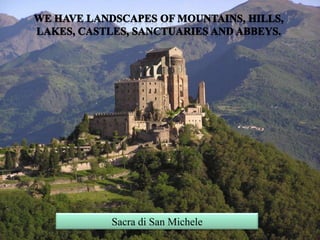
Sacra di San Michele
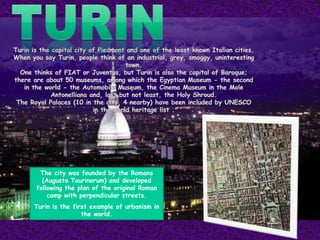
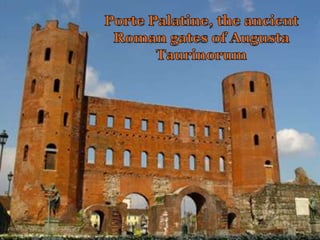
The city was founded by the Romans
(Augusta Taurinorum) and developed
following the plan of the original Roman
camp with perpendicular streets.
Turin is the first example of urbanism in
the world.
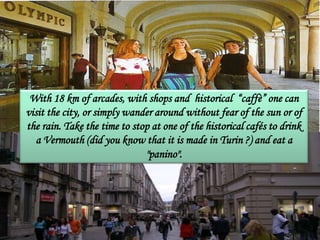
With 18 km of arcades, with shops and historical “caffè” one can
visit the city, or simply wander around without fear of the sun or of
the rain. Take the time to stop at one of the historical cafés to drink
a Vermouth (did you know that it is made in Turin ?) and eat a
"panino".
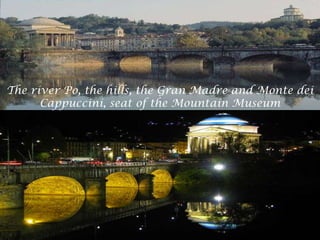
The river Po, the hills, the Gran Madre and Monte dei
Cappuccini, seat of the Mountain Museum
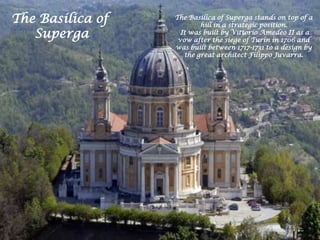
The Basilica of Superga stands on top of a
hill in a strategic position.
It was built by Vittorio Amedeo II as a
vow after the siege of Turin in 1706 and
was built between 1717-1731 to a design by
the great architect Filippo Juvarra.
The Basilica of
Superga
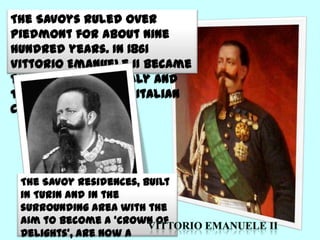
The Savoys ruled over
Piedmont for about nine
hundred years. In 1861
Vittorio Emanuele II became
the first king of Italy and
Turin was the first Italian
capital.
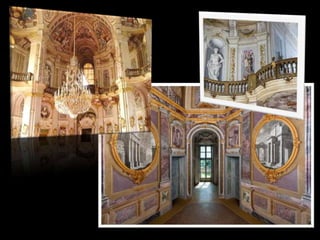
The Savoy residences, built
in Turin and in the
surrounding area with the
aim to become a ‘Crown of
Delights’, are now a
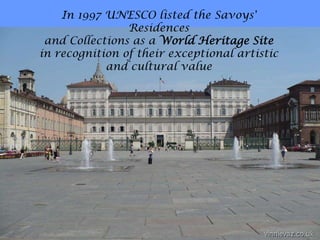
In 1997 UNESCO listed the Savoys'
Residences
and Collections as a World Heritage Site
in recognition of their exceptional artistic
and cultural value
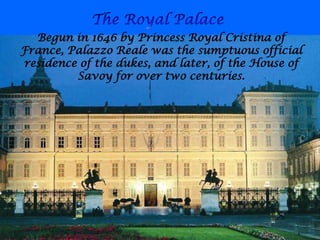
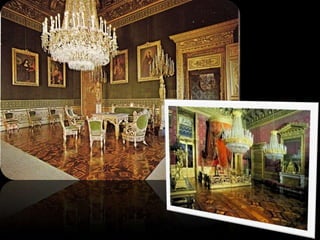
Begun in 1646 by Princess Royal Cristina of
France, Palazzo Reale was the sumptuous official
residence of the dukes, and later, of the House of
Savoy for over two centuries.
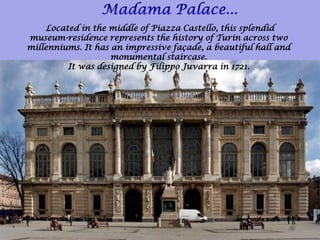
Located in the middle of Piazza Castello, this splendid
museum-residence represents the history of Turin across two
millenniums. It has an impressive façade, a beautiful hall and
monumental staircase.
It was designed by Filippo Juvarra in 1721.
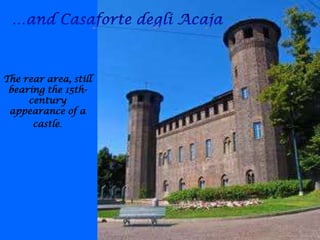
The rear area, still
bearing the 15th-
century
appearance of a
castle.
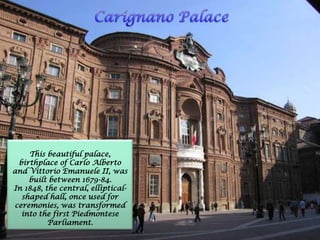
This beautiful palace,
birthplace of Carlo Alberto
and Vittorio Emanuele II, was
built between 1679-84.
In 1848, the central, elliptical-
shaped hall, once used for
ceremonies, was transformed
into the first Piedmontese
Parliament.
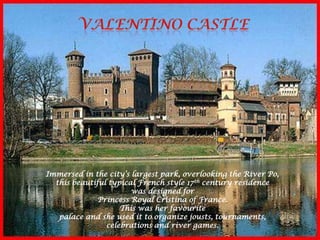
Immersed in the city’s largest park, overlooking the River Po,
this beautiful typical French style 17th century residence
was designed for
Princess Royal Cristina of France.
This was her favourite
palace and she used it to organize jousts, tournaments,
celebrations and river games.
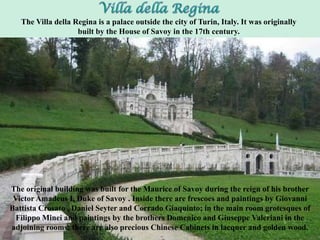
The original building was built for the Maurice of Savoy during the reign of his brother
Victor Amadeus I, Duke of Savoy . Inside there are frescoes and paintings by Giovanni
Battista Crosato , Daniel Seyter and Corrado Giaquinto; in the main room grotesques of
Filippo Minei and paintings by the brothers Domenico and Giuseppe Valeriani in the
adjoining rooms; there are also precious Chinese Cabinets in lacquer and golden wood.
The Villa della Regina is a palace outside the city of Turin, Italy. It was originally
built by the House of Savoy in the 17th century.
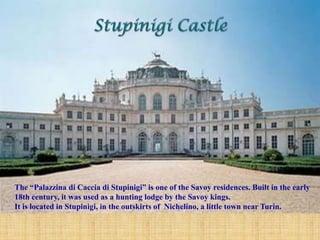
The “Palazzina di Caccia di Stupinigi” is one of the Savoy residences. Built in the early
18th century, it was used as a hunting lodge by the Savoy kings.
It is located in Stupinigi, in the outskirts of Nichelino, a little town near Turin.
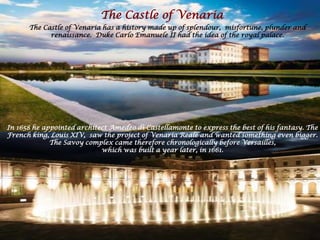
In 1658 he appointed architect Amedeo di Castellamonte to express the best of his fantasy. The
French king, Louis XIV, saw the project of Venaria Reale and wanted something even bigger.
The Savoy complex came therefore chronologically before Versailles,
which was built a year later, in 1661.
The Castle of Venaria
The Castle of Venaria has a history made up of splendour, misfortune, plunder and
renaissance. Duke Carlo Emanuele II had the idea of the royal palace.
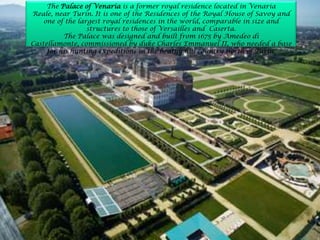
The Palace of Venaria is a former royal residence located in Venaria
Reale, near Turin. It is one of the Residences of the Royal House of Savoy and
one of the largest royal residences in the world, comparable in size and
structures to those of Versailles and Caserta.
The Palace was designed and built from 1675 by Amedeo di
Castellamonte, commissioned by duke Charles Emmanuel II, who needed a base
for his hunting expeditions in the heathy hill country north of Turin.
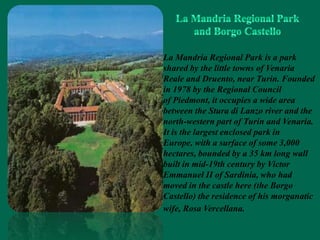
La Mandria Regional Park is a park
shared by the little towns of Venaria
Reale and Druento, near Turin. Founded
in 1978 by the Regional Council
of Piedmont, it occupies a wide area
between the Stura di Lanzo river and the
north-western part of Turin and Venaria.
It is the largest enclosed park in
Europe, with a surface of some 3,000
hectares, bounded by a 35 km long wall
built in mid-19th century by Victor
Emmanuel II of Sardinia, who had
moved in the castle here (the Borgo
Castello) the residence of his morganatic
wife, Rosa Vercellana.
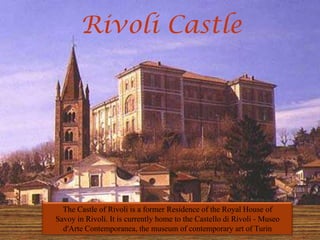
Rivoli Castle
The Castle of Rivoli is a former Residence of the Royal House of
Savoy in Rivoli. It is currently home to the Castello di Rivoli - Museo
d'Arte Contemporanea, the museum of contemporary art of Turin
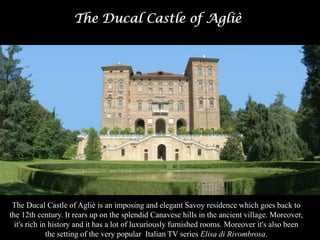
The Ducal Castle of Agliè
The Ducal Castle of Agliè is an imposing and elegant Savoy residence which goes back to
the 12th century. It rears up on the splendid Canavese hills in the ancient village. Moreover,
it's rich in history and it has a lot of luxuriously furnished rooms. Moreover it's also been
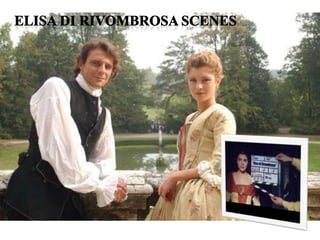
the setting of the very popular Italian TV series Elisa di Rivombrosa.
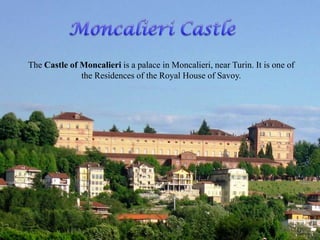
The Castle of Moncalieri is a palace in Moncalieri, near Turin. It is one of
the Residences of the Royal House of Savoy.
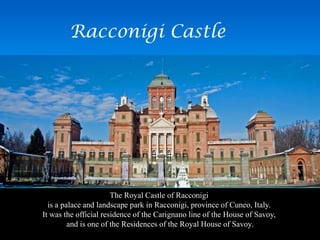
Racconigi Castle
The Royal Castle of Racconigi
is a palace and landscape park in Racconigi, province of Cuneo, Italy.
It was the official residence of the Carignano line of the House of Savoy,
and is one of the Residences of the Royal House of Savoy.
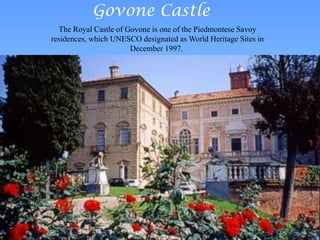
Govone Castle
The Royal Castle of Govone is one of the Piedmontese Savoy
residences, which UNESCO designated as World Heritage Sites in
December 1997.
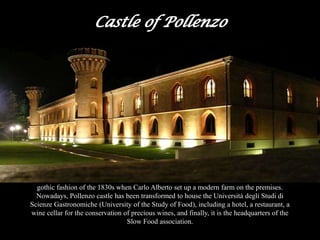
This Castle was built at the end of the 14th century and was later adapted to reflect the neo-
gothic fashion of the 1830s when Carlo Alberto set up a modern farm on the premises.
Nowadays, Pollenzo castle has been transformed to house the Università degli Studi di
Scienze Gastronomiche (University of the Study of Food), including a hotel, a restaurant, a
wine cellar for the conservation of precious wines, and finally, it is the headquarters of the
Slow Food association.
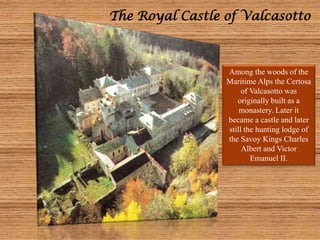
The Royal Castle of Valcasotto
Among the woods of the
Maritime Alps the Certosa
of Valcasotto was
originally built as a
monastery. Later it
became a castle and later
still the hunting lodge of
the Savoy Kings Charles
Albert and Victor
Emanuel II.
BY
ITES “ROSA LUXEMBURG”
TURIN - ITALY

Piedmont World Heritage Sites: the Residences of the Royal House of Savoy

  • 5.
    Sacra di SanMichele
  • 7.
    The city wasfounded by the Romans (Augusta Taurinorum) and developed following the plan of the original Roman camp with perpendicular streets. Turin is the first example of urbanism in the world.
  • 9.
    With 18 kmof arcades, with shops and historical “caffè” one can visit the city, or simply wander around without fear of the sun or of the rain. Take the time to stop at one of the historical cafés to drink a Vermouth (did you know that it is made in Turin ?) and eat a "panino".
  • 10.
    The river Po,the hills, the Gran Madre and Monte dei Cappuccini, seat of the Mountain Museum
  • 13.
    The Basilica ofSuperga stands on top of a hill in a strategic position. It was built by Vittorio Amedeo II as a vow after the siege of Turin in 1706 and was built between 1717-1731 to a design by the great architect Filippo Juvarra. The Basilica of Superga
  • 14.
    The Savoys ruledover Piedmont for about nine hundred years. In 1861 Vittorio Emanuele II became the first king of Italy and Turin was the first Italian capital. The Savoy residences, built in Turin and in the surrounding area with the aim to become a ‘Crown of Delights’, are now a
  • 15.
    In 1997 UNESCOlisted the Savoys' Residences and Collections as a World Heritage Site in recognition of their exceptional artistic and cultural value
  • 16.
    Begun in 1646by Princess Royal Cristina of France, Palazzo Reale was the sumptuous official residence of the dukes, and later, of the House of Savoy for over two centuries.
  • 18.
    Located in themiddle of Piazza Castello, this splendid museum-residence represents the history of Turin across two millenniums. It has an impressive façade, a beautiful hall and monumental staircase. It was designed by Filippo Juvarra in 1721.
  • 19.
    The rear area,still bearing the 15th- century appearance of a castle.
  • 20.
    This beautiful palace, birthplaceof Carlo Alberto and Vittorio Emanuele II, was built between 1679-84. In 1848, the central, elliptical- shaped hall, once used for ceremonies, was transformed into the first Piedmontese Parliament.
  • 21.
    Immersed in thecity’s largest park, overlooking the River Po, this beautiful typical French style 17th century residence was designed for Princess Royal Cristina of France. This was her favourite palace and she used it to organize jousts, tournaments, celebrations and river games.
  • 22.
    The original buildingwas built for the Maurice of Savoy during the reign of his brother Victor Amadeus I, Duke of Savoy . Inside there are frescoes and paintings by Giovanni Battista Crosato , Daniel Seyter and Corrado Giaquinto; in the main room grotesques of Filippo Minei and paintings by the brothers Domenico and Giuseppe Valeriani in the adjoining rooms; there are also precious Chinese Cabinets in lacquer and golden wood. The Villa della Regina is a palace outside the city of Turin, Italy. It was originally built by the House of Savoy in the 17th century.
  • 23.
    The “Palazzina diCaccia di Stupinigi” is one of the Savoy residences. Built in the early 18th century, it was used as a hunting lodge by the Savoy kings. It is located in Stupinigi, in the outskirts of Nichelino, a little town near Turin.
  • 25.
    In 1658 heappointed architect Amedeo di Castellamonte to express the best of his fantasy. The French king, Louis XIV, saw the project of Venaria Reale and wanted something even bigger. The Savoy complex came therefore chronologically before Versailles, which was built a year later, in 1661. The Castle of Venaria The Castle of Venaria has a history made up of splendour, misfortune, plunder and renaissance. Duke Carlo Emanuele II had the idea of the royal palace.
  • 26.
    The Palace ofVenaria is a former royal residence located in Venaria Reale, near Turin. It is one of the Residences of the Royal House of Savoy and one of the largest royal residences in the world, comparable in size and structures to those of Versailles and Caserta. The Palace was designed and built from 1675 by Amedeo di Castellamonte, commissioned by duke Charles Emmanuel II, who needed a base for his hunting expeditions in the heathy hill country north of Turin.
  • 27.
    La Mandria RegionalPark is a park shared by the little towns of Venaria Reale and Druento, near Turin. Founded in 1978 by the Regional Council of Piedmont, it occupies a wide area between the Stura di Lanzo river and the north-western part of Turin and Venaria. It is the largest enclosed park in Europe, with a surface of some 3,000 hectares, bounded by a 35 km long wall built in mid-19th century by Victor Emmanuel II of Sardinia, who had moved in the castle here (the Borgo Castello) the residence of his morganatic wife, Rosa Vercellana.
  • 28.
    Rivoli Castle The Castleof Rivoli is a former Residence of the Royal House of Savoy in Rivoli. It is currently home to the Castello di Rivoli - Museo d'Arte Contemporanea, the museum of contemporary art of Turin
  • 29.
    The Ducal Castleof Agliè The Ducal Castle of Agliè is an imposing and elegant Savoy residence which goes back to the 12th century. It rears up on the splendid Canavese hills in the ancient village. Moreover, it's rich in history and it has a lot of luxuriously furnished rooms. Moreover it's also been the setting of the very popular Italian TV series Elisa di Rivombrosa.
  • 32.
    The Castle ofMoncalieri is a palace in Moncalieri, near Turin. It is one of the Residences of the Royal House of Savoy.
  • 33.
    Racconigi Castle The RoyalCastle of Racconigi is a palace and landscape park in Racconigi, province of Cuneo, Italy. It was the official residence of the Carignano line of the House of Savoy, and is one of the Residences of the Royal House of Savoy.
  • 34.
    Govone Castle The RoyalCastle of Govone is one of the Piedmontese Savoy residences, which UNESCO designated as World Heritage Sites in December 1997.
  • 35.
    This Castle wasbuilt at the end of the 14th century and was later adapted to reflect the neo- gothic fashion of the 1830s when Carlo Alberto set up a modern farm on the premises. Nowadays, Pollenzo castle has been transformed to house the Università degli Studi di Scienze Gastronomiche (University of the Study of Food), including a hotel, a restaurant, a wine cellar for the conservation of precious wines, and finally, it is the headquarters of the Slow Food association.
  • 36.
    The Royal Castleof Valcasotto Among the woods of the Maritime Alps the Certosa of Valcasotto was originally built as a monastery. Later it became a castle and later still the hunting lodge of the Savoy Kings Charles Albert and Victor Emanuel II.
  • 37.