PICKLES
Processing technique-pickling
What is a pickle
◦ It is an appetizer prepared by immersing fruits or vegetables
in salt or vinegar.
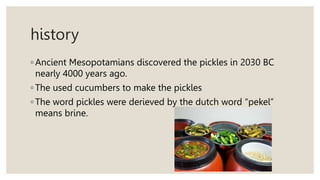
history
◦ Ancient Mesopotamians discovered the pickles in 2030 BC
nearly 4000 years ago.
◦ The used cucumbers to make the pickles
◦ The word pickles were derieved by the dutch word “pekel”
means brine.
Pickilng process
◦ The process of preserving fruits or vegetables in salt or
vinegar is known as pickling .
◦ Brine- it is an high concentration solution of salt in water.
◦ The concentration and preparation of brine is an important
step in the pickle making process
◦ Improper brine solution will lead to spoilage of the pickle.
Pickling process
◦ The surface of fruits and vegetables will have a high amount
of lactic acid forming bacteria .
◦ This lactic acid bacteria will undergo fermentation process
the result of this reaction is pickles.
Lactic acid forming bacteria
◦ Growing conditions:
8-10% salt solution
Temperture- 30 degree celcius.
This temperature must be maintained throughout the pickle
preparation process.
◦ When the vegetables or fruits are immersed in brine the brine
penetrates into the tissues of the fruits or vegetables through the
process known as osmosis.
◦ The soluble materials present in the fruit or vegetable will acts as the
food for this lactic acid forming bacteria.
◦ Fermentation will be slow at 5% salt solution and it will be rapid at 10%
salt solution.
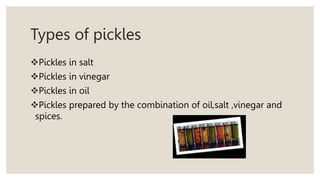
Types of pickles
Pickles in salt
Pickles in vinegar
Pickles in oil
Pickles prepared by the combination of oil,salt ,vinegar and
spices.
Pickles on salt
◦ When the pickles prepared by using salt the pickles will get
an good texture
◦ It hardens the outer coat of the fruits or vegetables and gives
an characteristic texture.
◦ Salt should be above15% to prevent the pickle from microbial
spoilage.
◦ Mango,lime,green chili pickles can be prepared by this
process.
Pickles with vinegar
◦ Pickles prepared by using vinegar will have the final
concentration in terms of acetic acid.
◦ The concentration should be maintained at 2% dilution
below this point will lead to spoilage.
◦ For this the fruits and vegetables should be immersed in 10%
salt solution for several days during this time the gases
present in the intercellular spaces of the fruits and vegetables
will comes out and it will be ready to get pickled.
Pickles with oil
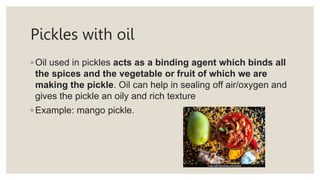
◦ Oil used in pickles acts as a binding agent which binds all
the spices and the vegetable or fruit of which we are
making the pickle. Oil can help in sealing off air/oxygen and
gives the pickle an oily and rich texture
◦ Example: mango pickle.
Pickles with salt,vinegar,oil,spices.
◦ Vinegar is a strong acid (acetic acid), and when used for pickling, it lowers the pH of
preserved foods. Because just a few germs can thrive in a low pH environment,
vinegar aids in preservation.
◦ Oil helps in preventing the spoilage of pickles by preventing the growth of microbes. Oil
forms a hydrophobic layer on the food and due to the lack of moisture, microbial growth is
checked. Therefore, oil is used as a preservative ingredient in the prepration of pickles.
◦ Eg: cauliflower pickle.
SPOILAGE IN PICKLES
Soft or slippery pickles (If
spoilage is evident,
Silveriness,bitter taste)
1. Vinegar too weak.
2. Insufficient amount of
brine.
3. Pickles not processed
properly (to destroy
microorganisms).
◦ - Assignment-2
◦ Navaneetha.C
◦ 20UFD037(III UGFSMD)

pickles.pptx

  • 1.
  • 2.
    What is apickle ◦ It is an appetizer prepared by immersing fruits or vegetables in salt or vinegar.
  • 3.
    history ◦ Ancient Mesopotamiansdiscovered the pickles in 2030 BC nearly 4000 years ago. ◦ The used cucumbers to make the pickles ◦ The word pickles were derieved by the dutch word “pekel” means brine.
  • 4.
    Pickilng process ◦ Theprocess of preserving fruits or vegetables in salt or vinegar is known as pickling . ◦ Brine- it is an high concentration solution of salt in water. ◦ The concentration and preparation of brine is an important step in the pickle making process ◦ Improper brine solution will lead to spoilage of the pickle.
  • 5.
    Pickling process ◦ Thesurface of fruits and vegetables will have a high amount of lactic acid forming bacteria . ◦ This lactic acid bacteria will undergo fermentation process the result of this reaction is pickles.
  • 6.
    Lactic acid formingbacteria ◦ Growing conditions: 8-10% salt solution Temperture- 30 degree celcius. This temperature must be maintained throughout the pickle preparation process.
  • 7.
    ◦ When thevegetables or fruits are immersed in brine the brine penetrates into the tissues of the fruits or vegetables through the process known as osmosis. ◦ The soluble materials present in the fruit or vegetable will acts as the food for this lactic acid forming bacteria. ◦ Fermentation will be slow at 5% salt solution and it will be rapid at 10% salt solution.
  • 8.
    Types of pickles Picklesin salt Pickles in vinegar Pickles in oil Pickles prepared by the combination of oil,salt ,vinegar and spices.
  • 9.
    Pickles on salt ◦When the pickles prepared by using salt the pickles will get an good texture ◦ It hardens the outer coat of the fruits or vegetables and gives an characteristic texture. ◦ Salt should be above15% to prevent the pickle from microbial spoilage. ◦ Mango,lime,green chili pickles can be prepared by this process.
  • 10.
    Pickles with vinegar ◦Pickles prepared by using vinegar will have the final concentration in terms of acetic acid. ◦ The concentration should be maintained at 2% dilution below this point will lead to spoilage. ◦ For this the fruits and vegetables should be immersed in 10% salt solution for several days during this time the gases present in the intercellular spaces of the fruits and vegetables will comes out and it will be ready to get pickled.
  • 11.
    Pickles with oil ◦Oil used in pickles acts as a binding agent which binds all the spices and the vegetable or fruit of which we are making the pickle. Oil can help in sealing off air/oxygen and gives the pickle an oily and rich texture ◦ Example: mango pickle.
  • 12.
    Pickles with salt,vinegar,oil,spices. ◦Vinegar is a strong acid (acetic acid), and when used for pickling, it lowers the pH of preserved foods. Because just a few germs can thrive in a low pH environment, vinegar aids in preservation. ◦ Oil helps in preventing the spoilage of pickles by preventing the growth of microbes. Oil forms a hydrophobic layer on the food and due to the lack of moisture, microbial growth is checked. Therefore, oil is used as a preservative ingredient in the prepration of pickles. ◦ Eg: cauliflower pickle.
  • 14.
    SPOILAGE IN PICKLES Softor slippery pickles (If spoilage is evident, Silveriness,bitter taste) 1. Vinegar too weak. 2. Insufficient amount of brine. 3. Pickles not processed properly (to destroy microorganisms).
  • 15.
    ◦ - Assignment-2 ◦Navaneetha.C ◦ 20UFD037(III UGFSMD)