


1
2
Prepared By:Prepared By:
MAQBOOL AHMED
“S . A . M . A . G”
Sensible, Appreciative, Meditative, Analytic & Gallant
M
3
PAKISTAN INTERNATIONAL AIRLINES CORPORATIONPAKISTAN INTERNATIONAL AIRLINES CORPORATION
FROM:
NATIONAL FLAGNATIONAL FLAG
CARRIERCARRIER
To:
NATIONALNATIONAL
LIABILITYLIABILITY
www.piac.com.pk
4
OOUTLINEUTLINE
 Company Profile
 Domestic Competitors
 Financial Analysis Toward Crisis
 Reasons of PIA Decline
 Remedies
 Conclusion
 References
5
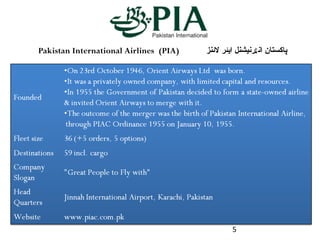
Pakistan International Airlines (PIA)  ‫لئنز‬ ‫ایئر‬ ‫رنیشنل‬ ‫ان‬ ‫پاکستان‬‫ٹ‬
6
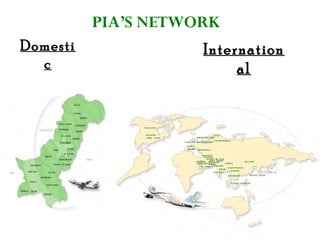
PIA’S NETWORK
Domesti
c
Internation
al
7
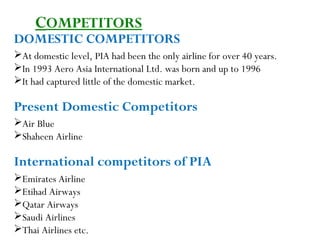
DOMESTIC COMPETITORS
At domestic level, PIA had been the only airline for over 40 years.
In 1993 Aero Asia International Ltd. was born and up to 1996
It had captured little of the domestic market.
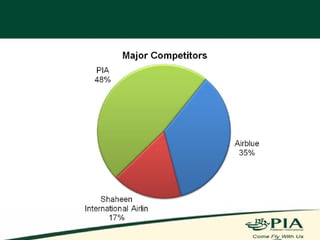
Present Domestic Competitors
Air Blue
Shaheen Airline
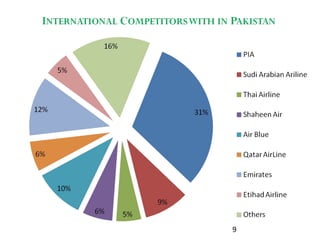
International competitors of PIA
Emirates Airline
Etihad Airways
Qatar Airways
Saudi Airlines
Thai Airlines etc.
COMPETITORS
8
9
10
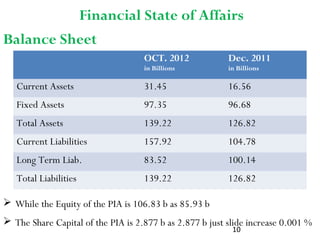
OCT. 2012
in Billions
Dec. 2011
in Billions
Current Assets 31.45 16.56
Fixed Assets 97.35 96.68
Total Assets 139.22 126.82
Current Liabilities 157.92 104.78
Long Term Liab. 83.52 100.14
Total Liabilities 139.22 126.82
Balance Sheet
 While the Equity of the PIA is 106.83 b as 85.93 b
 The Share Capital of the PIA is 2.877 b as 2.877 b just slide increase 0.001 %
Financial State of Affairs
11
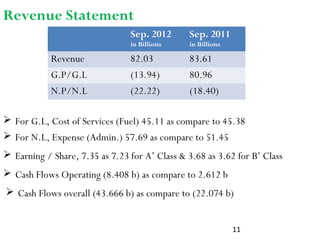
Revenue Statement
Sep. 2012
in Billions
Sep. 2011
in Billions
Revenue 82.03 83.61
G.P/G.L (13.94) 80.96
N.P/N.L (22.22) (18.40)
 For G.L, Cost of Services (Fuel) 45.11 as compare to 45.38
 For N.L, Expense (Admin.) 57.69 as compare to 51.45
 Earning / Share, 7.35 as 7.23 for A’ Class & 3.68 as 3.62 for B’ Class
 Cash Flows Operating (8.408 b) as compare to 2.612 b
 Cash Flows overall (43.666 b) as compare to (22.074 b)
12
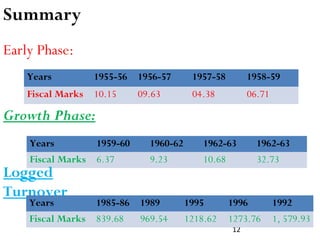
Summary
Years 1955-56 1956-57 1957-58 1958-59
Fiscal Marks 10.15 09.63 04.38 06.71
Early Phase:
Growth Phase:
Years 1959-60 1960-62 1962-63 1962-63
Fiscal Marks 6.37 9.23 10.68 32.73
Logged
Turnover
Years 1985-86 1989 1995 1996 1992
Fiscal Marks 839.68 969.54 1218.62 1273.76 1, 579.93
13
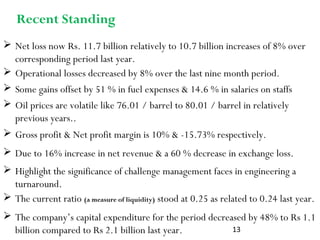
 Net loss now Rs. 11.7 billion relatively to 10.7 billion increases of 8% over
corresponding period last year.
 Operational losses decreased by 8% over the last nine month period.
 Due to 16% increase in net revenue & a 60 % decrease in exchange loss.
 Some gains offset by 51 % in fuel expenses & 14.6 % in salaries on staffs
 Oil prices are volatile like 76.01 / barrel to 80.01 / barrel in relatively
previous years..
 Gross profit & Net profit margin is 10% & -15.73% respectively.
 Highlight the significance of challenge management faces in engineering a
turnaround.
 The current ratio (a measure of liquidity) stood at 0.25 as related to 0.24 last year.
 The company’s capital expenditure for the period decreased by 48% to Rs 1.1
billion compared to Rs 2.1 billion last year.
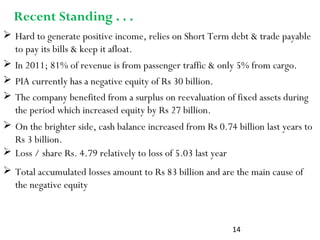
Recent Standing
14
 Hard to generate positive income, relies on Short Term debt & trade payable
to pay its bills & keep it afloat.
 PIA currently has a negative equity of Rs 30 billion.
 The company benefited from a surplus on reevaluation of fixed assets during
the period which increased equity by Rs 27 billion.
 On the brighter side, cash balance increased from Rs 0.74 billion last years to
Rs 3 billion.
 Total accumulated losses amount to Rs 83 billion and are the main cause of
the negative equity
 Loss / share Rs. 4.79 relatively to loss of 5.03 last year
Recent Standing . . .
 In 2011; 81% of revenue is from passenger traffic & only 5% from cargo.
15
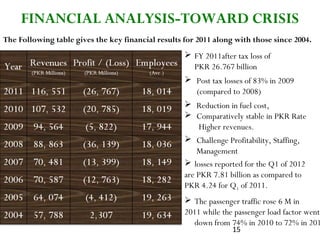
FINANCIAL ANALYSIS-TOWARD CRISIS
The Following table gives the key financial results for 2011 along with those since 2004.
 FY 2011after tax loss of
PKR 26.767 billion
 Post tax losses of 83% in 2009
(compared to 2008)
 Reduction in fuel cost,
 Comparatively stable in PKR Rate
Higher revenues.
 Challenge Profitability, Staffing,
Management
 losses reported for the Q1 of 2012
are PKR 7.81 billion as compared to
PKR 4.24 for Q1 of 2011.
 The passenger traffic rose 6 M in
2011 while the passenger load factor went
down from 74% in 2010 to 72% in 201
16
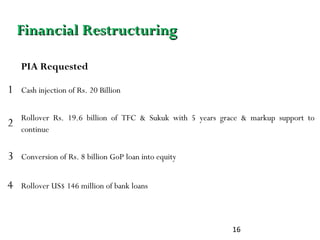
Financial RestructuringFinancial Restructuring
PIA Requested
1 Cash injection of Rs. 20 Billion
2 Rollover Rs. 19.6 billion of TFC & Sukuk with 5 years grace & markup support to
continue
3 Conversion of Rs. 8 billion GoP loan into equity
4 Rollover US$ 146 million of bank loans
17
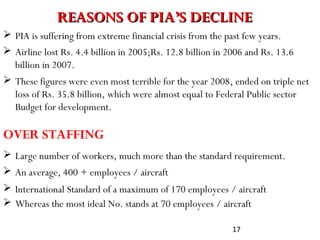
REASONS OF PIA’S DECLINEREASONS OF PIA’S DECLINE
 PIA is suffering from extreme financial crisis from the past few years.
 Large number of workers, much more than the standard requirement.
 Airline lost Rs. 4.4 billion in 2005;Rs. 12.8 billion in 2006 and Rs. 13.6
billion in 2007.
 These figures were even most terrible for the year 2008, ended on triple net
loss of Rs. 35.8 billion, which were almost equal to Federal Public sector
Budget for development.
OVER STAFFING
 An average, 400 + employees / aircraft
 International Standard of a maximum of 170 employees / aircraft
 Whereas the most ideal No. stands at 70 employees / aircraft
18
AGED FLEET
 PIA fleet has total 43 planes
 Only 36 are operating at the moment
 The average age of the fleet is 13 years
 Previously it was 14 years
 It has become 13 years with the induction of 4 new planes
 Due to the aged fleet and maintenance problem PIA has to pay higher
amount in terms of insurance cost.
Corruption is a sin that has hollowed Pakistani society bases. Like all other
departments of our country corruption is at its peak in Pakistan International
Airlines.
CORRUPTION AT ITS PEAK
Latest agreement b/w PIA & Boeing of 5 aircrafts (it embroil about 45 Corers)
Aircraft Prices is 15 Corers Dollar while MD PIA show 34 Corers.
19
 Apart from corruption and mismanagement, another biggest factor in running
down the airline is political interference.
POLITICAL INTERFERENCE
 The hiring and firing of employees as well as decisions taken on non-
commercial considerations have led to missed opportunities and billions of
rupees in losses.
 Instead of correcting this problem, successive managements of the airline
have turned to the government to bail them out.
 The lack of accountability in the Pakistan International Airlines (PIA) and the
management’s inability to take action against officials responsible for
irregularities was the main reason behind the poor financial situation of the
national flag carrier.
LACK OF ACCOUNTABILITY
20
 There is been consistent rise in fuel prices in the international market.
RISING FUEL PRICES IN THE WORLD
 Fuel prices have impacted on almost every airline in the world. This has
affected Pakistan international Airlines more than any other airline due to
its aged fleet.
 In an airline normally 30-35% of expenses account for fuel expenses.
 But in Pakistan International Airlines this number goes to 45-50%.
 Special skills such as engineering, technicians are lacking. If they are there,
they are not delivering.
LACK OF TRAINING
FACILITIES Although PIA is running a training and development department in
Kch. but it is insufficient to feed such a big organization with almost 18043
employees.
21
 PIA is a nursery for the children of the favored ones in our government.
LACK OF EXPERIENCE
Lack of experience relating to aviation industry for the top management is
one of the reasons of the poor performance of the organization.
NEPOTISM
Nepotism coupled with widespread corruption and indiscipline, have been the
cause of failure of this airline, which was once amongst the best in Asia.
 Currency devaluation also affected Airlines performance; due to it PIAC has
to pay more for fuel prices and against debts.
DEVALUATION OF LOCAL CURRENCY
 They join as trainees and after acquiring some skills and experience, leave for
greener pastures.
22
 Pakistan International Airlines being a national carrier has to go to those
routes which are going in loss.
SOCIO-ECONOMIC ROUTES
 Routes such as, Swat, Bahawalpur etc. are called socioeconomic routes and
PIA has to get to those routes despite of great loss.
 On these airports, airport staff is greater numbers as compared to
passengers.
 Due to all other problems the fares of PIA are higher
HIGH RATE OF TAXES
 The money which is received as for providing services to passengers is
taxed by the government at a very high rate.
POOR IMAGE
 But service is not up to that class.
 This also gives a bad image to the passengers. This bad image is adding to
decreased customer base and hence causing loss to PIA.
23
REMEDIES  REMEDIES  
Its survival is based solely on significant government support and protection
Downsizing of Employees
As per data collected by a private news agency:
 Over 6000 additional crew is working in PIA,
 Incurring additional expenses of over Rs 1.10n billion per year
 PIA management should phase out these employees step by step
http://dunyanews.tv/index.php/en/Business/152077-Over-6000-surplus-staff-adding-burden-to-PIA
 PIA seeks an amount of Rs. 60 billion, including restructuring of:
• Rs. 32 billion worth of debt
• Rs. 28 billion cash injection.
Vaccinating
 PIA wants Rs. 19.6 billion worth of its corporate bonds rolled over on
deferred interest payments for five years, in addition to a rollover of about
Rs.12.6 billion in bank loans.
24
Induction & Expansion
 The average age of the fleet should be reduced to cut costs and increase
efficiency.
 Growth in revenue can be achieved through induction of new aircraft &
expansion of the existing network.
Increase in fuel prices to pass on customers
 Pass on the increase in fuel prices to customers as it believes that the rapid
escalation of airline expenditure in the recent past is mainly due to an
unprecedented increase in fuel prices.
Cut on Cost & Increase efficiency
25
 A sound internal control system should be established. The management
must have a zero-tolerance policy for fraud and irregularities.
To reward Merit & Performance,
Punish Dishonesty & Inefficiency
 The human resource systems should reward merit and performance and
punish dishonesty and inefficiency.
 A set of strategies should be implemented to turn around operations and make
PIA a sustainable and profitable entity.
Sound Internal Control System
 Operational restructuring and human resource rationalization is also part of
the survival and turnaround.
Operational Restructuring
26
 Realizing that retention of ageing 747 aircraft means continued increase in
maintenance cost, the old aircraft should be phased out.
Replacement of Aged Fleet
 Replacing the ageing 737 aircraft should be a priority while the A310 aircraft
should be replaced as and when financial resources allow investment.
 The 737NG or A320 are being considered as replacement.
 ATRs (short-haul European aircraft) should be acquired to increase frequency
and capacity on socio-economic routes.
27
From the discussion above
 It is clear that PIA is the only national airline of Pakistan
 It has developed a strategy different from those of its competitors
 These differences directly and indirectly contribute to its competitive
advantage
 PIA has reasonable opportunities along with threats
 But the frequent involvement of every government in top management of
PIA resulted in discontinuation of its strategic policies.
 An organization earning average profits nine years ago is now bearing huge
lose.
But
By adopting the above remedies PIA can be bring out of such depraved
disasters situation.
ConclusionConclusion
28
 www.piac.com
 Annual Report of PIA
 Half yearly Report of PIA 2012
 PIA Annual Report 2004 (Directors Report) Retrieved on Sep 30, 2012 (www.piac.com)
 Business Recorder, 2012
 www.thenews.com.pk/Todays-News
 www.nation.com.pk
 www.pakinvestorsguide.com/index.php
 dnanews.com.pk
 http://tribune.com.pk/
 http://centreforaviation.com/analysis/the-woes-continue-for-loss-making-for-pakistan-
international-airlines
 http://dunyanews.tv/index.php/en/Business/152077-Over-6000-surplus-staff-adding-
burden-to-PIA
References
29
Thank
You
Any
Questions ?

Pia revival strategy

  • 1.
  • 2.
    2 Prepared By:Prepared By: MAQBOOLAHMED “S . A . M . A . G” Sensible, Appreciative, Meditative, Analytic & Gallant M
  • 3.
    3 PAKISTAN INTERNATIONAL AIRLINESCORPORATIONPAKISTAN INTERNATIONAL AIRLINES CORPORATION FROM: NATIONAL FLAGNATIONAL FLAG CARRIERCARRIER To: NATIONALNATIONAL LIABILITYLIABILITY www.piac.com.pk
  • 4.
    4 OOUTLINEUTLINE  Company Profile Domestic Competitors  Financial Analysis Toward Crisis  Reasons of PIA Decline  Remedies  Conclusion  References
  • 5.
    5 Pakistan International Airlines (PIA) ‫لئنز‬ ‫ایئر‬ ‫رنیشنل‬ ‫ان‬ ‫پاکستان‬‫ٹ‬
  • 6.
  • 7.
    7 DOMESTIC COMPETITORS At domesticlevel, PIA had been the only airline for over 40 years. In 1993 Aero Asia International Ltd. was born and up to 1996 It had captured little of the domestic market. Present Domestic Competitors Air Blue Shaheen Airline International competitors of PIA Emirates Airline Etihad Airways Qatar Airways Saudi Airlines Thai Airlines etc. COMPETITORS
  • 8.
  • 9.
  • 10.
    10 OCT. 2012 in Billions Dec.2011 in Billions Current Assets 31.45 16.56 Fixed Assets 97.35 96.68 Total Assets 139.22 126.82 Current Liabilities 157.92 104.78 Long Term Liab. 83.52 100.14 Total Liabilities 139.22 126.82 Balance Sheet  While the Equity of the PIA is 106.83 b as 85.93 b  The Share Capital of the PIA is 2.877 b as 2.877 b just slide increase 0.001 % Financial State of Affairs
  • 11.
    11 Revenue Statement Sep. 2012 inBillions Sep. 2011 in Billions Revenue 82.03 83.61 G.P/G.L (13.94) 80.96 N.P/N.L (22.22) (18.40)  For G.L, Cost of Services (Fuel) 45.11 as compare to 45.38  For N.L, Expense (Admin.) 57.69 as compare to 51.45  Earning / Share, 7.35 as 7.23 for A’ Class & 3.68 as 3.62 for B’ Class  Cash Flows Operating (8.408 b) as compare to 2.612 b  Cash Flows overall (43.666 b) as compare to (22.074 b)
  • 12.
    12 Summary Years 1955-56 1956-571957-58 1958-59 Fiscal Marks 10.15 09.63 04.38 06.71 Early Phase: Growth Phase: Years 1959-60 1960-62 1962-63 1962-63 Fiscal Marks 6.37 9.23 10.68 32.73 Logged Turnover Years 1985-86 1989 1995 1996 1992 Fiscal Marks 839.68 969.54 1218.62 1273.76 1, 579.93
  • 13.
    13  Net lossnow Rs. 11.7 billion relatively to 10.7 billion increases of 8% over corresponding period last year.  Operational losses decreased by 8% over the last nine month period.  Due to 16% increase in net revenue & a 60 % decrease in exchange loss.  Some gains offset by 51 % in fuel expenses & 14.6 % in salaries on staffs  Oil prices are volatile like 76.01 / barrel to 80.01 / barrel in relatively previous years..  Gross profit & Net profit margin is 10% & -15.73% respectively.  Highlight the significance of challenge management faces in engineering a turnaround.  The current ratio (a measure of liquidity) stood at 0.25 as related to 0.24 last year.  The company’s capital expenditure for the period decreased by 48% to Rs 1.1 billion compared to Rs 2.1 billion last year. Recent Standing
  • 14.
    14  Hard togenerate positive income, relies on Short Term debt & trade payable to pay its bills & keep it afloat.  PIA currently has a negative equity of Rs 30 billion.  The company benefited from a surplus on reevaluation of fixed assets during the period which increased equity by Rs 27 billion.  On the brighter side, cash balance increased from Rs 0.74 billion last years to Rs 3 billion.  Total accumulated losses amount to Rs 83 billion and are the main cause of the negative equity  Loss / share Rs. 4.79 relatively to loss of 5.03 last year Recent Standing . . .  In 2011; 81% of revenue is from passenger traffic & only 5% from cargo.
  • 15.
    15 FINANCIAL ANALYSIS-TOWARD CRISIS TheFollowing table gives the key financial results for 2011 along with those since 2004.  FY 2011after tax loss of PKR 26.767 billion  Post tax losses of 83% in 2009 (compared to 2008)  Reduction in fuel cost,  Comparatively stable in PKR Rate Higher revenues.  Challenge Profitability, Staffing, Management  losses reported for the Q1 of 2012 are PKR 7.81 billion as compared to PKR 4.24 for Q1 of 2011.  The passenger traffic rose 6 M in 2011 while the passenger load factor went down from 74% in 2010 to 72% in 201
  • 16.
    16 Financial RestructuringFinancial Restructuring PIARequested 1 Cash injection of Rs. 20 Billion 2 Rollover Rs. 19.6 billion of TFC & Sukuk with 5 years grace & markup support to continue 3 Conversion of Rs. 8 billion GoP loan into equity 4 Rollover US$ 146 million of bank loans
  • 17.
    17 REASONS OF PIA’SDECLINEREASONS OF PIA’S DECLINE  PIA is suffering from extreme financial crisis from the past few years.  Large number of workers, much more than the standard requirement.  Airline lost Rs. 4.4 billion in 2005;Rs. 12.8 billion in 2006 and Rs. 13.6 billion in 2007.  These figures were even most terrible for the year 2008, ended on triple net loss of Rs. 35.8 billion, which were almost equal to Federal Public sector Budget for development. OVER STAFFING  An average, 400 + employees / aircraft  International Standard of a maximum of 170 employees / aircraft  Whereas the most ideal No. stands at 70 employees / aircraft
  • 18.
    18 AGED FLEET  PIAfleet has total 43 planes  Only 36 are operating at the moment  The average age of the fleet is 13 years  Previously it was 14 years  It has become 13 years with the induction of 4 new planes  Due to the aged fleet and maintenance problem PIA has to pay higher amount in terms of insurance cost. Corruption is a sin that has hollowed Pakistani society bases. Like all other departments of our country corruption is at its peak in Pakistan International Airlines. CORRUPTION AT ITS PEAK Latest agreement b/w PIA & Boeing of 5 aircrafts (it embroil about 45 Corers) Aircraft Prices is 15 Corers Dollar while MD PIA show 34 Corers.
  • 19.
    19  Apart fromcorruption and mismanagement, another biggest factor in running down the airline is political interference. POLITICAL INTERFERENCE  The hiring and firing of employees as well as decisions taken on non- commercial considerations have led to missed opportunities and billions of rupees in losses.  Instead of correcting this problem, successive managements of the airline have turned to the government to bail them out.  The lack of accountability in the Pakistan International Airlines (PIA) and the management’s inability to take action against officials responsible for irregularities was the main reason behind the poor financial situation of the national flag carrier. LACK OF ACCOUNTABILITY
  • 20.
    20  There isbeen consistent rise in fuel prices in the international market. RISING FUEL PRICES IN THE WORLD  Fuel prices have impacted on almost every airline in the world. This has affected Pakistan international Airlines more than any other airline due to its aged fleet.  In an airline normally 30-35% of expenses account for fuel expenses.  But in Pakistan International Airlines this number goes to 45-50%.  Special skills such as engineering, technicians are lacking. If they are there, they are not delivering. LACK OF TRAINING FACILITIES Although PIA is running a training and development department in Kch. but it is insufficient to feed such a big organization with almost 18043 employees.
  • 21.
    21  PIA isa nursery for the children of the favored ones in our government. LACK OF EXPERIENCE Lack of experience relating to aviation industry for the top management is one of the reasons of the poor performance of the organization. NEPOTISM Nepotism coupled with widespread corruption and indiscipline, have been the cause of failure of this airline, which was once amongst the best in Asia.  Currency devaluation also affected Airlines performance; due to it PIAC has to pay more for fuel prices and against debts. DEVALUATION OF LOCAL CURRENCY  They join as trainees and after acquiring some skills and experience, leave for greener pastures.
  • 22.
    22  Pakistan InternationalAirlines being a national carrier has to go to those routes which are going in loss. SOCIO-ECONOMIC ROUTES  Routes such as, Swat, Bahawalpur etc. are called socioeconomic routes and PIA has to get to those routes despite of great loss.  On these airports, airport staff is greater numbers as compared to passengers.  Due to all other problems the fares of PIA are higher HIGH RATE OF TAXES  The money which is received as for providing services to passengers is taxed by the government at a very high rate. POOR IMAGE  But service is not up to that class.  This also gives a bad image to the passengers. This bad image is adding to decreased customer base and hence causing loss to PIA.
  • 23.
    23 REMEDIES  REMEDIES   Itssurvival is based solely on significant government support and protection Downsizing of Employees As per data collected by a private news agency:  Over 6000 additional crew is working in PIA,  Incurring additional expenses of over Rs 1.10n billion per year  PIA management should phase out these employees step by step http://dunyanews.tv/index.php/en/Business/152077-Over-6000-surplus-staff-adding-burden-to-PIA  PIA seeks an amount of Rs. 60 billion, including restructuring of: • Rs. 32 billion worth of debt • Rs. 28 billion cash injection. Vaccinating  PIA wants Rs. 19.6 billion worth of its corporate bonds rolled over on deferred interest payments for five years, in addition to a rollover of about Rs.12.6 billion in bank loans.
  • 24.
    24 Induction & Expansion The average age of the fleet should be reduced to cut costs and increase efficiency.  Growth in revenue can be achieved through induction of new aircraft & expansion of the existing network. Increase in fuel prices to pass on customers  Pass on the increase in fuel prices to customers as it believes that the rapid escalation of airline expenditure in the recent past is mainly due to an unprecedented increase in fuel prices. Cut on Cost & Increase efficiency
  • 25.
    25  A soundinternal control system should be established. The management must have a zero-tolerance policy for fraud and irregularities. To reward Merit & Performance, Punish Dishonesty & Inefficiency  The human resource systems should reward merit and performance and punish dishonesty and inefficiency.  A set of strategies should be implemented to turn around operations and make PIA a sustainable and profitable entity. Sound Internal Control System  Operational restructuring and human resource rationalization is also part of the survival and turnaround. Operational Restructuring
  • 26.
    26  Realizing thatretention of ageing 747 aircraft means continued increase in maintenance cost, the old aircraft should be phased out. Replacement of Aged Fleet  Replacing the ageing 737 aircraft should be a priority while the A310 aircraft should be replaced as and when financial resources allow investment.  The 737NG or A320 are being considered as replacement.  ATRs (short-haul European aircraft) should be acquired to increase frequency and capacity on socio-economic routes.
  • 27.
    27 From the discussionabove  It is clear that PIA is the only national airline of Pakistan  It has developed a strategy different from those of its competitors  These differences directly and indirectly contribute to its competitive advantage  PIA has reasonable opportunities along with threats  But the frequent involvement of every government in top management of PIA resulted in discontinuation of its strategic policies.  An organization earning average profits nine years ago is now bearing huge lose. But By adopting the above remedies PIA can be bring out of such depraved disasters situation. ConclusionConclusion
  • 28.
    28  www.piac.com  AnnualReport of PIA  Half yearly Report of PIA 2012  PIA Annual Report 2004 (Directors Report) Retrieved on Sep 30, 2012 (www.piac.com)  Business Recorder, 2012  www.thenews.com.pk/Todays-News  www.nation.com.pk  www.pakinvestorsguide.com/index.php  dnanews.com.pk  http://tribune.com.pk/  http://centreforaviation.com/analysis/the-woes-continue-for-loss-making-for-pakistan- international-airlines  http://dunyanews.tv/index.php/en/Business/152077-Over-6000-surplus-staff-adding- burden-to-PIA References
  • 29.