GHULAM ABBAS
QAISER ALI KHAN
M.Sc economics
4th semester
FUUAST
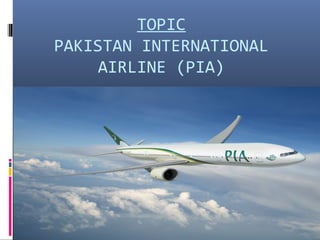
TOPIC
PAKISTAN INTERNATIONAL
AIRLINE (PIA)
Contents
ď‚§ Introduction
ď‚§ Importance of PIA
ď‚§ Objective
ď‚§ Code sharing Agreements of PIA
ď‚§ Privatization Plan
ď‚§ Special operations
ď‚§ The Financial performance
ď‚§ Problems & crises
ď‚§ Solution
ď‚§ Policy & Conclusion
INTRODUCTION
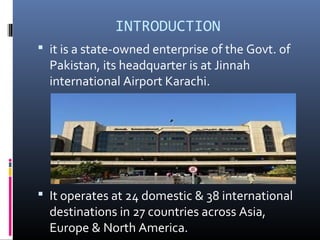
ď‚§ it is a state-owned enterprise of the Govt. of
Pakistan, its headquarter is at Jinnah
international Airport Karachi.
ď‚§ It operates at 24 domestic & 38 international
destinations in 27 countries across Asia,
Europe & North America.
ď‚§ Pakistan International Airlines Corporation is
majority owned by the Government of
Pakistan (87%) while the remainder (13%) by
private shareholders.
ď‚§ It has 3 main bases at Karachi, Lahore
Islamabad; its secondary bases are Peshawar,
Faisalabad, Quetta, Sialkot & Multan.
ď‚§ It is primarily owned by the Govt. of Pakistan.
ď‚§ the ministry of Defense as an autonomous body
the airline is managed by managing director as
well as the Board of Directors.
OBJECTIVES
ď‚§ It should focus on quality objectives without
compromising safety and legal requirements;
ď‚§ Prevent or minimize all aspects that can lead to
unacceptable impacts on environment;
ď‚§ Ensure the management of occupational
health and safety of our employees.
ď‚§ Ensure that all required audits are conducted
and reviewed regularly. All employees shall
cooperate fully with internal and external
auditors to achieve our goal of continuous
improvement.
IMPORTANCE OF PIA
ď‚§ Pakistan International Airlines should give
primary importance to the safety of the
passengers and make efforts to avoid any
untoward situation.
ď‚§ Important in our daily life, to visit families in
other citiescountries.
ď‚§ Important for freight transportation &
international trade of perishable goods.
Code sharing Agreements:
ď‚§ Code share agreement, sometimes simply
code share, is an aviation business
arrangement where two or more airlines
share the same flight.
ď‚§ PIA has code share agreements with the
following airlines (as of December 2012)
ď‚§ China Southern Airlines
ď‚§ Thai Airways International
ď‚§ Turkish Airlines
Privatization Plan:
ď‚§ In the late 1990s, the Government of Pakistan
considered selling the airline to the private
sector due to the persistent losses suffered by
the airline.
ď‚§ The Government announced its privatization
plans but they were never implemented.
ď‚§ During 1997, Pakistan called in a team from
International Finance (IFC), the consulting
arm of the World Bank,
ď‚§ to advice on restructuring and privatization of
Pakistan International Airlines (PIA).
However, no agreement was reached,
government had decided to restructure PIA.
Special Operations:
ď‚§ Charter Services(ATR).
ď‚§ Hajj & Umrah services.
ď‚§ State official Transportation.
European Union Ban
ď‚§ On 5 March 2007, the European Commission
banned PIA's 42-plane fleet from flying to
Europe citing safety concerns of its aging
fleet.
 European Commission’s Air Safety
Administrator, Zafar Khan was appointed as
the new chairman of PIA.
ď‚§ On 29 November 2007, the EU completely
removed the ban and PIA's entire fleet was
permitted to fly to Europe.
Financial Performance:
ď‚§ The financial performance for FY 2011
continues to be a challenge with an after tax
loss of PKR 26.767 billion. This was preceded
by six consecutive loss making years dating
back to 2005, The airline did report a
reduction of post tax losses of 83% in 2009
(compared to 2008) based on a reduction in
fuel cost, comparatively stable exchange rate
for the Pakistani Rupee and higher revenues.
ď‚§ But in 2011 & 2010, losses again rose sharply
compared to the previous years.
Problems & Crises:
ď‚§ Unfortunately PIA is functioning with costs
higher than returns.
ď‚§ PIA has problem of maintenance and repairs.
It is stated that tender for the maintenance of
the aircrafts has been given to a company
that does not have international reputation.
ď‚§ PIA claims that increase in oil prices and
devaluation of Pakistani currency are the
major reasons behind its deficit.
ď‚§ Saturday, December 03, 2012 - The PIA is
suffering from severe financial crisis.
ď‚§ Passing through a critical phase because of
poor management, lack of maintenance,
nepotism, corruption and financial issues.
ď‚§ There are complaints of bad service, long
delayed flights, emergency crash landings,
cancellation of flights, shortage of planes &
non-serious attitude of the administration.
ď‚§ These issues create frustration among the
passengers. They feel fear and life risk while
travelling through PIA.
Some More Crises:
ď‚§ Increase in oil prices.
ď‚§ overstaffing, devaluation of local currency.
ď‚§ Political interference.
ď‚§ Its weak financial position since the last
decade.
ď‚§ PIA has suffered huge loss of more than 64
billion rupees from 2005 to 2008.
ď‚§ It has also suffered huge losses in 2009 and
2010 particularly due to increase in the price
of the fuel and devaluation of Pakistani rupee
Solutions:
ď‚§ It needs remarkable effort and money to
improve its ranking in the world airlines.
ď‚§ It needs exemplary leadership, qualified and
merit based staff and technically strong
administration to improve its performance.
 It’s high time the government restructured
PIA. It should discard its old and obsolete
fleet of aircrafts and have new one to improve
its overall performance.
ď‚§ To stable Exchange Rate.
Policy Measures:
ď‚§ By reducing corruption.
ď‚§ By removing political interference.
ď‚§ Hiring on merits.
ď‚§ Stabilizing exchange rate.
ď‚§ By making batter management.
ď‚§ By making proper maintenance of aging
planes.
ď‚§ By reducing incentives to high level officers.
ď‚§ By making batter services new technologies,
new facilitated planes.
ECONOMIC SURVEY OF PAKISTAN
ď‚§ The airline industry provide services to every
corner of globe& has been integrated part of
global economy.
ď‚§ the airline industry it self is a major economic
force.
ď‚§ in recent years middle east oil price increase
have again climb as a result return and
profitability decrease.
ď‚§ however air travel increased 7% in the year
2012.
Some factors increase in
2010-11
ď‚§ Available seat Kilometer
ď‚§ demonstrating increased capacity with
existing flight.
ď‚§ frequencies in various destination such as
Jeddah and new York and increased new
destination in 2010.
ď‚§ cargo business generated& cargo capacity
increased
YEAR-TO -YEAR GROWTH
ď‚§ however despite positive year-to- year
growth in revenue of 13% but overall
financial position is not improve.

PIA

  • 2.
    GHULAM ABBAS QAISER ALIKHAN M.Sc economics 4th semester FUUAST
  • 3.
  • 4.
    Contents ď‚§ Introduction ď‚§ Importanceof PIA ď‚§ Objective ď‚§ Code sharing Agreements of PIA ď‚§ Privatization Plan ď‚§ Special operations ď‚§ The Financial performance ď‚§ Problems & crises ď‚§ Solution ď‚§ Policy & Conclusion
  • 5.
    INTRODUCTION ď‚§ it isa state-owned enterprise of the Govt. of Pakistan, its headquarter is at Jinnah international Airport Karachi. ď‚§ It operates at 24 domestic & 38 international destinations in 27 countries across Asia, Europe & North America.
  • 6.
    ď‚§ Pakistan InternationalAirlines Corporation is majority owned by the Government of Pakistan (87%) while the remainder (13%) by private shareholders. ď‚§ It has 3 main bases at Karachi, Lahore Islamabad; its secondary bases are Peshawar, Faisalabad, Quetta, Sialkot & Multan. ď‚§ It is primarily owned by the Govt. of Pakistan. ď‚§ the ministry of Defense as an autonomous body the airline is managed by managing director as well as the Board of Directors.
  • 8.
    OBJECTIVES ď‚§ It shouldfocus on quality objectives without compromising safety and legal requirements; ď‚§ Prevent or minimize all aspects that can lead to unacceptable impacts on environment; ď‚§ Ensure the management of occupational health and safety of our employees. ď‚§ Ensure that all required audits are conducted and reviewed regularly. All employees shall cooperate fully with internal and external auditors to achieve our goal of continuous improvement.
  • 9.
    IMPORTANCE OF PIA ď‚§Pakistan International Airlines should give primary importance to the safety of the passengers and make efforts to avoid any untoward situation. ď‚§ Important in our daily life, to visit families in other citiescountries. ď‚§ Important for freight transportation & international trade of perishable goods.
  • 10.
    Code sharing Agreements: ď‚§Code share agreement, sometimes simply code share, is an aviation business arrangement where two or more airlines share the same flight. ď‚§ PIA has code share agreements with the following airlines (as of December 2012) ď‚§ China Southern Airlines ď‚§ Thai Airways International ď‚§ Turkish Airlines
  • 11.
    Privatization Plan: ď‚§ Inthe late 1990s, the Government of Pakistan considered selling the airline to the private sector due to the persistent losses suffered by the airline. ď‚§ The Government announced its privatization plans but they were never implemented. ď‚§ During 1997, Pakistan called in a team from International Finance (IFC), the consulting arm of the World Bank,
  • 12.
    ď‚§ to adviceon restructuring and privatization of Pakistan International Airlines (PIA). However, no agreement was reached, government had decided to restructure PIA.
  • 13.
    Special Operations: ď‚§ CharterServices(ATR). ď‚§ Hajj & Umrah services. ď‚§ State official Transportation.
  • 14.
    European Union Ban On 5 March 2007, the European Commission banned PIA's 42-plane fleet from flying to Europe citing safety concerns of its aging fleet.  European Commission’s Air Safety Administrator, Zafar Khan was appointed as the new chairman of PIA.  On 29 November 2007, the EU completely removed the ban and PIA's entire fleet was permitted to fly to Europe.
  • 15.
    Financial Performance: ď‚§ Thefinancial performance for FY 2011 continues to be a challenge with an after tax loss of PKR 26.767 billion. This was preceded by six consecutive loss making years dating back to 2005, The airline did report a reduction of post tax losses of 83% in 2009 (compared to 2008) based on a reduction in fuel cost, comparatively stable exchange rate for the Pakistani Rupee and higher revenues. ď‚§ But in 2011 & 2010, losses again rose sharply compared to the previous years.
  • 16.
    Problems & Crises: ď‚§Unfortunately PIA is functioning with costs higher than returns. ď‚§ PIA has problem of maintenance and repairs. It is stated that tender for the maintenance of the aircrafts has been given to a company that does not have international reputation. ď‚§ PIA claims that increase in oil prices and devaluation of Pakistani currency are the major reasons behind its deficit.
  • 17.
    ď‚§ Saturday, December03, 2012 - The PIA is suffering from severe financial crisis. ď‚§ Passing through a critical phase because of poor management, lack of maintenance, nepotism, corruption and financial issues. ď‚§ There are complaints of bad service, long delayed flights, emergency crash landings, cancellation of flights, shortage of planes & non-serious attitude of the administration. ď‚§ These issues create frustration among the passengers. They feel fear and life risk while travelling through PIA.
  • 18.
    Some More Crises: ď‚§Increase in oil prices. ď‚§ overstaffing, devaluation of local currency. ď‚§ Political interference. ď‚§ Its weak financial position since the last decade. ď‚§ PIA has suffered huge loss of more than 64 billion rupees from 2005 to 2008. ď‚§ It has also suffered huge losses in 2009 and 2010 particularly due to increase in the price of the fuel and devaluation of Pakistani rupee
  • 19.
    Solutions:  It needsremarkable effort and money to improve its ranking in the world airlines.  It needs exemplary leadership, qualified and merit based staff and technically strong administration to improve its performance.  It’s high time the government restructured PIA. It should discard its old and obsolete fleet of aircrafts and have new one to improve its overall performance.  To stable Exchange Rate.
  • 20.
    Policy Measures: ď‚§ Byreducing corruption. ď‚§ By removing political interference. ď‚§ Hiring on merits. ď‚§ Stabilizing exchange rate. ď‚§ By making batter management. ď‚§ By making proper maintenance of aging planes. ď‚§ By reducing incentives to high level officers. ď‚§ By making batter services new technologies, new facilitated planes.
  • 21.
    ECONOMIC SURVEY OFPAKISTAN ď‚§ The airline industry provide services to every corner of globe& has been integrated part of global economy. ď‚§ the airline industry it self is a major economic force. ď‚§ in recent years middle east oil price increase have again climb as a result return and profitability decrease. ď‚§ however air travel increased 7% in the year 2012.
  • 22.
    Some factors increasein 2010-11 ď‚§ Available seat Kilometer ď‚§ demonstrating increased capacity with existing flight. ď‚§ frequencies in various destination such as Jeddah and new York and increased new destination in 2010. ď‚§ cargo business generated& cargo capacity increased
  • 23.
    YEAR-TO -YEAR GROWTH ď‚§however despite positive year-to- year growth in revenue of 13% but overall financial position is not improve.