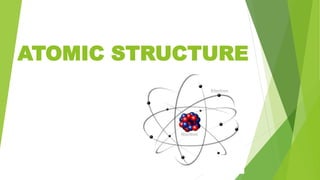
ATOMIC STRUCTURE
INTRODUCTION
 WHAT IS AN ATOM?
Atom is the smallest particle that
takes part in a chemical reaction.
Although the atom is very small
but it has a structure and a size. It has a
nucleus and it consists of electrons which
are negatively charged, protons which
are positively charged and neutrons
which are neutral.
THE THEORIES ABOUT THE STRUCTURE
OF AN ATOM
 Many scientists and researchers have done a lot
of research, discussions and discoveries on how
they can explain about the structure of an Atom
to explain the shape, size and what are present
inside it.
 Some of the most important theories that
clearly have a good explanation about the
structure of an Atom with the use of models.
These are as follows:
1. BOHR ATOMIC MODEL
2. J.J.THOMPSON ATOMIC MODEL
3. RUTHERFORD MODEL
THE BOHR ATOMIC THEORY
 The Bohr Atomic Model was proposed by NEIL BOHR in
1915.
 It was actually the modification of RUTHERFORD ’S
MODEL.
 In this theory, Bohr explained that the Atom has a
core or a centre called as THE NUCLEUS. The atom
consists of electrons which revolves around the
nucleus in a fixed orbit.
 Bohr explained with the help of an example of the
planets of the solar system revolving around the sun
where the sun is the nucleus and the planets are the
electrons. Hence it is also called as the Planetary
Model of Atom.
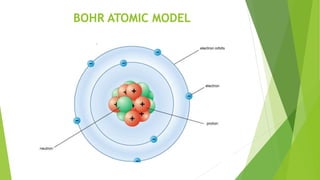
BOHR ATOMIC MODEL
CONCLUSION:IMPORTANT POSTULATES
 The important postulates or points from the Bohr
Atomic Model are as follows:
1. The electrons revolve around the nucleus in stable
orbits.
2. This model explained that an Atom has a nucleus and it
consists of electrons, protons and neutrons.
3. When the electrons make a transition from a higher to
a lower energy level energy is emitted in the form of a
photon.
THANK YOU
😊
The Group Members are:
1. MARBAHUN JALA KHARBHIH
2. NAPHISABET PHENWANROI
3. SHASI DEVI

PHYSICS PRESENTATION BSCMIT2NDSEMes.pptx

  • 1.
  • 2.
    INTRODUCTION  WHAT ISAN ATOM? Atom is the smallest particle that takes part in a chemical reaction. Although the atom is very small but it has a structure and a size. It has a nucleus and it consists of electrons which are negatively charged, protons which are positively charged and neutrons which are neutral.
  • 3.
    THE THEORIES ABOUTTHE STRUCTURE OF AN ATOM  Many scientists and researchers have done a lot of research, discussions and discoveries on how they can explain about the structure of an Atom to explain the shape, size and what are present inside it.  Some of the most important theories that clearly have a good explanation about the structure of an Atom with the use of models. These are as follows: 1. BOHR ATOMIC MODEL 2. J.J.THOMPSON ATOMIC MODEL 3. RUTHERFORD MODEL
  • 4.
    THE BOHR ATOMICTHEORY  The Bohr Atomic Model was proposed by NEIL BOHR in 1915.  It was actually the modification of RUTHERFORD ’S MODEL.  In this theory, Bohr explained that the Atom has a core or a centre called as THE NUCLEUS. The atom consists of electrons which revolves around the nucleus in a fixed orbit.  Bohr explained with the help of an example of the planets of the solar system revolving around the sun where the sun is the nucleus and the planets are the electrons. Hence it is also called as the Planetary Model of Atom.
  • 5.
  • 6.
    CONCLUSION:IMPORTANT POSTULATES  Theimportant postulates or points from the Bohr Atomic Model are as follows: 1. The electrons revolve around the nucleus in stable orbits. 2. This model explained that an Atom has a nucleus and it consists of electrons, protons and neutrons. 3. When the electrons make a transition from a higher to a lower energy level energy is emitted in the form of a photon.
  • 7.
  • 8.
    The Group Membersare: 1. MARBAHUN JALA KHARBHIH 2. NAPHISABET PHENWANROI 3. SHASI DEVI