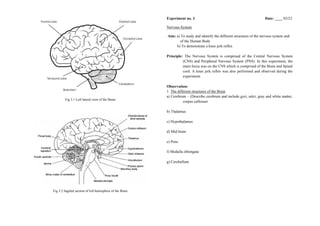
Fig 3.1 Left lateral view of the Brain
Fig 3.2 Sagittal section of left hemisphere of the Brain
Experiment no. 3 Date: ____ 03/23
Nervous System
Aim: a) To study and identify the different structures of the nervous system and
of the Human Body
b) To demonstrate a knee jerk reflex
Principle: The Nervous System is comprised of the Central Nervous System
(CNS) and Peripheral Nervous System (PNS). In this experiment, the
main focus was on the CNS which is comprised of the Brain and Spinal
cord. A knee jerk reflex was also performed and observed during the
experiment.
Observation:
1. The different structures of the Brain
a) Cerebrum – (Describe cerebrum and include gyri, sulci, gray and white matter,
corpus callosum
b) Thalamus
c) Hypothalamus
d) Mid brain
e) Pons
f) Medulla oblongata
g) Cerebullum
Figure 3.3 Cross – sectional view of spinal cord segment
Figure 3.4 Knee jerk reflex
2. The Spinal cord
• It is elongated, almost cylindrical part of the central nervous system,
which is suspended in the vertebral canal surrounded by meninges and
CSF.
• It extends from the upper border of the atlas to the lower border of the 1st
lumbar vertebra.
• It is approximately 45cm long in adult males, and is about the thickness
of the little finger.
• Except the cranial nerves, the spinal cord is the nervous tissue link
between the brain and the rest of the body.
• A cross-section of the spinal cord shows that it is composed of grey
matter in the centre surrounded by white matter.
3. Knee jerk reflex
a) Reflex arc
b) Sequence of knee jerk reflex
• A hammer hits patellar tendon and sensory neurons (somato-sensory
afferent) located in the tendon of the quadricep muscles are excited, the
sensory nerve impulses travel and enters the spinal cord through
the dorsal root ganglion and synapses with a motor neuron.
• The motor neuron (quadricep) immediately leaves the spinal cord and
returns to the quadriceps muscle causing a contraction.
• As this muscle contracts the leg straightens (extends) at the knee joint.
The quadricep is termed an extensor muscle. This type of synapse is a
monosynaptic reflex arc.

Nervous System DC-1.pdf

  • 1.
    Fig 3.1 Leftlateral view of the Brain Fig 3.2 Sagittal section of left hemisphere of the Brain Experiment no. 3 Date: ____ 03/23 Nervous System Aim: a) To study and identify the different structures of the nervous system and of the Human Body b) To demonstrate a knee jerk reflex Principle: The Nervous System is comprised of the Central Nervous System (CNS) and Peripheral Nervous System (PNS). In this experiment, the main focus was on the CNS which is comprised of the Brain and Spinal cord. A knee jerk reflex was also performed and observed during the experiment. Observation: 1. The different structures of the Brain a) Cerebrum – (Describe cerebrum and include gyri, sulci, gray and white matter, corpus callosum b) Thalamus c) Hypothalamus d) Mid brain e) Pons f) Medulla oblongata g) Cerebullum
  • 2.
    Figure 3.3 Cross– sectional view of spinal cord segment Figure 3.4 Knee jerk reflex 2. The Spinal cord • It is elongated, almost cylindrical part of the central nervous system, which is suspended in the vertebral canal surrounded by meninges and CSF. • It extends from the upper border of the atlas to the lower border of the 1st lumbar vertebra. • It is approximately 45cm long in adult males, and is about the thickness of the little finger. • Except the cranial nerves, the spinal cord is the nervous tissue link between the brain and the rest of the body. • A cross-section of the spinal cord shows that it is composed of grey matter in the centre surrounded by white matter. 3. Knee jerk reflex a) Reflex arc b) Sequence of knee jerk reflex • A hammer hits patellar tendon and sensory neurons (somato-sensory afferent) located in the tendon of the quadricep muscles are excited, the sensory nerve impulses travel and enters the spinal cord through the dorsal root ganglion and synapses with a motor neuron. • The motor neuron (quadricep) immediately leaves the spinal cord and returns to the quadriceps muscle causing a contraction. • As this muscle contracts the leg straightens (extends) at the knee joint. The quadricep is termed an extensor muscle. This type of synapse is a monosynaptic reflex arc.