WBUTTEPA
The West Bengal University
of Teachers’ Training,
Education Planning and
Administration
NAME : PRITY GHOSH
COLLEGE ROLL NO. : M-41
UNIVERSITY ROLL: 150152 NO. : 17054
What is an atom?
Atomic theory
Thomson’s model of an atom
 Rutherford’s atomic model
Bohr’s model of an Atom
Structure of atom
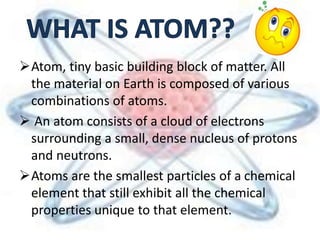
Atom, tiny basic building block of matter. All
the material on Earth is composed of various
combinations of atoms.
 An atom consists of a cloud of electrons
surrounding a small, dense nucleus of protons
and neutrons.
Atoms are the smallest particles of a chemical
element that still exhibit all the chemical
properties unique to that element.
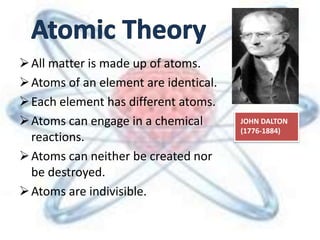
All matter is made up of atoms.
Atoms of an element are identical.
Each element has different atoms.
Atoms can engage in a chemical
reactions.
Atoms can neither be created nor
be destroyed.
Atoms are indivisible.
JOHN DALTON
(1776-1884)
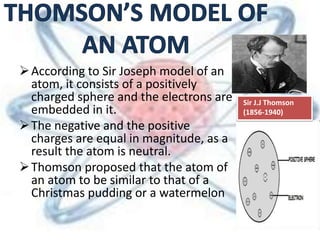
According to Sir Joseph model of an
atom, it consists of a positively
charged sphere and the electrons are
embedded in it.
The negative and the positive
charges are equal in magnitude, as a
result the atom is neutral.
Thomson proposed that the atom of
an atom to be similar to that of a
Christmas pudding or a watermelon
Sir J.J Thomson
(1856-1940)
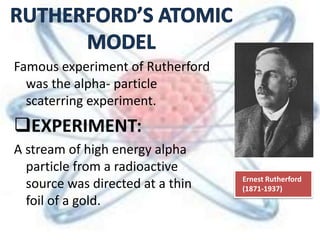
Famous experiment of Rutherford
was the alpha- particle
scaterring experiment.
EXPERIMENT:
A stream of high energy alpha
particle from a radioactive
source was directed at a thin
foil of a gold.
Ernest Rutherford
(1871-1937)
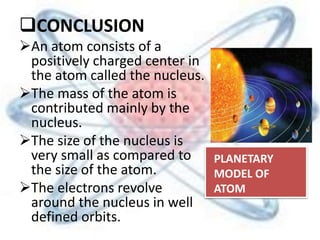
CONCLUSION
An atom consists of a
positively charged center in
the atom called the nucleus.
The mass of the atom is
contributed mainly by the
nucleus.
The size of the nucleus is
very small as compared to
the size of the atom.
The electrons revolve
around the nucleus in well
defined orbits.
PLANETARY
MODEL OF
ATOM
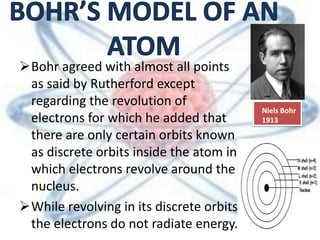
Bohr agreed with almost all points
as said by Rutherford except
regarding the revolution of
electrons for which he added that
there are only certain orbits known
as discrete orbits inside the atom in
which electrons revolve around the
nucleus.
While revolving in its discrete orbits
the electrons do not radiate energy.
Niels Bohr
1913
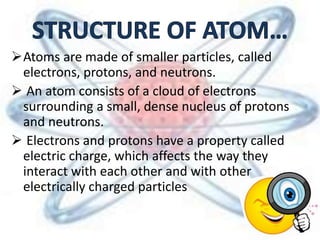
Atoms are made of smaller particles, called
electrons, protons, and neutrons.
 An atom consists of a cloud of electrons
surrounding a small, dense nucleus of protons
and neutrons.
 Electrons and protons have a property called
electric charge, which affects the way they
interact with each other and with other
electrically charged particles
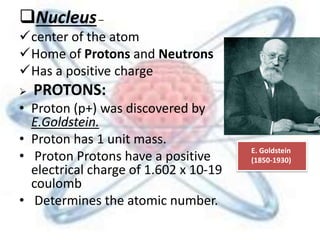
Nucleus–
center of the atom
Home of Protons and Neutrons
Has a positive charge
 PROTONS:
• Proton (p+) was discovered by
E.Goldstein.
• Proton has 1 unit mass.
• Proton Protons have a positive
electrical charge of 1.602 x 10⁻¹⁹
coulomb
• Determines the atomic number.
E. Goldstein
(1850-1930)
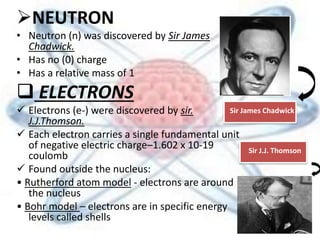
NEUTRON
• Neutron (n) was discovered by Sir James
Chadwick.
• Has no (0) charge
• Has a relative mass of 1
 ELECTRONS
 Electrons (e-) were discovered by sir.
J.J.Thomson.
 Each electron carries a single fundamental unit
of negative electric charge–1.602 x 10⁻¹⁹
coulomb
 Found outside the nucleus:
• Rutherford atom model - electrons are around
the nucleus
• Bohr model – electrons are in specific energy
levels called shells
Sir James Chadwick
Sir J.J. Thomson
REFERENCE
• BOOK:
December 2012, Chemistry Textbook for class
IX, Selina Publishers, 4725/21A, Dayanand
Marg, Darya Ganj, New Delhi- 110 002.
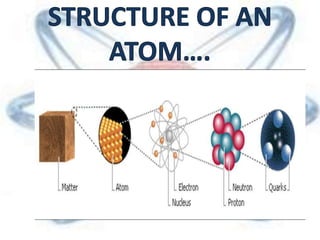
structure of atom

structure of atom

  • 1.
    WBUTTEPA The West BengalUniversity of Teachers’ Training, Education Planning and Administration NAME : PRITY GHOSH COLLEGE ROLL NO. : M-41 UNIVERSITY ROLL: 150152 NO. : 17054
  • 3.
    What is anatom? Atomic theory Thomson’s model of an atom  Rutherford’s atomic model Bohr’s model of an Atom Structure of atom
  • 4.
    Atom, tiny basicbuilding block of matter. All the material on Earth is composed of various combinations of atoms.  An atom consists of a cloud of electrons surrounding a small, dense nucleus of protons and neutrons. Atoms are the smallest particles of a chemical element that still exhibit all the chemical properties unique to that element.
  • 5.
    All matter ismade up of atoms. Atoms of an element are identical. Each element has different atoms. Atoms can engage in a chemical reactions. Atoms can neither be created nor be destroyed. Atoms are indivisible. JOHN DALTON (1776-1884)
  • 6.
    According to SirJoseph model of an atom, it consists of a positively charged sphere and the electrons are embedded in it. The negative and the positive charges are equal in magnitude, as a result the atom is neutral. Thomson proposed that the atom of an atom to be similar to that of a Christmas pudding or a watermelon Sir J.J Thomson (1856-1940)
  • 7.
    Famous experiment ofRutherford was the alpha- particle scaterring experiment. EXPERIMENT: A stream of high energy alpha particle from a radioactive source was directed at a thin foil of a gold. Ernest Rutherford (1871-1937)
  • 8.
    CONCLUSION An atom consistsof a positively charged center in the atom called the nucleus. The mass of the atom is contributed mainly by the nucleus. The size of the nucleus is very small as compared to the size of the atom. The electrons revolve around the nucleus in well defined orbits. PLANETARY MODEL OF ATOM
  • 9.
    Bohr agreed withalmost all points as said by Rutherford except regarding the revolution of electrons for which he added that there are only certain orbits known as discrete orbits inside the atom in which electrons revolve around the nucleus. While revolving in its discrete orbits the electrons do not radiate energy. Niels Bohr 1913
  • 10.
    Atoms are madeof smaller particles, called electrons, protons, and neutrons.  An atom consists of a cloud of electrons surrounding a small, dense nucleus of protons and neutrons.  Electrons and protons have a property called electric charge, which affects the way they interact with each other and with other electrically charged particles
  • 11.
    Nucleus– center of theatom Home of Protons and Neutrons Has a positive charge  PROTONS: • Proton (p+) was discovered by E.Goldstein. • Proton has 1 unit mass. • Proton Protons have a positive electrical charge of 1.602 x 10⁻¹⁹ coulomb • Determines the atomic number. E. Goldstein (1850-1930)
  • 12.
    NEUTRON • Neutron (n)was discovered by Sir James Chadwick. • Has no (0) charge • Has a relative mass of 1  ELECTRONS  Electrons (e-) were discovered by sir. J.J.Thomson.  Each electron carries a single fundamental unit of negative electric charge–1.602 x 10⁻¹⁹ coulomb  Found outside the nucleus: • Rutherford atom model - electrons are around the nucleus • Bohr model – electrons are in specific energy levels called shells Sir James Chadwick Sir J.J. Thomson
  • 13.
    REFERENCE • BOOK: December 2012,Chemistry Textbook for class IX, Selina Publishers, 4725/21A, Dayanand Marg, Darya Ganj, New Delhi- 110 002.