Introduction to Radiation:
Radiation Types
©Health Physics Society
Introduction to Radiation
• Objectives
• To provide useful information about
radiation for interested individuals
• To introduce basic concepts of radiation
and radioactivity
• Improve understanding of radiation –
what it is and how it interacts
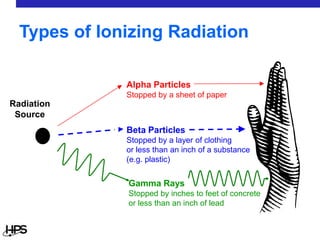
Types of Ionizing Radiation
Alpha Particles
Stopped by a sheet of paper
Beta Particles
Stopped by a layer of clothing
or less than an inch of a substance
(e.g. plastic)
Gamma Rays
Stopped by inches to feet of concrete
or less than an inch of lead
Radiation
Source
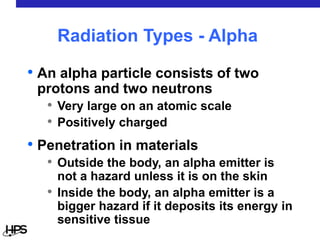
• An alpha particle consists of two
protons and two neutrons
• Very large on an atomic scale
• Positively charged
• Penetration in materials
• Outside the body, an alpha emitter is
not a hazard unless it is on the skin
• Inside the body, an alpha emitter is a
bigger hazard if it deposits its energy in
sensitive tissue
Radiation Types - Alpha
• Common alpha-particle emitters
• Radon-222 gas in the environment
• Uranium-234 and -238) in the
environment
• Polonium-210 in tobacco
• Common alpha-particle emitter uses
• Smoke detectors
• Cigarettes/cigars
• Static eliminators
Radiation Types - Alpha
• A beta particle is a charged electron
• Has the size and weight of an electron
• Can be positively or negatively charged
• Penetration in materials
• At low energies, a beta particle is not very
penetrating – stopped by the outer layer
of skin or a piece of paper
• At higher energies, a beta particle may
penetrate to the live layer of skin and may
need 0.5” of plexiglass to be stopped
Radiation Types - Beta
• Penetration in materials, continued
• Inside the body, a beta particle is not as
hazardous as an alpha particle because it
is not as big
• Because it is not as big, it travels farther,
interacting with more tissue (but each
small piece of tissue gets less energy
deposited)
Radiation Types - Beta
• Common beta-particle emitters
• Tritium (hydrogen-3) in the
environment
• Carbon (14) in the environment
• Phosphorus (32) used in research and
medicine
• Common beta-particle emitter uses
• Carbon dating
• Basic research
• Cancer treatment
Radiation Types - Beta
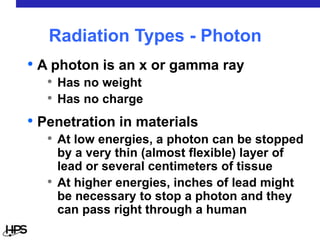
• A photon is an x or gamma ray
• Has no weight
• Has no charge
• Penetration in materials
• At low energies, a photon can be stopped
by a very thin (almost flexible) layer of
lead or several centimeters of tissue
• At higher energies, inches of lead might
be necessary to stop a photon and they
can pass right through a human
Radiation Types - Photon
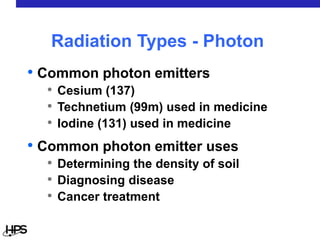
• Common photon emitters
• Cesium (137)
• Technetium (99m) used in medicine
• Iodine (131) used in medicine
• Common photon emitter uses
• Determining the density of soil
• Diagnosing disease
• Cancer treatment
Radiation Types - Photon
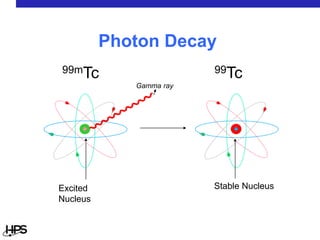
99mTc
Excited
Nucleus
Gamma ray
99Tc
Stable Nucleus
Photon Decay
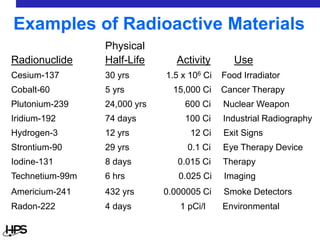
Physical
Radionuclide Half-Life Activity Use
Cesium-137 30 yrs 1.5 x 10⁶ Ci Food Irradiator
Cobalt-60 5 yrs 15,000 Ci Cancer Therapy
Plutonium-239 24,000 yrs 600 Ci Nuclear Weapon
Iridium-192 74 days 100 Ci Industrial Radiography
Hydrogen-3 12 yrs 12 Ci Exit Signs
Strontium-90 29 yrs 0.1 Ci Eye Therapy Device
Iodine-131 8 days 0.015 Ci Therapy
Technetium-99m 6 hrs 0.025 Ci Imaging
Americium-241 432 yrs 0.000005 Ci Smoke Detectors
Radon-222 4 days 1 pCi/l Environmental
Examples of Radioactive Materials

physician_intro_rad_types.ppt

  • 1.
    Introduction to Radiation: RadiationTypes ©Health Physics Society
  • 2.
    Introduction to Radiation •Objectives • To provide useful information about radiation for interested individuals • To introduce basic concepts of radiation and radioactivity • Improve understanding of radiation – what it is and how it interacts
  • 3.
    Types of IonizingRadiation Alpha Particles Stopped by a sheet of paper Beta Particles Stopped by a layer of clothing or less than an inch of a substance (e.g. plastic) Gamma Rays Stopped by inches to feet of concrete or less than an inch of lead Radiation Source
  • 4.
    • An alphaparticle consists of two protons and two neutrons • Very large on an atomic scale • Positively charged • Penetration in materials • Outside the body, an alpha emitter is not a hazard unless it is on the skin • Inside the body, an alpha emitter is a bigger hazard if it deposits its energy in sensitive tissue Radiation Types - Alpha
  • 5.
    • Common alpha-particleemitters • Radon-222 gas in the environment • Uranium-234 and -238) in the environment • Polonium-210 in tobacco • Common alpha-particle emitter uses • Smoke detectors • Cigarettes/cigars • Static eliminators Radiation Types - Alpha
  • 6.
    • A betaparticle is a charged electron • Has the size and weight of an electron • Can be positively or negatively charged • Penetration in materials • At low energies, a beta particle is not very penetrating – stopped by the outer layer of skin or a piece of paper • At higher energies, a beta particle may penetrate to the live layer of skin and may need 0.5” of plexiglass to be stopped Radiation Types - Beta
  • 7.
    • Penetration inmaterials, continued • Inside the body, a beta particle is not as hazardous as an alpha particle because it is not as big • Because it is not as big, it travels farther, interacting with more tissue (but each small piece of tissue gets less energy deposited) Radiation Types - Beta
  • 8.
    • Common beta-particleemitters • Tritium (hydrogen-3) in the environment • Carbon (14) in the environment • Phosphorus (32) used in research and medicine • Common beta-particle emitter uses • Carbon dating • Basic research • Cancer treatment Radiation Types - Beta
  • 9.
    • A photonis an x or gamma ray • Has no weight • Has no charge • Penetration in materials • At low energies, a photon can be stopped by a very thin (almost flexible) layer of lead or several centimeters of tissue • At higher energies, inches of lead might be necessary to stop a photon and they can pass right through a human Radiation Types - Photon
  • 10.
    • Common photonemitters • Cesium (137) • Technetium (99m) used in medicine • Iodine (131) used in medicine • Common photon emitter uses • Determining the density of soil • Diagnosing disease • Cancer treatment Radiation Types - Photon
  • 11.
  • 12.
    Physical Radionuclide Half-Life ActivityUse Cesium-137 30 yrs 1.5 x 10⁶ Ci Food Irradiator Cobalt-60 5 yrs 15,000 Ci Cancer Therapy Plutonium-239 24,000 yrs 600 Ci Nuclear Weapon Iridium-192 74 days 100 Ci Industrial Radiography Hydrogen-3 12 yrs 12 Ci Exit Signs Strontium-90 29 yrs 0.1 Ci Eye Therapy Device Iodine-131 8 days 0.015 Ci Therapy Technetium-99m 6 hrs 0.025 Ci Imaging Americium-241 432 yrs 0.000005 Ci Smoke Detectors Radon-222 4 days 1 pCi/l Environmental Examples of Radioactive Materials