4TH QUARTER EXAMAMINATION TECHNOLOGY AND LIVELIHOOD EDUCATION
1.
Republic of thePhilippines
Department of Education
Region VII – Central Visayas
Schools Division of Cebu Province
District of Argao II
Taloot Integrated School
Taloot, Argao, Cebu
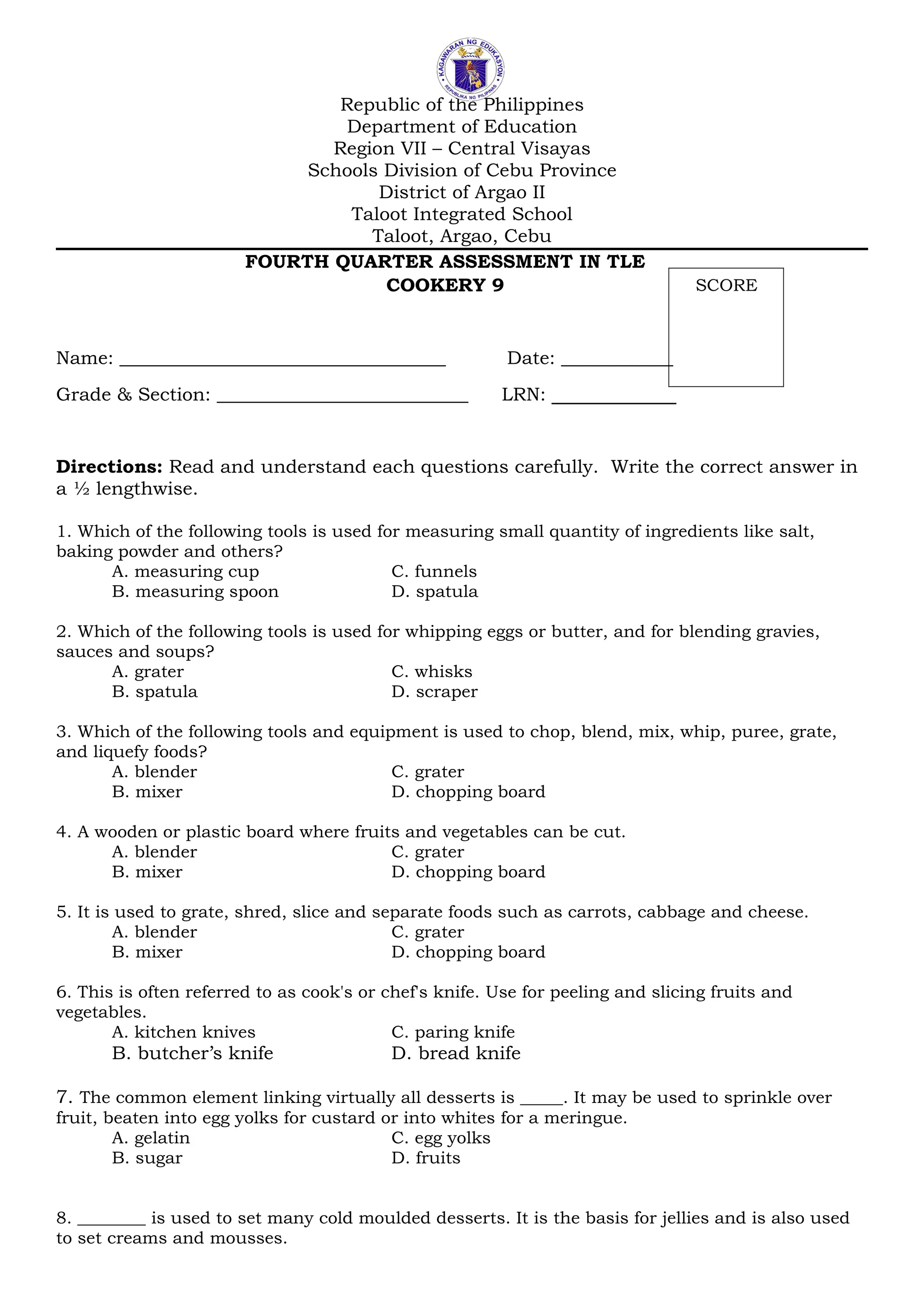
FOURTH QUARTER ASSESSMENT IN TLE
COOKERY 9
Name: ___________________________________ Date: ____________
Grade & Section: ___________________________ LRN: ____________
Directions: Read and understand each questions carefully. Write the correct answer in
a ½ lengthwise.
1. Which of the following tools is used for measuring small quantity of ingredients like salt,
baking powder and others?
A. measuring cup C. funnels
B. measuring spoon D. spatula
2. Which of the following tools is used for whipping eggs or butter, and for blending gravies,
sauces and soups?
A. grater C. whisks
B. spatula D. scraper
3. Which of the following tools and equipment is used to chop, blend, mix, whip, puree, grate,
and liquefy foods?
A. blender C. grater
B. mixer D. chopping board
4. A wooden or plastic board where fruits and vegetables can be cut.
A. blender C. grater
B. mixer D. chopping board
5. It is used to grate, shred, slice and separate foods such as carrots, cabbage and cheese.
A. blender C. grater
B. mixer D. chopping board
6. This is often referred to as cook's or chef's knife. Use for peeling and slicing fruits and
vegetables.
A. kitchen knives C. paring knife
B. butcher’s knife D. bread knife
7. The common element linking virtually all desserts is _____. It may be used to sprinkle over
fruit, beaten into egg yolks for custard or into whites for a meringue.
A. gelatin C. egg yolks
B. sugar D. fruits
8. ________ is used to set many cold moulded desserts. It is the basis for jellies and is also used
to set creams and mousses.
SCORE
2.
A. Gelatin C.Egg yolks
B. Sugar D. Fruits
9. _____ may be pureed, baked or poached and can then be used for pies, soufflés and puddings.
A. Gelatin C. Egg yolks
B. Sugar D. Fruits
10. This ingredient is often used as a decoration or accompaniment for both cold and hot
desserts, but may also be used as one of the recipe ingredients.
A. cream C. nuts
B. batters D. chocolates
11. This are available whole, ground, roasted or caramelised. They are an important part of
dessert cookery as they provide flavor for creams and ice creams.
A. cream C. nuts
B. batters D. chocolates
12. This simple mixture of flour and water is used to make crepes and pancakes. Batter is also
used to coat fruit for fritters.
A. cream C. nuts
B. batters D. chocolates
13. It is melted to easily blend into fillings and batters. It can also be poured over desserts such
as cakes and puddings.
A. cream C. nuts
B. batters D. chocolates
14. A flavored liquid blend of ingredients that adds flavor and enhances the appearance of the
food.
A. sauces C. fudge
B. soup D. meringue
15. Which decorations and garnishes for desserts that is stirred vanilla custard sauce; consist of
milk, sugar, egg yolks and vanilla stirred over low heat until lightly thickened.
A. dessert syrup C. pastry cream
B. cream anglaise D. custards
16. In plating and presenting food, which among the following statement is related to texture?
A. Enhances plate presentation
B. Plays important part in plate presentation
C. Adds visual interest to the food
D. Serves as frame of the presentation
17. What are the four garnishes that add wow factor to your dessert?
A. fruit garnish, nut garnish, chocolate garnish and cookie garnish
B. fudge garnish, fruit garnish, cookie garnish and nut garnish
C. fudge garnish, fruit garnish, chocolate garnish and cookie garnish
D. fruit garnish, nut garnish, cream garnish and chocolate garnish
18. The following are guidelines in plating dessert except one
A. make garnishes edible
B. keep it clean and simple
C. try 1 plate
D. layer flavors and textures in your dessert
19. Which of the following is not an important technique in plating and presenting desserts?
A. the plate C. keep things clean
B. color D. the ingredients
20. What is the process of storing food by means of refrigeration?
3.
A. refrigerate C.chilling
B. cold storage D. freezing
21. What storage techniques that keep cool or cold to your dessert?
A. refrigerate C. chilling
B. cold storage D. freezing
22. It is the storage technique for dessert that refrigerate or to reduce the temperature of food.
A. refrigerate C. chilling
B. cold storage D. freezing
23. The following are sanitary practices when storing desserts, arrange tha following in
chronological order.
I. Handle the food properly to prevent spoilage and contamination.
II. Safeguard the food during distribution and service.
III. Wash utensils and equipment thoroughly.
IV. Keep away from food when you are ill.
V. Store foods and ingredients properly.
A. I, II, III, IV and V C. I, IV, III, II and V
B. I, III, IV, V and II D. I, II, IV, V and III
24. If you plan to keep a pre-prepared dessert hot until service, make sure that the temperature
of the food is over ____ °C?
A. 75 °C B. 65 °C C. 45 °C D. 85 °C
25. Milk and cream that are used in dessert should be kept in the _____ until the last possible
moment to avoid food poisoning.
A. chiller B. refrigerator C. freezer D. trash bin
26. Egg custards contain ______, which provides good food for bacteria. If custards are not
heated and cooled properly and quickly, bacteria that are present in the custard can grow
quickly to dangerous numbers.
A. protein B. carbohydrates C. fats D. nutrients
27. Desserts containing uncooked eggs should be handled with extreme care, as ______ is a
medium in which dangerous bacteria such as salmonella can thrive.
A. raw egg C. roast egg
B. uncooked egg D. baked egg
28. As many desserts contain egg and dairy products, they present a potential health ____ if not
stored properly.
A. hazard B. unsanitary C. risk D. bacteria
29. Which of the following is not the method in food packaging?
A. freezing and chilling food C. canned foods
B. home canned foods D. plastic packaging
30. The following are classification of package according to its use except one.
A. as a primary package C. as a tertiary package
B. as a secondary package D. as a binary package
31. The following are important things to consider when storing and transporting food, except
A. The hazards of loading and unloading
B. The movement of vehicles
C. The shelf life of the food
D. The warehousing methods and the environmental conditions like relative humidity and
temperature changes.
4.
32. What isthe main aim of packaging food?
A. to keep the food fresh
B. to keep the food in good condition
C. to maintain the quality of food
D. to extend the shelf life of food
33. In many developing countries the most commonly used food packaging materials include___,
which of the following does not belong to the group?
A. glass B. plastics C. leaves D. soap
34. The use of wood container continues for some wines and spirits because the transfer of flavor
compounds from the wooden barrels improves the ____ of the product.
A. quantity B. quality C. size D. mixture
35. _________ pots are used worldwide for storing liquids and solid foods such as curd, yoghurt,
beer, dried food, and honey.
A. Paper B. Earthenware C. Glass D. Wood
36. Which of the following is a popular choice as a packaging?
A paper B. earthenware C. glass D. wood
37. They are extremely useful as they can be made in either soft or hard forms, as sheets or
containers, and with different thickness, light resistance, and flexibility.
A. wood B. paper C. plastic D. metal
38. Why is it that metal cans have a number of advantages over other types of containers?
A. They provide total protection of the contents.
B. Give little weight to the product
C. They fit closely to the shape of the product.
D. They are inconvenient to use.
39. The following are the three major functions of a package, which of the following does not
belong to the group?
A. to contain C. to help sell
B. to protect D. to transport
40. Why is it that flexible plastic films are the most common form of plastic?
A. Good barrier properties against moisture and gases.
B. They are convenient for presentation.
C. They are heavier than other materials,
D. They have higher cost.
ANSWER KEY
5.
1. B
2. C
3.A
4. D
5. C
6. A
7. B
8. C
9. D
10.A
11.C
12.B
13.D
14.A
15.B
16.C
17.A
18.C
19.D
20.B
21.A
22.C
23.B
24.B
25.B
26.A
27.A
28.A
29.D
30.D
31.C
32.B
33.D
34.B
35.B
36.C
37.D
38.A
39.D
40.A


![present desserts [Autosaved].pptx in home economics](https://cdn.slidesharecdn.com/ss_thumbnails/presentdessertsautosaved-250209154306-6b86c409-thumbnail.jpg?width=640&height=640&fit=bounds)


