<date/time> <footer> 1
6. Physical and
Chemical Changes
Physical changes
Change
Changes in our surroundings.
 Making a sugar solution is a change.
 Setting curd from milk is a change.
 Souring of milk is a change.
 Stretched rubber band also
represents a change.
Make a list of ten changes you have
noticed around you.
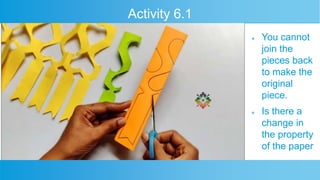
Activity 6.1
 You cannot
join the
pieces back
to make the
original
piece.
 Is there a
change in
the property
of the paper
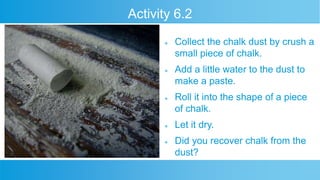
Activity 6.2
 Collect the chalk dust by crush a
small piece of chalk.
 Add a little water to the dust to
make a paste.
 Roll it into the shape of a piece
of chalk.
 Let it dry.
 Did you recover chalk from the
dust?
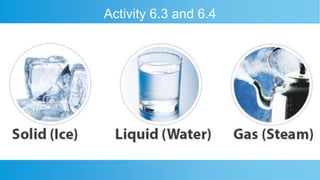
Activity 6.3 and 6.4
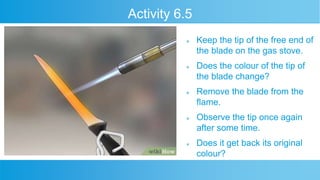
Activity 6.5
 Keep the tip of the free end of
the blade on the gas stove.
 Does the colour of the tip of
the blade change?
 Remove the blade from the
flame.
 Observe the tip once again
after some time.
 Does it get back its original
colour?
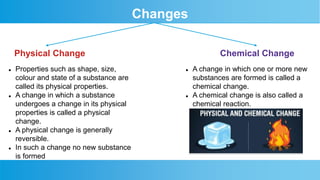
Changes
Physical Change Chemical Change
 Properties such as shape, size,
colour and state of a substance are
called its physical properties.
 A change in which a substance
undergoes a change in its physical
properties is called a physical
change.
 A physical change is generally
reversible.
 In such a change no new substance
is formed
 A change in which one or more new
substances are formed is called a
chemical change.
 A chemical change is also called a
chemical reaction.
Activity 6.6

physical and chemical changes | Physical change

  • 1.
    <date/time> <footer> 1 6.Physical and Chemical Changes Physical changes
  • 2.
    Change Changes in oursurroundings.  Making a sugar solution is a change.  Setting curd from milk is a change.  Souring of milk is a change.  Stretched rubber band also represents a change. Make a list of ten changes you have noticed around you.
  • 3.
    Activity 6.1  Youcannot join the pieces back to make the original piece.  Is there a change in the property of the paper
  • 4.
    Activity 6.2  Collectthe chalk dust by crush a small piece of chalk.  Add a little water to the dust to make a paste.  Roll it into the shape of a piece of chalk.  Let it dry.  Did you recover chalk from the dust?
  • 5.
  • 6.
    Activity 6.5  Keepthe tip of the free end of the blade on the gas stove.  Does the colour of the tip of the blade change?  Remove the blade from the flame.  Observe the tip once again after some time.  Does it get back its original colour?
  • 7.
    Changes Physical Change ChemicalChange  Properties such as shape, size, colour and state of a substance are called its physical properties.  A change in which a substance undergoes a change in its physical properties is called a physical change.  A physical change is generally reversible.  In such a change no new substance is formed  A change in which one or more new substances are formed is called a chemical change.  A chemical change is also called a chemical reaction.
  • 10.