Modified level - Physical and Chemical change.pptx
1.
Animations Disclaimer
You maywish to delete this slide before beginning the presentation.
PowerPoi
nt
This resource has been designed with animations to make it as fun and engaging as
possible. To view the content in the correct formatting, please view the PowerPoint in
“slide show mode.” This takes you from desktop to presentation mode. If you view the
slides out of “slide show mode,” you may find that some of the text and images overlap
each other and/or are difficult to read.
To enter slide show mode, go to the slide show menu tab and select either from
beginning or from current slide.
We hope you find the information on our website and resources useful.
Slides
This resource has been designed with animations to make it fun and engaging for
children.
To ensure the content has the correct formatting, please view the presentation in
“present mode.” This takes you from edit mode to presentation mode. If you view the
slides out of “present mode,” you may find that some of the text and images overlap
each other and/or are difficult to read.
To enter present mode, go to the “Present” tab and select “Present from beginning” or
simply click “Present” to play from the current slide.
3.
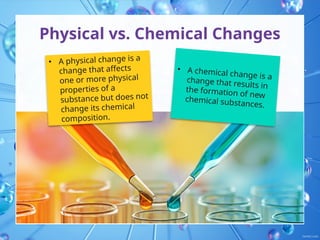
Physical vs. ChemicalChanges
• A physical change is a
change that affects
one or more physical
properties of a
substance but does not
change its chemical
composition.
• A chemical change is a
change that results in
the formation of new
chemical substances.
4.
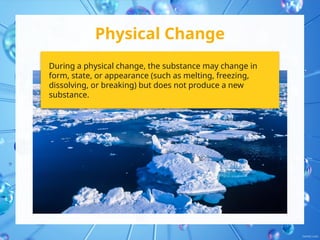
Physical Change
During aphysical change, the substance may change in
form, state, or appearance (such as melting, freezing,
dissolving, or breaking) but does not produce a new
substance.
5.
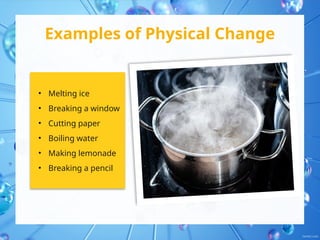
Examples of PhysicalChange
• Melting ice
• Breaking a window
• Cutting paper
• Boiling water
• Making lemonade
• Breaking a pencil
6.
Turn and Talk
Thinkof a physical change you have seen or
experienced recently, such as melting ice or cutting
paper.
Share your example with a partner and explain why it
is a physical change.
7.
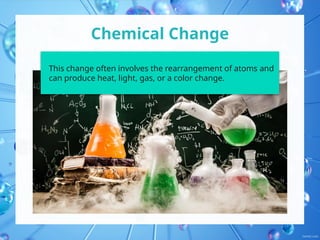
Chemical Change
This changeoften involves the rearrangement of atoms and
can produce heat, light, gas, or a color change.
8.
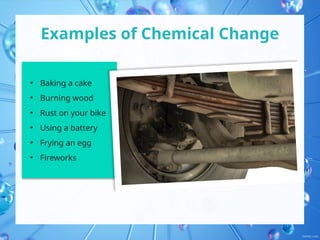
Examples of ChemicalChange
• Baking a cake
• Burning wood
• Rust on your bike
• Using a battery
• Frying an egg
• Fireworks
9.
Turn and Talk
Canyou think of a chemical change you've witnessed,
like baking cookies or rust forming on a bike?
Share your example with a partner and discuss what
new substances were created during that change.
10.
Summary
• Physical changesinvolve changes in state or
appearance without changing the chemical
identity.
• Chemical changes create new substances and
often involve energy changes.
11.
What is onekey difference between a physical change
and a chemical change?
Provide an example of each to illustrate your answer.
Exit Ticket




![谷歌留痕技术 [ 𝙩𝙤𝙥 𝟮𝟯𝟯. 𝙘 𝙤𝙢 ]](https://cdn.slidesharecdn.com/ss_thumbnails/top233-260130174328-3833018c-thumbnail.jpg?width=640&height=640&fit=bounds)


