Subhashree Behera
Roll no:PHY-27/2023
Fakir Mohan University,Balasore
Semiconductor LASER
Contents:-
• Introduction
• Basic laser theory
• Types of LASER
• Direct and Indirect gap Semiconductor
• Semiconductor laser
• Principle and Working of Semiconductor LASER
• Advantage and Disadvantages
• Application
Introduction
• History of LASER:
Invented in 1958 by Charles Townes(Nobel prize in Physics in 1964) and
Arthur Schawlow of Bell Laboratories.
• Characteristics of LASER:
1. Directionality(Divergence- rad)
2. Spectral purity(~m)
3. High power(power-W/)
4. Extremely short pulse duration(t-sec) for pulsed LASER
Basic LASER Theory
• An atom in the ground state may absorb
a photon of appropriate energy and get
raised to an excited state. This is called
induced absorption.
Equation:
Atom + photon  atom*
• An atom in the excited state may give up
energy and fall back to ground state. This
process is called spontaneous emission.
Equation:
atom*  atom+ photon
• An atom in the excited state,under the
influence of electromagnetic field of a
photon of frequency  incident upon
it,decays to a lower state ,emitting an
additionl photon of same frequency  .
Equation:
Atom*+photon  atom +2 photon
Population Inversion:
• According to Boltzmann Distribution law, the number of atom N1 in lower
energy level E1 is much greater than the number N2 in the upper energy level
E2 under the condition of thermal equilibrium.
• In order to get optical amplification it is necessary to produce the reverse
distribution condition of atoms so that the population in upper energy level is
greater than lower energy level. This condition is referred as “population
Inversion”.
• To population in two energy level are given by
N2=N1
• The process by which atoms are raised from lower to higher energy state is
called as “Pumping of atom”
Types of LASER-
Solid state laser:
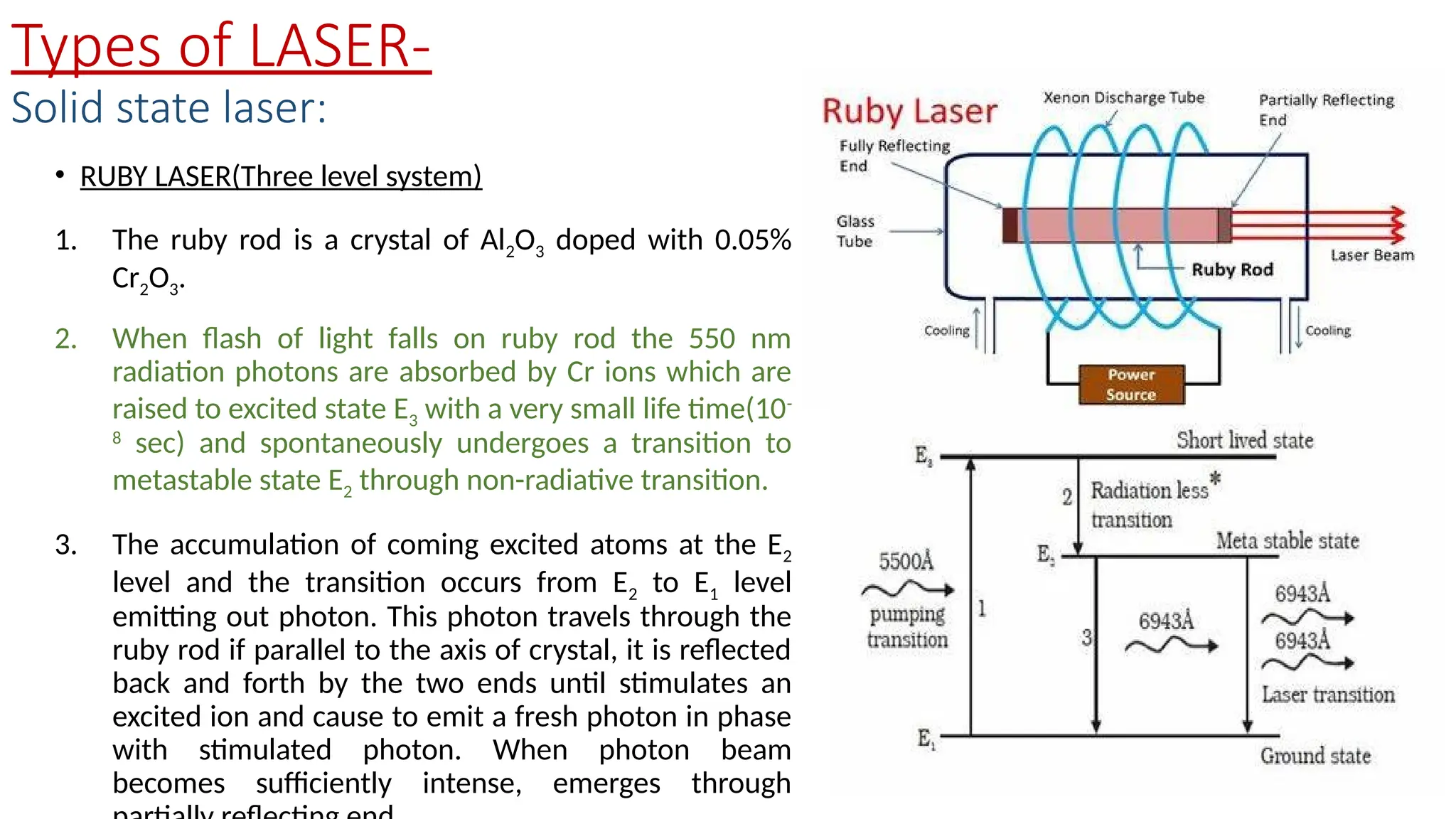
• RUBY LASER(Three level system)
1. The ruby rod is a crystal of Al2O3 doped with 0.05%
Cr2O3.
2. When flash of light falls on ruby rod the 550 nm
radiation photons are absorbed by Cr ions which are
raised to excited state E3 with a very small life time(10-
8
sec) and spontaneously undergoes a transition to
metastable state E2 through non-radiative transition.
3. The accumulation of coming excited atoms at the E2
level and the transition occurs from E2 to E1 level
emitting out photon. This photon travels through the
ruby rod if parallel to the axis of crystal, it is reflected
back and forth by the two ends until stimulates an
excited ion and cause to emit a fresh photon in phase
with stimulated photon. When photon beam
becomes sufficiently intense, emerges through
Gas LASER:
He-Ne LASER(Four level LASER):
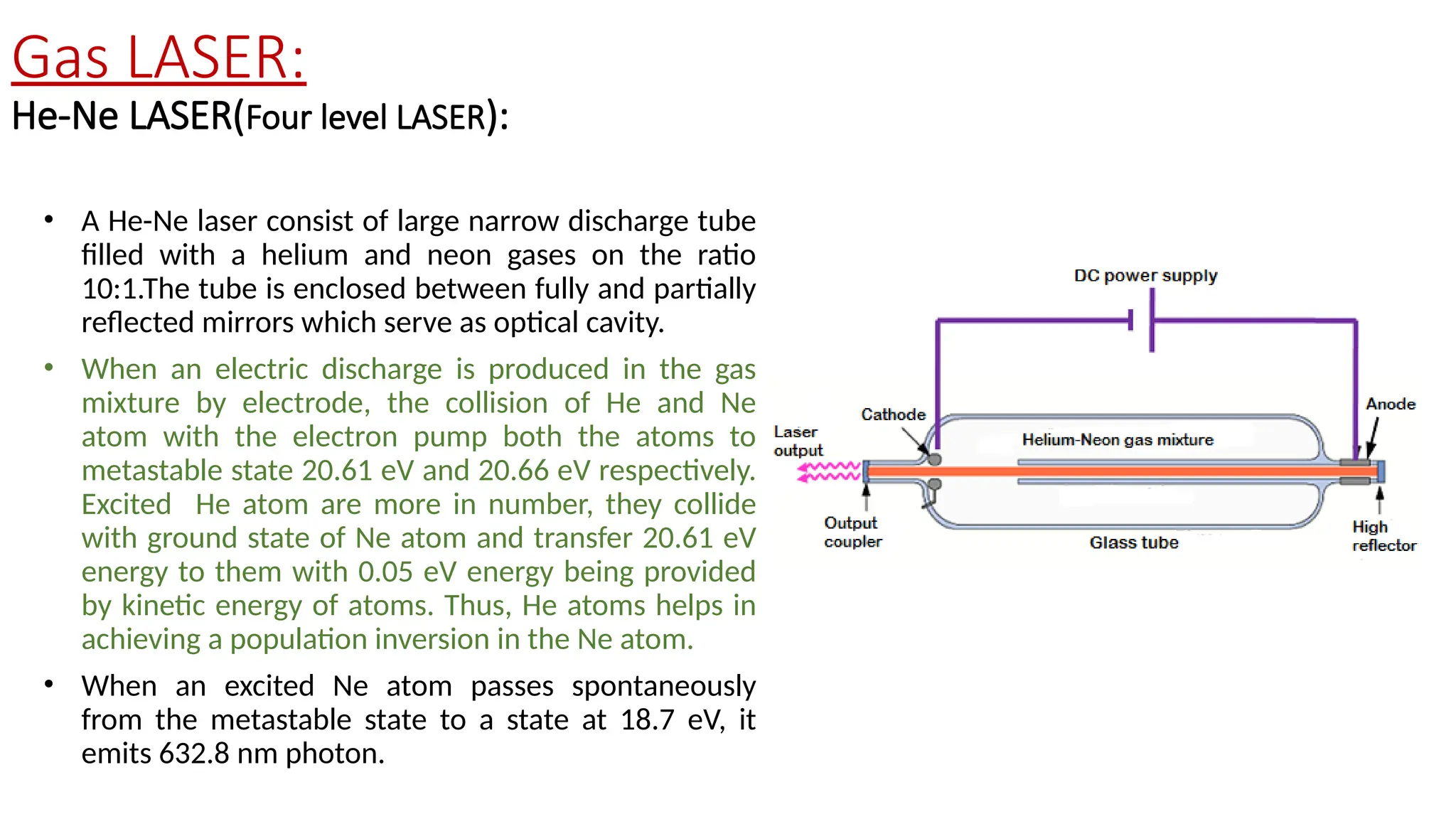
• A He-Ne laser consist of large narrow discharge tube
filled with a helium and neon gases on the ratio
10:1.The tube is enclosed between fully and partially
reflected mirrors which serve as optical cavity.
• When an electric discharge is produced in the gas
mixture by electrode, the collision of He and Ne
atom with the electron pump both the atoms to
metastable state 20.61 eV and 20.66 eV respectively.
Excited He atom are more in number, they collide
with ground state of Ne atom and transfer 20.61 eV
energy to them with 0.05 eV energy being provided
by kinetic energy of atoms. Thus, He atoms helps in
achieving a population inversion in the Ne atom.
• When an excited Ne atom passes spontaneously
from the metastable state to a state at 18.7 eV, it
emits 632.8 nm photon.
Continue
• This photon travels through the gas
mixture and if it is parallel to the axis of
the tube, is reflected back and forth by
the mirror end until it stimulate an excited
Ne atom and causes it to emit fresh 632.8
nm photon in phase with the stimulating
photon.
• This process is continued and a beam of
coherent radiation builds up in the tube.
When this beam becomes sufficiently
intense, a portion of it escapes through a
partially-silvered end.
• From the 18.7 eV level, the Ne atom
passes down spontaneously to a lower
metastable state emitting incoherent light
and finally to the ground state through
collision with wall tube. The final
transition is radiationless.
A brief discussion about semiconductor:
• Semiconductor is an insulator at absolute zero
temperature.
• Based on the band gap semiconductor it is
classified into two types
1.Direct gap Semiconductor: In direct gap
semiconductor the energy maximum at valence
band and the energy minimum in the conduction
band occurs almost same value of crystal
momentum so that the direct recombination
between electron and hole is possible.
2.Indirect gap semiconductor: The energy maximum
in the valence band and energy minimum in
conduction band occurs at different value of
electron crystal momentum.
3. For electron-hole recombination to occur, it is
essential that electrons loses momentum which
requires emission of a third particle ‘phonon’ with
a momentum p.
Principle of Semiconductor Laser :-
• When a p-n junction diode is forward biased, the electrons from
n– region and the Holes from the p- region cross the junction and
recombine with each other.
• During the recombination process, the light radiation (photons) is
released from a certain specified direct band gap semiconductors
like Ga-As. This light radiation is known as recombination
radiation.
• The photon emitted during recombination stimulates other
electrons and holes to recombine. As a result, stimulated emission
takes place which produces laser.
Construction and Working:
• The active medium is a PN junction diode made
from the single crystal of GaAs. The crystal is cut in
the form of platelet having thickness 0.1mm.
• The Platelet consist of two part having electron
conductivity(n type) and hole conductivity(p type).
• When the PN junction is forward biased with large
applied voltage, the electron and holes are injected
into the region into considerable concentration.
Thus there will be more no of electrons in the
conduction band as compared to valence band .So
population inversion can be achieved.
• The electrons and holes recombine with each
other and this recombination resulting in the
release of photon in phase.
Continue..
• These photons moves back and forth by
reflection between two side placed
parallel and opposite to each other. After
gaining enough strength it gives out a
laser beam of wavelength 8000
• The wavelength of Laser light is given by,
Eg= h = h
  ,
Materials for
Semiconductor LASER
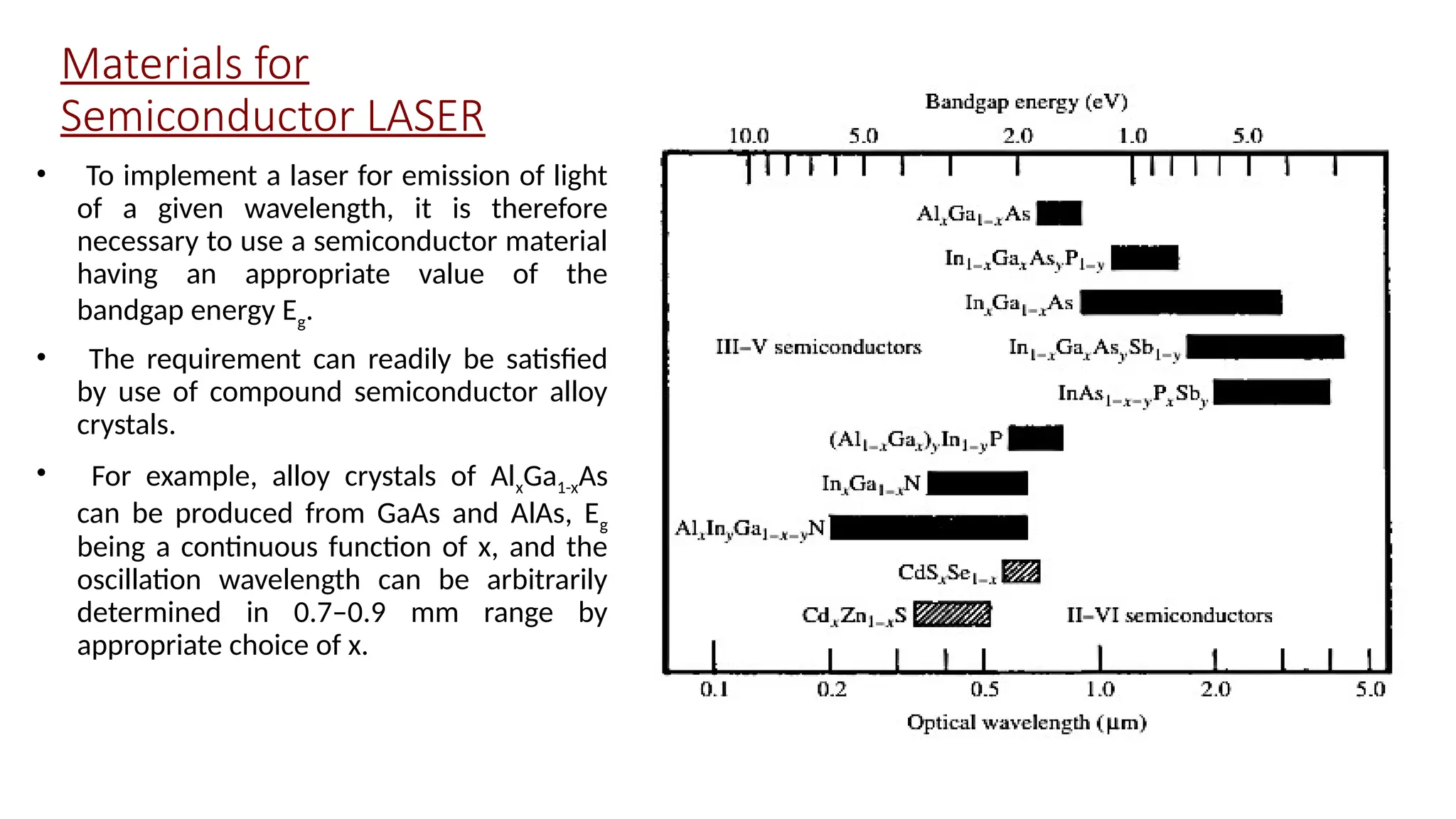
• To implement a laser for emission of light
of a given wavelength, it is therefore
necessary to use a semiconductor material
having an appropriate value of the
bandgap energy Eg.
• The requirement can readily be satisfied
by use of compound semiconductor alloy
crystals.
• For example, alloy crystals of AlxGa1-xAs
can be produced from GaAs and AlAs, Eg
being a continuous function of x, and the
oscillation wavelength can be arbitrarily
determined in 0.7–0.9 mm range by
appropriate choice of x.
Comparison with other LASER
• In semiconductor Laser the electron transition are
associated with band structure of material ,whereas other
laser the transition take place between discrete energy
level.
• Because the active region in semiconductor laser is very
narrow(1 m thickness) the divergence of laser beam is
considerably larger than in case of other laser.
• The spatial and spectral characteristics of a semiconductor
are strongly influenced by the properties of junction
medium, such as band gap.
Advantages:
• Low power consumption
• The output of the laser can be easily increased by controlling the
junction current.
• The laser has a continuous wave output or pulsed output.
• This laser exhibits high efficiency.
• Semiconductor laser requires low power for its operation.
• They are compact and lightweight.
• They have a long life.
Disadvantages:
• Temperature dependence, which affects the laser output.
• Unusual beam profile due to the short and rectangular lasing
medium.
• Difficult control of mode pattern and structure.
• Large divergence in the output beam.
• Poor coherence and stability.
Application:
• They are used in optical fiber communication to provide
high-frequency waves for modulating the low-frequency
signal.
• They are used as a laser pointer.
• They are used for storing data on CD or DVD.
• They are used as a pumping source in a solid-state laser.
• Semiconductor laser are used to read information strores
in compact disc(CDs) and digital versatile discs(DVDs).
• Used in laser diode and laser printer.
References:
• Book: Moll (1964) Physics of semiconductors. McGraw-Hill Book Co
• Book: (Optical engineering 90) Toshiaki Suhara - Semiconductor Laser
Fundamentals-Marcel Dekker (2004)
• Book: [Woodhead Publishing Series in Electronic and Optical Materials]
Alexei Baranov, Eric Tournie - Semiconductor lasers_ Fundamentals and
applications (2013, Woodhead Publishing) - libgen.li
• Book: Semiconductor Lasers | SpringerLink
• Internet: Laser Diodes – semiconductor, gain, index guiding, high power
(rp-photonics.com)
• Semiconductor laser | PPT (slideshare.net)
Semiconductor laser by Subhashree behera

Semiconductor laser by Subhashree behera

  • 1.
    Subhashree Behera Roll no:PHY-27/2023 FakirMohan University,Balasore Semiconductor LASER
  • 2.
    Contents:- • Introduction • Basiclaser theory • Types of LASER • Direct and Indirect gap Semiconductor • Semiconductor laser • Principle and Working of Semiconductor LASER • Advantage and Disadvantages • Application
  • 3.
    Introduction • History ofLASER: Invented in 1958 by Charles Townes(Nobel prize in Physics in 1964) and Arthur Schawlow of Bell Laboratories. • Characteristics of LASER: 1. Directionality(Divergence- rad) 2. Spectral purity(~m) 3. High power(power-W/) 4. Extremely short pulse duration(t-sec) for pulsed LASER
  • 4.
    Basic LASER Theory •An atom in the ground state may absorb a photon of appropriate energy and get raised to an excited state. This is called induced absorption. Equation: Atom + photon  atom* • An atom in the excited state may give up energy and fall back to ground state. This process is called spontaneous emission. Equation: atom*  atom+ photon • An atom in the excited state,under the influence of electromagnetic field of a photon of frequency  incident upon it,decays to a lower state ,emitting an additionl photon of same frequency  . Equation: Atom*+photon  atom +2 photon
  • 5.
    Population Inversion: • Accordingto Boltzmann Distribution law, the number of atom N1 in lower energy level E1 is much greater than the number N2 in the upper energy level E2 under the condition of thermal equilibrium. • In order to get optical amplification it is necessary to produce the reverse distribution condition of atoms so that the population in upper energy level is greater than lower energy level. This condition is referred as “population Inversion”. • To population in two energy level are given by N2=N1 • The process by which atoms are raised from lower to higher energy state is called as “Pumping of atom”
  • 6.
    Types of LASER- Solidstate laser: • RUBY LASER(Three level system) 1. The ruby rod is a crystal of Al2O3 doped with 0.05% Cr2O3. 2. When flash of light falls on ruby rod the 550 nm radiation photons are absorbed by Cr ions which are raised to excited state E3 with a very small life time(10- 8 sec) and spontaneously undergoes a transition to metastable state E2 through non-radiative transition. 3. The accumulation of coming excited atoms at the E2 level and the transition occurs from E2 to E1 level emitting out photon. This photon travels through the ruby rod if parallel to the axis of crystal, it is reflected back and forth by the two ends until stimulates an excited ion and cause to emit a fresh photon in phase with stimulated photon. When photon beam becomes sufficiently intense, emerges through
  • 7.
    Gas LASER: He-Ne LASER(Fourlevel LASER): • A He-Ne laser consist of large narrow discharge tube filled with a helium and neon gases on the ratio 10:1.The tube is enclosed between fully and partially reflected mirrors which serve as optical cavity. • When an electric discharge is produced in the gas mixture by electrode, the collision of He and Ne atom with the electron pump both the atoms to metastable state 20.61 eV and 20.66 eV respectively. Excited He atom are more in number, they collide with ground state of Ne atom and transfer 20.61 eV energy to them with 0.05 eV energy being provided by kinetic energy of atoms. Thus, He atoms helps in achieving a population inversion in the Ne atom. • When an excited Ne atom passes spontaneously from the metastable state to a state at 18.7 eV, it emits 632.8 nm photon.
  • 8.
    Continue • This photontravels through the gas mixture and if it is parallel to the axis of the tube, is reflected back and forth by the mirror end until it stimulate an excited Ne atom and causes it to emit fresh 632.8 nm photon in phase with the stimulating photon. • This process is continued and a beam of coherent radiation builds up in the tube. When this beam becomes sufficiently intense, a portion of it escapes through a partially-silvered end. • From the 18.7 eV level, the Ne atom passes down spontaneously to a lower metastable state emitting incoherent light and finally to the ground state through collision with wall tube. The final transition is radiationless.
  • 9.
    A brief discussionabout semiconductor: • Semiconductor is an insulator at absolute zero temperature. • Based on the band gap semiconductor it is classified into two types 1.Direct gap Semiconductor: In direct gap semiconductor the energy maximum at valence band and the energy minimum in the conduction band occurs almost same value of crystal momentum so that the direct recombination between electron and hole is possible. 2.Indirect gap semiconductor: The energy maximum in the valence band and energy minimum in conduction band occurs at different value of electron crystal momentum. 3. For electron-hole recombination to occur, it is essential that electrons loses momentum which requires emission of a third particle ‘phonon’ with a momentum p.
  • 10.
    Principle of SemiconductorLaser :- • When a p-n junction diode is forward biased, the electrons from n– region and the Holes from the p- region cross the junction and recombine with each other. • During the recombination process, the light radiation (photons) is released from a certain specified direct band gap semiconductors like Ga-As. This light radiation is known as recombination radiation. • The photon emitted during recombination stimulates other electrons and holes to recombine. As a result, stimulated emission takes place which produces laser.
  • 11.
    Construction and Working: •The active medium is a PN junction diode made from the single crystal of GaAs. The crystal is cut in the form of platelet having thickness 0.1mm. • The Platelet consist of two part having electron conductivity(n type) and hole conductivity(p type). • When the PN junction is forward biased with large applied voltage, the electron and holes are injected into the region into considerable concentration. Thus there will be more no of electrons in the conduction band as compared to valence band .So population inversion can be achieved. • The electrons and holes recombine with each other and this recombination resulting in the release of photon in phase.
  • 12.
    Continue.. • These photonsmoves back and forth by reflection between two side placed parallel and opposite to each other. After gaining enough strength it gives out a laser beam of wavelength 8000 • The wavelength of Laser light is given by, Eg= h = h   ,
  • 13.
    Materials for Semiconductor LASER •To implement a laser for emission of light of a given wavelength, it is therefore necessary to use a semiconductor material having an appropriate value of the bandgap energy Eg. • The requirement can readily be satisfied by use of compound semiconductor alloy crystals. • For example, alloy crystals of AlxGa1-xAs can be produced from GaAs and AlAs, Eg being a continuous function of x, and the oscillation wavelength can be arbitrarily determined in 0.7–0.9 mm range by appropriate choice of x.
  • 14.
    Comparison with otherLASER • In semiconductor Laser the electron transition are associated with band structure of material ,whereas other laser the transition take place between discrete energy level. • Because the active region in semiconductor laser is very narrow(1 m thickness) the divergence of laser beam is considerably larger than in case of other laser. • The spatial and spectral characteristics of a semiconductor are strongly influenced by the properties of junction medium, such as band gap.
  • 15.
    Advantages: • Low powerconsumption • The output of the laser can be easily increased by controlling the junction current. • The laser has a continuous wave output or pulsed output. • This laser exhibits high efficiency. • Semiconductor laser requires low power for its operation. • They are compact and lightweight. • They have a long life.
  • 16.
    Disadvantages: • Temperature dependence,which affects the laser output. • Unusual beam profile due to the short and rectangular lasing medium. • Difficult control of mode pattern and structure. • Large divergence in the output beam. • Poor coherence and stability.
  • 17.
    Application: • They areused in optical fiber communication to provide high-frequency waves for modulating the low-frequency signal. • They are used as a laser pointer. • They are used for storing data on CD or DVD. • They are used as a pumping source in a solid-state laser. • Semiconductor laser are used to read information strores in compact disc(CDs) and digital versatile discs(DVDs). • Used in laser diode and laser printer.
  • 18.
    References: • Book: Moll(1964) Physics of semiconductors. McGraw-Hill Book Co • Book: (Optical engineering 90) Toshiaki Suhara - Semiconductor Laser Fundamentals-Marcel Dekker (2004) • Book: [Woodhead Publishing Series in Electronic and Optical Materials] Alexei Baranov, Eric Tournie - Semiconductor lasers_ Fundamentals and applications (2013, Woodhead Publishing) - libgen.li • Book: Semiconductor Lasers | SpringerLink • Internet: Laser Diodes – semiconductor, gain, index guiding, high power (rp-photonics.com) • Semiconductor laser | PPT (slideshare.net)