Phrasal Verbs
Workshop Grammar is Fun
Mtra. Patricia Salgado N. Facultad de Lenguas – BUAP Summer 2017
Phrasal verbs:
 Are mainly used in spoken English and informal texts. The more formal a
conversation or text is, the less phrasal verbs are found.
 Consist of a verb and a particle (preposition, adverb or both).
 The particle can change the meaning of the verb completely.
For example:
look + up = consult a reference book
look + for = seek
look + forward = anticipate with pleasure
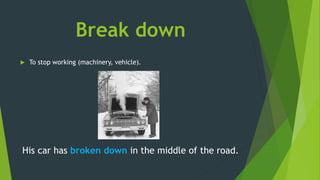
Break down
 To stop working (machinery, vehicle).
His car has broken down in the middle of the road.
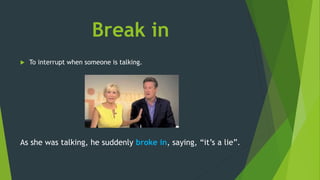
Break in
 To interrupt when someone is talking.
As she was talking, he suddenly broke in, saying, “it’s a lie”.
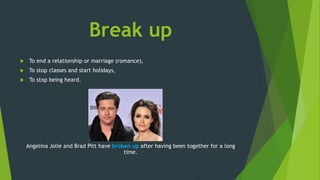
Break up
 To end a relationship or marriage (romance),
 To stop classes and start holidays,
 To stop being heard.
Angelina Jolie and Brad Pitt have broken up after having been together for a long
time.
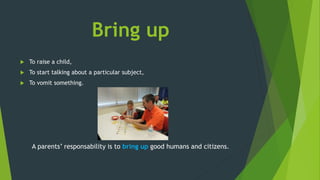
Bring up
 To raise a child,
 To start talking about a particular subject,
 To vomit something.
A parents’ responsability is to bring up good humans and citizens.
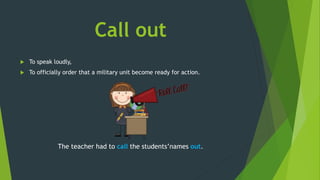
Call out
 To speak loudly,
 To officially order that a military unit become ready for action.
The teacher had to call the students’names out.
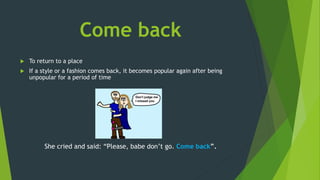
Come back
 To return to a place
 If a style or a fashion comes back, it becomes popular again after being
unpopular for a period of time
She cried and said: “Please, babe don’t go. Come back”.
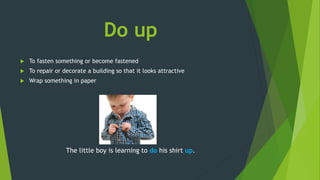
Do up
 To fasten something or become fastened
 To repair or decorate a building so that it looks attractive
 Wrap something in paper
The little boy is learning to do his shirt up.
Fall for
 To suddenly have strong romantic feelings about someone
He fell for her from the very first time he met her.
Get off
 To leave a place, usually to start a journey
 To leave work with permission, usually at the end of the day
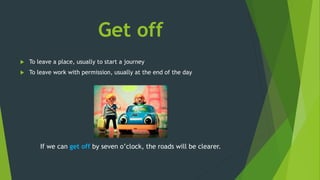
If we can get off by seven o’clock, the roads will be clearer.
Go down
 To move down to a lower level or place
 To reach or go as far as
 When the sun goes down, it moves down in the sky until it cannot be seen
 To be reduce in price, value, amount, quality, level, size
 To be remembered or recorded in a particular way
 To be received in a particular way
The temperature went down to minus ten last night.
Keep on
 To continue to talk in an annoying way about something
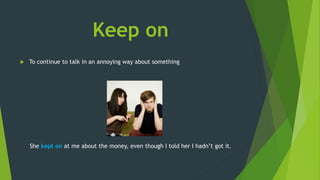
She kept on at me about the money, even though I told her I hadn’t got it.
Look after
 To take care of or be in charge of someone or something
I look after my little niece when her parents go out at night.
Make for
 To result in or make posible
Having faster computers would make for a more efficient system.
Put on
 To make a device operate, or to cause a device to play something, such as a
CD or DVD, by pressing a switch
 To cover part of the body with clothes, shoes, make-up, or something similar
 If people or animals put weight on, they become heavier
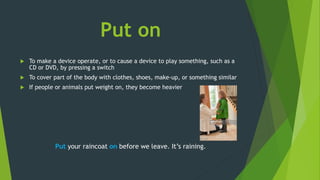
Put your raincoat on before we leave. It’s raining.
Run away
 To leave a place or person secretly and suddenly
 To avoid dealing with a problema or difficult situation
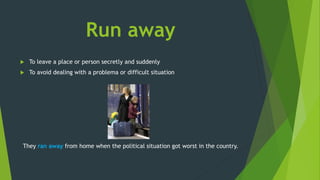
They ran away from home when the political situation got worst in the country.
Take off
 If an aircraft, bird, or insect takes off, it leaves the ground and begins to fly
 To suddenly start to be successful or popular
The plane took off at 8:30 a.m.
Set off
 To start on a trip
 To cause a device to explode or a signal to start
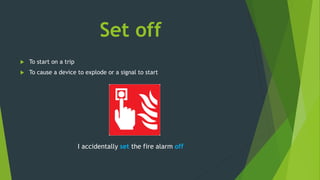
I accidentally set the fire alarm off
Some resources:
 https://www.ego4u.com/en/cram-up/grammar/phrasal-verbs/list#turn
 https://www.englishclub.com/vocabulary/phrasal-verbs-list.htm
 https://en.oxforddictionaries.com/grammar/phrasal-verbs
 https://learnenglish.britishcouncil.org/es/english-grammar/verbs/phrasal-
verbs

Phrasal verbs

  • 1.
    Phrasal Verbs Workshop Grammaris Fun Mtra. Patricia Salgado N. Facultad de Lenguas – BUAP Summer 2017
  • 2.
    Phrasal verbs:  Aremainly used in spoken English and informal texts. The more formal a conversation or text is, the less phrasal verbs are found.  Consist of a verb and a particle (preposition, adverb or both).  The particle can change the meaning of the verb completely. For example: look + up = consult a reference book look + for = seek look + forward = anticipate with pleasure
  • 3.
    Break down  Tostop working (machinery, vehicle). His car has broken down in the middle of the road.
  • 4.
    Break in  Tointerrupt when someone is talking. As she was talking, he suddenly broke in, saying, “it’s a lie”.
  • 5.
    Break up  Toend a relationship or marriage (romance),  To stop classes and start holidays,  To stop being heard. Angelina Jolie and Brad Pitt have broken up after having been together for a long time.
  • 6.
    Bring up  Toraise a child,  To start talking about a particular subject,  To vomit something. A parents’ responsability is to bring up good humans and citizens.
  • 7.
    Call out  Tospeak loudly,  To officially order that a military unit become ready for action. The teacher had to call the students’names out.
  • 8.
    Come back  Toreturn to a place  If a style or a fashion comes back, it becomes popular again after being unpopular for a period of time She cried and said: “Please, babe don’t go. Come back”.
  • 9.
    Do up  Tofasten something or become fastened  To repair or decorate a building so that it looks attractive  Wrap something in paper The little boy is learning to do his shirt up.
  • 10.
    Fall for  Tosuddenly have strong romantic feelings about someone He fell for her from the very first time he met her.
  • 11.
    Get off  Toleave a place, usually to start a journey  To leave work with permission, usually at the end of the day If we can get off by seven o’clock, the roads will be clearer.
  • 12.
    Go down  Tomove down to a lower level or place  To reach or go as far as  When the sun goes down, it moves down in the sky until it cannot be seen  To be reduce in price, value, amount, quality, level, size  To be remembered or recorded in a particular way  To be received in a particular way The temperature went down to minus ten last night.
  • 13.
    Keep on  Tocontinue to talk in an annoying way about something She kept on at me about the money, even though I told her I hadn’t got it.
  • 14.
    Look after  Totake care of or be in charge of someone or something I look after my little niece when her parents go out at night.
  • 15.
    Make for  Toresult in or make posible Having faster computers would make for a more efficient system.
  • 16.
    Put on  Tomake a device operate, or to cause a device to play something, such as a CD or DVD, by pressing a switch  To cover part of the body with clothes, shoes, make-up, or something similar  If people or animals put weight on, they become heavier Put your raincoat on before we leave. It’s raining.
  • 17.
    Run away  Toleave a place or person secretly and suddenly  To avoid dealing with a problema or difficult situation They ran away from home when the political situation got worst in the country.
  • 18.
    Take off  Ifan aircraft, bird, or insect takes off, it leaves the ground and begins to fly  To suddenly start to be successful or popular The plane took off at 8:30 a.m.
  • 19.
    Set off  Tostart on a trip  To cause a device to explode or a signal to start I accidentally set the fire alarm off
  • 20.
    Some resources:  https://www.ego4u.com/en/cram-up/grammar/phrasal-verbs/list#turn https://www.englishclub.com/vocabulary/phrasal-verbs-list.htm  https://en.oxforddictionaries.com/grammar/phrasal-verbs  https://learnenglish.britishcouncil.org/es/english-grammar/verbs/phrasal- verbs