THE SUN: MAIN SOURCE OF ENERGY FOR LIFE ON EARTH
Photosynthesis
Dr. T.Shasthree Assistant Professor in Department
of Biotechnology KU
2
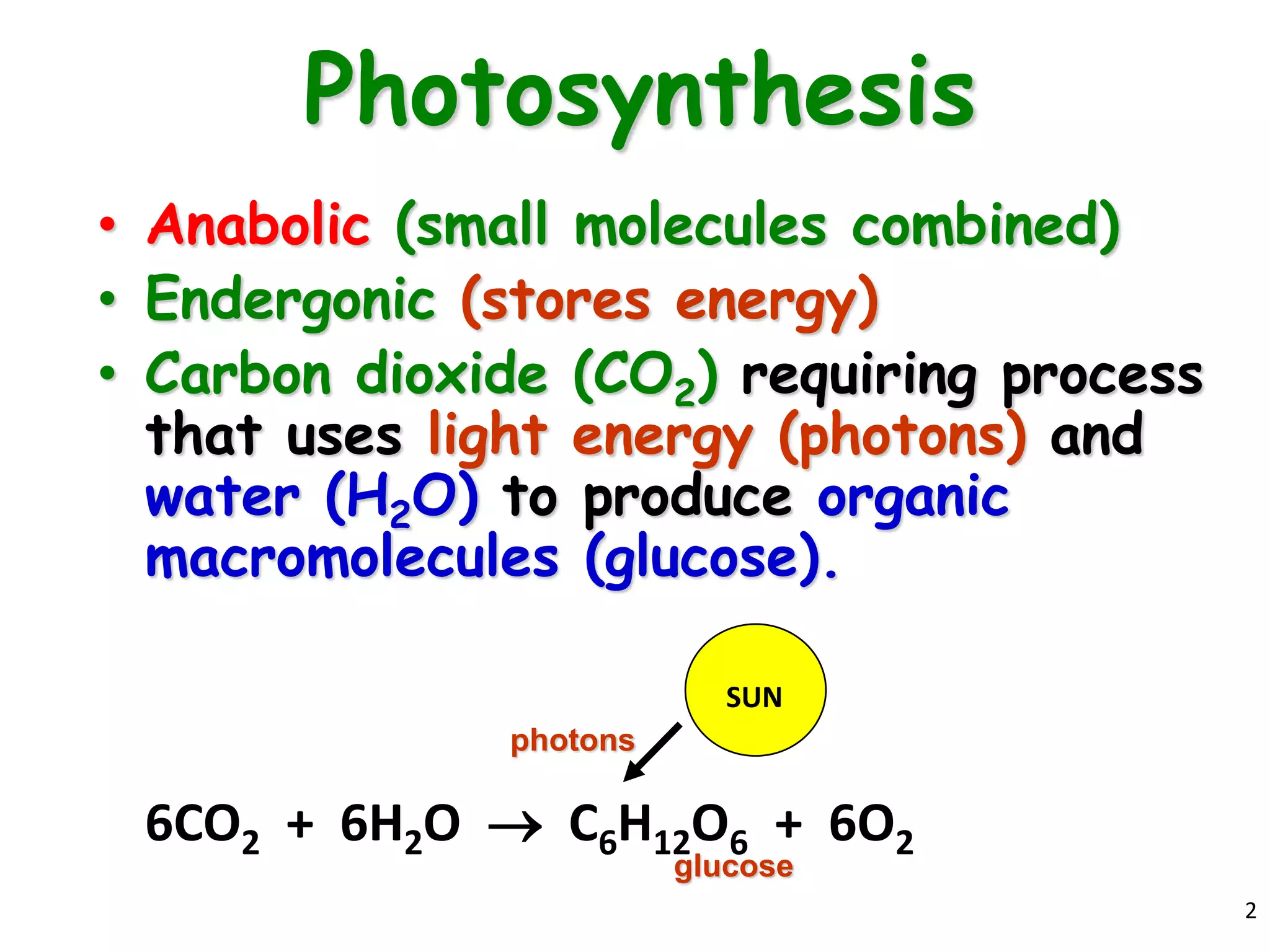
Photosynthesis
• Anabolic (small molecules combined)
• Endergonic (stores energy)
• Carbon dioxide (CO2) requiring process
that uses light energy (photons) and
water (H2O) to produce organic
macromolecules (glucose).
6CO2 + 6H2O  C6H12O6 + 6O2
glucose
SUN
photons
Photosynthesis Overview
However, the above is a bit of a lie…
4
Light Reactions
O2
H2O
Energy Building
Reactions
ATP
 produces ATP
 produces NADPH
 releases O2 as a
waste product
sunlight
H2O ATP O2
light
energy
 +
+ + NADPH
NADPH
6
Cyclic Electron Flow
P700
Primary
Electron
Acceptor
e-
e-
e-
e-
ATP
produced
by ETC
Photosystem I
Accessory
Pigments
SUN
Photons
Pigments absorb light energy & excite e- of
Chlorophyll a to produce ATP
Discovery of Photosynthesis
• Jan Baptista van Helmont (1580–1644)
– Demonstrated that the substance of the plant was
not produced only from the soil
• Joseph Priestly (1733–1804)
– Living vegetation adds something to the air
• Jan Ingen-Housz (1730–1799)
– Proposed plants carry out a process that uses
sunlight to split carbon dioxide into carbon and
oxygen (O2 gas)
7
• C. B. van Niel (1897–1985)
– Found purple sulfur bacteria do not release O2 but
accumulate sulfur
– Proposed general formula for photosynthesis
• CO2 + 2 H2A + light energy → (CH2O) + H2O + 2 A
– Later researchers found O2 produced comes from
water
• Robin Hill (1899–1991)
– Demonstrated Niel was right that light energy
could be harvested and used in a reduction
reaction
8
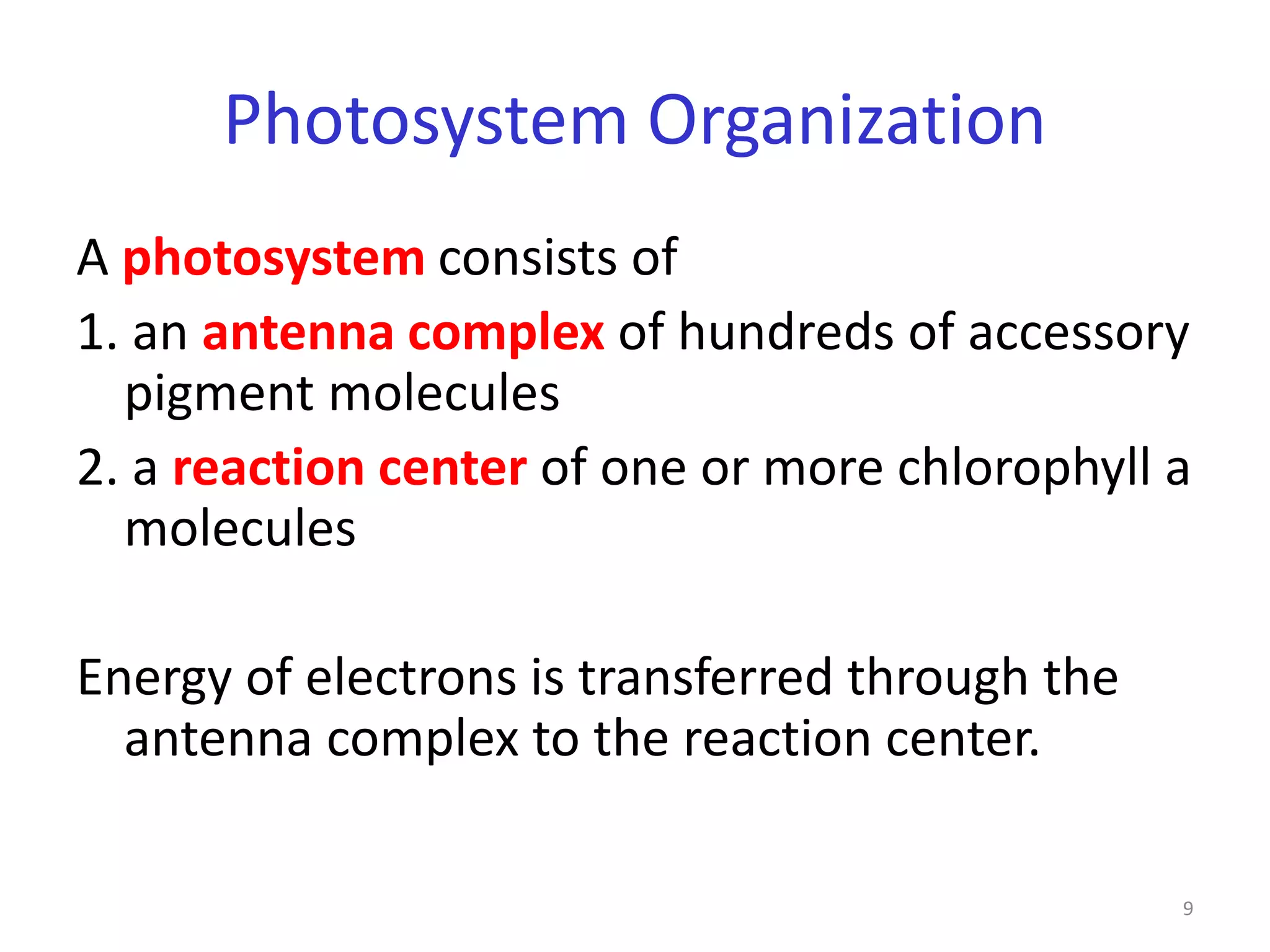
Photosystem Organization
A photosystem consists of
1. an antenna complex of hundreds of accessory
pigment molecules
2. a reaction center of one or more chlorophyll a
molecules
Energy of electrons is transferred through the
antenna complex to the reaction center.
9
10
PHOTOSYNTHETIC PIGMENTES
12
13
14
• Types of chlorophylls:
Molecular formula Occurrence
• Chlorohyll a C55H72O5N4Mg Universal
• Chlorohyll b C55H70O6N4Mg Mostly plants
• Chlorohyll c1 C35H30O5N4Mg Various algae
• Chlorohyll c2 C35H28O5N4Mg Various algae
• Chlorohyll d C54H70O6N4Mg Various algae
• Chlorohyll f C55H70O6N4Mg Various algae
16
chlorophyll d
chlorophyll c1
chlorophyll c2
chlorophyll f
18
2. Carotenoids
•In addition to chlorophylls, another group of yellow–orange pigments called carotenoids are also found in the photosystems.
•Carotenoids , also called tetraterpenoids, are organic pigments that are produced by plants and algae, as well as several bacteria
and fungi.
•There are about thirty photosynthetic carotenoids. They help transfer and dissipate excess energy, and their bright colors
sometimes override the chlorophyll green, like during the fall, when the leaves of some land plants change color.
•Carotenoids are a large group of fat soluble pigments that are found in many plants and other organisms. They are often red or
yellow.
20
21
3. Phycobilins
• Rudolf Lemberg in the 1962 termed
these molecules as phycobilins because
they mostly occur in algae (red algae and
blue green algae)
• Structurally resemble bile pigments
• Like chlorophylls, phycobilins are also
tetrapyrroles.
• However the 4 pyrrole rings occure
in an open chain (like phytochrome).
• Phycobilisome: assembly of 300-800 phycobilins with diameter of 40 nm
• Shows Absorption bands from 500-650nm
• Two well known phycobilins are
– Phycoerythrin
– Phycocyanin
24
25
Phycoerythrin
• Reddish pigment absorbs green and have main band between 530 and 570.
• Soluble in aqueous solution and occurs throughout the red algae and in some
cyanobacteria.
Phycocyanin
Appears blue, absorption maxima in between 610-650.
It is the main phycobilin in cyanobacteria.
28
THANK YOU
31
Light Reaction (Electron Flow)
• Occurs in the Thylakoid
membranes
• During the light reaction, there
are two possible routes for
electron flow:
A.Cyclic Electron Flow
B. Noncyclic Electron Flow
32
Chlorophyll Molecules
• Located in the thylakoid membranes
• Chlorophyll have Mg+ in the center
• Chlorophyll pigments harvest energy
(photons) by absorbing certain
wavelengths (blue-420 nm and red-
660 nm are most important)
• Plants are green because the green
wavelength is reflected, not absorbed.
Energy transfer during photosynthesis
become oxidized after ‘boosted’ electron is transferred
• PSI and PSII operate in series
– PSI absorbs far-red light (>680 nm) = P700
• Produces a very strong reductant
– PSII absorbs red light (680 nm) = P680
• Produces a strong very strong oxidant
– Can oxidize water
Photosynthesis - light
Z scheme of Photosynthesis
Ultimate
source of e-
36
Cyclic Electron Flow
• Occurs in the thylakoid membrane.
• Uses Photosystem I only
• P700 reaction center- chlorophyll a
• Uses Electron Transport Chain
(ETC)
• Generates ATP only
ADP + ATP
P
37
Cyclic Electron Flow
P700
Primary
Electron
Acceptor
e-
e-
e-
e-
ATP
produced
by ETC
Photosystem I
Accessory
Pigments
SUN
Photons
Pigments absorb light energy & excite e- of
Chlorophyll a to produce ATP
Cyclic photophosphorylation
• If PS I can’t pass electron
to NADP…
it cycles back to PS I &
makes more ATP, but no
NADPH
– coordinates light reactions
to Calvin cycle
– Calvin cycle uses more ATP
than NADPH
X
40
Noncyclic Electron Flow
• Occurs in the thylakoid membrane
• Uses Photosystem II and
Photosystem I
• P680 reaction center (PSII) -
chlorophyll a
• P700 reaction center (PS I) -
chlorophyll a
• Uses Electron Transport Chain
(ETC)
• Generates O2, ATP and NADPH
42
Noncyclic Electron Flow
• ADP +  ATP
• NADP+ + H  NADPH
• Oxygen comes from the splitting
of H2O, not CO2
H2O  1/2 O2 + 2H+
P
43
Chemiosmosis
• Powers ATP synthesis
• Takes place across the thylakoid
membrane
• Uses ETC and ATP synthase
(enzyme)
• H+ move down their concentration
gradient through channels of ATP
synthase forming ATP from ADP
Carbon Reactions
46
Calvin Cycle
• Carbon Fixation (light independent
reaction)
• C3 plants (80% of plants on earth)
• Occurs in the stroma
• Uses ATP and NADPH from light
reaction as energy
• Uses CO2
• To produce glucose: it takes 6
turns and uses 18 ATP and 12
NADPH.
• Recent estimates indicate that about 200 billion tons
of CO2 are converted to biomass each year.
• About 40% of this mass originates from the activities
of marine phytoplankton.
• The bulk of the carbon is incorporated into organic
compounds by the carbon reduction reactions
associated with photosynthesis.
• the photochemical oxidation of water to molecular
oxygen is coupled to the generation of ATP and
reduced pyridine nucleotide (NADPH)
• The reactions catalyzing the reduction of CO2 to
carbohydrate are coupled to the consumption of
NADPH and ATP by enzymes found in the stroma,
the soluble phase of chloroplasts.
• dark reactions carbon reactions
of photosynthesis
THE CALVIN CYCLE
• All photosynthetic eukaryotes, from the most
primitive alga to the most advanced angiosperm,
reduce CO2 to carbohydrate via the same basic
mechanism:
• the photosynthetic carbon reduction cycle originally
described for C3 species (the Calvin cycle, or
reductive pentose phosphate [RPP] cycle)
• The Calvin Cycle has Three Stages: Carboxylation,
Reduction, and Regeneration
• Melvin Calvin
and his colleagues
in the 1950s, for
which Nobel Prize
was awarded
in 1961
Over view
• In the Calvin cycle, CO2 and water from the
environment are enzymatically combined with a five-
carbon acceptor molecule to generate two molecules
of a three-carbon intermediate.
• This intermediate (3-phosphoglycerate) is reduced to
carbohydrate by use of the ATP and NADPH
generated photochemically.
• The cycle is completed by regeneration of the five-
carbon acceptor (ribulose-1,5-bisphosphate,
abbreviated RuBP).
• 1. Carboxylation of the CO2 acceptor ribulose-1,5-
bisphosphate, forming two molecules of 3-
phosphoglycerate, the first stable intermediate of the
Calvin cycle
• 2. Reduction of 3-phosphoglycerate, forming
gyceraldehyde-3-phosphate, a carbohydrate
• 3. Regeneration of the CO2 acceptor ribulose-1,5-
bisphosphate from glyceraldehyde-3-phosphate
The Carboxylation of Ribulose Bisphosphate Is Catalyzed by
the Enzyme Rubisco:
• 3 molecule of CO2 enters the Calvin cycle by reacting
with 3 molecule of ribulose-1,5bisphosphate to yield six
molecules of 3-phosphoglycerate
– 3(Ribulose-1,5bisphosphate) + 3CO2 +3H2O
– 6(3-Phosphoglycerate) + 6H+
• the enzyme also has an oxygenase activity in which O2
competes with CO2 for the common substrate ribulose-
1,5-bisphosphate.
• CO2 is added to 2nd Carbon of ribulose-1,5-
bisphosphate, yielding an unstable, enzyme-bound
intermediate, which is hydrolyzed to yield two
molecules of the stable product 3-phosphoglycerate
• Rubisco is highly abundant, representing up to 40%
of the total soluble protein of most leaves.
Triose Phosphates Are Formed in the Reduction Step of
the Calvin Cycle
• 3-phosphoglycerate formed in the carboxylation stage
undergoes two modifications:
• 1. It is first phosphorylated via 3-phosphoglycerate kinase
to 1,3-bisphosphoglycerate through use of the ATP
generated in the light reactions.
– 6(3-Phosphoglycerate) + 6ATP → 6(1,3-bisphosphoglycerate) +6 ADP
• 2. Then it is reduced to glyceraldehyde-3-phosphate
through use of the NADPH generated by the light
reactions.
• The chloroplast enzyme NADP:glyceraldehyde-3-
phosphate dehydrogenase catalyzes this step.
– 6(1,3-Bisphosphoglycerate) + 6NADPH + 12H+
– 6(Glyceraldehye-3-phosphate) + 6NADP+ + 6Pi
Operation of the Calvin Cycle Requires the
Regeneration of Ribulose-1,5-Bisphosphate
• The continued uptake of CO2 requires that the CO2
acceptor, ribulose-1,5-bisphosphate, be constantly
regenerated.
• To prevent depletion of Calvin cycle intermediates,
three molecules of ribulose-1,5-bisphosphate (15
carbons total) are formed by reactions that reshuffle
the carbons from the five molecules of triose
phosphate (5 × 3 = 15 carbons).
• 1. One molecule of glyceraldehyde-3-phosphate is
converted via triose phosphate isomerase to
dihydroxyacetone-3-phosphate in an isomerization
reaction
– 2(Glyceraldehyde-3-phosphate)
Ismerisation
2(Dihydroxyacetone-3-phosphate)
• 2. Dihydroxyacetone-3-phosphate then undergoes
aldol condensation with a second molecule of
glyceraldehyde-3-phosphate, a reaction catalyzed by
aldolase to give fructose-1,6-bisphosphate
– Dihydroxyacetone-3--P +glyceraldehyde-3--P
Fructose-1,6-bisphosphate
Aldol condensation Aldolase
• 3. Fructose-1,6-bisphosphate occupies a key position
in the cycle and is hydrolyzed to fructose-6-
phosphate, which then reacts with the enzyme
transketolase
– Fructose-1,6-bisphosphate
Fructose-6-phosphate
Hydrolysis
Fructose-1-6-phosphatase
• A two-carbon unit (C-1 and C-2 of fructose-6-P) is
transferred via transketolase to a third molecule of
glyceraldehyde-3-phosphate to give erythrose-4-P
(from C-3 to C-6 of the fructose) & xylulose-5-P
(from of the fructose and the glyceraldehyde-3-P)
– Fructose-6-phosphate + 2 glyceraldehyde-3-phosphate
Erythrose-4-phosphate + 2 Xylulose-5-phosphate
Transketolase
• 5. Erythrose-4-phosphate then combines via aldolase
with a fourth molecule of triose phosphate
(dihydroxyacetone-3-phosphate) to yield the seven-
carbon sugar sedoheptulose-1,7-bisphosphate.
– Erythrose-4- P + dihydroxyacetone-3-P
Sedoheptulose-1,7-bisphosphate.
Aldolase
Confensation
• 6. This seven-carbon bisphosphate is then hydrolyzed
by way of a specific phosphatase to give
sedoheptulose-7-phosphate
• Sedoheptulose-1,7-bisphosphate.
• Sedoheptulose-7-phosphate.
Hydrolysis
Sedoheptulose-1-7-bisphosphatase
• 7. Sedoheptulose-7-p donates a two-carbon unit to the
fifth (and last) molecule of glyceraldehyde-3-p via
transketolase and produces ribose-5-p (from C-3 to
C-7 of sedoheptulose) & xylulose-5-p (from C-2 of
the sedoheptulose & the glyceraldehyde-3-p)
– Sedoheptulose-7--P + glyceraldehyde-3 --P
Ribose-5-phosphate + Xylulose-5-phosphate
Transketolase
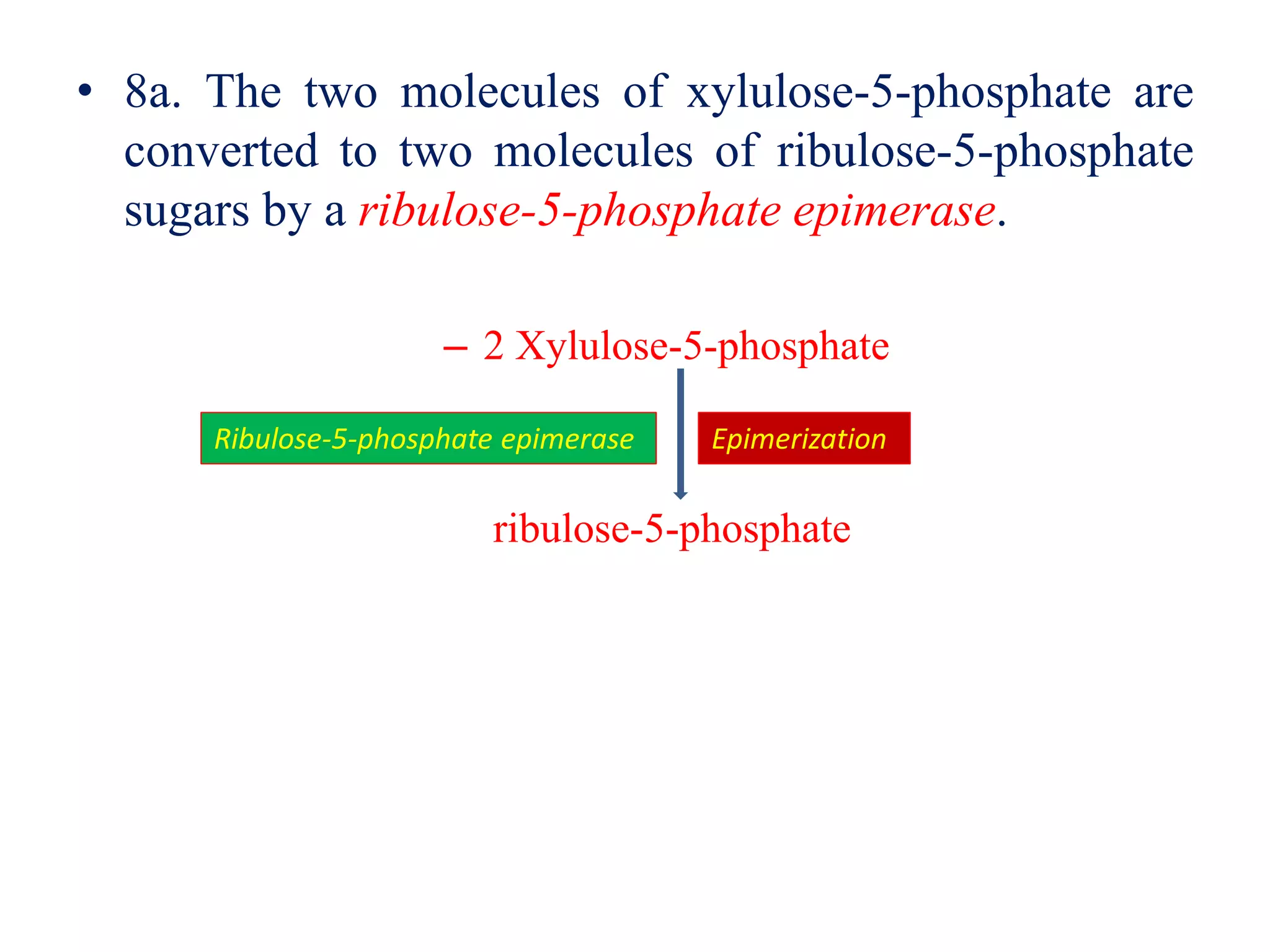
• 8a. The two molecules of xylulose-5-phosphate are
converted to two molecules of ribulose-5-phosphate
sugars by a ribulose-5-phosphate epimerase.
– 2 Xylulose-5-phosphate
ribulose-5-phosphate
Epimerization
Ribulose-5-phosphate epimerase
• 8b. The third molecule of ribulose-5-phosphate is
formed from ribose-5-phosphate by ribose-5-
phosphate isomerase
• Ribose-5-phosphate
• Ribulose-5-phosphate
Ribose-5-phosphate isomerase Isomerization
• 9. Finally, ribulose-5-phosphate kinase catalyzes the
phosphorylation of ribulose-5-phosphate with ATP,
thus regenerating the three needed molecules of the
initial CO2 acceptor, ribulose-1,5-bisphosphate
– 3Ribulose-5-phosphate + 3 ATP
– 3 Ribulose-1,5-bisphosphate +3 ADP + 3 H+
(regeneration of RuBP)
Ribulose-5-phosphate kinase Phosphorylation
• Calvin Cycle Stoichiometry Shows That Only
One-Sixth of the Triose Phosphate Is Used for
Sucrose or Starch;
• most of the triose phosphates are drawn back
into the cycle to facilitate the buildup of an
adequate concentration of metabolites.
• five-sixths of the triose phosphate contributes to
regeneration of the ribulose-1,5-bisphosphate,
and one-sixth is exported to the cytosol for the
synthesis of sucrose or other metabolites
• in order to synthesize the equivalent of 1 molecule of
hexose, 6 molecules of CO2 are fixed at the expense
of 18 ATP and 12 NADPH.
• In other words, the Calvin cycle consumes two
molecules of NADPH and three molecules of ATP for
every molecule of CO2 fixed into carbohydrate.
C4 pathway
Photosynthesis.pptx
Photosynthesis.pptx
Photosynthesis.pptx
Photosynthesis.pptx
Photosynthesis.pptx
Photosynthesis.pptx

Photosynthesis.pptx

  • 1.
    THE SUN: MAINSOURCE OF ENERGY FOR LIFE ON EARTH Photosynthesis Dr. T.Shasthree Assistant Professor in Department of Biotechnology KU
  • 2.
    2 Photosynthesis • Anabolic (smallmolecules combined) • Endergonic (stores energy) • Carbon dioxide (CO2) requiring process that uses light energy (photons) and water (H2O) to produce organic macromolecules (glucose). 6CO2 + 6H2O  C6H12O6 + 6O2 glucose SUN photons
  • 3.
    Photosynthesis Overview However, theabove is a bit of a lie…
  • 4.
    4 Light Reactions O2 H2O Energy Building Reactions ATP produces ATP  produces NADPH  releases O2 as a waste product sunlight H2O ATP O2 light energy  + + + NADPH NADPH
  • 6.
    6 Cyclic Electron Flow P700 Primary Electron Acceptor e- e- e- e- ATP produced byETC Photosystem I Accessory Pigments SUN Photons Pigments absorb light energy & excite e- of Chlorophyll a to produce ATP
  • 7.
    Discovery of Photosynthesis •Jan Baptista van Helmont (1580–1644) – Demonstrated that the substance of the plant was not produced only from the soil • Joseph Priestly (1733–1804) – Living vegetation adds something to the air • Jan Ingen-Housz (1730–1799) – Proposed plants carry out a process that uses sunlight to split carbon dioxide into carbon and oxygen (O2 gas) 7
  • 8.
    • C. B.van Niel (1897–1985) – Found purple sulfur bacteria do not release O2 but accumulate sulfur – Proposed general formula for photosynthesis • CO2 + 2 H2A + light energy → (CH2O) + H2O + 2 A – Later researchers found O2 produced comes from water • Robin Hill (1899–1991) – Demonstrated Niel was right that light energy could be harvested and used in a reduction reaction 8
  • 9.
    Photosystem Organization A photosystemconsists of 1. an antenna complex of hundreds of accessory pigment molecules 2. a reaction center of one or more chlorophyll a molecules Energy of electrons is transferred through the antenna complex to the reaction center. 9
  • 10.
  • 11.
  • 12.
  • 13.
  • 14.
  • 15.
    • Types ofchlorophylls: Molecular formula Occurrence • Chlorohyll a C55H72O5N4Mg Universal • Chlorohyll b C55H70O6N4Mg Mostly plants • Chlorohyll c1 C35H30O5N4Mg Various algae • Chlorohyll c2 C35H28O5N4Mg Various algae • Chlorohyll d C54H70O6N4Mg Various algae • Chlorohyll f C55H70O6N4Mg Various algae
  • 16.
  • 17.
  • 18.
    18 2. Carotenoids •In additionto chlorophylls, another group of yellow–orange pigments called carotenoids are also found in the photosystems. •Carotenoids , also called tetraterpenoids, are organic pigments that are produced by plants and algae, as well as several bacteria and fungi. •There are about thirty photosynthetic carotenoids. They help transfer and dissipate excess energy, and their bright colors sometimes override the chlorophyll green, like during the fall, when the leaves of some land plants change color. •Carotenoids are a large group of fat soluble pigments that are found in many plants and other organisms. They are often red or yellow.
  • 20.
  • 21.
  • 22.
    3. Phycobilins • RudolfLemberg in the 1962 termed these molecules as phycobilins because they mostly occur in algae (red algae and blue green algae) • Structurally resemble bile pigments • Like chlorophylls, phycobilins are also tetrapyrroles. • However the 4 pyrrole rings occure in an open chain (like phytochrome).
  • 23.
    • Phycobilisome: assemblyof 300-800 phycobilins with diameter of 40 nm • Shows Absorption bands from 500-650nm • Two well known phycobilins are – Phycoerythrin – Phycocyanin
  • 24.
  • 25.
  • 26.
    Phycoerythrin • Reddish pigmentabsorbs green and have main band between 530 and 570. • Soluble in aqueous solution and occurs throughout the red algae and in some cyanobacteria.
  • 27.
    Phycocyanin Appears blue, absorptionmaxima in between 610-650. It is the main phycobilin in cyanobacteria.
  • 28.
  • 29.
  • 31.
    31 Light Reaction (ElectronFlow) • Occurs in the Thylakoid membranes • During the light reaction, there are two possible routes for electron flow: A.Cyclic Electron Flow B. Noncyclic Electron Flow
  • 32.
    32 Chlorophyll Molecules • Locatedin the thylakoid membranes • Chlorophyll have Mg+ in the center • Chlorophyll pigments harvest energy (photons) by absorbing certain wavelengths (blue-420 nm and red- 660 nm are most important) • Plants are green because the green wavelength is reflected, not absorbed.
  • 33.
    Energy transfer duringphotosynthesis become oxidized after ‘boosted’ electron is transferred
  • 34.
    • PSI andPSII operate in series – PSI absorbs far-red light (>680 nm) = P700 • Produces a very strong reductant – PSII absorbs red light (680 nm) = P680 • Produces a strong very strong oxidant – Can oxidize water Photosynthesis - light Z scheme of Photosynthesis Ultimate source of e-
  • 36.
    36 Cyclic Electron Flow •Occurs in the thylakoid membrane. • Uses Photosystem I only • P700 reaction center- chlorophyll a • Uses Electron Transport Chain (ETC) • Generates ATP only ADP + ATP P
  • 37.
    37 Cyclic Electron Flow P700 Primary Electron Acceptor e- e- e- e- ATP produced byETC Photosystem I Accessory Pigments SUN Photons Pigments absorb light energy & excite e- of Chlorophyll a to produce ATP
  • 39.
    Cyclic photophosphorylation • IfPS I can’t pass electron to NADP… it cycles back to PS I & makes more ATP, but no NADPH – coordinates light reactions to Calvin cycle – Calvin cycle uses more ATP than NADPH X
  • 40.
    40 Noncyclic Electron Flow •Occurs in the thylakoid membrane • Uses Photosystem II and Photosystem I • P680 reaction center (PSII) - chlorophyll a • P700 reaction center (PS I) - chlorophyll a • Uses Electron Transport Chain (ETC) • Generates O2, ATP and NADPH
  • 42.
    42 Noncyclic Electron Flow •ADP +  ATP • NADP+ + H  NADPH • Oxygen comes from the splitting of H2O, not CO2 H2O  1/2 O2 + 2H+ P
  • 43.
    43 Chemiosmosis • Powers ATPsynthesis • Takes place across the thylakoid membrane • Uses ETC and ATP synthase (enzyme) • H+ move down their concentration gradient through channels of ATP synthase forming ATP from ADP
  • 45.
  • 46.
    46 Calvin Cycle • CarbonFixation (light independent reaction) • C3 plants (80% of plants on earth) • Occurs in the stroma • Uses ATP and NADPH from light reaction as energy • Uses CO2 • To produce glucose: it takes 6 turns and uses 18 ATP and 12 NADPH.
  • 47.
    • Recent estimatesindicate that about 200 billion tons of CO2 are converted to biomass each year. • About 40% of this mass originates from the activities of marine phytoplankton. • The bulk of the carbon is incorporated into organic compounds by the carbon reduction reactions associated with photosynthesis.
  • 48.
    • the photochemicaloxidation of water to molecular oxygen is coupled to the generation of ATP and reduced pyridine nucleotide (NADPH) • The reactions catalyzing the reduction of CO2 to carbohydrate are coupled to the consumption of NADPH and ATP by enzymes found in the stroma, the soluble phase of chloroplasts.
  • 49.
    • dark reactionscarbon reactions of photosynthesis
  • 50.
    THE CALVIN CYCLE •All photosynthetic eukaryotes, from the most primitive alga to the most advanced angiosperm, reduce CO2 to carbohydrate via the same basic mechanism: • the photosynthetic carbon reduction cycle originally described for C3 species (the Calvin cycle, or reductive pentose phosphate [RPP] cycle)
  • 51.
    • The CalvinCycle has Three Stages: Carboxylation, Reduction, and Regeneration • Melvin Calvin and his colleagues in the 1950s, for which Nobel Prize was awarded in 1961
  • 54.
    Over view • Inthe Calvin cycle, CO2 and water from the environment are enzymatically combined with a five- carbon acceptor molecule to generate two molecules of a three-carbon intermediate. • This intermediate (3-phosphoglycerate) is reduced to carbohydrate by use of the ATP and NADPH generated photochemically. • The cycle is completed by regeneration of the five- carbon acceptor (ribulose-1,5-bisphosphate, abbreviated RuBP).
  • 55.
    • 1. Carboxylationof the CO2 acceptor ribulose-1,5- bisphosphate, forming two molecules of 3- phosphoglycerate, the first stable intermediate of the Calvin cycle • 2. Reduction of 3-phosphoglycerate, forming gyceraldehyde-3-phosphate, a carbohydrate • 3. Regeneration of the CO2 acceptor ribulose-1,5- bisphosphate from glyceraldehyde-3-phosphate
  • 56.
    The Carboxylation ofRibulose Bisphosphate Is Catalyzed by the Enzyme Rubisco: • 3 molecule of CO2 enters the Calvin cycle by reacting with 3 molecule of ribulose-1,5bisphosphate to yield six molecules of 3-phosphoglycerate – 3(Ribulose-1,5bisphosphate) + 3CO2 +3H2O – 6(3-Phosphoglycerate) + 6H+ • the enzyme also has an oxygenase activity in which O2 competes with CO2 for the common substrate ribulose- 1,5-bisphosphate.
  • 57.
    • CO2 isadded to 2nd Carbon of ribulose-1,5- bisphosphate, yielding an unstable, enzyme-bound intermediate, which is hydrolyzed to yield two molecules of the stable product 3-phosphoglycerate
  • 58.
    • Rubisco ishighly abundant, representing up to 40% of the total soluble protein of most leaves. Triose Phosphates Are Formed in the Reduction Step of the Calvin Cycle • 3-phosphoglycerate formed in the carboxylation stage undergoes two modifications:
  • 59.
    • 1. Itis first phosphorylated via 3-phosphoglycerate kinase to 1,3-bisphosphoglycerate through use of the ATP generated in the light reactions. – 6(3-Phosphoglycerate) + 6ATP → 6(1,3-bisphosphoglycerate) +6 ADP • 2. Then it is reduced to glyceraldehyde-3-phosphate through use of the NADPH generated by the light reactions. • The chloroplast enzyme NADP:glyceraldehyde-3- phosphate dehydrogenase catalyzes this step. – 6(1,3-Bisphosphoglycerate) + 6NADPH + 12H+ – 6(Glyceraldehye-3-phosphate) + 6NADP+ + 6Pi
  • 60.
    Operation of theCalvin Cycle Requires the Regeneration of Ribulose-1,5-Bisphosphate • The continued uptake of CO2 requires that the CO2 acceptor, ribulose-1,5-bisphosphate, be constantly regenerated. • To prevent depletion of Calvin cycle intermediates, three molecules of ribulose-1,5-bisphosphate (15 carbons total) are formed by reactions that reshuffle the carbons from the five molecules of triose phosphate (5 × 3 = 15 carbons).
  • 63.
    • 1. Onemolecule of glyceraldehyde-3-phosphate is converted via triose phosphate isomerase to dihydroxyacetone-3-phosphate in an isomerization reaction – 2(Glyceraldehyde-3-phosphate) Ismerisation 2(Dihydroxyacetone-3-phosphate)
  • 64.
    • 2. Dihydroxyacetone-3-phosphatethen undergoes aldol condensation with a second molecule of glyceraldehyde-3-phosphate, a reaction catalyzed by aldolase to give fructose-1,6-bisphosphate – Dihydroxyacetone-3--P +glyceraldehyde-3--P Fructose-1,6-bisphosphate Aldol condensation Aldolase
  • 65.
    • 3. Fructose-1,6-bisphosphateoccupies a key position in the cycle and is hydrolyzed to fructose-6- phosphate, which then reacts with the enzyme transketolase – Fructose-1,6-bisphosphate Fructose-6-phosphate Hydrolysis Fructose-1-6-phosphatase
  • 66.
    • A two-carbonunit (C-1 and C-2 of fructose-6-P) is transferred via transketolase to a third molecule of glyceraldehyde-3-phosphate to give erythrose-4-P (from C-3 to C-6 of the fructose) & xylulose-5-P (from of the fructose and the glyceraldehyde-3-P) – Fructose-6-phosphate + 2 glyceraldehyde-3-phosphate Erythrose-4-phosphate + 2 Xylulose-5-phosphate Transketolase
  • 67.
    • 5. Erythrose-4-phosphatethen combines via aldolase with a fourth molecule of triose phosphate (dihydroxyacetone-3-phosphate) to yield the seven- carbon sugar sedoheptulose-1,7-bisphosphate. – Erythrose-4- P + dihydroxyacetone-3-P Sedoheptulose-1,7-bisphosphate. Aldolase Confensation
  • 68.
    • 6. Thisseven-carbon bisphosphate is then hydrolyzed by way of a specific phosphatase to give sedoheptulose-7-phosphate • Sedoheptulose-1,7-bisphosphate. • Sedoheptulose-7-phosphate. Hydrolysis Sedoheptulose-1-7-bisphosphatase
  • 69.
    • 7. Sedoheptulose-7-pdonates a two-carbon unit to the fifth (and last) molecule of glyceraldehyde-3-p via transketolase and produces ribose-5-p (from C-3 to C-7 of sedoheptulose) & xylulose-5-p (from C-2 of the sedoheptulose & the glyceraldehyde-3-p) – Sedoheptulose-7--P + glyceraldehyde-3 --P Ribose-5-phosphate + Xylulose-5-phosphate Transketolase
  • 70.
    • 8a. Thetwo molecules of xylulose-5-phosphate are converted to two molecules of ribulose-5-phosphate sugars by a ribulose-5-phosphate epimerase. – 2 Xylulose-5-phosphate ribulose-5-phosphate Epimerization Ribulose-5-phosphate epimerase
  • 71.
    • 8b. Thethird molecule of ribulose-5-phosphate is formed from ribose-5-phosphate by ribose-5- phosphate isomerase • Ribose-5-phosphate • Ribulose-5-phosphate Ribose-5-phosphate isomerase Isomerization
  • 72.
    • 9. Finally,ribulose-5-phosphate kinase catalyzes the phosphorylation of ribulose-5-phosphate with ATP, thus regenerating the three needed molecules of the initial CO2 acceptor, ribulose-1,5-bisphosphate – 3Ribulose-5-phosphate + 3 ATP – 3 Ribulose-1,5-bisphosphate +3 ADP + 3 H+ (regeneration of RuBP) Ribulose-5-phosphate kinase Phosphorylation
  • 73.
    • Calvin CycleStoichiometry Shows That Only One-Sixth of the Triose Phosphate Is Used for Sucrose or Starch; • most of the triose phosphates are drawn back into the cycle to facilitate the buildup of an adequate concentration of metabolites. • five-sixths of the triose phosphate contributes to regeneration of the ribulose-1,5-bisphosphate, and one-sixth is exported to the cytosol for the synthesis of sucrose or other metabolites
  • 74.
    • in orderto synthesize the equivalent of 1 molecule of hexose, 6 molecules of CO2 are fixed at the expense of 18 ATP and 12 NADPH. • In other words, the Calvin cycle consumes two molecules of NADPH and three molecules of ATP for every molecule of CO2 fixed into carbohydrate.
  • 78.